





























How to pair Cypripedium - Lady's Slipper?
A hardy orchid for the garden
Contents
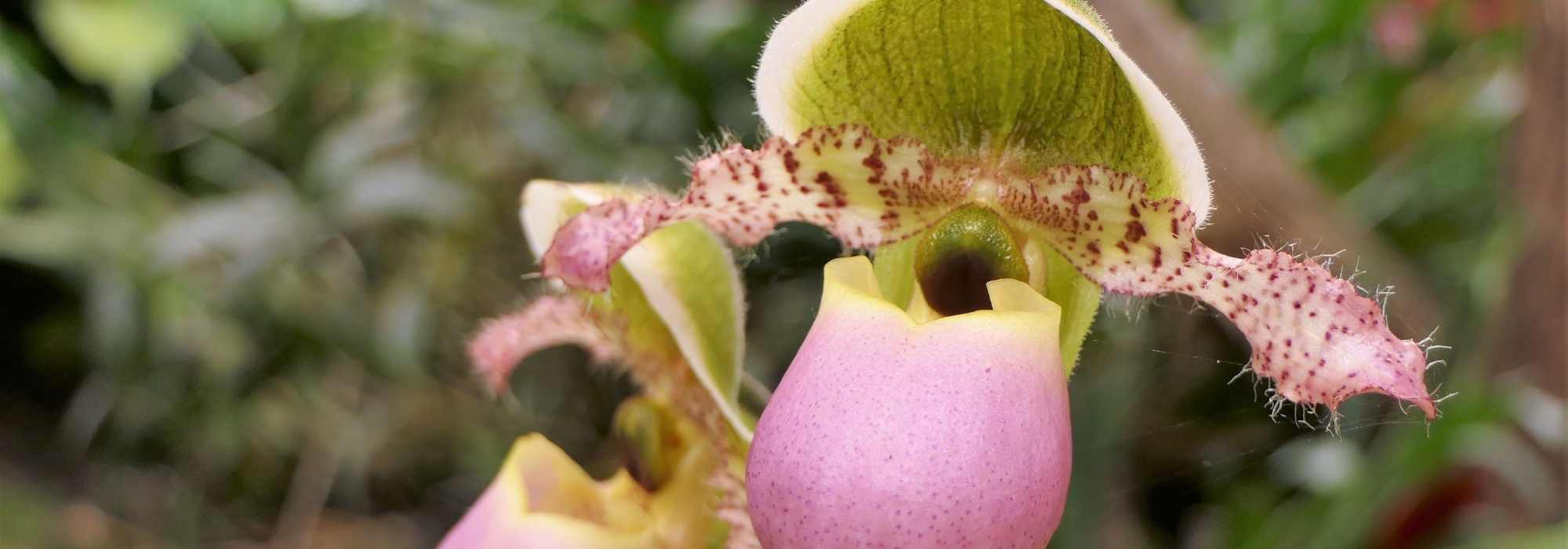
Cypripediums, more commonly known as “lady’s slipper”, are perennial orchids for the garden. They bloom in spring, producing one to two flowers per plant. A typical flower of the Cypripedium genus features a large lip resembling a slipper or a shoe. Once reserved for seasoned collectors, lady’s slippers are becoming more popular and are gradually appearing in gardens. This is the case for Cypripedium reginae, probably the easiest orchid of the genus to grow.
Very hardy, these orchids are still delicate regarding their growing conditions. It is important to remember that these plants require specific conditions: a poor, cool, but well-drained soil (the required pH depends on the species), and a partially shaded exposure.
→ Let’s see how to best associate cypripediums or lady’s slippers in the garden.

In a cool, shaded woodland
Plant Cypripediums in the shade, such as at the edge of a cool woodland. These orchids are self-sufficient, so we will aim for a subtle accompaniment. Let’s take the easiest to grow and ultimately one of the most beautiful: the Royal Venus Slipper or Cypripedium reginae. We will pair it with perennials that enjoy a cool woodland atmosphere in well-drained, poor, and slightly calcareous soil.
Several ferns thrive in this type of soil and exposure: such as the classic yet effective Polypodium vulgare, which will quickly form colonies of evergreen fronds.
For flowering, a few Lamium orvala will have the good taste to bloom at the same time as the Cypripediums. Moreover, the flower of this lamium somewhat resembles those of orchids. Even if the soil is slightly calcareous, the Brunnera macrophylla ‘Jack Frost’ with its silver-marbled foliage and blue flowers will be perfect as a groundcover.
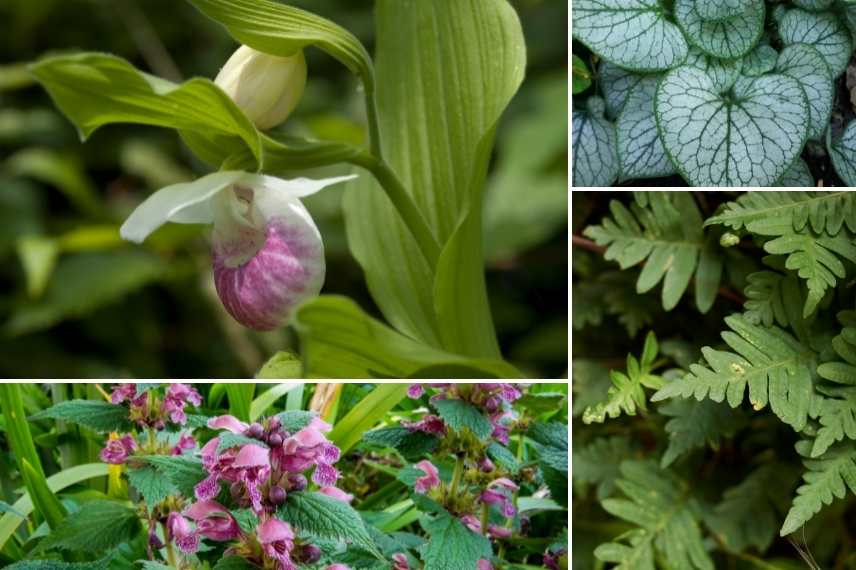
Cypripedium reginae, Brunnera macrophylla ‘Jack Frost’, Lamium orvala, and Polypodium vulgare
In a cool shady rockery
Cypripediums thrive in rockeries with partial shade that remain cool throughout the season. It is also essential that the substrate remains acidic to neutral, rather poor, and well-draining. Other perennials appreciate this type of environment.
One of the most beautiful and hardy Lady’s Slippers to choose from is: Cypripedium formosanum or Formosan Lady’s Slipper. This garden orchid displays, early in spring, a flower with white sepals and petals maculated with violet-pink, dominating a swollen, white lip that is striated and maculated in the same tone. It is grown in partial shade in soil low in organic matter, well-draining, and always slightly moist: perfect for a shady rockery.
To accompany it, we will opt for accommodating perennials whose flowering colour echoes that of the orchid. Some Iberis ‘Absolutely Amethyst’ with its violet spring flowering, rather than white, sits atop a cushion of dark, evergreen foliage, effectively covering the soil throughout the year. The moss phlox Phlox subulata ‘Emerald Cushion Blue’ is a small, spreading, evergreen perennial that disappears from late spring to early summer under a blanket of soft blue star-shaped flowers with a deeper violet-blue centre. To add some verticality to the arrangement, the Carex morrowii ‘Ice Dance’ is a small “grass” (botanically, it is not one!) groundcover that stands out with its evergreen foliage of emerald green, beautifully marginate with cream-white.
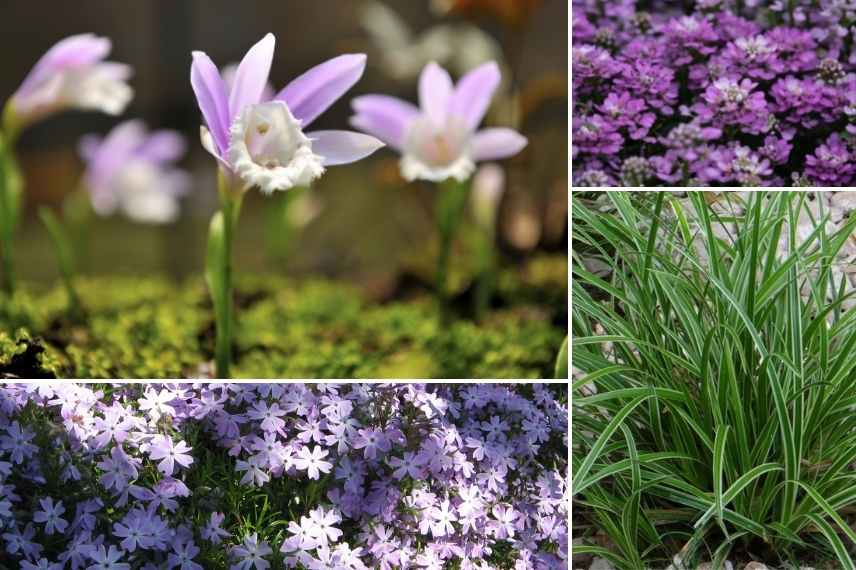
Cypripedium formosanum, Iberis ‘Absolutely Amethyst’, Phlox subulata ‘Emerald Cushion Blue’ and Carex morrowii ‘Ice Dance’
Discover other Cypripedium
View all →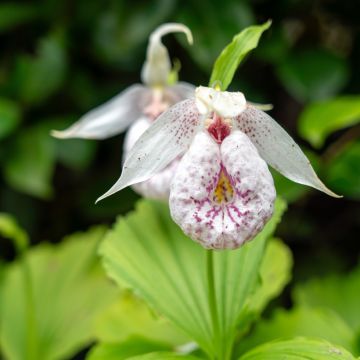
Available in 1 sizes
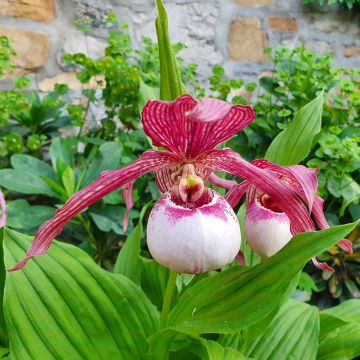
Available in 1 sizes
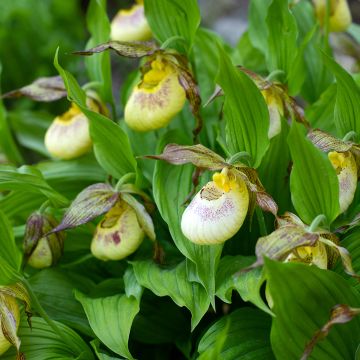
Available in 1 sizes
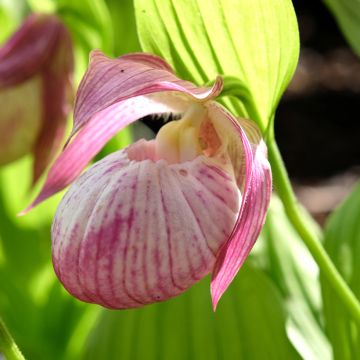
Available in 1 sizes
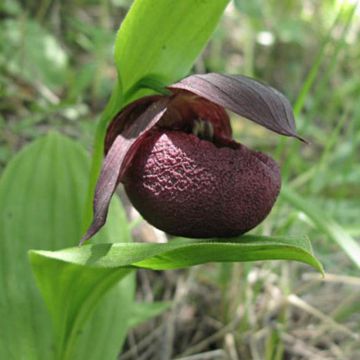
Available in 1 sizes
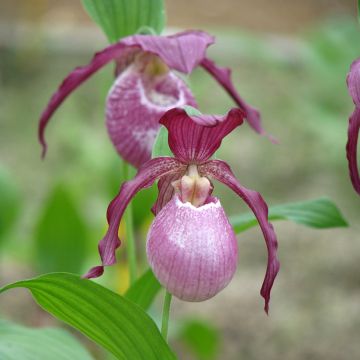
Available in 1 sizes
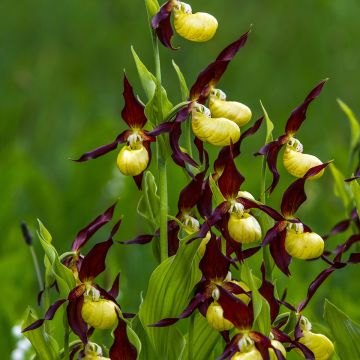
Available in 1 sizes

Available in 1 sizes
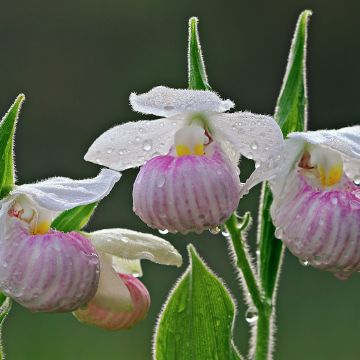
Available in 1 sizes
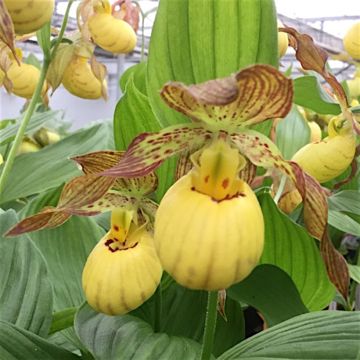
Available in 1 sizes
Some original potted plants
Venus slippers generally thrive better in the ground. However, some can be kept in pots for two or three years: this is the case for Cypripedium japonicum, C. smithii, and C. formosanum. They can be accompanied by other orchid species that appreciate this method of cultivation.
Start with a beautiful pot (a terracotta pot with a diameter of 22 cm) of Cypripedium smithii, a red-purple Venus slipper. It is an extremely hardy garden orchid, with flowers made up of red petals and sepals marbled with white and a purple lip. There are many fascinating hardy or semi-hardy orchids known for their flowering. Accompany your Cypripedium smithii with a small selection of these orchids on a beautiful antique table with a vintage charm, which will become one of the focal points of the garden.
Pleione formosana is a lovely little orchid, somewhat tender, that is most often grown in pots. Its large flowers, a pinkish mauve, bloom in March-April. The Calanthe discolor is a terrestrial orchid with an exotic look, yet hardy, bearing sublime bicoloured brown and white flowers. The Spiranthes cernua ‘Chadd’s Ford’ is a charming terrestrial orchid whose white flowers, fragrant with vanilla, seem to twist like braids at the top of the upright flower spikes. Finally, the Habenaria radiata, known as the Dove Orchid, is a rare terrestrial orchid native to Japan. Its summer flowering closely resembles a cluster of immaculate white doves. A marvel!
For all these orchids, remember to choose beautiful glazed pots that are wider than they are deep: those used for bonsai cultivation.
Moreover, if you are also a bonsai enthusiast, these orchid pots can find their place alongside them.
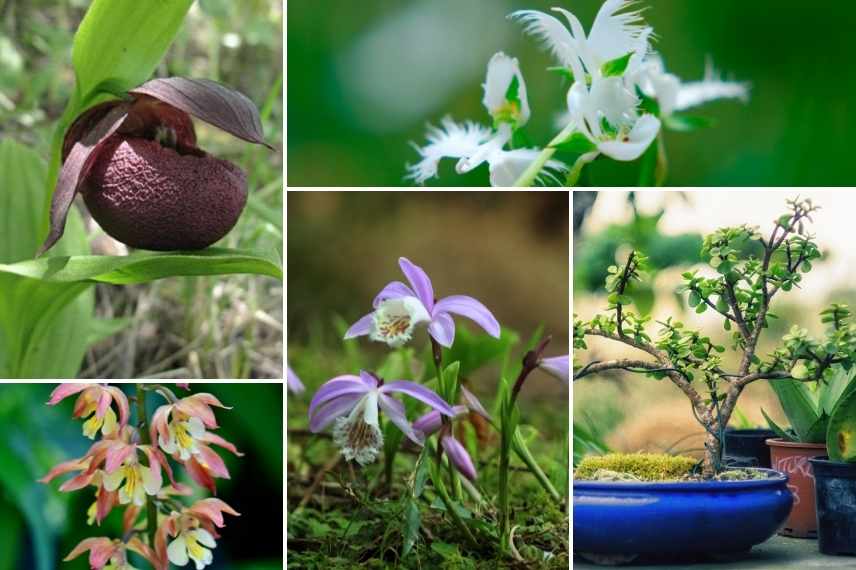
Pleione, Habenaria radiata, Calanthe discolor, Pleione formosana, and bonsai pot
- Subscribe!
- Contents
Comments