


How to choose a fritillary?
Buying guide and criteria for finding the ideal variety
Contents
There are around a hundred species of fritillaries and these bulbous perennials can have very different characteristics. They are distinguished by their size, the colour of their flowers, their flowering period, or their cultivation needs.
All share a spring flowering with bell-shaped or star-shaped flowers, which rarely goes unnoticed. Fritillaries are fairly easy to grow, requiring little care. They also have the advantage of returning faithfully year after year to our gardens or pots.
So, to help you find the perfect fritillary variety, discover our buying guide.

Choose a fritillary according to its flowers.
Fritillaries offer us a delightful palette of colours, ranging from species with the darkest flowers to those with the most flamboyant blooms. The shape of the flowers, for its part, is generally bell-shaped, although some species have a rather star-shaped flowering.
Fritillaries with dark flowers
These dark-coloured fritillaries, with their enigmatic charm, bring a contemporary touch to the garden or to a container planting. They create striking colour contrasts.
Some, for example, reward us with bell-shaped flowers in a violet so dark it almost looks black, as with the Fritillaria persica ‘Purple Dynamite’, ‘Twintowers Tribute’ ou ‘Adiyaman’.
The Fritillaria davisii prefers, for its part, a brown-purple colour for its waxy-looking bell-shaped flowers.
Among the Fritillaria camschatcensis or Kamchatka lily, the flowers display a purple leaning toward chocolate, sometimes prettily speckled with yellow.
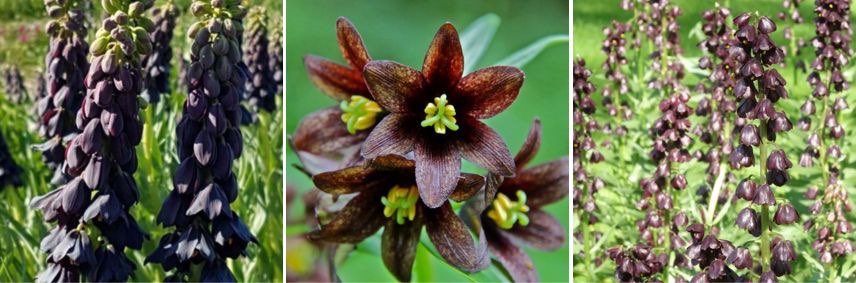
Fritillaria persica ‘Twintowers Tribute’, Fritillaria camschatcensis, Fritillaria persica ‘Purple Dynamite’
Fritillaries with light-coloured flowers
The fritillary pintade (Fritillaria meleagris) ‘Alba’ flowers with refined elegance, thanks to its small, drooping bell-shaped blossoms of pure white. On the Persian fritillaries’ side, the variety also known as ‘Alba’ offers large flower spikes of an off-white.
More difficult to observe due to its rarity, the Fritillaria bucharica produces star-shaped flowers in silvery white, contrasting with a green throat.
The wild fritillary F. liliacea, equally remarkable, produces small bell-shaped flowers white striped with green.
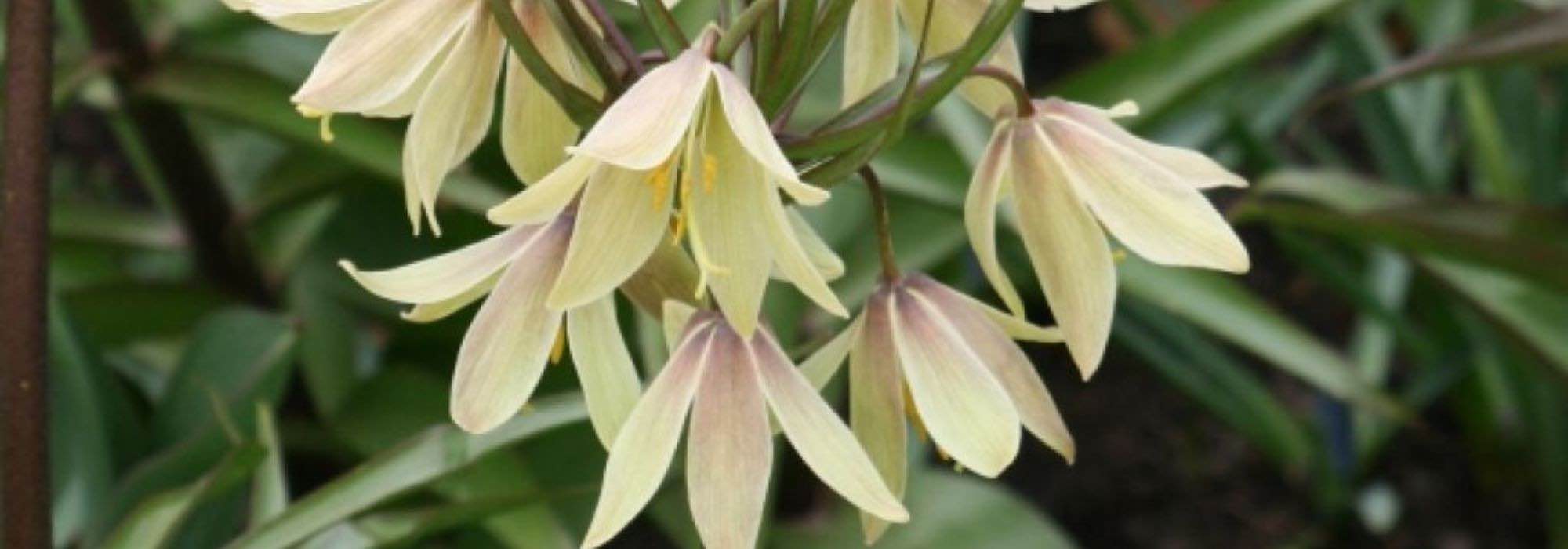
Finally, the Fritillaria raddeana will reward us with bell-shaped flowers of a particularly pale yellow, leaning toward a cream and greenish hue. With the F. pallidiflora, they are more of a pale yellow tinged with anis green.
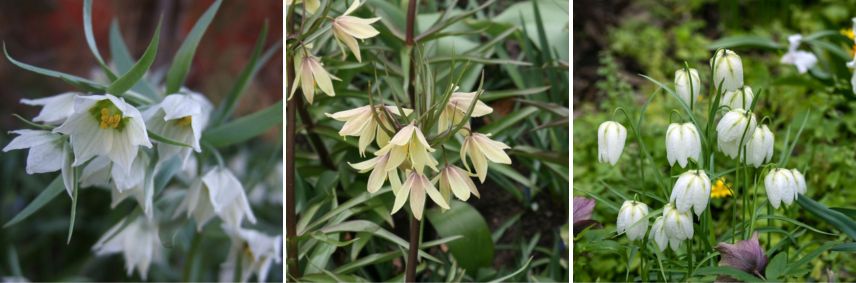
Fritillaria bucharica, Fritillaria raddeana, Fritillaria meleagris ‘Alba’
Fritillaries with warm-coloured flowers
These fritillaries can be orange, yellow or even red. They instantly bring a dynamic and warm touch to the garden, and are also ideal for adding an exotic note.
Choose, for example:
- the Fritillaria imperialis ‘Striped Beauty’, with its beautiful orange bell-shaped flowers striped with red;
- ‘Rubra’, which produces flowers of a deep red;
- ‘Tchaikovsky’, which flowers in salmon-orange;
- ‘Lutea’, with its large, bright yellow bells;
- ‘Vivaldi’, which graces us with light orange bell-shaped flowers.
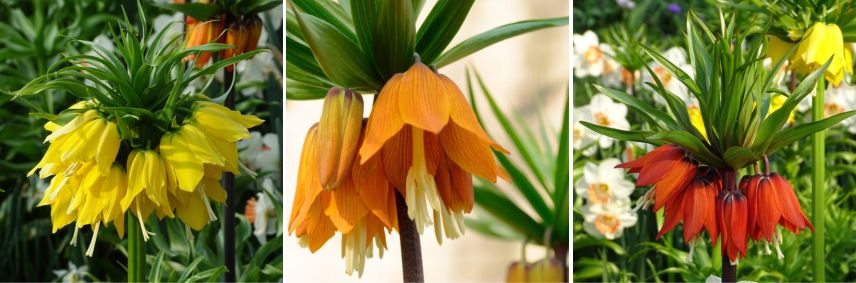
Fritillaria imperialis ‘Lutea’, Fritillaria imperialis ‘Striped Beauty’, Fritillaria imperialis ‘Rubra’
Fritillaries with multicoloured flowers
You may know the pintade fritillary (F. meleagris) this wild plant whose rarity has led to it being listed as a “protected species” in some of our regions. It produces striking checkered purple and white flowers.
Among fritillaries, other species bear several colours on their flowers. Among Persian fritillaries ‘Green Dreams’, the flowering unveils an astonishing almond green, tinged with purple-brown. On its side, ‘Bicolour Magic Bells’ perfectly lives up to its name, with bells of pistachio green enhanced with mauve.
The F. michailovskyi is a less common species, which stands out for its mahogany-red bells edged with bright yellow. In similar colourings, for example, there is F. reuteri, which rewards us with curled bells whose petals are burgundy, with bright yellow tips. Another rare colour‑wise species: the F. thunbergii, which flowers in yellow-green speckled with brown.
Attention to collectors, with the unusually coloured spur fritillary (F. stenathera). This bulbous plant indeed produces star-shaped flowers apricot pink, with a violet base.
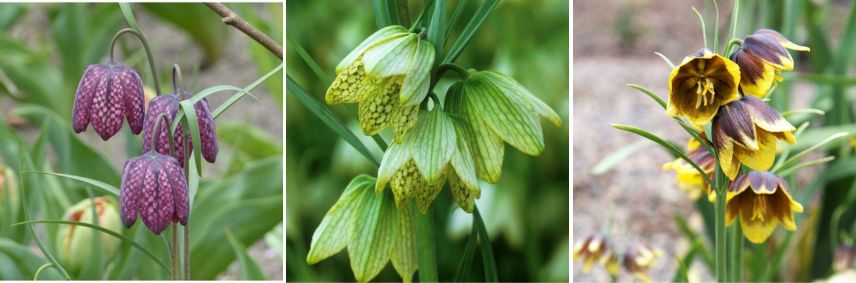
Fritillaria meleagris or snake’s head fritillary, Fritillaria thunbergii, Fritillaria reuteri
Choose a fritillary based on its flowering period.
The flowering of fritillaries occurs in spring. The earliest varieties begin flowering from February or March. This is the case for snake’s-head fritillaries or botanical fritillaries, such as F. davisii, F. elwesii and F. liliacea.
Some species, conversely, wait for temperatures to be milder toward the end of spring. Among these late-flowering fritillaries, for example the F. olivieri, whose long green flowers marked with brown do not reveal themselves until May–June.
Choosing a fritillary based on its foliage
Foliage of fritillaries is generally green, ranging from bright green to darker or greyish shades. But some varieties stand out for their variegated foliage, which adds an even brighter touch. This is the case with theimperial fritillary ‘Aureomarginata’, with variegated leaves of golden yellow and cream. In‘Argentea variegata’, the foliage is bright green, edged with a cream-silver margin. A relatively uncommon variety to discover!
Another species with remarkable foliage: thePersian fritillary black ‘Adiyaman’, which has leaves subtly tinted blue-silver. This is also the case for thetype species, whose bluish foliage is coated with a fine silvery bloom.
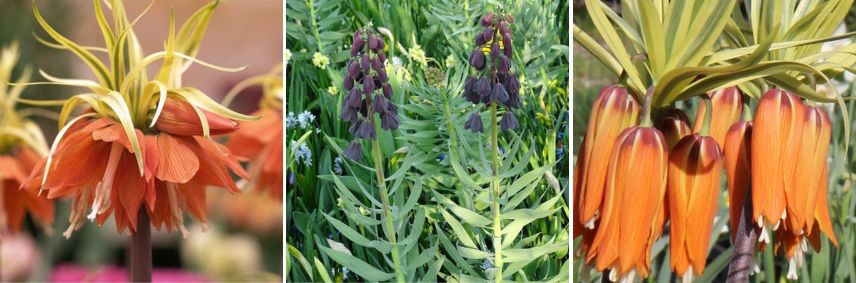
Imperial fritillary ‘Aureomarginata’, Persian fritillary ‘Adiyaman’, Imperial fritillary ‘Argentea Variegata’
Read also
Botanical fritillariasChoosing a fritillary according to its growth habit and use.
The height of fritillaries can vary from 15 cm to well over a metre, enabling different uses in the garden or in containers.
The smallest varieties
They measure less than 25 cm in height. These fritillaries are ideal for planting around the bases of trees in light woodland, but also for livening up a lawn that is a little too tame (for this, opt for planting in groups). Of course, these bulbous plants can also enhance a border, a flower bed or a rockery. They will also make good candidates for pot cultivation, to brighten terraces, balconies or windowsills.
Among them we include the pintail fritillaries (25 cm tall by 10 cm across), the F. davisii (15 cm in all directions) or the F. michailovskyi (20 cm tall by 10 cm across).
Medium-sized varieties
These versatile fritillaries will suit everywhere, both in the garden and in pots. They measure between 30 and 70 cm in height.
This includes the pale-flowered fritillary (40 cm tall by 15 cm across), the F. thunbergii (50 cm tall by 10 cm across) and also the F. uva-vulpis with its delightful bi-colour flowers (40 cm tall by 14 cm across).
Among imperial fritillaries, we mention ‘Tchaikovsky’ (60 cm tall by 25 cm across).
Tall, architectural varieties
Among the largest varieties, we find the famous imperial fritillaries, with a particularly architectural silhouette. They are, in fact, among the tallest spring bulbs, which can reach up to 1.5 metres in height.
In this category, we include varieties starting from 80 cm tall. They offer a well-groomed, elegant and majestic silhouette. These bulbous plants will immediately add verticality and structure, for example in a border. This is the case with the cultivar ‘Vivaldi’, but also with ‘Lutea’ and ‘Orange Beauty’,
But Persian fritillaries are not to be outdone, as demonstrated by ‘Adiyaman’ or ‘Purple Dynamite’ (90 cm tall by 30 cm across).
The tallest varieties will benefit from staking, or be grown in a wind-sheltered location to prevent their stems from bending.
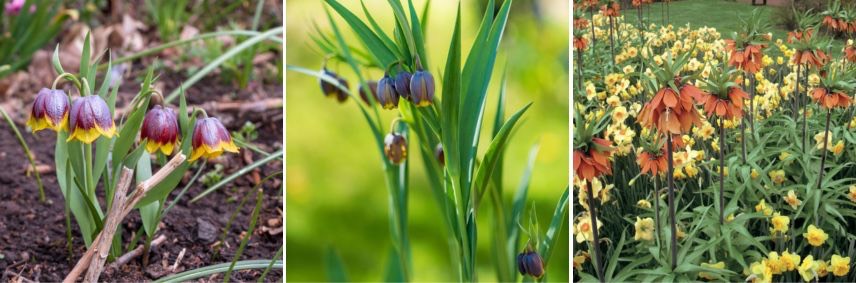
Fritillaria michailovskyi, Fritillaria uva-vulpis, Fritillaria imperialis ‘Orange Beauty’
Choosing a fritillary according to growing conditions
Fritillaries grow in sun that isn’t scorching or in partial shade. They are fairly easy to grow plants, but their requirements can vary greatly depending on the species: some prefer dry, light soils, while others need a cool to moist soil, even heavy.
As for their cold hardiness, it ranges from -5°C to -20°C depending on the fritillaries.
For dry soils
Most fritillaries prefer well-drained soils (which prevent waterlogging), fertile (rich in organic matter), but rather cool to moist. However, some species will tolerate occasional drought, which will allow them to be grown in a well-exposed border. This is the case for imperial fritillaries and their various varieties, as well as Persian fritillaries.
In a poorer substrate, for example in a rock garden, favour Fritillaria acmopetala, with its petals that are pointed.
For cool to moist soils
Due to their origins (forests and damp meadows, stream banks…), some fritillaries will need a cool, even damp soil.
It is the case for meleagris (guinea fowl) varieties, which prefer soils that never dry out completely. Place them in a bright exposure, in full sun or light shade. They will thus be good candidates for woodland edges, particularly in regions with cool, damp summers.
For regions with cold winters: the hardiest
If your region experiences particularly harsh winters, turn to varieties that tolerate strong frosts. This is the case for Persian fritillaries (generally down to -20°C), F. pintade and F. camschatcensis (beyond -20°C).
Note: even though they are hardy (to -15°C), imperial fritillaries dislike winter wet soils. In that case, if you still wish to grow them, cultivate them in a sheltered location protected from the elements. You may also opt for container cultivation, so you can bring them indoors to a dry place during the cold season.
- Subscribe!
- Contents
Comments