





























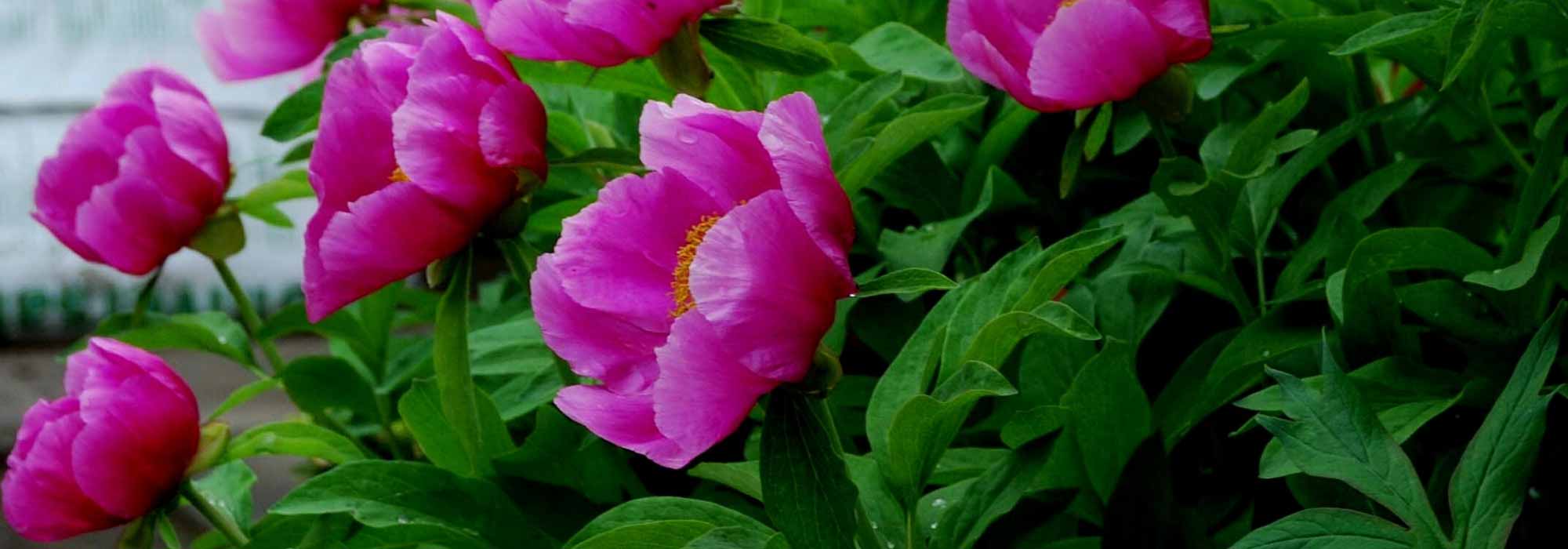
How to choose a peony according to the shape of its flowers?
Different forms of peony flowers
Contents
Peony have such a distinctive personality that you can tell it apart from a thousand others. However, it’s not easy to navigate the wide diversity of peonies, in which more than thirty deciduous, herbaceous or shrubby species are listed and countless cultivars mostly derived from Paeonia lactiflora. Peony flowers come in an infinite variety of shapes and colours. They can be of simple form, with one or two rows of petals surrounding a centre of clearly visible stamens, semi-double, double, globular or Japanese form. Frilly or elegant and understated, we help you choose the right peony according to the shape of its flowers! And to learn everything about their cultivation, be sure to consult our full guide: Peonies: planting, pruning and care.

Single-flowered peonies
Flowers of the so-called “Japanese” form
The Japanese peonies derived from Paeonia lactiflora have a clean, graceful presence. Their blossoms open into a broad, cup-shaped bloom 15–20 cm in diameter centred around a heart of delicate frilly petaloids. These herbaceous, Japanese-type peonies often display bi-colour shades, ranging from pure white to deep purple, passing through yellow and including a full palette of pinks and reds. These single-flowered peonies are often scented, bring a touch of light to the garden and integrate perfectly into cut flower arrangements, lending them grace and finesse even if they sometimes lack vase life.
-
- The peony ‘Do Tell’, a particularly floriferous variety that, in April, features large single, elegant and softly scented pink flowers with a heart of lilac-pink stamens fading toward the end of flowering.
- The Paeonia lactiflora ‘Nippon Beauty’, a peony with a theatrical look, with its magnificent cup-shaped petals in garnet-red surrounding a heart of red and gold petaloids. It flowers in late May, giving off a light fragrance.
- The Paeonia lactiflora ‘Fantastic’, a peony full of grace, delicate and light, exhaling a soft and delicate fragrance. It displays, during June, broad flowers in intense pink around a frilly heart of white-tinged pink and bright pink.
- The Paeonia lactiflora ‘Immaculée’, as light as a cloud, showcases a large corolla of rounded petals in pure white revealing a heart almost double in creamy white, enhanced by red stigmas.
- The Paeonia lactiflora ‘Bowl of Beauty’, is another form with large single flowers of the Japanese type that flower in tones carmine pink and cream white.
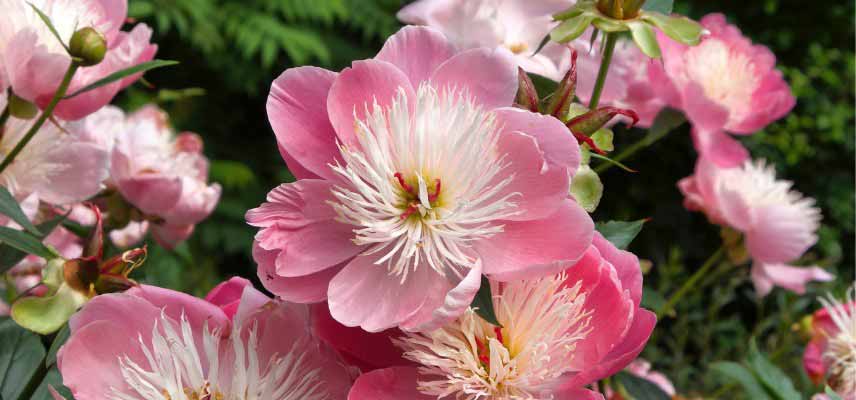 Paeonia lactiflora ‘Bowl of Beauty'</caption]
Botanical peonies
They also typically have single flowers, displayed in a wide range of colours. The flowering period of botanical peonies is shorter, and often earlier, than that of their hybrids.
- The Paeonia officinalis ‘Mollis’, blooms at the end of the peony season, late June–July, offering cup-shaped flowers in a very vivid pink, opening to a prominent heart of yellow stamens.
- The Paeonia mascula whose large pink cup-shaped flowers open from March to May.
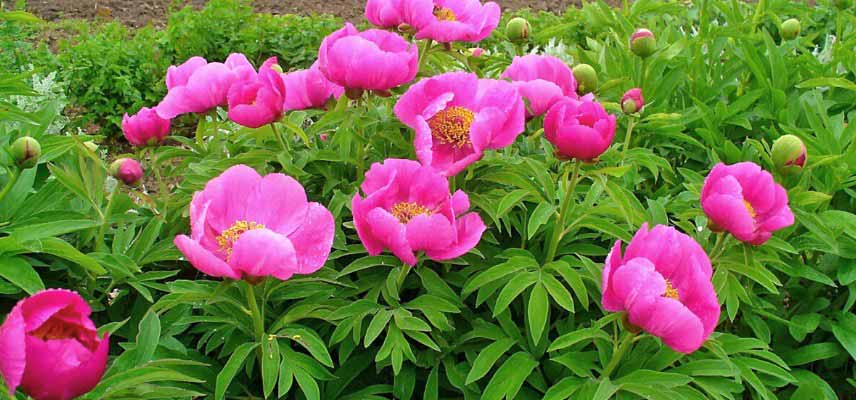 Paeonia officinalis ‘Mollis'</caption]
Anemone-flowered peonies
All single or pleasantly ruffled, these peonies have a natural habit, offering elegant and graceful flowers. They brighten the garden or add a great deal of charm to your bouquets.
- The Paeonia ‘Late Windflower’ offers pretty white flowers with a natural habit, resembling those of a Japanese anemone. Single, graceful and subtly scented, they appear in early summer.
- The Paeonia lactiflora ‘Inspecteur Lavergne’ is distinguished by its very large, rose-coloured anemone-type flowers tinged with raspberry.
- The Paeonia lactiflora ‘Primevère’, offers anemone-type flowers that are both delicate and of intense freshness, whose corollas of a subtly rosé white surround a double heart of nacreous canary-yellow petals that fade into a tender and soothing yellow.
- The Paeonia lactiflora ‘Gay Paree’ features delightfully scented bi-colour flowers of anemone-type, semi-double, which are superb in bouquets. They open in vivid and fresh fuchsia pink, revealing a white centre, all softly ruffled.
- The Paeonia lactiflora ‘Amabilis’, full of charm, with double 16 cm flowers, very fragrant, anemone-shaped, bloom in mid-May as a compact pompon, cleverly unruly, in a candy-pink shade edged with white.
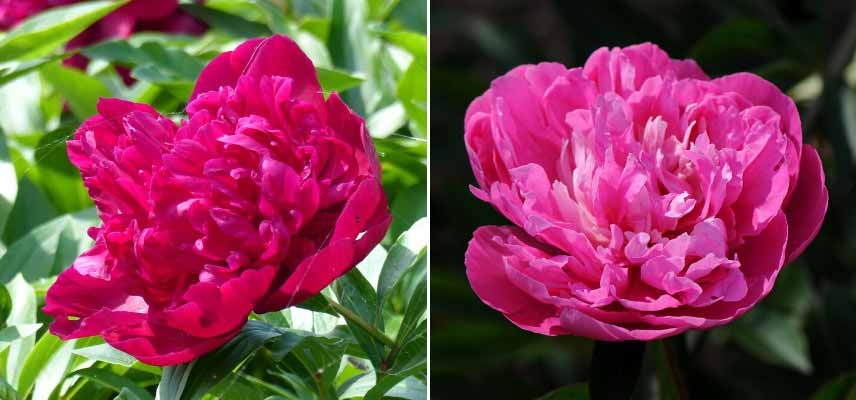
Paeonia lactiflora ‘Inspecteur Lavergne’ and Paeonia lactiflora ‘Amabilis’ (photo: Steph Cross)
Crown peonies
They are formed by a crown of wider outer petals surrounding a very double heart formed of smaller, ruffled florets, often providing a striking contrast.
- Paeonia ‘Felix Crousse’, this old French cultivar dating from 1881, awarded in England by the Royal Horticultural Society, features in May–June large, beautiful double flowers in carmine red. They are formed of a crown topped by a large pompon edged in silver along the rim and are accompanied by a light fragrance.
- Paeonia lactiflora ‘Big Ben’ shows a collar of red-rose fuchsia petals surrounding a swirling heart formed of small, ruffled florets in the same bright colour.
- Paeonia officinalis ‘Rosea Plena’ is another fine herbaceous peony which unfolds remarkable double crown flowers in a rose-purple colour around a pompon-shaped heart that is prettily frilled and very compact.
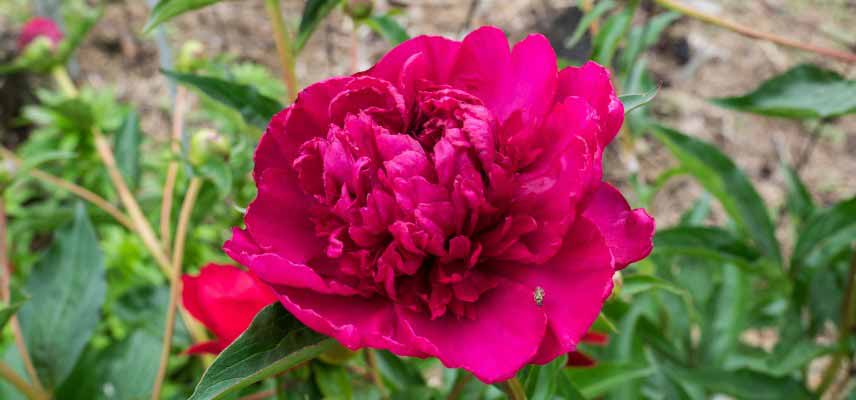
Paeonia lactiflora ‘Big Ben’ (photo: F.D. Richards)
Read also
Choosing the Right PeoniesSemi-double or double peonies
Opulent and generous, they take the form of pretty rosettes. They are also more fragrant than single-flowered peonies. The Chinese peonies most often have semi-double flowers, measuring up to 20 cm in diameter, white, yellow or in all shades of pink to red or purple. Double-flowered peonies are those that remind us of the gardens of our grandparents in which they bloomed prolifically.
Semi-double flowers
- The Itoh peony ‘Garden Treasure’ develops semi-double flowers of 12 cm in diameter, with yellow nuances throughout. They burst into canary yellow, ending in butter yellow, exuding a delicious fruity fragrance.
- The Peony ‘King’s Day’, is a shimmering fragrant variety offering large semi-double flowers of 16 to 18 cm in diameter. Its petals display pastel colours, salmon to orange centred around a heart of orange stamens.
- The Itoh peony ‘Morning Lilac’ is a lively hybrid variety with flowers 18 cm in diameter, ranging from single to semi-double, lightly scented. They transition from fuchsia pink to deep violet, then to pale lilac-grey before fading.
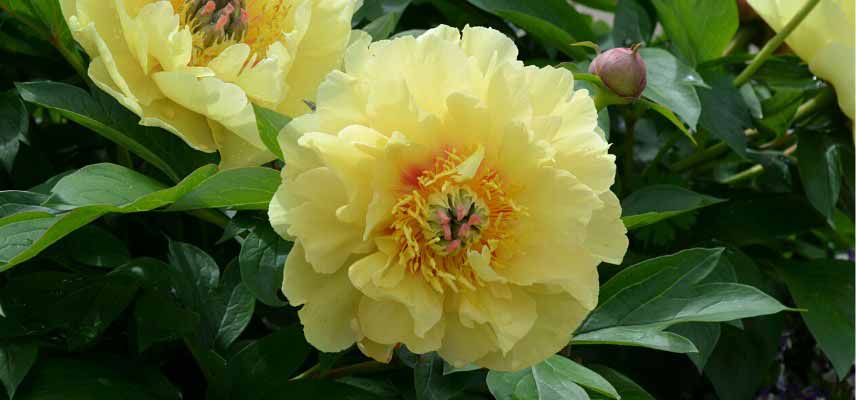
Paeonia ‘Garden Treasure’
Double flowers
- The Paeonia lactiflora ‘Shirley Temple’ is an old variety with very double flowers that open into large pom-poms, initially tinted with pink, then unfolding to white. They resemble old-fashioned roses.
- The Peony or Paeonia lactiflora ‘Duchesse de Nemours’ offers beautiful, fragrant, very double flowers, 13 cm in diameter, white washed with green at the base of the petals. A timeless classic with old-world charm.
- The Peony ‘Coral Sunset’ stands out for its double flowers with a subtle fragrance and in an inédit colour of peach-pink to coral.
- The Peony ‘Sarah Bernhardt’ is a must-have variety with large double flowers that are highly fragrant. They open into a pom-pom and take the shape of pretty rosettes in pale silvery pink edged with white.
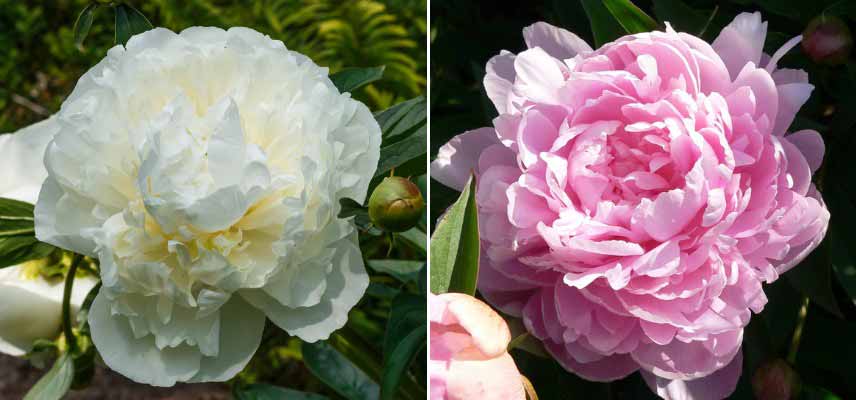
Paeonia ‘Duchesse de Nemours’ et ‘Sarah Bernhardt’ (photo : F.D. Richards)
Globular bloom
They unfurl well-formed corollas with a rounded profile that recalls the shape of some old-fashioned roses.
- The Paeonia lactiflora ‘Coral Charm’, a historic variety that has stood the test of time with its semi-double flowers, very globose on opening, in shades of peach-pink and orange.
- The Paeonia lactiflora ‘Pink Hawaiian Coral’ is another peony with semi-double flowers, very globose at first and displaying a coral pink, turning over the weeks to soft apricot-pink, up to creamy white.
- The Peony Cytherea (Paeonia x lactiflora) produces large semi-double flowers of about 16 cm in diameter, in a cup shape that is almost perfect, with a brilliant cherry-rose.
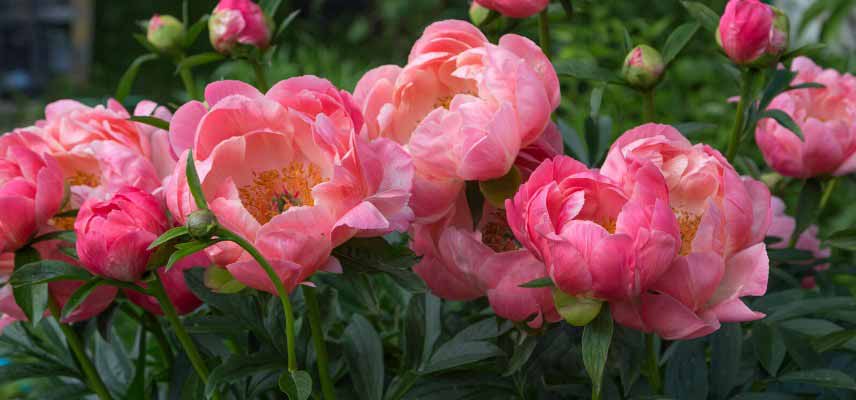
Paeonia ‘Coral Charm’
Peonies with original flowers
They stand out for their unique appearance. These are unusual varieties, botanical rarities.
- Paeonia lactiflora ‘Green Lotus’ is an original selection that stands out for the irregular form of its flowers, white flowers brushed with green and pink, reminiscent of a cactus dahlia.
- Paeonia lactiflora ‘Green Halo’ is a rarity with its semi-double and crinkled corollas, curiously irregular in shades of greens and whites.
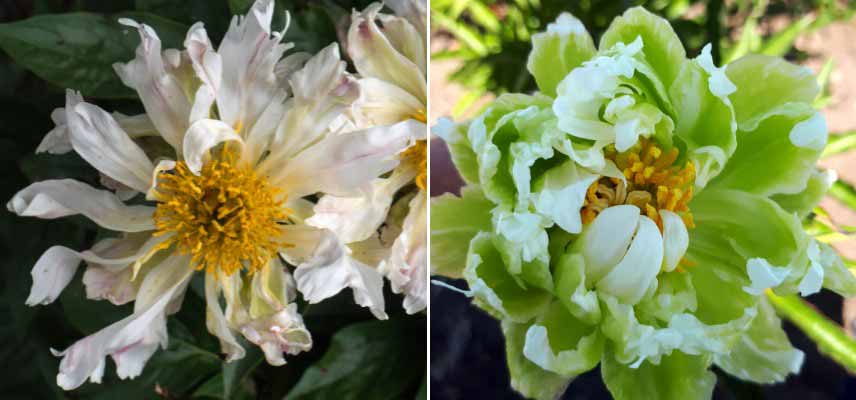 Paeonia ‘Green Lotus’ and ‘Green Halo’
- Subscribe!
- Contents
Comments