





























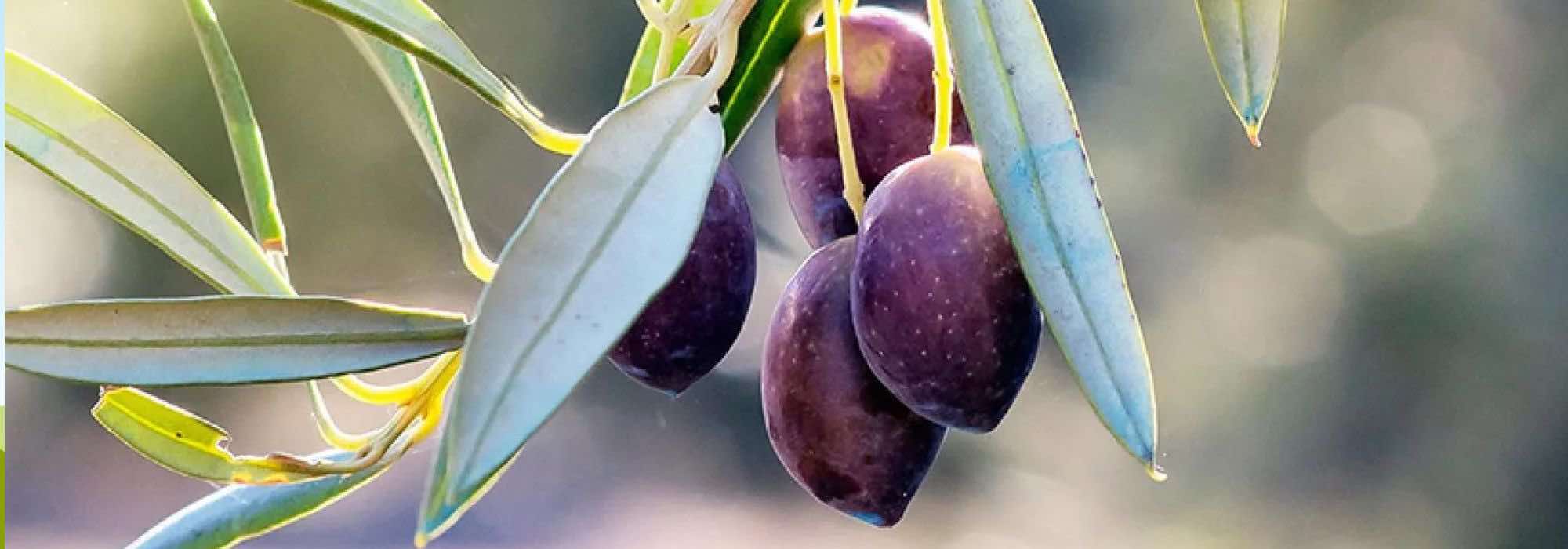
How to choose an olive tree? Our buying guide
To find the ideal variety
Contents
The olive tree is an iconic tree of the Mediterranean, renowned for its long life. There are several species, including the Olea Europea, which is among the most cultivated. It comes in many varieties.
You can choose an olive tree for its ornamental qualities (shape, foliage, trunk) or for the usefulness of its well-known fruits (table olives, oil production, or both). To help you find the perfect olive variety, discover our buying guide.
And to learn everything about olive cultivation, discover our complete guide: Olive tree, Olea europaea: planting, pruning

Choosing an olive tree based on its fruit
All olive trees can yield green, black or oil-producing olives, but some varieties are more productive or suited to a specific use.
For table olives
‘Picholine’ is a table olive variety originating from Gard in the south of France, which is found widely in the south of France and Corsica. Its fruits are perfect as table olives, or for more elaborate cocktail olives. They are, moreover, among the greenest olives most commonly used in France. The fruits are crisp, with a delicious flavour, a hint of bitterness and a peppery bite. They have a more elongated, pointed shape than those of other olive trees.
To obtain black olives, opt for ‘Grossane’, whose fruits have a fleshy pulp and reveal notes of hazelnut. ‘Olivière’ also yields black olives, with aromas of almond and apple.
In terms of fruit shapes, ‘Lucques’ stands out with its long, elongated olives, described as crescent-shaped. Their flesh is fine and fruity, with a somewhat buttery texture.
‘Salonenque’ is, for its part, the variety used to make cracked olives, this Provence speciality allowing olives to be split. It yields large calibres, well fleshy fruits.
‘Arbequina’, a variety grown mainly in Spain, produces small, very aromatic brown olives.
For olive oil
The olive tree ‘Aglandau’ is among the most used for olive oil production. Its fruity flavour would reveal notes of artichokes and almond. This variety benefits from a very good yield.
‘Bouteillan’ is also among the varieties used to make oil. Its olives have a fruity and herbaceous flavour.
Also consider ‘Olivière’, ‘Cailletier’, ‘Sabine’ and ‘Frantoio’, which are suitable for this use.
‘Negrette’ offers pointed olives, yielding a golden and mild oil, but its yield is low (allow around 7 kilograms of olives to obtain 1 litre of oil).
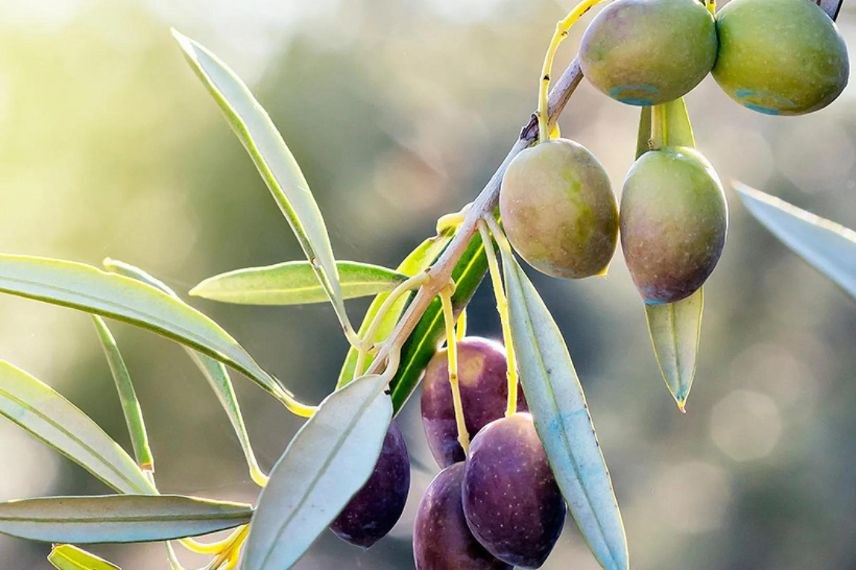
The ‘Negrette’ olive is an olive oil variety
Dual-use varieties
‘Tanche’ and ‘Lucques’ prove very productive. These are dual-use olive trees, used for producing table olives as well as oil. That is also the case for ‘Picholine’.
Read also
Growing an olive tree in a potSelf-fertile olive varieties
These self-fertile olive varieties do not require the presence of other olive trees nearby to bear fruit. Recall that, to obtain fruit, the flowers must be pollinated. This pollination occurs naturally either by the wind or by insects responsible for dispersing the pollen.
If you wish to grow olives, but you do not have the option to grow several olive trees, consider the olive trees ‘Aglandau’, ‘Grossane’ or ‘Picholine’. Their own pollen allows them to set fruit.
‘Canyon’ is also among the self-fertile varieties and makes an excellent pollinator for varieties that are not, notably for ‘Lucques’.
Choose an olive tree based on its flowering period and harvest.
The harvest period for fruit depends on the flowering period, but also on its intended use. Green olives are harvested first, before black olives (the riper ones) and olives destined for oil.
The earliest
‘Tanche’ is among the earliest olive trees, with flowering occurring between March and May.
In terms of harvest, ‘Luques’ is among the first: its green olives can be harvested from September. ‘Picholine’ also yields harvest from September for green olives, October for black olives and January for oil.
Despite its late fruiting, ‘Belgentierose’ allows an early harvest, from the end of August.
Also mention ‘Negrette’, an early variety that fruits quickly after 2 to 3 years. This olive tree is also less prone toalternate bearing.
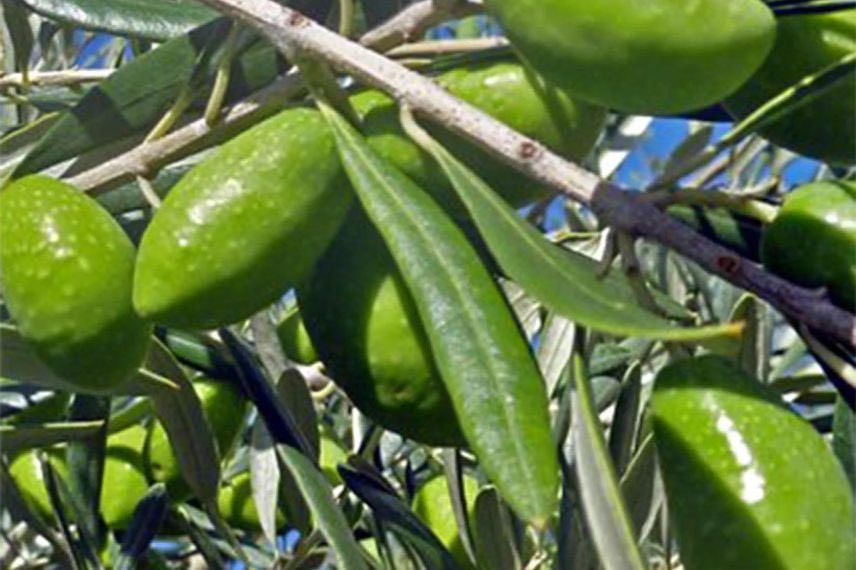
The olive tree ‘Lucques’ is an early variety
The latest to bear fruit
The olive tree ‘Aglandau’ is among late-fruiting varieties. It flowers in late spring, between May and June.
‘Bouteillan’ will benefit from late harvest to increase its yield. Flowering occurs in May.
Harvest of the olives of ‘Tanche’ will take place between December and January.
Read also
Diseases and pests of the olive treeChoosing an olive tree by its silhouette
The smallest varieties
Olive trees can reach nearly 20 metres in the wild, but are generally half that in cultivation. Plan for about 9 to 10 metres in height with a 7-metre spread for the typical specimen.
Some smaller varieties will suit pot culture well, which will allow you to protect them from frost in winter by bringing them under cover. For this use, for example choose ‘Negrette’ (4.5 metres tall with a 3.5-metre spread at maturity).
For ornamental purposes, you can also opt for a olive on a stem, which will present a taller and finer trunk.
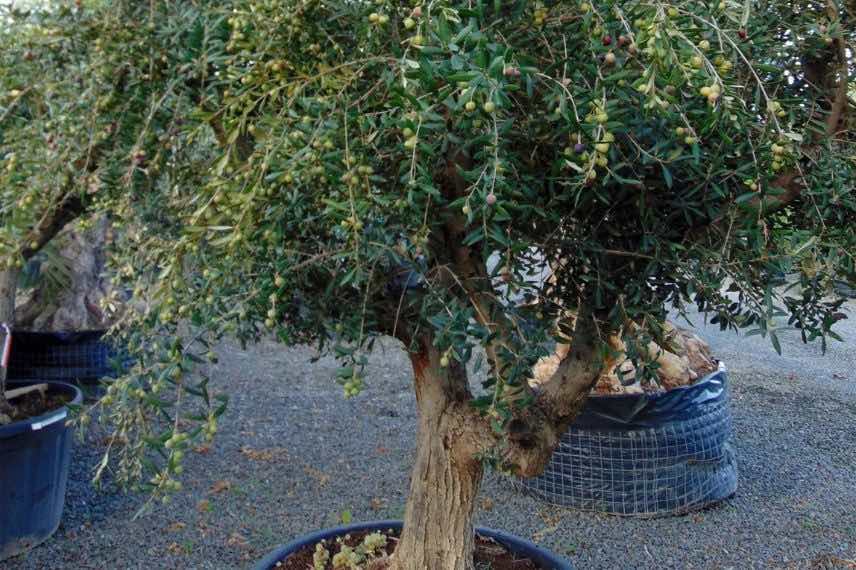
Olive on a stem
The different growth habits
Most olive trees have a fairly spreading habit, almost as wide as tall. Their gnarled trunk supports a bushy crown, made up of evergreen, silvery-green foliage that is highly recognisable. This is the case with ‘Picholine’ (5 metres tall with a 4-metre spread), ‘Lucques’ or ‘Grossane’.
‘Aglandau’ stands out, producing shoots with a somewhat weeping habit, which tend to droop. This is also the case with ‘Olivière’.
‘Tanche’ has the trait of presenting a more rounded habit, while ‘Canyon’ has an upright, somewhat pyramidal silhouette.
Choosing an olive tree based on growing conditions
The hardiest olive trees
Olive trees can be hardy down to -10°C when grown in open ground. But it is mainly waterlogged soils that it fears during the cold season, and these can harm it.
Among the cold-hardiness varieties, the following are worth mentioning: ‘Arbequina’, ‘Lucques’, ‘Bouteillan’, ‘Olivière’, ‘Frantoio’, ‘Grossane’ or ‘Aglandou’. Conversely, avoid varieties such as ‘Picholine’, ‘Cayon’, ‘Manzanille’ or ‘Cailletier’, which are more sensitive to cold.
In regions with harsh winters, you can of course opt for pot culture, so that you can move the tree to a sheltered place to protect it from severe frosts.
Note that outside the milder regions, the olive tree is mainly grown for its ornamental qualities, with fruiting being virtually impossible north of the Loire. Remember that success in olive cultivation depends on several cultivation criteria:
- perfect soil drainage, to prevent roots from rotting due to excess water;
- a sunny exposure, ideally south or west-facing;
- a site sheltered from cold winds.
Disease resistance
The olive tree is well known for its resilience, but it can nonetheless be subject to parasitic pests or diseases. This is the case with the olive fruit fly which affects crops and renders the fruit unfit for consumption.
‘Leccino’ is among those varieties that prove more resistant to diseases. ‘Aglandau’ is also a resistant variety, both to the olive fruit fly and to verticillium wilt (a fungal disease).
In contrast, ‘Lucques’ is fairly susceptible, as are ‘Grossane’ and ‘Frantoio’. Generally, olive varieties with large fruit and thin skin are the least resistant to pests.
- Subscribe!
- Contents
Comments