





























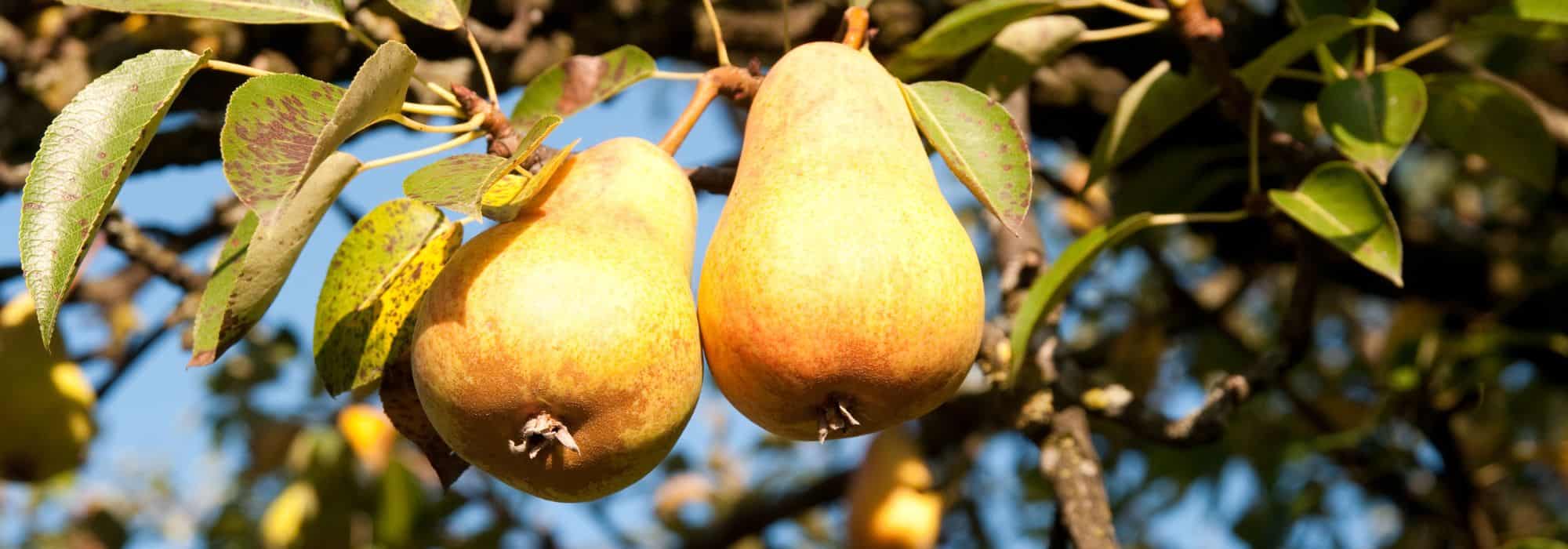
How to choose the right pear tree?: our buying guide
Our buying guide to choosing the best pear trees according to different criteria
Contents
The joy of tasting pears straight from the tree, with melt-in-the-mouth, juicy flesh… Relatively easy to grow, the pear tree (Pyrus communis) is a staple in orchards and gardens, on a par with the apple tree. Not least because it grows almost anywhere, albeit with a preference for temperate climates, provided it has a cool, fertile soil and a sunny site sheltered from cold winds. It will also require another pear variety, a pollinating variety, nearby to enable good fruiting, as most pear trees are self-sterile. Bees and other melliferous insects that visit the melliferous flowers will ensure cross-pollination.
In addition to this fruiting, the pear tree offers a magnificent flowering, in clusters of white flowers, which occurs quite early between March and April. This generous flowering makes it a very handsome ornamental tree that can take several forms and growth habits to suit gardens, large or small, but also balconies and terraces.
To help you choose the pear tree variety best suited to your constraints and preferences, discover our buying guide prepared according to various criteria of quality, productivity and flavour.

According to the harvest season
To enjoy tasty pears, harvest them about two weeks before full ripeness. However, this ripeness depends on many criteria, among which climate plays a crucial role. Nevertheless, variety also matters since some pears are known as summer, autumn or winter varieties.
By planting several different varieties, you can achieve multiple harvests over a period from July to November. This is also an added advantage to maximise your chances of pollination!
Pears harvested in summer
The Saint-Jean pear tree is certainly one of the earliest varieties, as pears are harvested from mid-June to July. This old variety yields fruits of medium-to-fairly large size, rounded and plump, with pale skin and white, semi-fine, juicy and sweet flesh. They should be eaten fairly soon after harvest. The Jules Guyot pear tree offers pears that are rather elongated, maturing from the end of July into August. The epidermis is lemon-yellow and green, tinged with pink, and the flesh is fine, juicy and melting, and sweet. The pears keep for 1–2 months. The Beurré Giffard pear is also a relatively early pear, maturing from the end of July. Medium-sized, these pears with a pale to greenish-yellow epidermis offer flesh of excellent eating quality. White, melting and juicy, it is very sweet and fragrant. It is an old and hardy variety from Anjou.
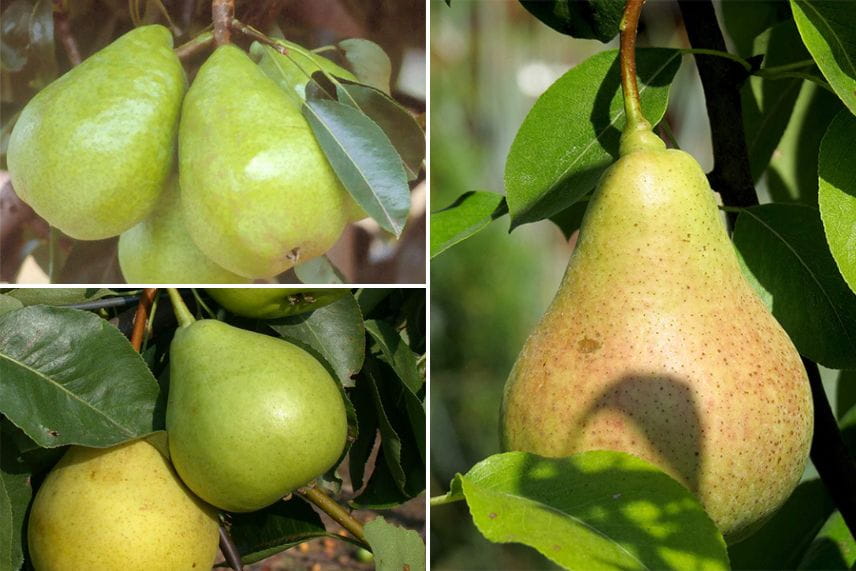
Three summer pear trees: Jules Guyot, Saint-Jean and William’s Bon Chrétien
Finally, we cannot conclude this selection of summer pears without mentioning the ‘William’s Bon Chrétien’, certainly one of the most popular varieties worldwide. Its pears reach ripeness from mid-August and offer a melting, fine, sweet and fragrant flesh, under a skin that is well yellow.
Pears harvested in autumn
Other pear trees are later and wait for autumn to offer their pears. These are logically autumn pear trees. Among the most commonly cultivated, we find the highly productive variety ‘Beurré Hardy’ which is characterised by its very good hardiness that allows it to be grown anywhere, up to 800 m in altitude. The pears are round, with a smooth green-bronze skin and a flesh that is fine and juicy, white and very sweet. Harvesting takes place in September and October.
The ‘Doyenné du Comice’ is picked from the end of September and in October. The pears of this variety are large and ventrous with a green-yellow epidermis, speckled with red if the pears are in full sun. The flesh is pale cream, juicy and fragrant, of great finesse and very sweet. They keep for 4–5 months.
The ‘Général Leclerc’ is also an autumn variety, fairly recent and hardy, which produces stout pears with yellow-bronze skin at maturity, with flesh that is very pleasant in bite, very sweet but with a touch of acidity. These pears are picked from mid-September to mid-October and keep for 3–4 months.
Pears harvested in winter
Due to their hardiness, some varieties are very lates. This is the case for the ‘Doyenné d’hiver’, an old variety that produces large yellow-brown pears that reach maturity from January to March. The flesh is fine, melting, a little grainy at the core and well sweet. It is a delicious pear to eat fresh and to cook.
The variety ‘Jeanne d’Arc is also a late variety whose blunt-ended pears are harvested in November. Under a pale yellow skin, pink when sun-exposed, the flesh is white, very fine, very fragrant, sweet and slightly tart. It is a very productive variety with medium vigour.
The pears with smooth yellow-green skin and brown speckles of the pear tree Comtesse de Paris reach maturity between November and January. The flesh benefits from a very pronounced flavour, a good level of sweetness and plenty of juice. It is a self-fertile variety that makes an excellent pollinator for other pear trees.
Read also
Pear tree: planting, pruning and careDepending on colour
The epidermis of pears is most often yellow to green, with white flesh. But to add a touch of whimsy to your orchard, garden and on your plates, you could plant red pear varieties:
- The pear tree ‘William’s Rouge’ is derived from the variety ‘William’s Bon Chrétien’, bearing pears with dark red skin. These pears have yellow, melting flesh and are very fragrant, less musky but juicier and sweeter than their parent. They reach ripeness in mid-August and are harvested until the end of September. They are pears that can be eaten raw and keep for 3 to 4 months.
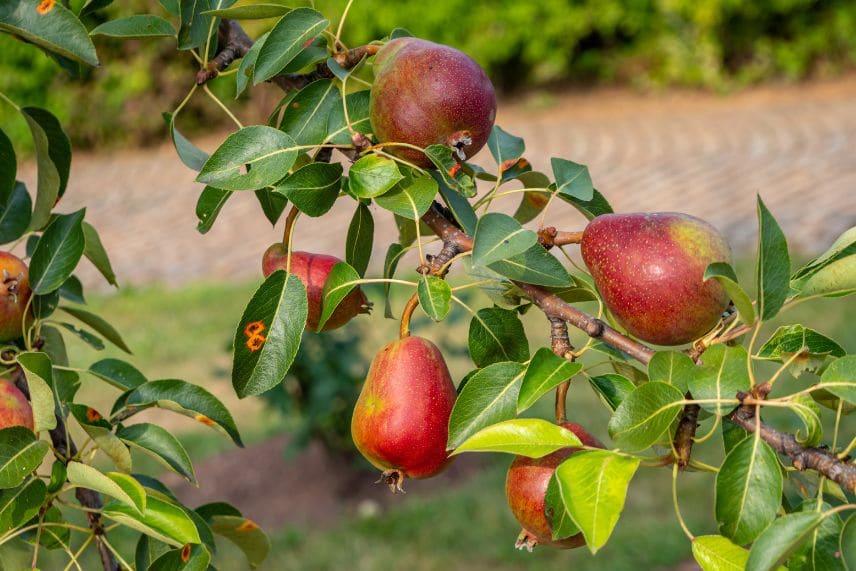
The pear tree ‘William’s Rouge’
- The pear tree ‘Garden Gem’ is a dwarf variety (it does not exceed 1.50 m in height) that can be grown in the ground as well as in a pot. The pears are of good size, somewhat rounded, and with a slightly orange-red colour. The flesh is melting, sweet and mildly sugary. The harvest takes place between September and October.
- The pear tree ‘Stark Crimson’ forms a vigorous tree with a slightly weeping habit that bears medium-sized pears with dark red skin. The flesh is very juicy and creamy, highly fragrant. These pears, harvested in August–September, can be eaten raw or cooked. It is a partially self-fertile variety.
Depending on how pears are used
Obviously, with their fine, melt-in-the-mouth flesh, sometimes slightly grainy, pears are wonderful to eat raw, just bitten into. Nevertheless, others are cooked to make excellent compotes. We can also distinguish pears ideal for making very tasty juices.
Thus, among pears to be eaten raw, some stand out as the variety ‘Abate Fetel’ which produces fruits very elongated with bronze-yellow skin when ripe. The flesh is particularly aromatic, sweet and sugary. Widely grown in Italy and ideal for very sunny regions, this variety bears fruit from September. The ‘Delbard gourmande®’ also bears its name well, as its flesh is fragrant, perfectly balanced between sweet and tart, melt-in-the-mouth and juicy. Obviously, the ‘Conférence’, with its sweet flesh, moderately tart and well-juicy, is delicious raw from September. Just like the ‘Louise Bonne d’Avranches’, a pear-shaped brick-red pear on a yellow background with excellent flavour. It is also a pear tree very well suited to high-altitude cultivation.
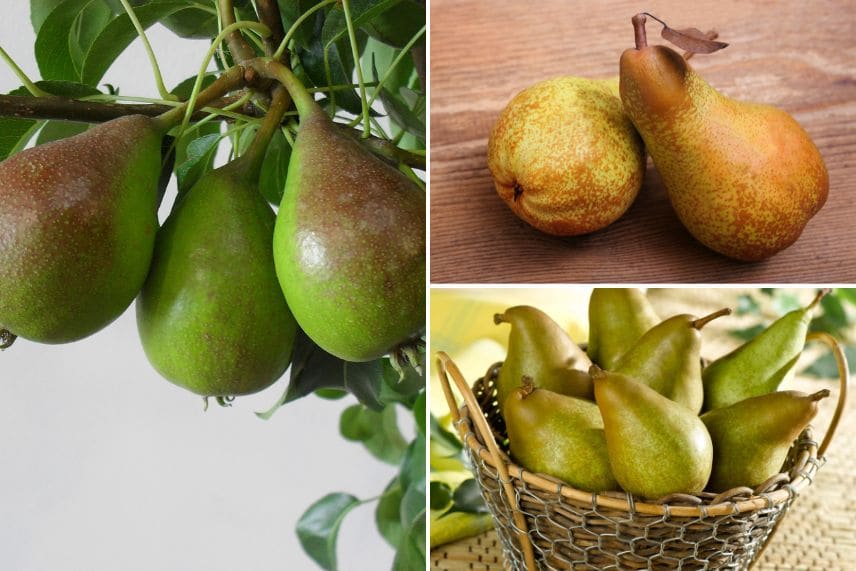
Three delicious pears to nibble: the ‘Louise Bonne d’Avranches’, the ‘Abate’ and the Delbard Gourmande®’
For those who prefer pears for compotes or jams, you can plant varieties with pears well suited to cooking, such as the ‘Beurré Hardy’, the ‘Saint-Jean’, the ‘Doyenné du Comice’… or the ‘Duchesse d’Angoulême’, a variety nicknamed pear tree of the heights thanks to its ability to bear fruit up to 1,000 m above sea level. Its pears are large and almost round, with flesh that is mid-fine, sweet and melt-in-the-mouth.
Finally, for making juice, choose rather a variety such as the Perry pear tree ‘Plat de Blanc’, very common in Normandy. It is a very productive variety of small pears in the shape of apples. The pear tree ‘Fausset’ is also suited to this use.
Read also
Pyrus: planting, pruning and careStorage conditions
Some pears benefit from very long storage, provided they are not harvested too ripe and free from the slightest bruising or damage. They should then be spread out on shelves or racks, not touching each other, in a well-ventilated room, protected from light and humidity, ideally at 10°C.
Some varieties store very well:
- The Angelys variety which produces large pears with yellow-bronzed skin and sweet-tart flesh. They are harvested in October and can be stored until March
- The Épine du Mas variety, also known as Duc de Bordeaux, is ancient and hardy. Pears are harvested from the end of October and keep throughout the winter
- The Figue d’Alençon variety, which yields keeper pears in the shape of a fig, as good raw as cooked
- The Charneux variety of Belgian origin that produces large fruit with green-yellow skin. They are harvested in October and eaten through December.
→ Also read: The 7 best pears for long storage.
- Subscribe!
- Contents
Comments