





























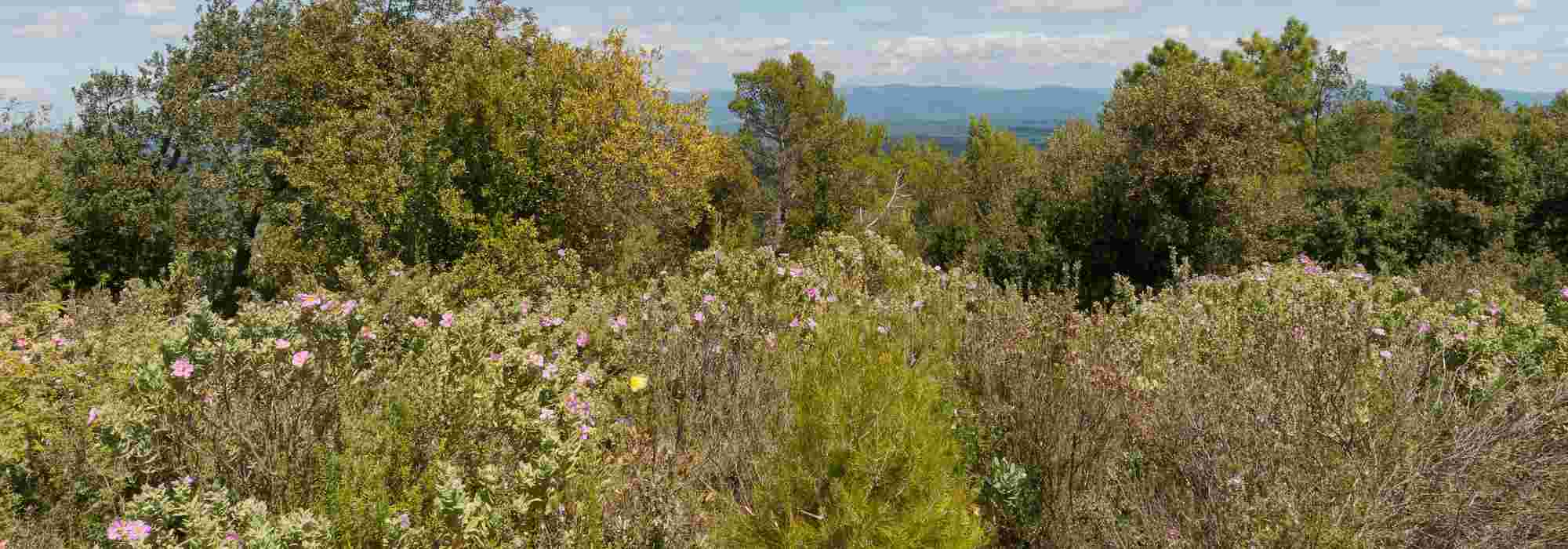
How to create a garrigue ambience?
A garden with a Southern flair... even further north!
Contents
If you can’t bring cicadas home, you can still fill your garden with a Garrigue ambience. Holiday memories, the warmth and the characteristic scents of landscapes in southern France can be translated into our gardens by carefully selecting the plant palette and by ensuring the soil conditions are favourable to this typical vegetation. Creating a Garrigue-style garden is also a way to combat climate change, with plants particularly suited to drought.
Plants, landscaping and decor: we share valuable tips to transform a garden and give it a Garrigue look!
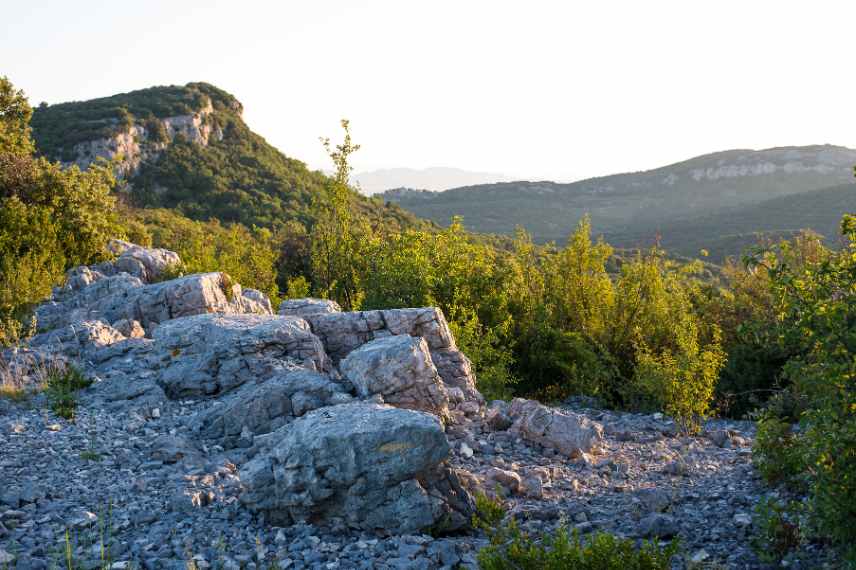
Garrigue: a unique natural medium, blending Mediterranean plants, mineral elements and aromatic scents.

The importance of soil
We find the garrigue on the rocky, calcareous soils of the western Mediterranean. If you want to imbue your outdoor space with a garrigue ambience, you must start at the beginning, namely by being able to plant in soil that will meet the cultivation requirements of the emblematic plants of these regions. Because you won’t be able to change all the soil in a garden!
There are therefore a few constraints to observe:
- Your soil must be calcareous It’s the sine qua non condition! Garrigue plants are generally calcicolous, meaning they favour calcareous soils. This type of soil, rich in lime, provides an alkaline pH (above 7) that is perfectly suited to these plants. If your soil is naturally acidic, forget about a garrigue garden, or only on a very small area, because you will need to lime or dolomite to raise its pH and make it more alkaline… not ideal, as you’ll agree.
- Your soil must be well-drained, light and free-draining Very well-drained soil is essential for garrigue plants, as they fear excess moisture and waterlogging. To improve drainage, you can incorporate materials such as coarse sand or gravel during site preparation. The substrate should also be light, made up of fine, loosely compacted particles to accommodate garrigue plants. This type of soil allows good infiltration of water and air, thus promoting root growth. If your soil is heavy and clayey, lighten it by incorporating decomposed organic matter, compost or leaf mould, for example.
- Your garden should ideally be poor and stony Garrigue plants are adapted to soils low in nutrients. A rocky, stony and lean soil with low organic matter content suits them perfectly. It does not retain moisture and helps prevent root oxygen deprivation during winter rainfall. So avoid enriching the soil.
Finally, if your ground or part of your garden is on a slope, that’s an asset for the garrigue garden, as elevated plantings will enjoy natural drainage! Exposed to the sun, it’s the sure-fire way to see a wide range of suitable plants prosper.
Not sure about the nature of your soil? Read our articles on the subject: Acid soil, neutral soil or calcareous soil, how to tell? ; Determining your soil texture: clayey, sandy, silty;Carrying out a soil analysis – why and how? ; How to enrich poor soil?
The plant palette of the garrigue
Garrigue-style planting is the closest to a maquis, distinguished by its calcareous soil, and populated with so-called xerophytic plants (which love heat), often spiny and scented.
The good news when choosing a garrigue-inspired ambiance for the garden is that most of the plants that grow there are particularly hardy and hardy, unlike a Mediterranean garden, which includes frost-sensitive species. They do indeed grow in areas where winter frost can be severe, exposed to cold winds and very hot summers, at mid to high elevations. Overall, these are plants that only fear winter damp; the sun does not scare them. Often with small evergreen foliage, the garrigue flora is of mountainous, Mediterranean or Eastern European origin. Rich in scented flowers and aromatic foliage, garrigue plants tend to be low in height. They are predominantly shrubs or subshrubs, best paired with a few taller, well-established plants:
Shrubs
It is the strength of this garrigue flora that has adapted to its harsh environment. The plants display greyish or silvery colours, with a texture that can be prickly. They are essential for reproducing the garrigue’s lower stratum: rosmarinus, thyme, cistes (Cistus albidus, also known as the woolly rockrose of the garrigues), Cistus populifolius, Cistus salviifolius, euphorbias. Also include arbousiers, the cade juniper, myrtuses, bagua de gu…, Colutea arborescens, teucriums, Lentisque pistachier, filaires (Phyllirea angustifolia), Montpellier maple, Laburnum, filaires…
Explore also: 5 shrubs for rocky soil; 7 shrubs resistant to cold and drought; 9 Mediterranean shrubs
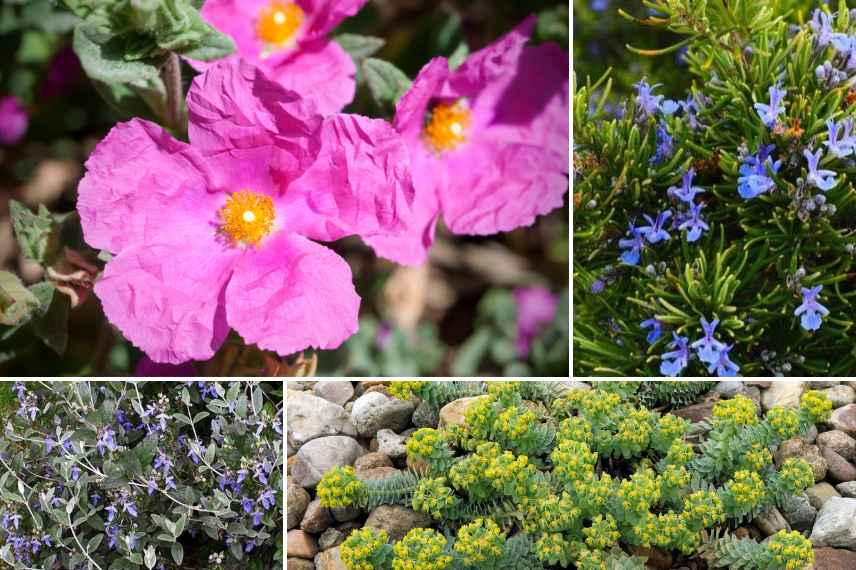
Cistus, Rosmarinus prostratus, Teucrium fruticans et Euphorbia myrsinites.
Perennials
Generally blue or yellow, they bring soft flowering: lavender essential, spurge such as Euphorbia myrsinites, Aster lynosyris, wild fennel and common fennel, Phalangères (Anthericum), rock Iris (Iris lutescens). Add verticality with Eremurus (Foxtail Lily) or Lupinus micranthus!
Also integrate grasses for volume and lightness that tolerate these soils, such as Muhlenbergia, Ampelodesmos mauritanicus or Stipa calamagrostis.
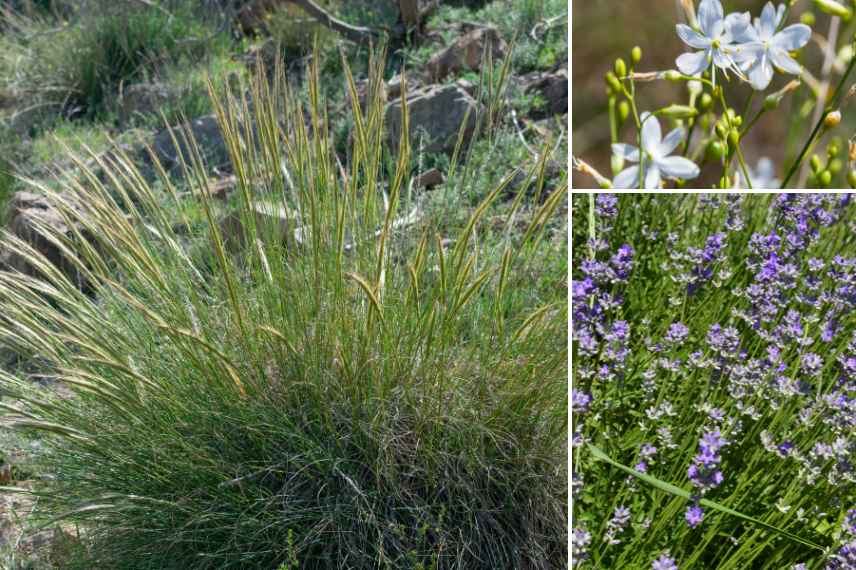
Ampelodesmos mauritanicus, Anthericum ramosum et lavande.
Ground covers
With spreading habit (carpet or creeping), they are emblematic of the garrigue and colonise the beds or are used in rockeries: Euphorbia myrsinites, Santolina chamaecyp… (Santolina chamaecyparissus), Teucrium chamaedrys, Helianthèmes, like mini Cistus, Anacyclus pyrethrum var. depressus (or Moroccan chamomile), Campanula portenschlagiana, Armeria maritima (Spain lawn), Phlox subulata ‘Atropurpurea’, etc.
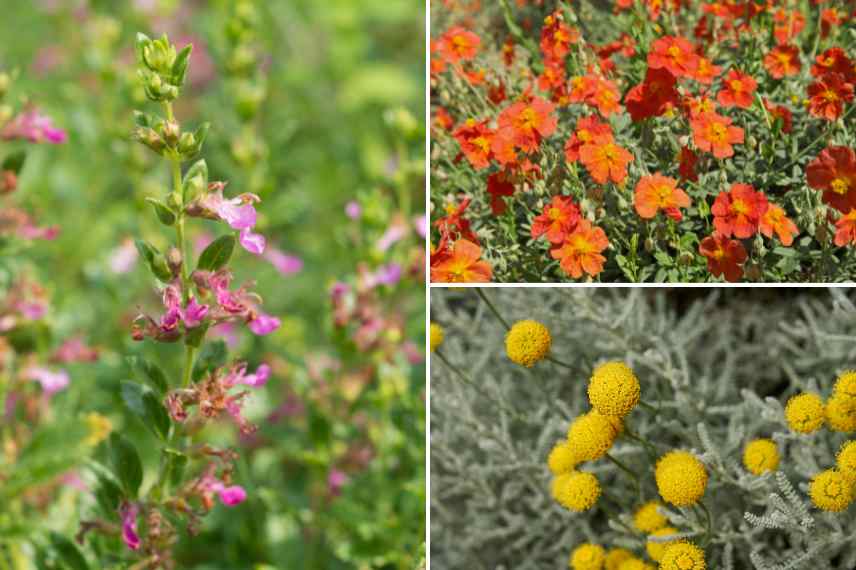
Teucrium chamaedrys, Helianthemum ‘Fire Dragon’ and santolina chamaecyparissus.
Trees
Finally, a tall strata with iconic, highly ornamental species, such as maritime pines, Aleppo pines (Pinus halepensis), cypresses, and evergreen-topped oaks (holm oak Q. ilex), and as a smaller tree, Montpellier maple (Acer monspessulanum).
Explore also: the essential garrigue plants; and 7 Mediterranean trees
Find our garrigue garden range in our online catalogue.
Specific layouts, colours, furniture and materials
Landscaping
To imitate garrigue landscapes, one visualises the stony land, even if it means rereading or revisiting Manon des sources! The small limestone walls are an integral part of this landscape, and we reproduce these mineral visions on a smaller scale in the garden.
The presence of stone is indeed the indispensable complement that supports the atmosphere created by the plantings. Terraced beds, dry rockeries, stone-paved paths, and why not walls or dry-stone huts in large gardens, like the pretty capitelles of the Languedoc or the caselles of the Quercy Causses? They can serve as a garden tool shed.
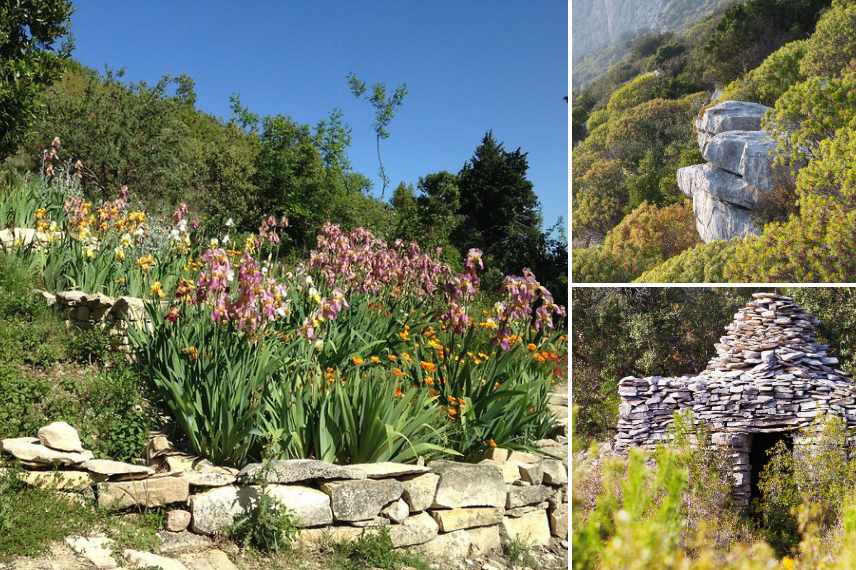
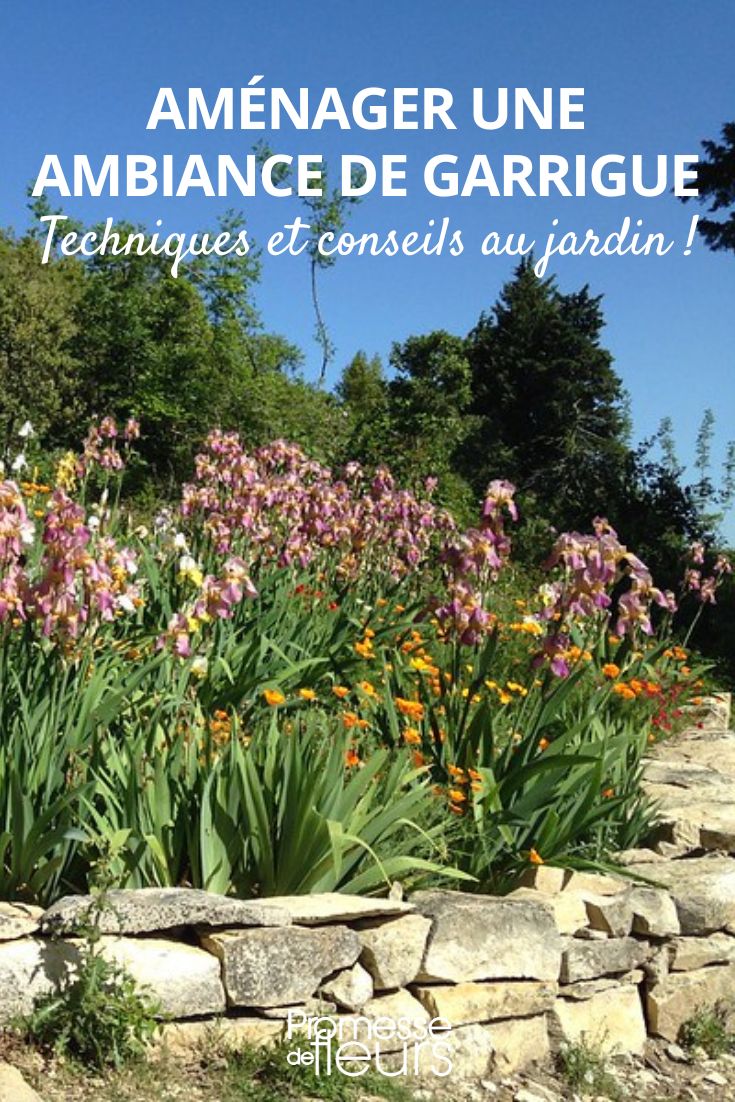
Plantings on terraced beds, stone terraces, rocks or scree, and small typical structures like those seen on garrigue lands.
We extend this mineral idea that heightens the scorching sun effect, and which recalls the limestone origins of the garrigue, on the pathways that will be laid with light gravel, but also in the beds or in a natural area of the garden, by placing a few large stones here and there. The aim is to recreate rocky scree in places and to stay as natural as possible, as one would spontaneously stroll through these sun-drenched zones.
→ Read our tips and tutorials How to build a dry-stone wall?, Designing a terraced garden, and Create a rockery: our tips for success
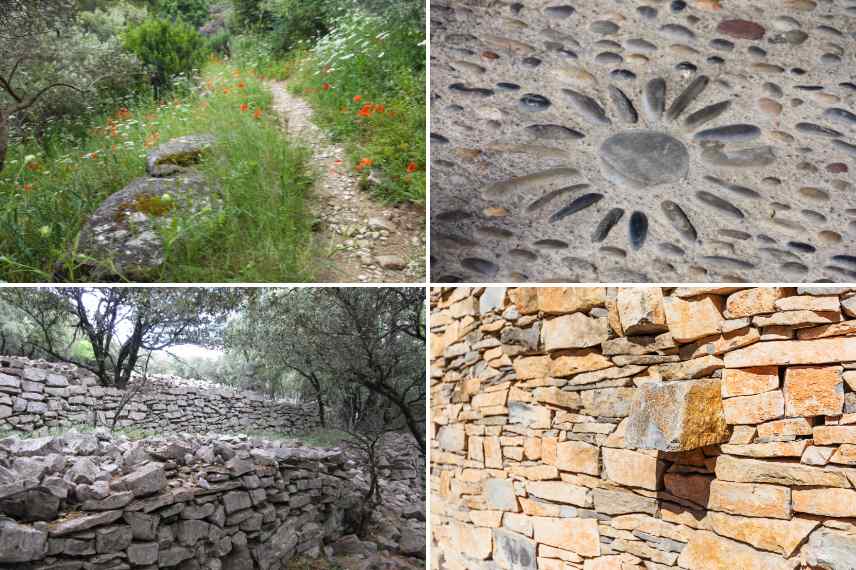
The mineral inspirations extend to walls, floors and paths.
Colours, materials and furniture
The colour palette leans toward limestone hues to further evoke the garrigue: every shade of ochre, terracotta, clays, and also honeyed tones, sand-coloured or chamois-toned, and, in small doses, the stone-coloured and grey-toned hues. We will bring all these warm colours into pots around the house. In terms of furniture, wrought-iron arbors set against the house, typical of the south, pair well with this decor, as do seats in dark metal. Keep the decoration restrained, which should above all showcase the mineral elements and the plant life. You can incorporate stone objects, such as troughs for example, or a few neutral-coloured pots. If you come across an old fountain or basin, it can sit proudly in the garden, recalling some Provençal villages where water is so precious.
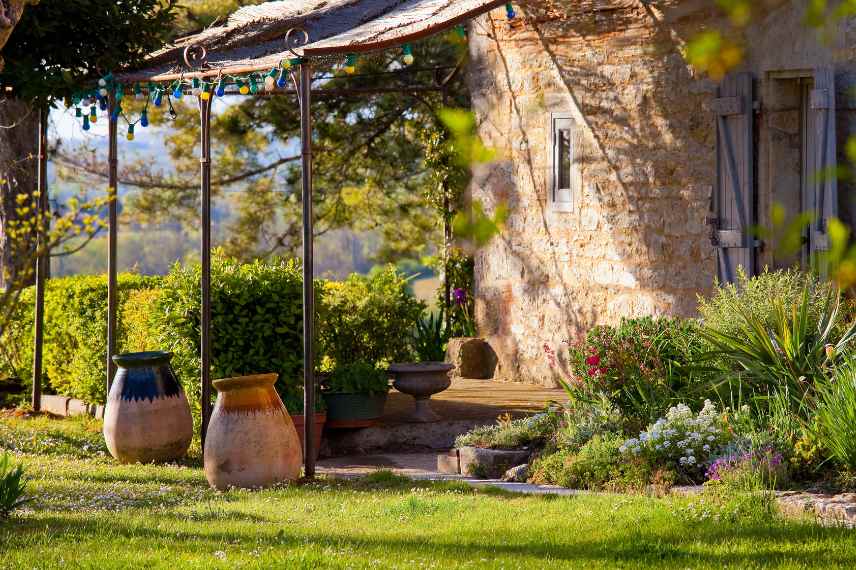
Pretty neutral-coloured pottery, Medici vase, a charming arbour: an evocation of garrigue for this Quercy garden.
→ Discover our orange and honey inspiration for a warm colour palette.
Read also
Must-have garrigue plantsMaintenance, watering and precautions for the garrigue garden
Garrigue gardens are ideally suited to second homes: the evergreen vegetation that forms the planting requires little pruning, and the absence or limited extent of lawn greatly reduces gardening maintenance.
Regarding watering, even though it will eventually be reduced to its strict minimum, or may be completely superfluous, during the establishment period (the first two years) do not neglect watering, given that drought-tolerant plants have been planted. They will manage without you, but give them every chance to become an autonomous garrigue.
What other precautions should be taken into account, especially with regard to good cultural practices:
- The planting period: ideally, you will carry out your autumn plantings so that they benefit from heavier rainfall and establish stronger roots. Planting in spring requires for these plants a much more demanding watering regime.
- Take time to loosen and decompact the soil before planting.
- Subscribe!
- Contents
Comments