





























How to grow caviar lime in a pot?
Easily plant and care for this unique citrus
Contents
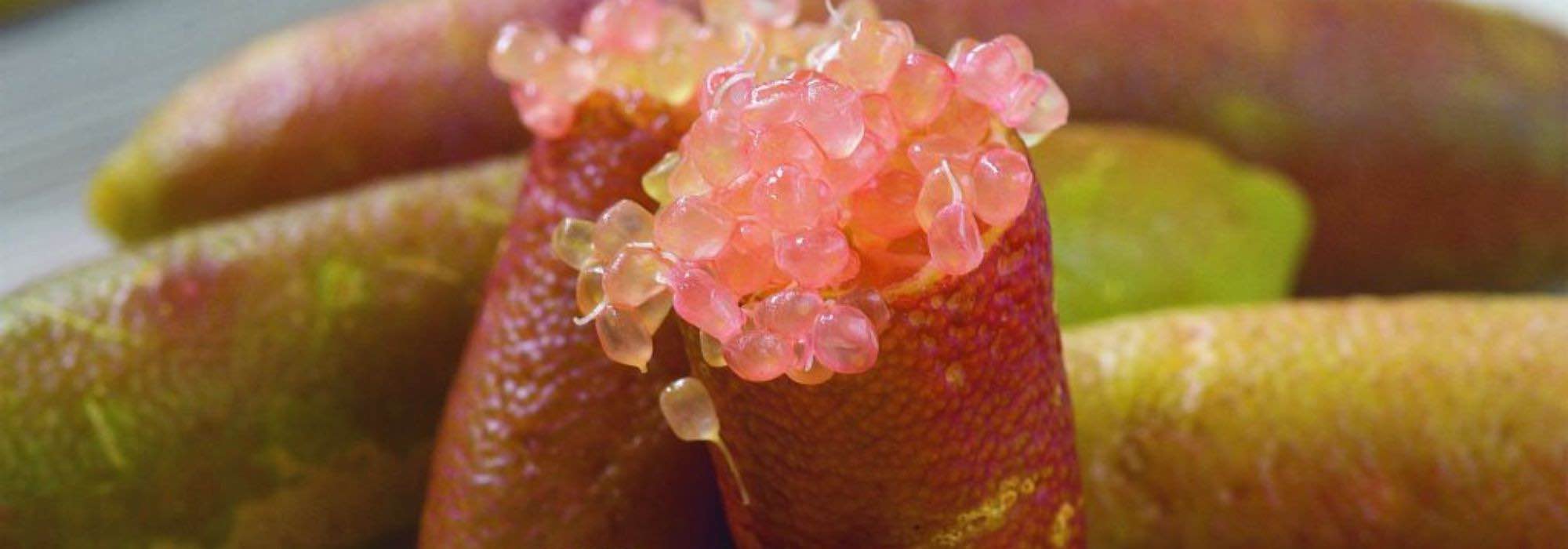
Among citrus trees, the finger lime (Microcitrus australasica) is one of the most astonishing. This bush native to Australia produces elongated fruits containing small tangy, juicy and crunchy pearls. Their appearance is reminiscent of caviar, which is how the bush got its name.
Its evergreen foliage, as well as its delicate scented flowering, are among its other ornamental qualities.
Fairly tender, the finger lime can only be grown in the ground in the mildest regions of our country, which are not subject to severe and regular frosts (> -5°C). This will be the case around the Mediterranean coast, and possibly in some areas of the Atlantic coastline.
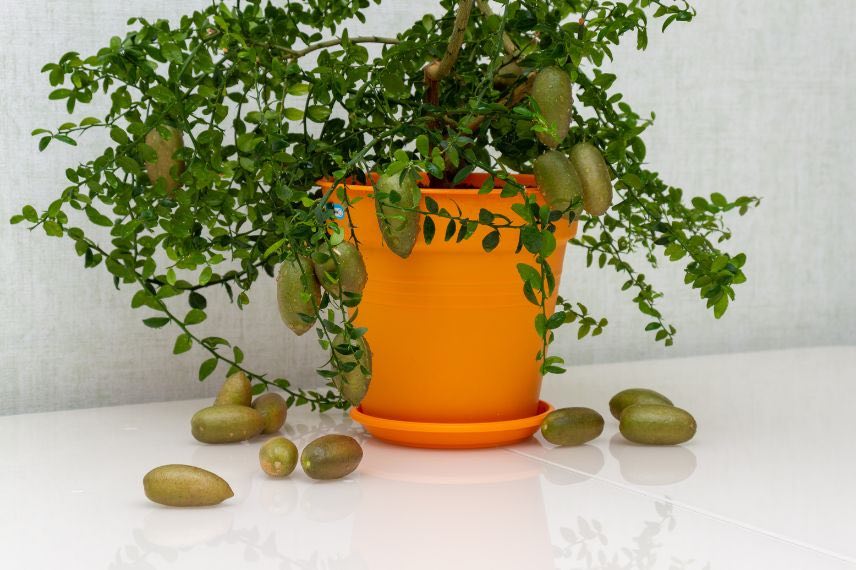
But if you live outside these areas, do not give up the idea of growing it! You can perfectly well pot your finger lime tree so you can bring it indoors for the winter. In addition to the type species, there are a few cultivars, such as ‘Red crystal’, whose fruits contain red pearls, but also the variety with green pearls or that with black pearls.
In terms of size, this finger lime reaches 3 metres in height with a 2-metre spread when planted in the ground, but will be more compact in a container.
Here are our tips for planting your finger lime in a pot, providing the right care and enjoying its surprising fruits.

When should you plant the finger lime in a pot?
For planting your finger lime in a pot, you can theoretically do so all year round, except during frosts or heatwaves. But the most favourable times remain spring or autumn. So plant between March and May or October and November, depending on the region.
Planting a lemon tree in a pot
Container
You can choose from several container shapes to grow your caviar lime, from the classic round pot to an orangery planter.
Only requirement: choose a container with a pierced bottom, so that water never stagnates in the root system and can drain away easily. For the same reason, avoid pots with a water reservoir.
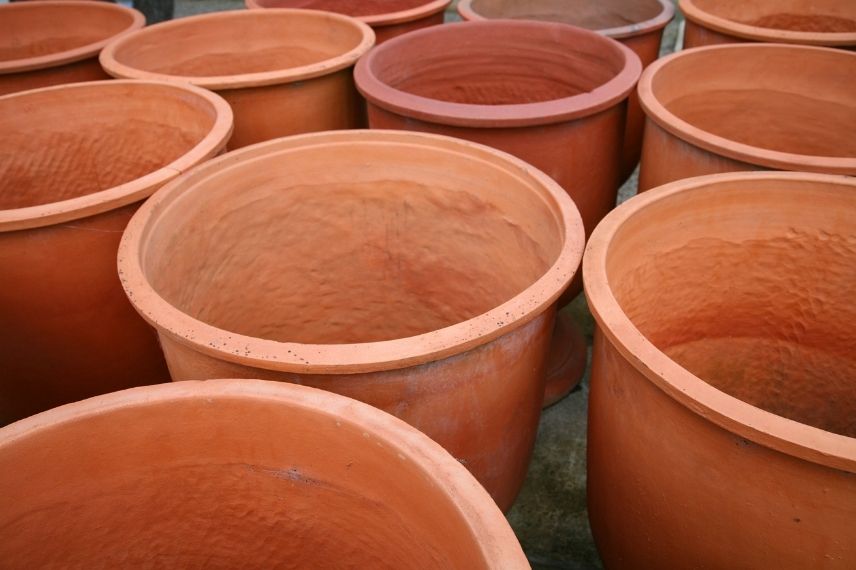
As for material, we often recommend choosing terracotta, a porous material that allows the substrate to breathe better. However, watering will need to be more frequent, since water evaporates more quickly. A wooden container can also be perfectly suitable.
Plan for a pot or planter whose volume is about 2 to 3 times the rootball, that is, the root system surrounded by its adhering soil.
When the specimen becomes heavy, we recommend providing a wheeled stand, which will make it easier to move your potted caviar lime.
Prefer terracotta or wood
Substrate
The caviar lime requires a fairly fertile soil (rich in organic matter), but well drained (allowing water to flow away without stagnating). The substrate should be neutral to acidic, in any case never calcareous.
Opt for a special potting compost for citrus trees, or alternatively a potting compost for Mediterranean plants, which will promote flowering and fruiting.
You can also make a mixture with:
- 2/3 good-quality horticultural potting compost or garden soil that is absolutely non-calcareous;
- 1/3 coarse sand or gravel for drainage;
- 1 to 2 handfuls of well‑rotted household compost.
Planting
- Begin by moistening the rootball by plunging it into a bucket or basin with a shallow layer of water for about fifteen minutes. This rehydrates the root system and makes removing the container easier.
- Line the bottom of the container with a 3 to 5 cm drainage layer (clay balls, gravel, terracotta shards…).
- Add the substrate mixture up to two-thirds of the container.
- Remove the citrus tree from its pot and gently tease out the outer roots with your fingers if necessary.
- Place the rootball in the centre of the container, then fill in with substrate, taking care not to bury the collar of the plant (the junction between the stem and the root system).
- Firm down gently with your fingers.
- Water thoroughly.
- Add an organic mulch at the base of your caviar lime tree (plant husks, RCW…).
- Place a saucer under the container (optional).
Exposure
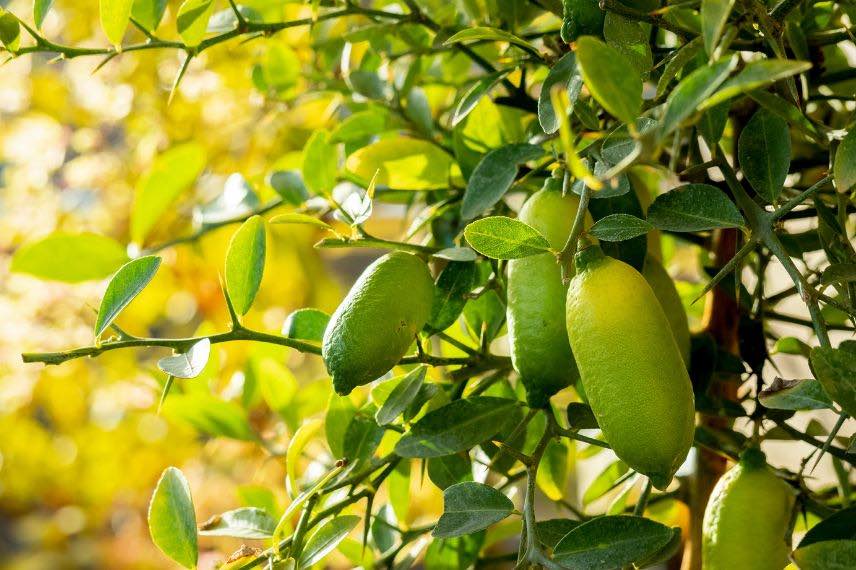
Like other citrus trees, the caviar lime will appreciate a sunny but not scorching position. In the hottest southern regions, prefer a semi‑shaded spot.
Choose a location sheltered from strong winds, which dry out the foliage and can cause very young fruits to fall. Sea spray is also unwelcome.
Your potted caviar lime tree will do wonderfully in the garden, but also on a well‑exposed terrace or balcony.
Place it in full sun, or in partial shade in the south
Caring for a potted finger lime
Growing the finger lime is not difficult: the citrus tree will mainly need water and nutrients to develop and fruit properly.
Watering
Due to its origins (the humid understory and forests of Australia), the finger lime retains a preference for soils that remain moist and environments that are not too dry.
Watering must be regular so that the substrate never dries out completely. Extra care should be taken on this point for two additional reasons:
- the shallow root system of citrus trees prevents them from seeking water deep down;
- the substrate is more limited when grown in a pot, so water evaporates more quickly.
From spring to autumn, water your finger lime tree about once a week. In summer, don’t hesitate to be more generous: as soon as the substrate is dry at the surface, give your citrus tree some water. In case of a heatwave and/or a long period without rain, daily watering may be necessary.
Prefer rainwater, which is less hard than mains water.
If you have placed a saucer under your container, empty it about twenty minutes after watering (or after heavy rain). Stagnant moisture is indeed one of the enemies of citrus trees in pots.
In winter, waterings can be more spaced out, depending on the ambient temperature (approximately every 10 to 15 days).
Adding a mulch (as we recommend when planting) limits evaporation and thus allows you to space out watering.
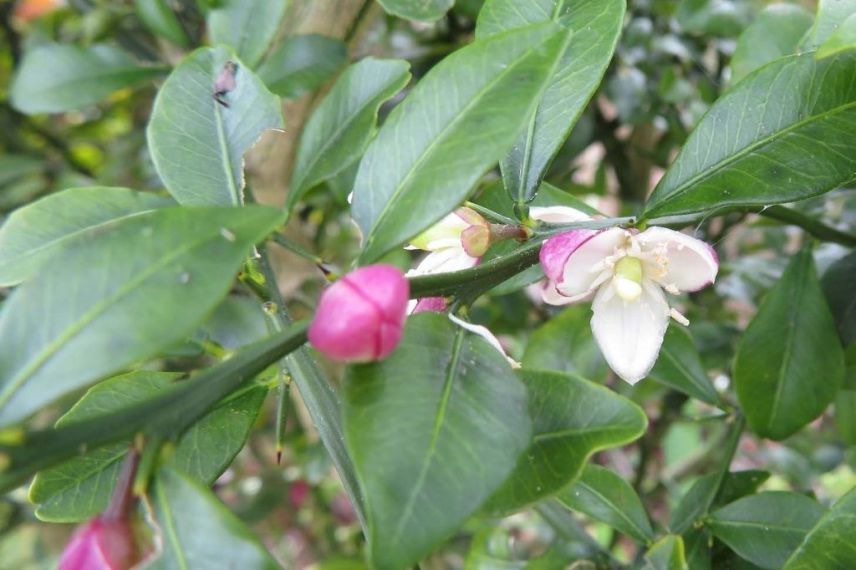
Water your finger lime carefully from spring to autumn, from flowering to harvest
Fertilisation
The finger lime prefers fertile soil rich in organic matter. This is even more true in a pot, since the substrate’s nutrients are used up more quickly.
Regular feeding will help your citrus tree to flower and fruit more abundantly. Choose fertilisers high in potassium, rather than nitrogen (which favours foliage).
From spring to autumn, use a citrus fertiliser.
Liquid fertilisers have a rapid boosting effect; they need to be reapplied more regularly (generally every 15 days). Solid fertilisers have a slow-acting, longer duration (3 to 6 months). Always follow the quantities indicated by the manufacturers for each product.
You can also opt for an organic fertiliser: well-rotted manure, household compost, horn meal, blood meal, fireplace ashes, etc.
Pruning
Prune your finger lime once a year for maintenance, at the end of winter. Carry out pruning before flowering, which occurs between March and April.
Equip yourself with a clean, well-sharpened pruning shear, and gloves (the shoots bear thorns). Remove any dead, damaged or crossing branches. This helps to improve light penetration and air circulation.
Pruning also helps to maintain a harmonious shape by removing overly long or poorly placed branches.
To learn more: Citrus trees: when and how to prune them?.
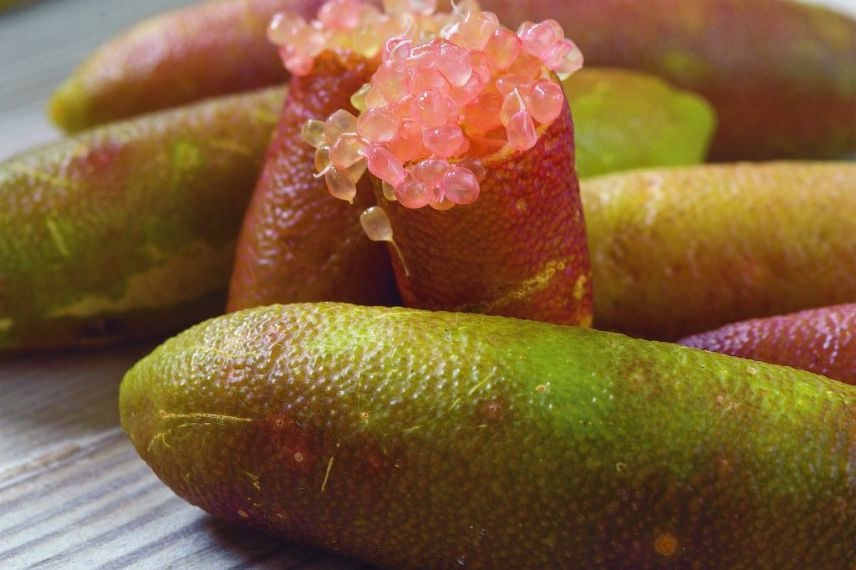
Grow a finger lime to enjoy its rare pulp
Pests and diseases
Growing the finger lime is still uncommon in France, which is why we do not yet have much experience regarding the pests and diseases that may affect it.
However, like most citrus trees, it can be susceptible to aphids and scale insects, especially in dry, confined conditions.
In case of a light infestation, they can be removed by hand. In case of infestation, use a natural insecticidal product based on black soap (one tablespoon diluted in 1 litre of lukewarm water). Spray the affected leaves or shoots in the late afternoon.
Pascale tells you more in Diseases and pests of the finger lime.
Repotting
Repotting should be carried out in spring, roughly every two years, depending on the growth of your citrus tree. If roots start to escape from the bottom of the pot or become visible on the surface, it is a sign that it’s time to repot.
Simply choose a container one size larger.
To learn more: How to choose the ideal pot for repotting a plant?
In other years, we recommend surface topdressing. This action consists of removing the top few centimetres of substrate and replacing them with fresh potting compost (or garden soil). Be gentle during this operation, as the roots of citrus trees are superficial.
Overwintering
The finger lime is among the more tender citrus trees: it does not withstand prolonged or severe frosts. Its hardiness is limited to -3°C, or even -5°C, only for short periods. It will therefore need protection from the cold in winter in most of our regions.
Before the first frosts, take care to put your finger lime in shelter, in a bright but unheated place. With the exception of the calamondin, citrus trees do not tolerate the too-warm temperatures of our heated indoor environments in winter. A conservatory or an unheated greenhouse will be perfect, especially if the atmosphere is not too dry. Ideally, the temperature should average around 10°C.
In spring, once the last risk of frost has passed, you can gradually move your finger lime outdoors. It can remain there until autumn.
To learn more: Overwintering orange trees, lemon trees and other citrus trees.
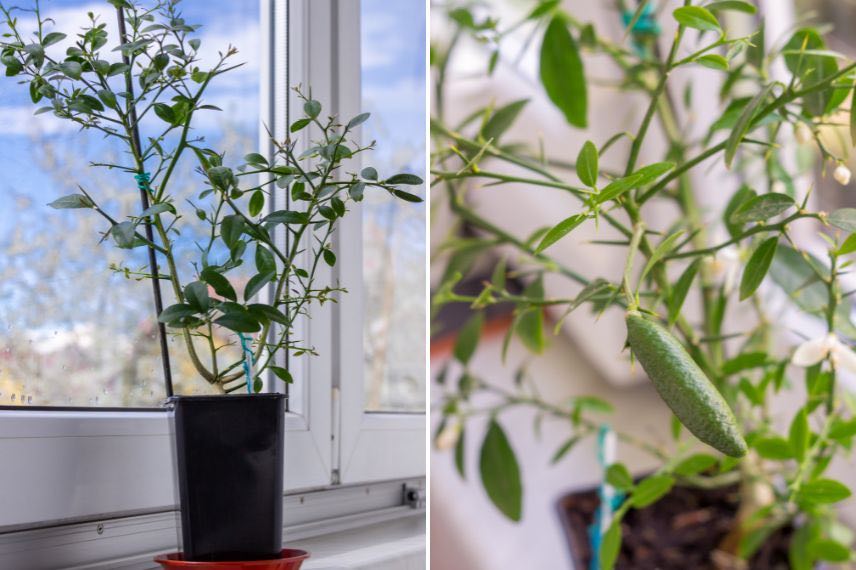
Overwinter the finger lime indoors, in a bright, unheated room
- Subscribe!
- Contents
Comments