





























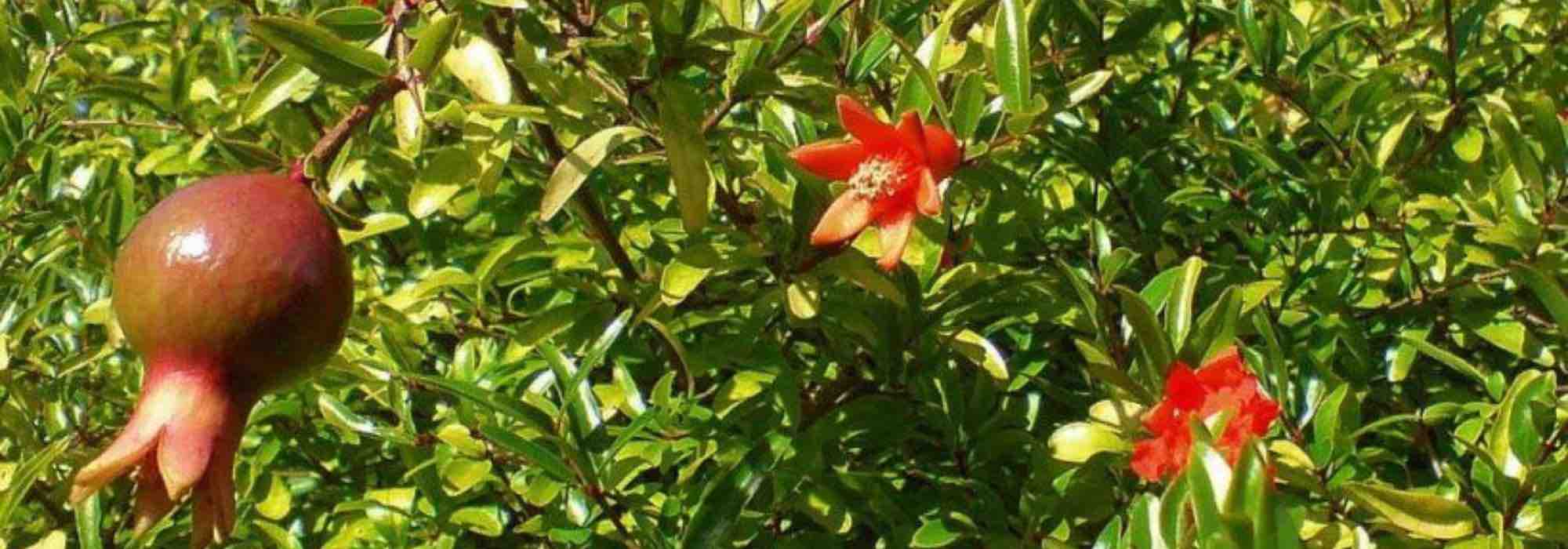
How to grow a pomegranate tree in a pot?
Our tips for successfully planting and maintaining flowering and fruiting Punica granatum
Contents
Pomegranates (Punica granatum) are bushes found in France around the Mediterranean coast, and they are especially known for their sweet and tangy fruits: the pomegranates. However, some varieties with double flowers are cultivated solely for their ornamental value, featuring a long and vibrant summer flowering, enhanced by bright green foliage that turns orange in autumn.
Pomegranates are moderately hardy, tolerating frosts of around -10° to -15°C, provided they are planted in a sheltered position and well-drained soil. However, in regions with harsh winters, they can easily be grown in pots, with careful attention to watering and fertilisation.
Discover our tips for successfully planting and maintaining pomegranates in pots.

Which varieties of pomegranate to choose?
There are two types of pomegranates: flowering pomegranates and fruiting pomegranates.
Fruiting varieties generally reach heights of between 3 to 5 metres, but their slow growth allows them to be grown in pots for several years. There are dwarf varieties, such as Punica granatum ‘Nana’ (1 metre tall with a spread of 80 cm) or ‘Chico’ (70 cm in all directions), perfect for container growing and small spaces. In a large tub or pot, you can also choose ‘Masili’ (3 metres tall with a spread of 2 metres). Note: fruiting requires quite long periods of warmth and is not guaranteed when grown in pots.
For flowering varieties, consider for example:
- the Punica granatum ‘California Sunset’ (3 metres tall with a spread of 2 metres), featuring salmon flowers striped with cream-white;
- ‘Maxima Rubra’ (3.5 metres tall with a spread of 2.5 metres) with beautiful red-orange flowers;
- ‘Noshi Shibari’ (3.5 metres tall with a spread of 2.5 metres), with bright orange flowering.
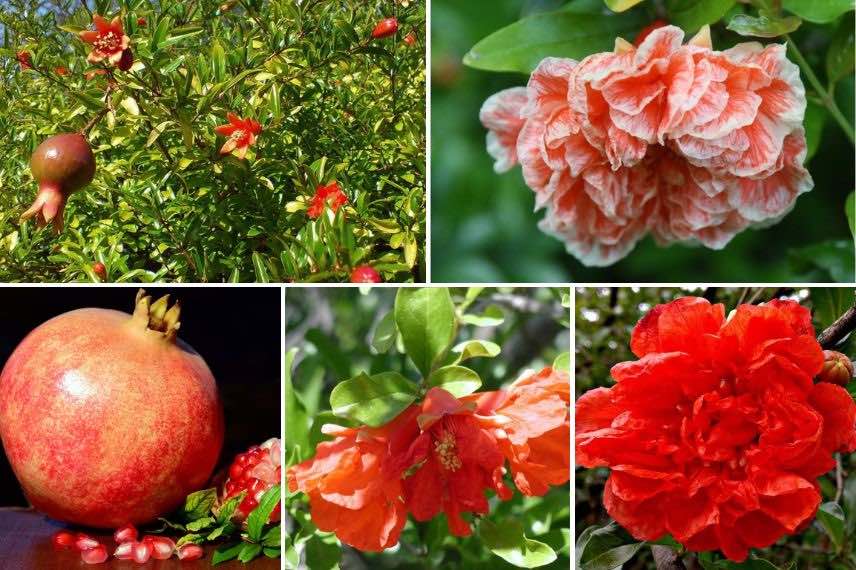
Clockwise, fruiting or flowering varieties: Punica granatum ‘Nana’, ‘California’, ‘Noshi Shibari’, ‘Maxima Rubra’, ‘Masili’
When to plant the pomegranate in a pot?
Pomegranate planting in pots takes place in spring, between March and May depending on the regions.
Autumn planting is also possible in the southern regions of France with mild winters.
Planting Pomegranate in a Pot
The Container
For planting your pomegranate in a pot, choose a container that is at least 50 to 60 cm deep and in diameter. Only dwarf varieties can be grown in smaller pots.
Prefer wooden containers such as troughs or orange boxes, or terracotta containers, which allow the substrate to breathe well. Opt for a model that is definitely perforated to ensure drainage, preventing rainwater or watering from stagnating around the roots. Avoid water-retaining containers, which are not suitable for growing pomegranates.
Feel free to place your container on wheels for easier movement during wintering.
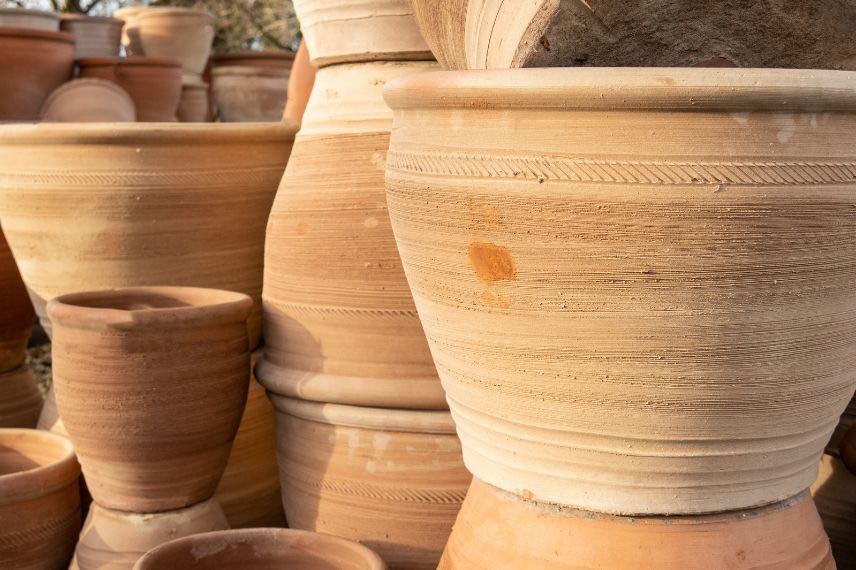
Prefer a terracotta pot or a wooden trough
The Substrate
Pomegranates are not particularly demanding regarding soil type. They tolerate calcareous, poor, and stony soils, even dry or saline, as long as they are not too heavy (clay). For optimal growth, our bushes will prefer a soil rich in organic matter, but well-drained to avoid excess water retention.
For planting your pomegranate, mix:
- 2/3 of good quality horticultural soil, of soil for Mediterranean plants or garden soil if it is not too heavy;
- 1/3 of coarse sand or gravel to promote drainage;
- 1 handful of household compost or well-decomposed manure.
The Planting
- Soak the root ball of your pomegranate in a bucket or basin of water. This helps to rehydrate it and makes it easier to remove from its original container. If you have chosen a pomegranate with bare roots, protect the roots with a pralin (find all our tips in the article “Coating the roots of trees and bushes with pralin”).
- Install a drainage layer at the bottom of the container (clay balls, gravel, or terracotta shards), about 5 cm thick.
- Add the substrate mixture up to 2/3 of the container.
- Remove the root ball from its original container and gently untangle the roots with your fingers if necessary.
- Place the root ball in the centre of the container, then fill in with substrate.
- Firm the substrate around the root ball with your hands and add more substrate if needed, until the roots are no longer visible.
- Water generously.
- Add a mulch at the base of the plant to better retain moisture and limit the growth of adventive plants (“weeds”). Use, for example, RCW, dead leaves, or vegetable husks.
The Exposure
Flowering pomegranates, like common fruiting pomegranates, are eager for warmth and light. Therefore, place them in a sunny location, possibly partially shaded in the hot regions of southern France. Prefer sheltered spots from prevailing winds, such as against a protective wall, which will also have the advantage of reflecting heat.
These bushes make perfect outdoor plants for a terrace or large balcony during the beautiful season.
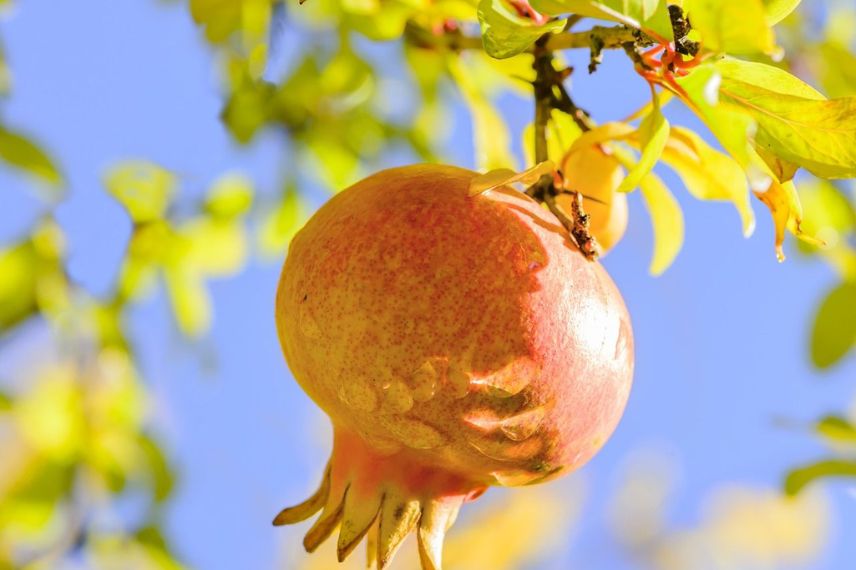
Pomegranates need warmth and light
Pomegranate Tree Care in Pots
Pomegranate is an easy plant to grow, but it will require regular attention regarding watering and fertilisation. In pots, the substrate dries out and depletes more quickly than when grown in the ground.
Watering
Water your pomegranate in a pot as soon as the substrate feels dry to the touch on the top few centimetres. Depending on the weather conditions, watering can therefore be done once to several times a week. Fruit-bearing pomegranates are slightly more demanding in water than flowering ones, preferring cool (slightly moist) soil. More frequent watering will be necessary if you wish to attempt to obtain pomegranates.
You can place a saucer under the container, but remember to empty it after about twenty minutes to avoid standing water.
In autumn, watering will gradually be reduced, before being minimised in winter (wait until the substrate is thoroughly dry between waterings).
Fertilisation
To encourage the growth of your pomegranate in a pot, consider providing fertiliser in spring and summer.
Opt for a fertiliser for fruit trees, a fertiliser for Mediterranean plants, or possibly a fertiliser for window boxes and pots that stimulates flowering. Liquid fertilisers mix with watering for a quick effect; solid fertilisers mix directly into the substrate (granules or sticks) for a longer-lasting action.
You can also add well-decomposed household compost twice a year; gently rake the surface of the substrate to incorporate it. A handful of ash, rich in potash, will also be beneficial in spring.
Pruning
Pruning will help your pomegranate in a pot maintain a harmonious shape:
- remove dried, damaged, or crossing branches;
- shorten branches that are too long or poorly positioned by one-third;
- eliminate any suckers or shoots.
Carry out pruning in spring, using a pruning shear. Always use clean, previously disinfected cutting tools to limit the risk of spreading diseases.
This maintenance pruning is generally not necessary in the first year of development.
Note: flowering occurs on old shoots, so never cut them back entirely.
Pests and Diseases
Pomegranate is a hardy bush. It is mainly the fruits that can be subject to fungal diseases or fall victim to fruit flies or pomegranate moths. However, as we have seen, it will be difficult to get pomegranates to fruit in a pot.
In case of intense attacks of aphids or red spiders, spray a solution of diluted black soap in warm water (1 tablespoon for 1 litre of water) on the affected parts at the end of the day.
Wintering
In most regions of France, the pomegranate will need to be protected during winter. A potted plant is always more sensitive to cold than a plant grown in the ground.
In regions with mild winters, experiencing only short frosts not exceeding -6° to -8°C, it is possible to leave the pomegranate outside. Isolate the container from the ground by placing it on a stand, wrapping it in bubble wrap or newspaper. Add a thick layer of mulch at the base of the plant. You can also protect the aerial parts with fleece in case of forecasted frosts.
In other regions, it should ideally be wintered from October in a conservatory or unheated greenhouse, but frost-free.
Stop fertilising during this period and reduce watering by allowing the substrate to dry thoroughly each time.
Your potted pomegranate can be moved outside in spring, once the last risks of frost have passed.
Repotting
Repotting will occur every 2 to 3 years in spring, depending on the growth of your pomegranate.
In years without repotting, you can carry out a top dressing by removing a portion of the substrate (about 5 cm) and replacing it with fresh potting soil or well-matured compost.
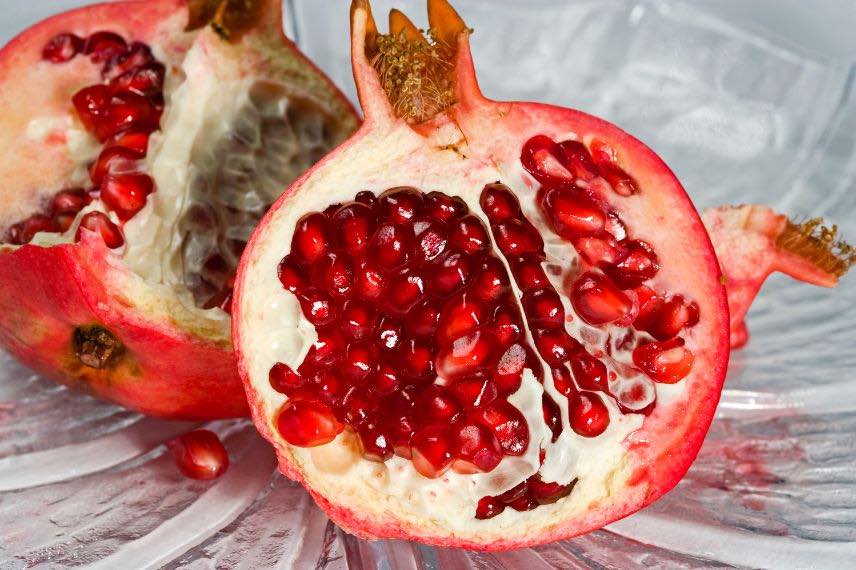
Pomegranates need careful maintenance to produce beautiful fruits
- Subscribe!
- Contents
Comments