





























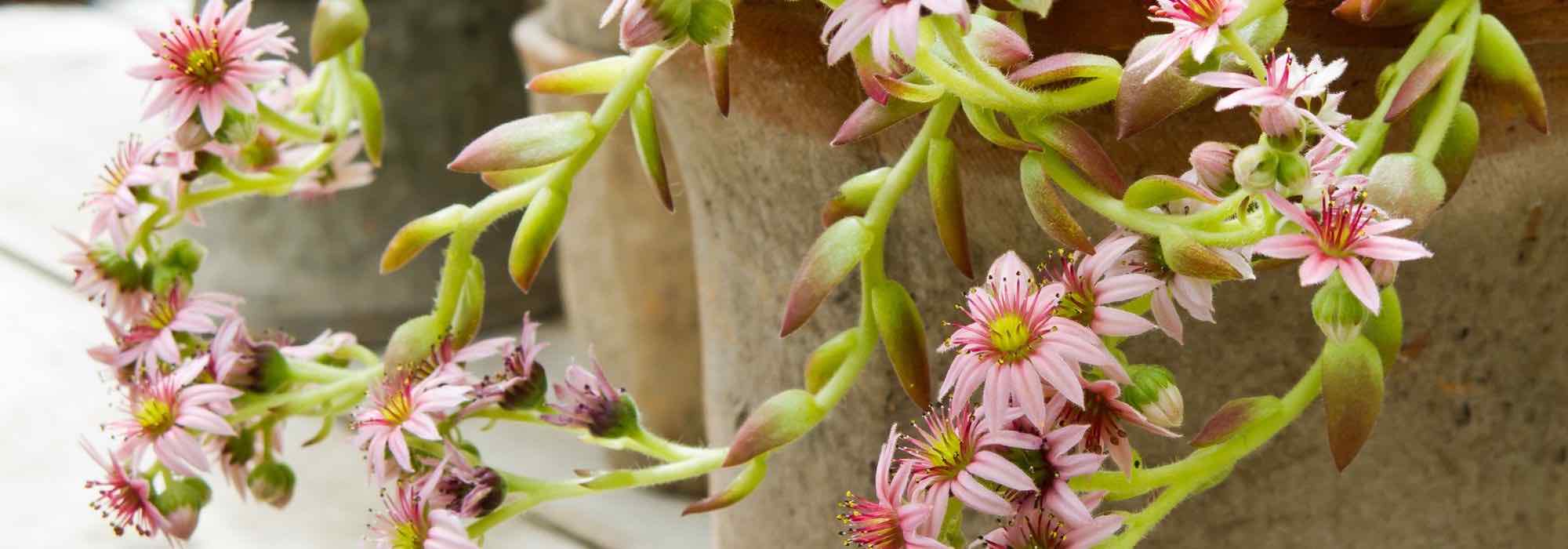
How to grow a Sedum in a pot?
Our tips for successful planting and easy maintenance
Contents
The least one can say is that the Sedum or stonecrops are low-maintenance and very easy to grow. These fleshy or succulent plants from the Crassulaceae family can withstand almost anything: cold and heat, the poorest or chalky soils, drought, wind, and sea spray… Good drainage and sunlight are all they need to thrive.
Sedum are valued for both their ornamental fleshy foliage and their late flowering, which comes in a wide range of colours. There are several hundred varieties, most of which thrive very well in containers. Discover how to successfully plant and care for Sedum in pots.
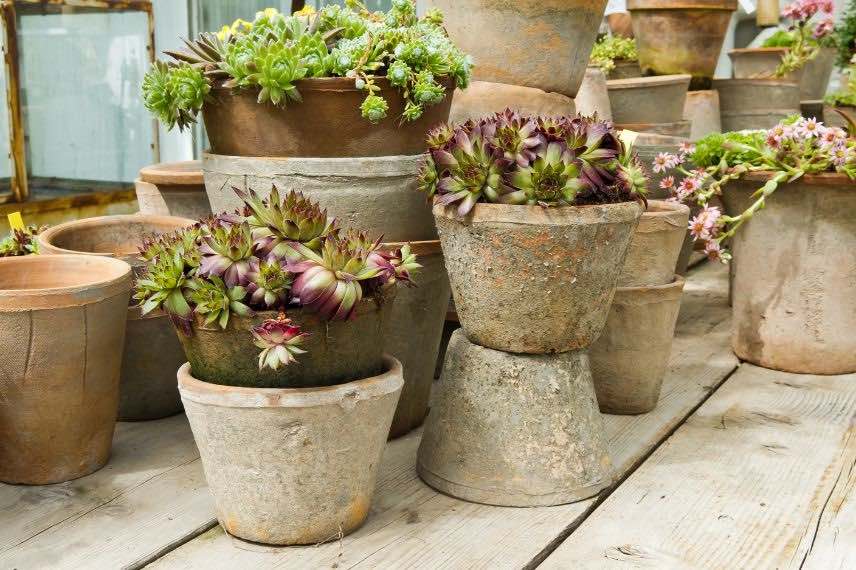
Sedum are perfect for container planting

Which varieties of Sedum to choose?
Most Sedums can be easily grown in pots, thanks to their modest silhouette, rarely exceeding 1 metre in height. The choice of variety will depend on the desired effect and the chosen container.
In a hanging basket, a small pot, or another small container, opt for very low groundcover varieties, such as:
- the Oregon stonecrop (Sedum oreganum), with evolving foliage that changes from green to red and bright yellow flowers (5 cm in height and 45 cm in spread);
- the white stonecrop (Sedum album ‘Murale’), one of the most colourful stonecrops with its reddish-purple leaves in winter and pinkish-white flowers (5 cm in height and 45 cm in spread);
- the creeping stonecrop (Sedum spathulifolium ‘Cape Blanco’), with grey-silver to bronze rosettes and yellow flowers (5 cm in height and 40 cm in spread);
- the Sedum pachyclados, featuring green leaf rosettes highlighted by orange-yellow flowers (5 cm in height and 30 cm in spread);
- the Sedum makinoi ‘Ogon’, very bright with its round, shiny fleshy leaves that change from golden yellow to chartreuse green (5 cm in height and 25 cm in spread).
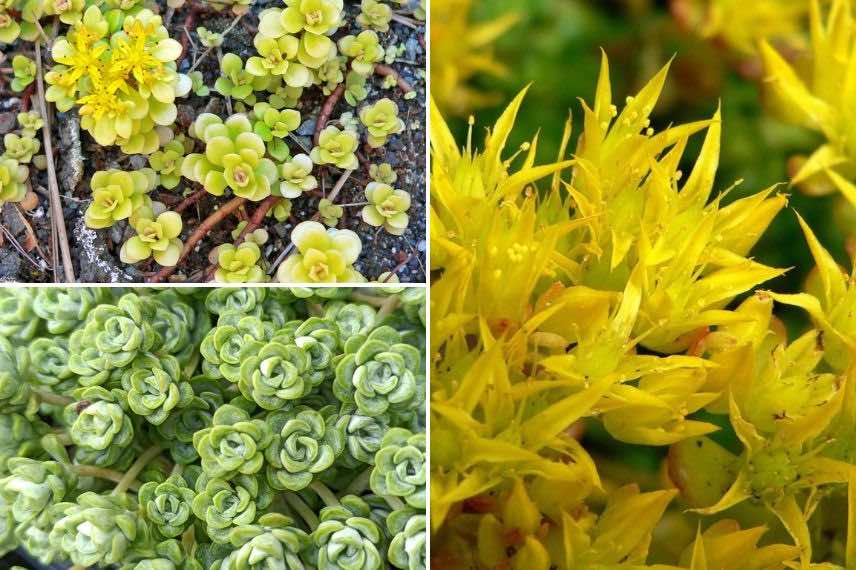
Sedum makinoi ‘Ogon’, Sedum spathulifolium ‘Cape Blanco’ and to the right, the flowers of Sedum oreganum
In a trough or pot, you can also choose larger varieties to add verticality. Among these different Sedums, try for example:
- the Sedum spectabile ‘Septemberglut’, an autumn stonecrop with generous raspberry-pink flowering (50 cm in height and 40 cm in spread);
- ‘Herbstfreude’ (‘Autumn Joy’), for its initially blue-green foliage, then orange-yellow, as well as its burgundy flowers (50 cm in height and 40 cm in spread);
- ‘Matrona’, with purple stems bearing inflorescences of small light pink stars (60 cm in height and 30 cm in spread);
- the surprising ‘Black Night’, with dark purple almost black foliage, adorned with rose-red flowers (50 cm in all directions);
- the bicoloured ‘Strawberry and Cream’, with charming pink and cream flowers turning burgundy (50 cm in height and 40 cm in spread).
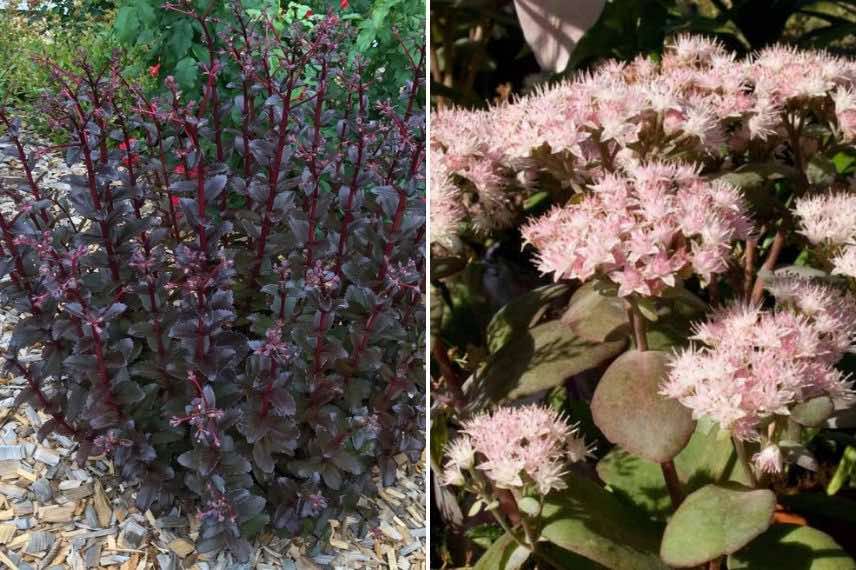
The surprising ‘Black Knight’ and the famous ‘Matrona’
Of course, it is perfectly possible to mix trailing varieties with a lovely cascading habit with upright cultivars to play with heights.
When to plant Sedum in pots?
Pot-grown Sedum should be planted in spring or autumn, outside of frost periods. Depending on the regions, intervene between March and May or between September and November.
Planting Sedum in Pots
The Container
Due to their diverse shapes, Sedum can be grown in many containers: pots, window boxes, troughs, saucers, hanging baskets, and planters, etc.
The only requirement is that the bottom of the container must be pierced to allow rainwater or watering to drain away without stagnating.
The size of the container should be suited to the dimensions of the chosen variety. If you plan to grow several Sedum together, maintain a distance of 30 to 50 cm between each.
There’s no need to choose overly deep containers, as Sedum has a rather shallow root system.
The Substrate
Sedum has only one requirement regarding their substrate: it must be perfectly drained to prevent water retention and stagnation.
These succulents adapt to the most challenging soils: stony, dry, poor, even calcareous. Conversely, overly rich soils can make Sedum more fragile.
In pots, provide them with a light substrate, consisting of a mixture of equal parts horticultural compost and coarse sand or gravel. You can also find ready-made compost in garden centres, specially formulated for cacti and succulents.
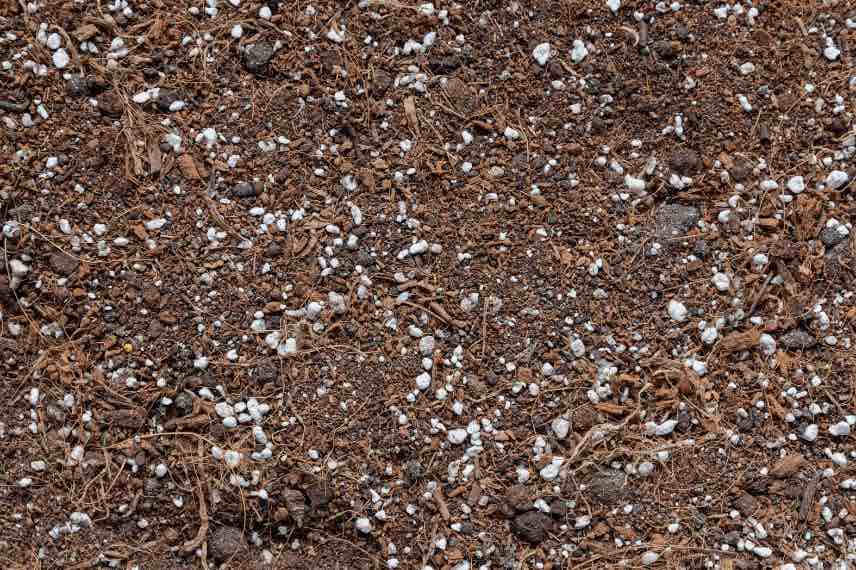
The more fibrous and mixed with materials like sand, perlite, vermiculite, or gravel a substrate is, the more draining it becomes
Planting
- Soak the root ball of your Sedum in a bucket or basin of water to rehydrate it.
- Install a good drainage layer about 3 to 5 cm high, depending on the height of the container. For this, use clay balls, gravel, or broken terracotta.
- Add substrate up to 2/3 of the container.
- Place your Sedum in the container and top up with substrate.
- Firm the substrate around the root ball with your fingers.
- Water.
- Apply a mineral mulch at the base of the plant (optional).
Exposure
Sedum enjoys warmth and sunlight. Place them in the garden, on the terrace, or on the balcony in a bright, even warm, location.
They will thrive anywhere, even in mountainous regions or by the sea, thanks to their tolerance to wind, cold, drought, and sea spray.
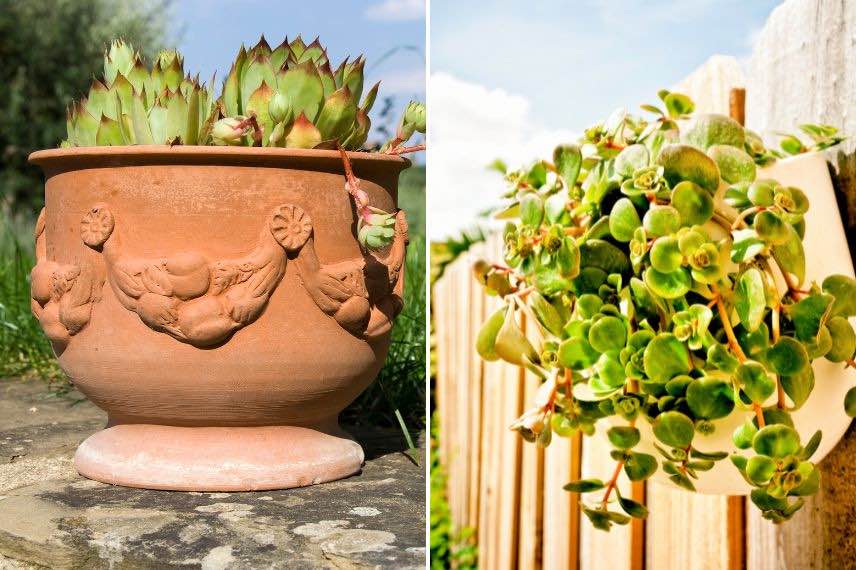
Two Sedum in two very different styles of pots, but always in full sun
Read also
Sedum or orpin: which variety to choose?Caring for Potted Sedum
Watering
Sedum are succulents, capable of storing juice in their foliage to withstand long periods of drought.
Rainwater is naturally sufficient to meet the water needs of Sedum. If your pot is not exposed, water moderately only when the substrate is thoroughly dry. Generally, watering every 15 days is sufficient, except during heatwaves.
Do not place a saucer under your containers, or if you do, be sure to empty it after about twenty minutes following watering or heavy rain.
In winter, watering should be reduced to a minimum (about once a month).
Fertilisation
Sedum thrive without issue in poor soils, containing few nutrients. In pots, you may optionally apply fertiliser for succulents during the growing season, but this is not essential.
Pruning
Pruning Sedum is straightforward. Using previously disinfected pruning shears, remove faded flower spikes and dried stems. For low varieties, cut back the dried clumps to ground level.
Act at the end of winter or the beginning of spring. The dried parts remain as protection against frost during the cold season.
Pests and Diseases
Sedum are not very susceptible to pests and diseases. Just keep an eye out for attacks from snails, slugs, or caterpillars, which enjoy feasting on the young foliage in spring.
Wintering
Sedum are hardy plants, tolerating temperatures down to -15°C, and even -20°C in some varieties. They can therefore spend the winter outdoors in most regions.
It is primarily waterlogged soils that can be detrimental to them during the cold season, risking root rot. Therefore, protect your potted Sedum from rainy exposures.
Repotting
Sedum can remain in their original pot for several years (about 3 to 4 years). If you need to repot or divide the clumps, do so in spring.
- Subscribe!
- Contents
Comments