





























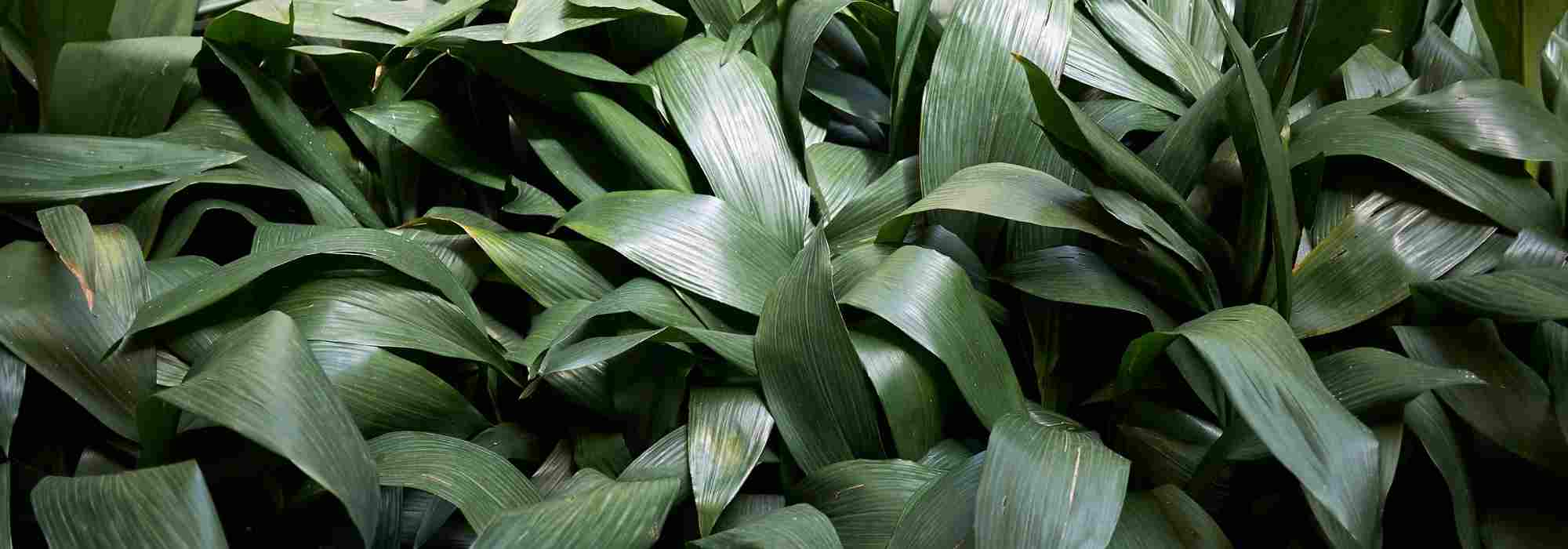
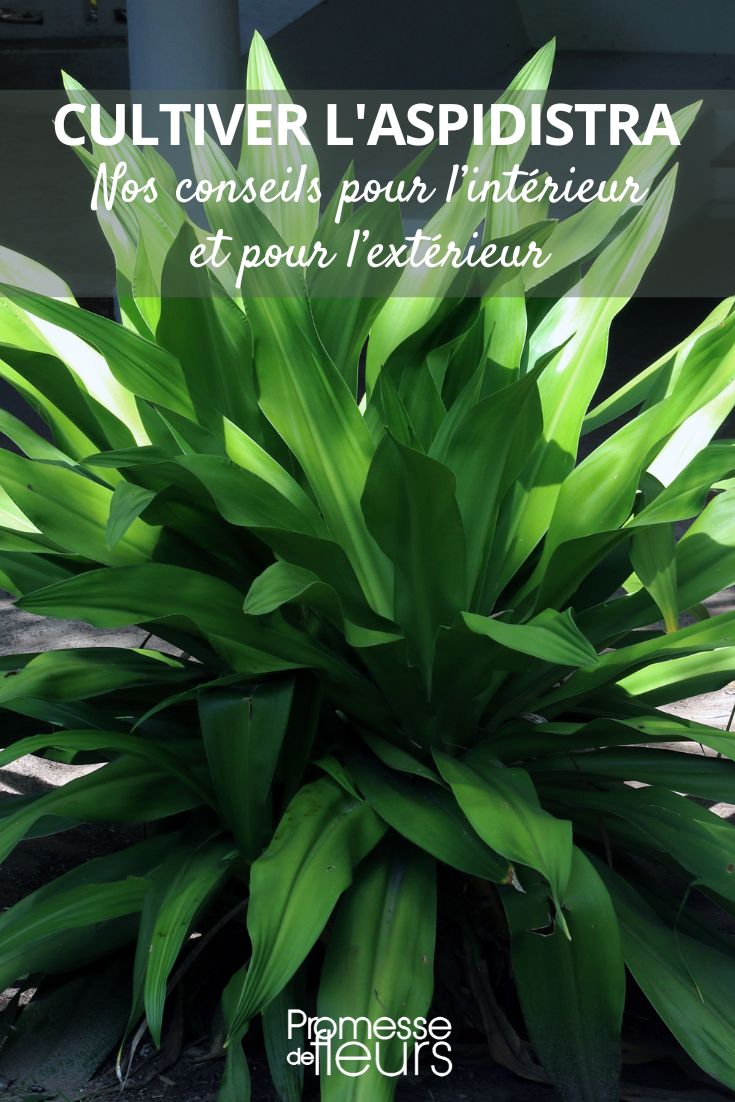
Growing Aspidistra indoors and in the garden
Growing and care tips for the iron cast plant
Contents
Do you love houseplants but struggle to keep one alive? Do you often forget to water your indoor plants? Is your flat rather dim? Aspidistra elatior, also known as the cast-iron plant, or more commonly ‘mother-in-law’s tongue’, is certainly the plant you need if you’ve failed with all the others. With exceptional resilience, tolerating missed waterings, dry indoor air, and confined spaces, the Aspidistra is regarded as an indestructible houseplant for interiors.
But did you know that this plant, a staple of grandmothers’ interiors, also makes a charming evergreen perennial garden plant with dark green or variegated foliage for shaded areas? And again, it requires very little care.
Discover all our tips for growing and caring for the Aspidistra as a houseplant or ornamental garden plant.
For more information, also read: Aspidistra: growing and care.

Planting Aspidistra in a pot as an indoor plant.
Grandmother’s plant par excellence (in the best sense of the term), the Aspidistra eliator is a hardy plant! It resists everything, adapts to anything (except waterlogged substrates), and thrives anywhere. With stiff, glossy, very long leaves that can reach 50 cm in length, this perennial plant in the Asparagaceae family, of Chinese or Japanese origin, makes an ideal houseplant for beginners or the absent-minded. It’s even said that where you have failed with all the other green plants, this one will endure. Provided, of course, you offer it optimal cultural conditions. Even so, the Aspidistra is hardly demanding and, above all, very resilient!
What kind of pot to choose?
The Aspidistra has an upright, broad and supple habit that forms a handsome tuft of lanceolate leaves. It has a rootstock rather thick. That is why you should not give it a pot too large, but rather a pot in which you will have the impression that it is snug. Indeed, a pot that is too large would be detrimental for the Aspidistra which absolutely cannot tolerate a substrate that is too damp. By contrast, repotting should be done every two years. The pot will, of course, have drainage holes.
Choosing the pot material is up to you, but bear in mind that terracotta is always preferable for green plants. More porous and breathable, terracotta promotes drainage and aeration of the substrate. As for plastic, it is ideal for plants that prefer more humid environments. This is not the case with the Aspidistra, whose thick rootstock dislikes stagnant moisture.
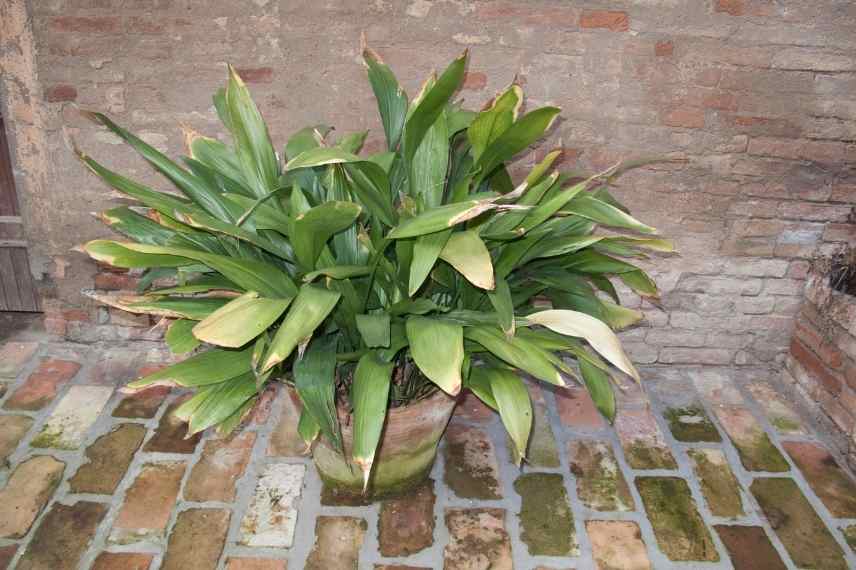
Aspidistra is an easy houseplant to grow in pots
Which substrate?
Fairly easy to care for, Aspidistra, however, does require a permeable and well-draining soil mix to prevent rootstock rot. It can therefore content itself with a simple potting mix for houseplants. But a mix of ordinary garden soil, fairly rich, with potting mix and sand, in equal parts, will suit it well. It is also feasible to add perlite or vermiculite to ensure drainage.
How to plant the Aspidistra?
- Place a layer of clay balls or gravel at the bottom of the pot to ensure drainage.
- Fill half the pot with the soil mix.
- Remove the Aspidistra clump from its pot and place it gently on the substrate. The collar should be level with the surface of the substrate.
- Top up with the remaining soil mix and gently firm with your fingers to remove air pockets.
- Water thoroughly.
→ For more information, also read our article: “Aspidistra indoors: seasonal care guide“.
Read also
The easiest indoor plants to growPlanting Aspidistra in the ground
Aspidistra has long been grown solely as an indoor plant, and it still enjoys great success in homes. However, its relative frost resistance allows it to be planted outdoors, in the ground. Aspidistra indeed shows a hardiness of around -12 to -15 °C under optimum growing conditions. Thus, the type species Aspidistra eliator tolerates frosts down to -15 °C, whereas the hybrids, ‘Zebra‘ with dark green foliage striped with yellow, or ‘Milky Way’ with leaves green prettily speckled with white, prove hardy to -12 °C.
In winter, in regions with harsh winters, this rhizomatous perennial will lose its foliage, but come spring it will regrow from the rhizome stock. Especially if you give it a good mulch. Otherwise, the foliage persists.
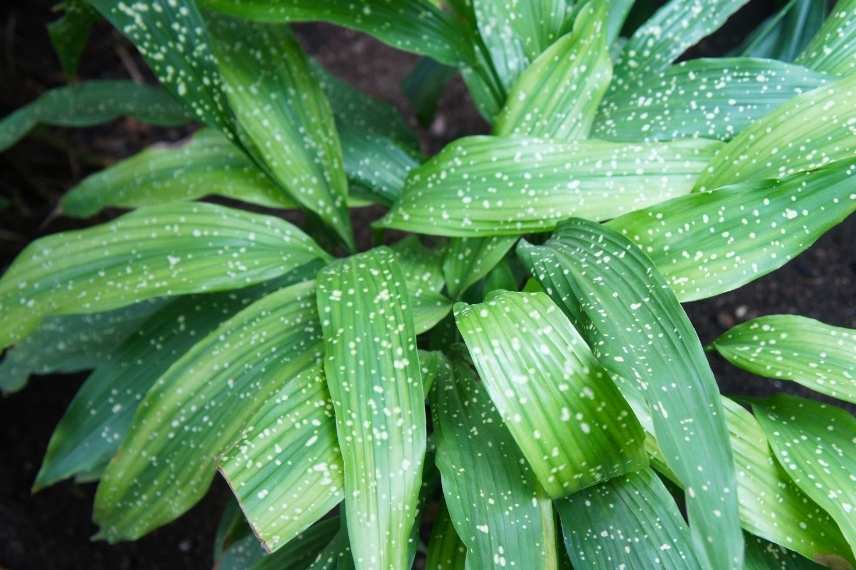
Aspidistra ‘Milky Way’
Outdoor planting is even one of the few chances to see the Aspidistra flower. And this flowering is one of the most distinctive. The purple, thick and waxy-looking flowers appear at the base of the foliage, at ground level. Slightly scented and nectariferous, they attract insects, but also slugs and snails. This flowering takes place from March to June.
In the ground, Aspidistra needs fertile, humus-bearing soil, well-drained and fairly light, tending towards acidity. Calcareous soils are poorly tolerated by Aspidistra. But it can cope with an ordinary garden soil, to which an addition of heath soil can be added, and, if the soil is clayey, perhaps some sand.
As it prefers semi-shaded to shaded areas, woodland soils suit it perfectly.
Where to plant Aspidistra?
At home, a potted Aspidistra tolerates the darkest rooms, with little natural light (not completely dark!). You can therefore place it in a room with low light, in a hallway, an entrance hall or a stairwell, or an office… For its part, despite its tolerance for reduced light, the Aspidistra will show faster growth with good diffuse light. However, it must never be exposed to direct sunlight, which would be fatal to it, scorching and discolouring its foliage.
Thus, placed in a cool conservatory, it will feel perfectly at home. Moreover, in winter the temperatures there are not too high. Winter temperatures around 10°C are very favourable. And temperatures above 20°C are not to its liking.
And, as soon as spring arrives, your potted Aspidistra can take its summer quarters outside, in the garden, or on the terrace or balcony. One condition: the pot must be placed in bright shade, for example under the leafy canopies of tall trees, and sheltered from winds. Never direct sun which could scorch the foliage, especially on balconies or terraces!
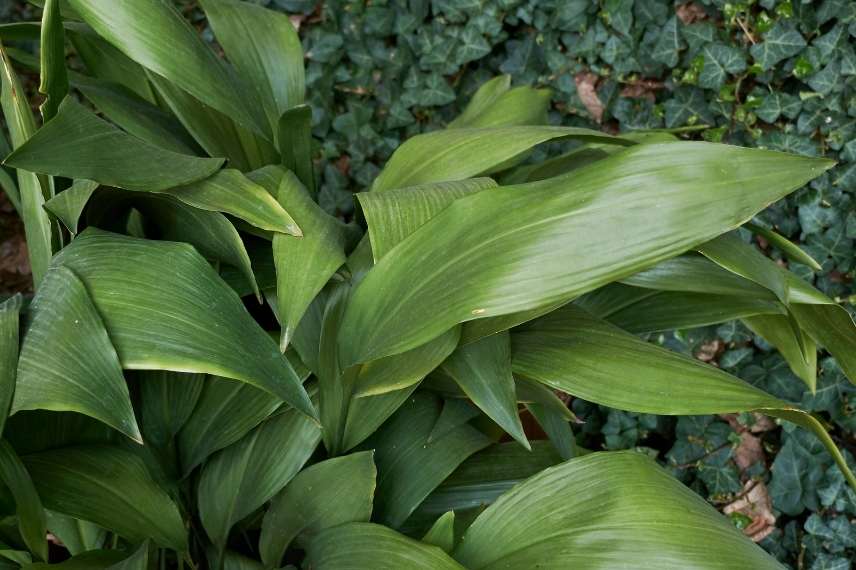
Hardy down to -12°C, Aspidistra adapts to in-ground planting
As for Aspidistras planted in the ground, they should enjoy a position from partial shade to shade. Nothing more beautiful than this tuft of soft, compact and dense foliage in a woodland border, at the foot of trees or shrubs! However, it absolutely needs a position sheltered from winds and draughts to overwinter in proper conditions.
Read also
Perennials for dry shadeHow to care for Aspidistra?
Although considered hardy, Aspidistra still needs a few care steps to thrive. Admittedly, it can tolerate occasional delays in watering or a lack of repotting… But it requires some attention.
Watering
It is necessary to water Aspidistra in a pot regularly, but with moderation, so as not to soak the rootball. Thus, watering twice a week in spring and summer is sufficient. In winter, it drops to two waterings per month. The essential thing is to remove residual water from saucers or cachepots, which risk rotting the rootstock.
If you miss a watering, don’t panic; Aspidistra can cope. The potting mix will shrink and growth will stop. At the next watering, everything restarts.
It’s best to water with rainwater, due to the plant’s low tolerance to lime.
In-ground, Aspidistra also needs regular watering, especially during periods of hot summer weather or drought. A watering once a week may be necessary in this case. Once well established, it can go without water and cope with the weather.
Winter protection
A good layer of dead leaves will help protect the rootstock from winter cold.
Fertilising
A supply of special indoor plant liquid fertiliser is recommended twice a month, from March to October.
Cleaning
Dusting indoor foliage is done regularly with a sponge simply dampened with water, without any leaf-shine products. Take the opportunity to remove dry or yellowing leaves.
Repotting and dividing the clump
Repotting takes place every two years, in a slightly larger pot, in spring. You can take advantage of this repotting to divide the clump into two or three pieces. Simply separate the rootstock into several pieces, replant immediately and water. Do not hesitate to offer rootstock segments to friends, even to the least attentive among gardeners.
Pruning
Pruning the foliage is unnecessary.
Diseases and parasitic pests to monitor
Indoors, the foliage of the Aspidistra can be infested by mealybugs. Sometimes it is enough to adjust drainage, watering or light. To get rid of them and prevent their appearance, I invite you to read Virginie D.’s article: Mealybug: Identification and Treatment.
Red spider mites also thrive when conditions are very dry and hot. François explains everything: Red Spider Mite: Identification and Treatment.
In the garden, it’s mainly slugs and snails that you need to fear. Ingrid brings you 7 Ways to Fight Slugs Effectively and Naturally.
- Subscribe!
- Contents
Comments