





























Growing Beaucarnea, the Elephant's Foot
Our tips and tricks for a plant grown in a pot indoors or outdoors
Contents
Beaucarnea recurvata, sometimes called Nolina recurvata, or more commonly the elephant’s foot or bottle tree, is a tree that stands out for its originality. Originating from Mexico, this small tree, grown as a houseplant in our latitudes (or in the ground on the Côte d’Azur), offers a distinctive form with its swollen and twisted trunk, bearing long trailing leaves. Very slow-growing, this pachycaul species is also highly attractive due to its cracked bark that resembles elephant skin.
Beaucarnea with its unusual shapes and very slow growth proves fairly easy to cultivate as a houseplant, or even outdoors in regions where temperatures never dip below -5°C.
Discover all our tips on planting, growing and care for this Beaucarnea recurvata, better known as the elephant’s foot.

Beaucarnea recurvata, an astonishing plant of great originality
In its native habitat, Central America and the southern United States, the Beaucarnea recurvata, also marketed under the name Nolina recurvata, reaches the size of a tree, between 10 and 15 m in height. Obviously, in our latitudes, and grown in a pot, this caudiciform plant remains considerably more modest in size, around 1 to 1.5 m tall. A height that the elephant’s foot will reach after many years, as growth is very slow.
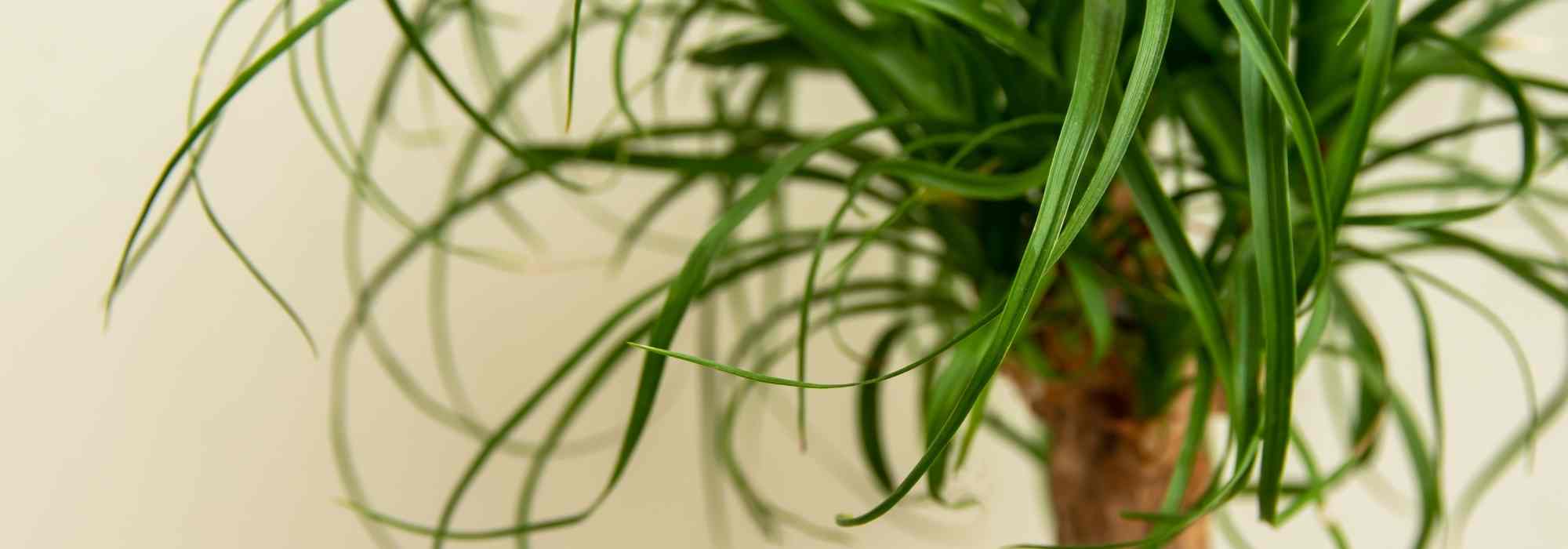
Beaucarnea recurvata grows naturally in rocky, arid and dry landscapes, which makes it a xerophytic tree that stores water in the base of its trunk. A trunk that takes the form of a large bottle at the base, or a bottle-shaped swelling. As it develops, the trunk swells and its grey bark cracks. This trunk is topped by a tuft of evergreen, hardy, glossy foliage, dark green. The narrow leaves are strap-shaped and slender, barely 2 cm wide, and cascade downwards. These fine leaves often tend to twist. The foliage of Beaucarnea recurvata therefore presents a striking weeping habit.
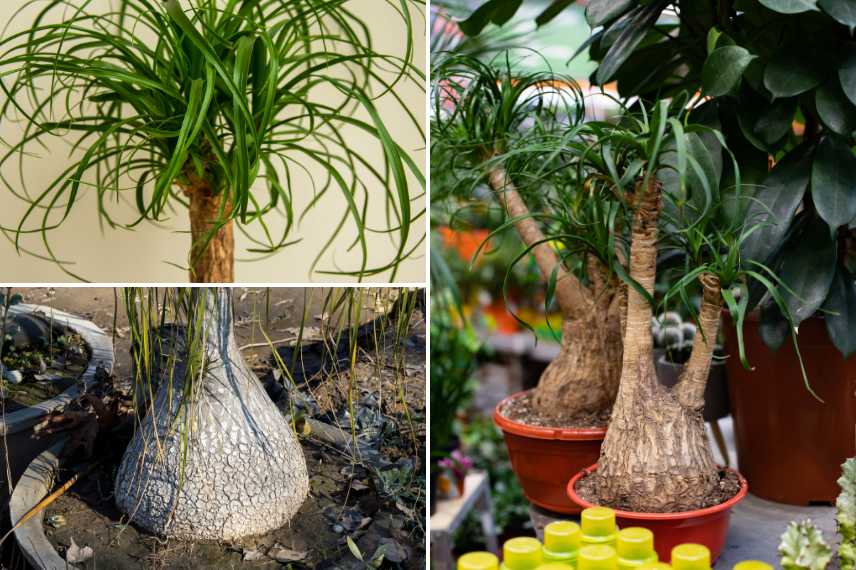
Beaucarnea recurvata is a pachycaul plant
Cultivated in the ground, older elephant’s-foot plants can bloom. This flowering occurs in summer, from June to September depending on the climate, and takes the form of long, airy panicles consisting of small cream-white flowers. These flowers give rise to pink fruits containing 1 to 3 seeds.
By origin, this pachycaul species (with a swollen stem) is very frost-sensitive. Young plants are damaged at temperatures from -2 to -3 °C; older plants can withstand -5 °C, provided they are grown in shelter and in well-drained soil. This tree is therefore grown as an indoor plant, or outdoors in open ground only on the Côte d’Azur.
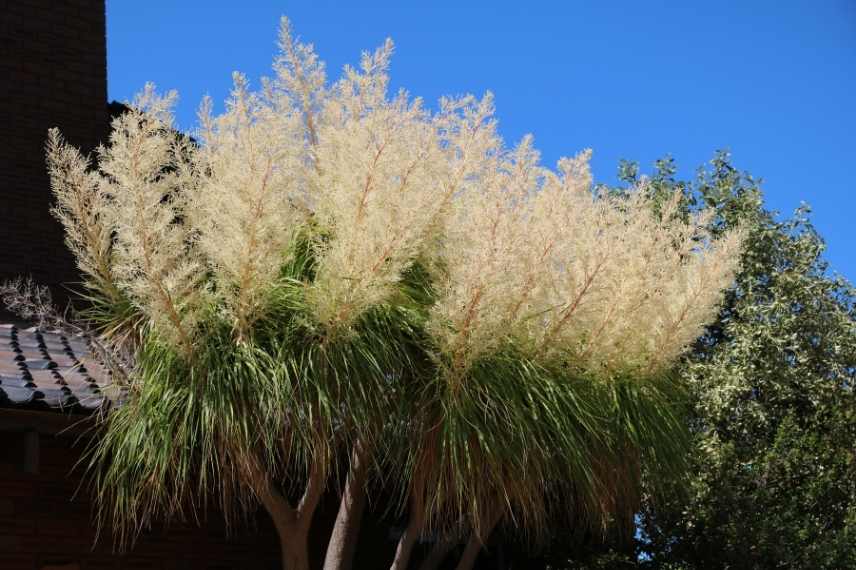
Older Beaucarnea recurvata plants can flower
Read also
The easiest indoor plants to growGrowing Beaucarnea as an indoor plant
If you’re not fortunate enough to live on the Côte d’Azur, you can still enjoy the distinctive character of this bottle plant with a swollen and slightly twisted trunk. This plant with curved foliage adapts very well to pot cultivation. It will grow there steadily, but fairly slowly. With a deliberately exotic look, this plant fits perfectly in our homes.
What pot should you offer it?
This Beaucarnea recurvata is grown almost like a bonsai, in very little soil. That is why you should offer it a relatively wide pot, but with shallow depth. Beaucarnea prefers to have its root system confined and its base snug.
In terms of material, terracotta pots are always preferable, as they guarantee good aeration of the substrate and optimum drainage. By contrast, plastic pots are not at all recommended for this bottle tree, which fears stagnant moisture above all. Plastic is more suitable for plants that tolerate at least a little moisture.
Which substrate?
Beaucarnea recurvata needs a light, well-drained substrate, neutral or slightly acidic. That is why the substrate will consist of equal parts houseplant potting compost or cactus potting mix and heather soil. Thus, this mix will ensure perfect drainage while remaining light. As for the heather soil, it provides the acidity.
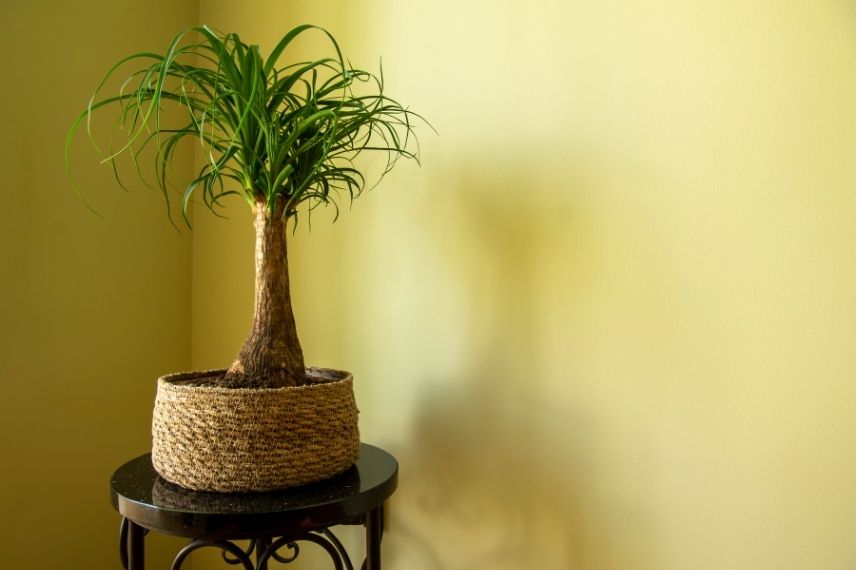
Over time, slowly, the trunk thickens and swells
How to plant it?
- Place a layer of clay pebbles or gravel at the bottom of the pot
- Fill the pot halfway with the potting mix
- Position the Beaucarnea, taking care not to damage the root system
- Top up with the remaining potting mix
- Gently press with the fingertips to remove air pockets
- Water generously, ensuring water does not stagnate in the saucer or cachepot
Outdoor planting of the elephant's foot plant
In the warmest areas of our territory, where frost is rare, the elephant’s foot palm can be planted in the ground. However, it can only be planted in the ground if the soil is perfectly drained. Indeed, winter moisture would be fatal to it, as would excess rainfall. That is why the Beaucarnea recurvata cannot be planted in the garden except on the Côte d’Azur, possibly on the Mediterranean fringe, or in the extreme south-west.
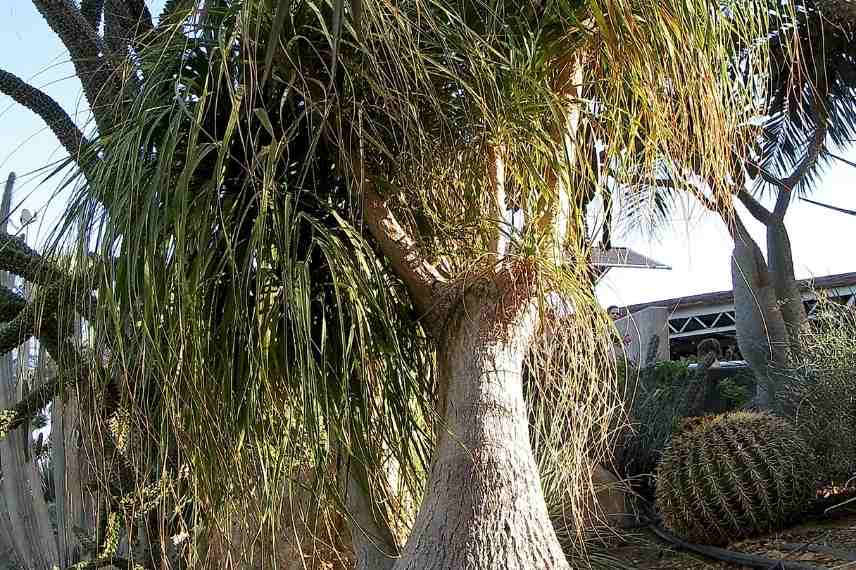
The elephant’s foot is planted in the ground in the gardens of the Côte d’Azur
In terms of soil, the elephant’s foot will have the same needs as when grown in a pot. It will require a light, well-drained soil, neutral to slightly acidic. Therefore, once the planting hole has been dug, twice as wide as the root ball, a good layer of coarse sand or gravel should be added to ensure drainage. Garden soil will be mixed in equal parts with heath soil. Planting on a mound or slope can be considered, as it provides excellent drainage.
Planting in the ground will take place in spring, to allow the bottle tree to establish itself before winter.
Read also
Perfect indoor plants to give as giftsWhere to place Beaucarnea?
To ensure optimum growth of the Beaucarnea recurvata, it absolutely needs as much light as possible. So, in indoor cultivation, it should receive plenty of light. Thus, like a succulent plant, full sun does not bother it at all. In summer, it should be placed in a room bathed in light or, better still, in a garden, on a balcony or terrace. In winter, it also needs a very bright and airy location. However, it is preferable to avoid positioning it behind a south-facing window, exposed to the very intense rays of direct sun.
If you wish to place your Beaucarnea grown in a pot outdoors during the warmer months, it is essential that it be protected from the weather. On the other hand, it can easily be placed outdoors from spring to early autumn, provided you monitor night-time temperatures, which must not fall below 5°C. In winter, placing it in a conservatory will allow it to receive sufficient light, but the thermometer should read around 10°C. This temperature will enable it to enter an essential period of vegetative rest.
To ensure your plant grows evenly, regularly turning the pot is essential.
Planted in the ground, the Beaucarnea thrives in full sun, sheltered from cold winds such as the mistral.
Care
If cultural conditions are met, the Beaucarnea is not particularly demanding when it comes to care and maintenance. In fact, success hinges on three keywords: light, warmth and moderate watering.
Watering
When it comes to watering, with the elephant’s foot, moderation is key. Indeed, remember that this plant naturally grows in arid regions of Central America and is drought-tolerant. So the substrate should dry out between two waterings in spring and summer. In winter, watering should be reduced to once a month.
It is preferable to provide your bottle plant with soft water, ideally rainwater. Likewise, it is essential to remove residual water from the saucer or cachepot a few minutes after watering.
In the ground, Beaucarnea relies on rainfall. Watering is therefore unnecessary, except in the weeks following planting.
Fertilisation
Container-grown Beaucarnea will appreciate a dose of special indoor plant fertiliser in spring and autumn.
→ For more, also read our article: “Beaucarnea or Elephant’s Foot: caring for this indoor plant through the seasons.”
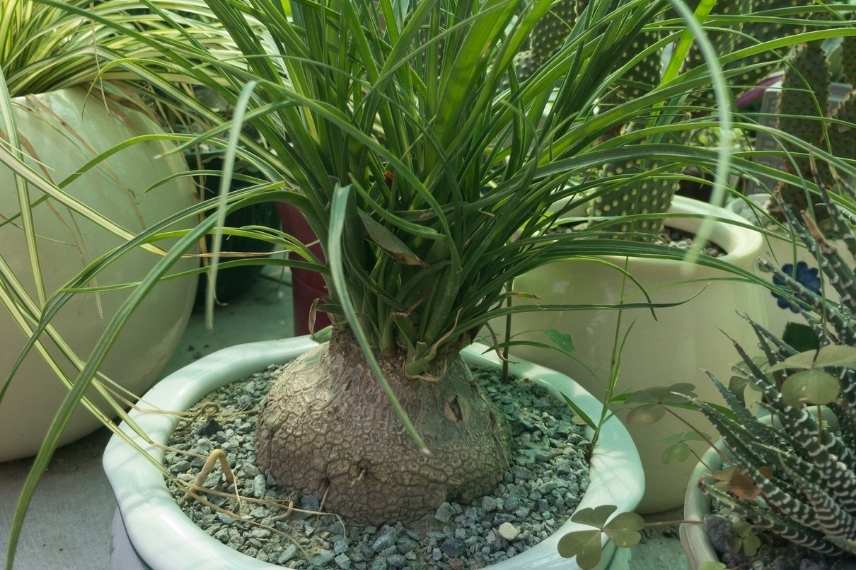
The elephant’s foot is a plant that requires moderate watering
Cleaning the foliage
The leaves are very narrow and sharp, making them difficult to dust with a damp cloth. However, regular misting can be carried out in spring and summer, as this plant has a strong need to capture light.
Repotting
Slow-growing and favouring confined spaces, Beaucarnea should be repotted only every 3 to 4 years, in a pot only slightly larger than the current one. When it becomes too large to repot, top-dressing is sufficient, once a year.
Pruning
Pruning is unnecessary. However, dead leaves should be removed as they appear. Remember to wear gloves, as the leaves can be very sharp.
Winter protection
In winter, Beaucarnea grown outdoors must be protected from frost. A thick mulch should therefore be laid at the base of the plant, for example pine bark, and covered with a winter cover. Beaux arbres elephant-grown in pots should not stay outside over winter. They should be brought into a conservatory or a bright room with a temperature between 10 and 12 °C.
Diseases and parasites to monitor
Elephant’s-foot plant can be susceptible to red spider mites and to mealybugs. Likewise, its foliage may show signs of fatigue due to overwatering.
To learn more about Beaucarnea
- Our article : Elephant’s Foot – Beaucarnea: how to grow and care?
- Subscribe!
- Contents
Comments