





























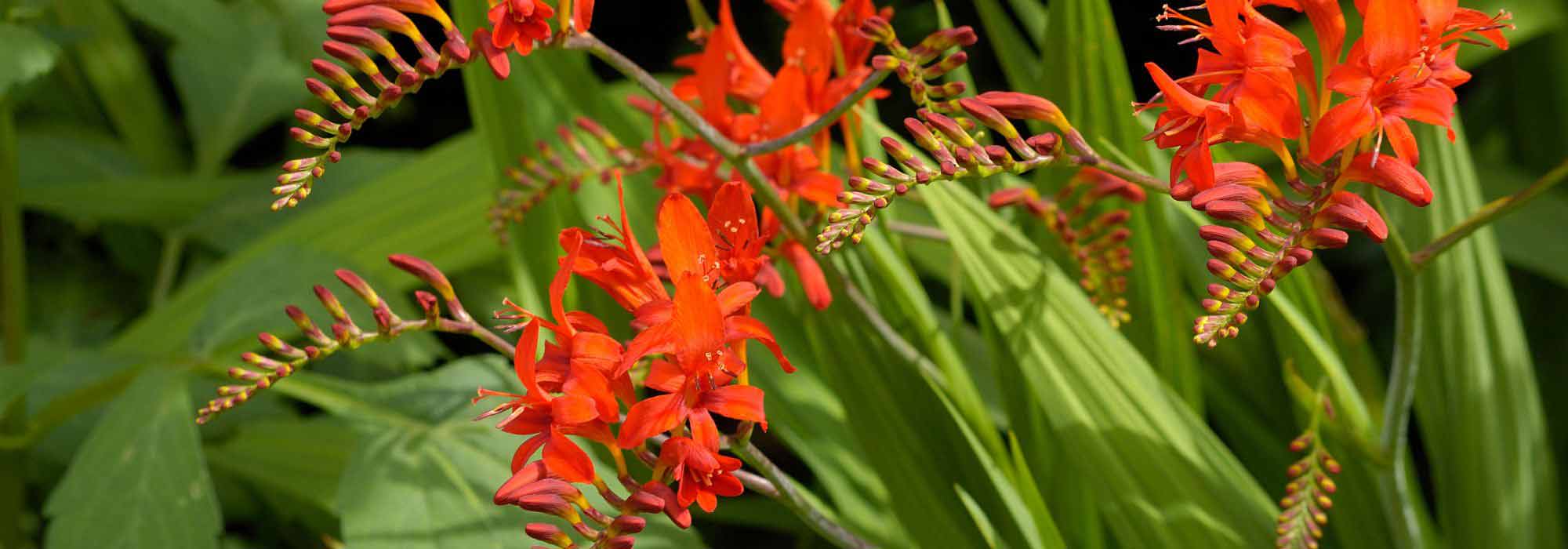
How to grow Crocosmias in pots?
Our tips for successful planting and maintenance
Contents
Crocosmias, also known as montbretias, are elegant bulbous plants that delight us in summer with their vibrant colours. Both the flowers and foliage boast aesthetic appeal.
In borders, as part of mass plantings, or in cool rockeries, Crocosmias add a cheerful touch and a hint of the exotic to the garden. However, these perennials of modest size can also be grown in containers, to warm up sunny terraces or balconies.
Discover our tips for successfully growing Crocosmias in pots and enjoy their magnificent flowering even without a garden.
Additionally, we invite you to read our dedicated article: “Crocosmia or montbretia: planting, cultivation, and maintenance.”

Which varieties of Crocosmias to choose?
Crocosmias, or Montbretias, typically measure between 60 cm and 1.2 metres in height, with a spread of 30 to 80 cm. All varieties can therefore be grown in pots, provided you choose a suitable container.
You can opt for red, orange, or yellow varieties of Crocosmias, such as:
- ‘Emily McKenzie’, with its beautiful bicoloured orange and red flowers (60 cm in height and 40 cm in spread);
- ‘Babylon’, a variety blending orange, red, and golden yellow (70 cm in height and 30 cm in spread);
- ‘Buttercup’, with sunny, bright golden yellow flowering (60 cm in height and 40 cm in spread);
- ‘George Davison’, a compact variety with orange-yellow hues (45 cm in height and 40 cm in spread);
- ‘Hellfire’, a slightly taller cultivar, offering beautiful crimson red flowers (1 metre in height and 50 cm in spread);
- The must-have ‘Lucifer’, certainly the most well-known Crocosmia with its flamboyant red flowers (1 metre in height and 60 cm in spread).
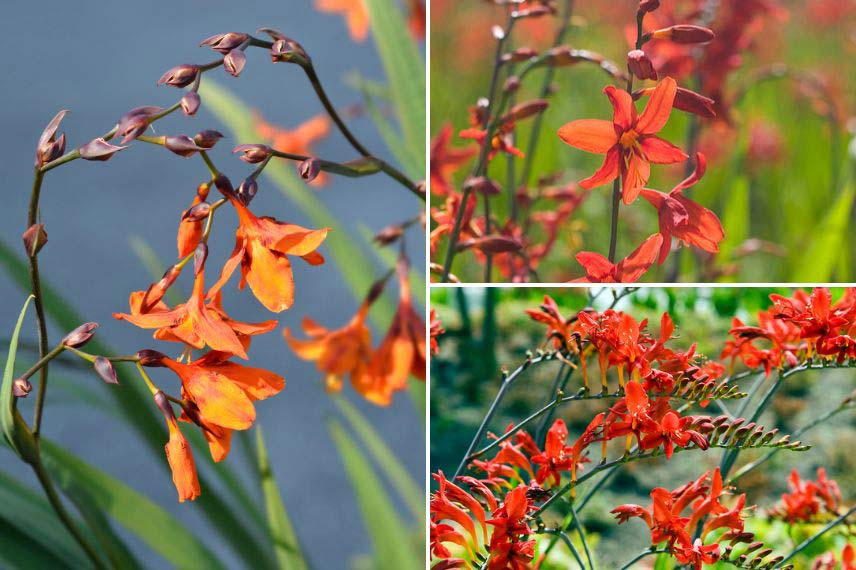
Crocosmias ‘Emily McKenzie’, ‘Babylon’ and ‘Lucifer’
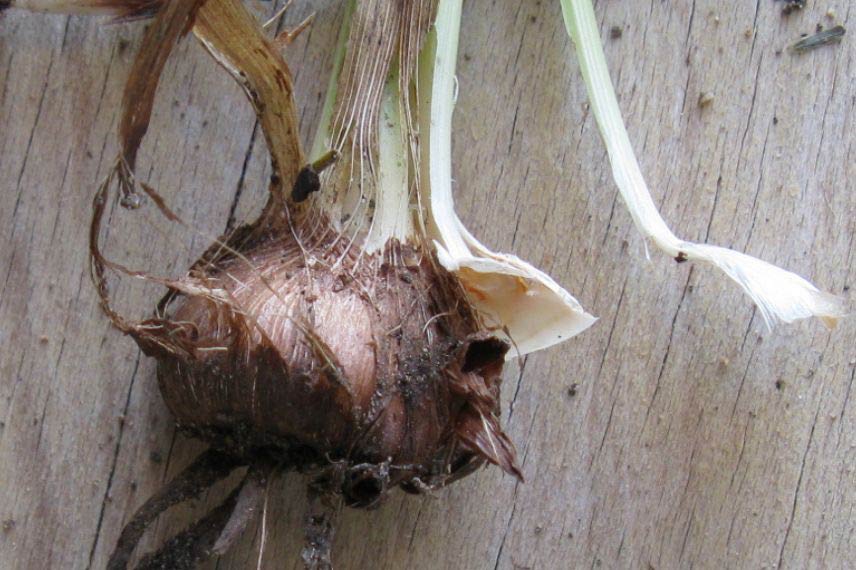
We recommend choosing corms (scale-like storage organs that are slightly flatter than bulbs) that are well-dried, healthy in appearance, and free from any signs of mould. They should also be devoid of spots or cuts.
When to plant Crocosmias in pots?
Planting Crocosmia in pots is ideally done in spring, between March and May.
In regions with mild winters (not dropping below -5 °C), which are not prone to long and intense frosts, it is possible to proceed in autumn.
You can also choose to sow Crocosmias in autumn, but this technique will require patience: flowering will only occur after an average of 2 to 3 years of cultivation.
Discover other Crocosmia
View all →
Available in 0 sizes
Available in 3 sizes
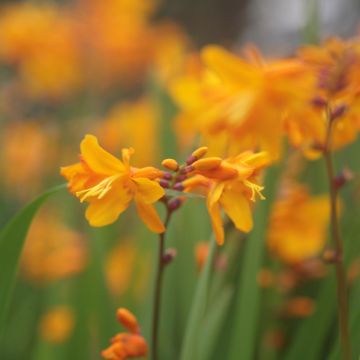
Available in 3 sizes
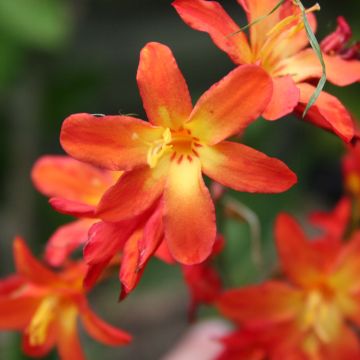
Available in 2 sizes
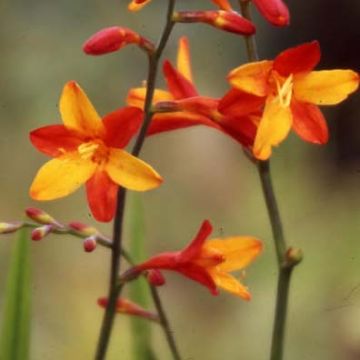
Available in 3 sizes
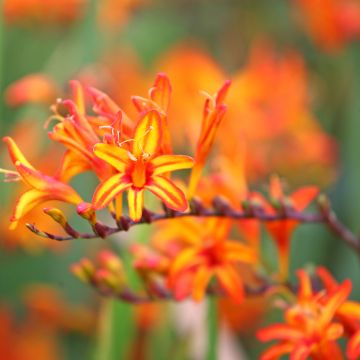
Available in 1 sizes
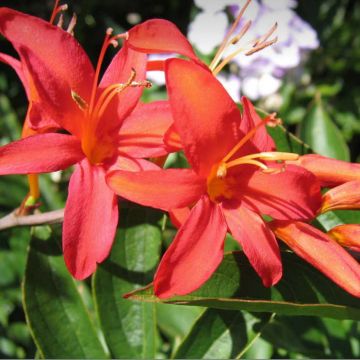
Available in 1 sizes
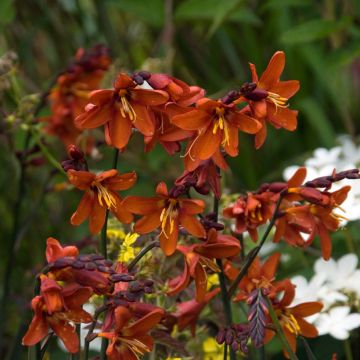
Available in 1 sizes
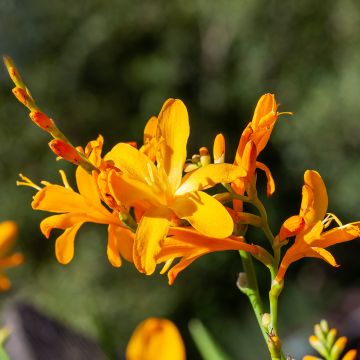
Available in 1 sizes
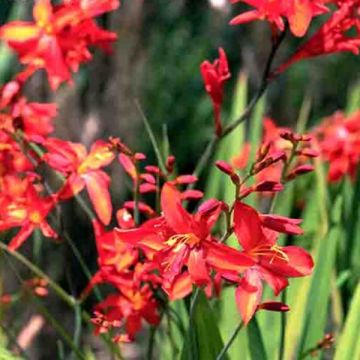
Available in 1 sizes
Planting Crocosmias in Pots
Container
For planting your Montbretias in pots, choose containers that are definitely perforated. Excess water must be able to drain away to prevent any risk of rotting the corms.
Choose containers that are deep enough, between 30 to 40 cm deep. Window boxes, pots, or troughs can all be suitable. For the diameter, adjust according to the number of plants you wish to grow. Allow 10 cm of spacing between each.
If you opt for the larger varieties, reaching about 1 metre in height, ensure you choose heavy and stable containers to avoid any imbalance during flowering.
Finally, regarding material, prefer terracotta, which allows for better aeration of the substrate due to its natural porosity.
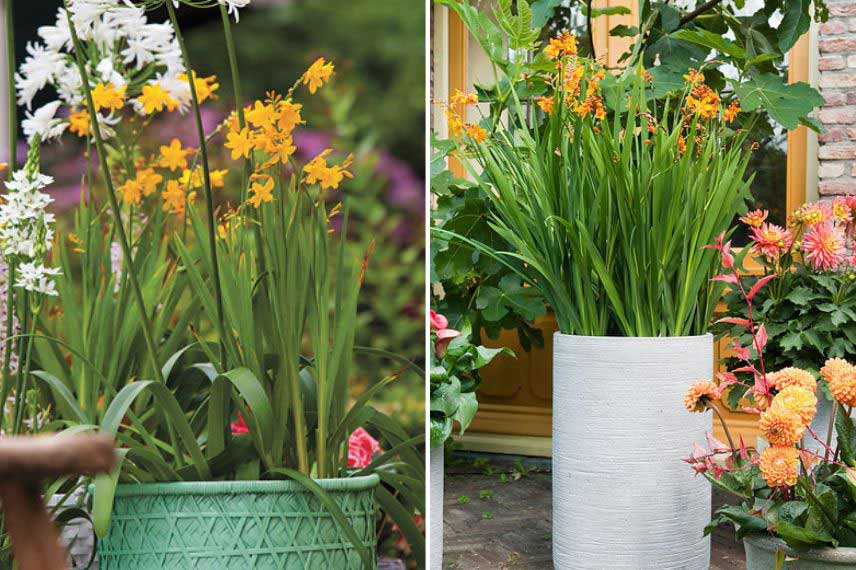 Adjust the pot size to the variety of Crocosmia chosen
Substrate
Crocosmias are not very demanding regarding their substrate, except for drainage. They thrive in soil with an acidic or neutral pH. They prefer light soils.
To plant Crocosmias in pots, mix:
- 2/3 of good quality potting soil, of flowering plant soil such as geranium soil or garden soil;
- 1/3 of river sand, from garden sand or gravel for drainage;
- a handful of well-decomposed household compost (facultative).
Planting
We recommend growing several Crocosmias together for a more beautiful visual effect.
- Install a drainage layer of about 3 to 5 cm at the bottom of your container (clay balls, gravel, broken terracotta, …).
- Fill with the substrate mix up to ¾ of the container.
- Using a bulb planter, prepare planting holes to a depth of about 10 cm.
- Place the corms in the holes, with the point facing upwards. Plant the other bulbs about 10 cm apart. You can choose a staggered or linear arrangement.
- Lightly cover with substrate, then firm down with your hands.
- Water generously.
- Install a mulch to keep the base of your plants cool for longer and to limit the growth of adventive plants (“weeds”).
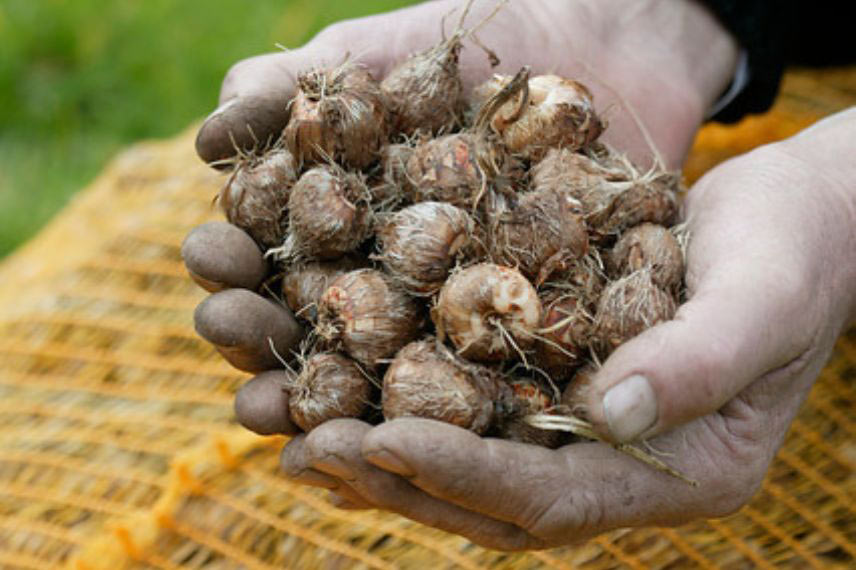 Crocosmias are easy-to-grow bulbous plants
Exposure
Crocosmias in pots should be placed in a sunny position. The sun ensures a beautiful and abundant flowering.
In southern regions with particularly hot summers, it is possible to choose a position with light shade.
In cooler regions, you can place your container at the foot of a south-facing wall, which will radiate heat during the night.
Caring for potted Crocosmias
Montbretias are easy to grow plants that require little maintenance. Their only requirements are to have consistently moist (wet) soil during growth and to be protected from severe or prolonged frosts.
Watering
Throughout its growth period, Crocosmia needs its substrate to remain fresh. It cannot tolerate summer drought, which is why you should ensure regular watering about once a week, as soon as the substrate is no longer moist on the surface. Increase the frequency of watering during prolonged dry spells.
Installing a layer of mulch at planting time will help limit natural evaporation and thus space out watering.
In autumn, gradually reduce watering, then stop completely in winter while the plant is dormant.
Fertilisation
In pots, the substrate inevitably depletes its nutrient reserves more quickly. To ensure a beautiful and prolonged flowering, apply fertiliser during the growth period, from mid-spring to mid-summer (May to August).
Choose a fertiliser for flowering plants, a fertiliser for window boxes and pots, or any other fertiliser rich in potassium, which promotes the production of flower buds among other things.
You can opt for a slow-release solid fertiliser in the form of sticks to be inserted into the substrate, or a liquid fertiliser to be diluted in the watering water, which should be renewed approximately every 15 days. In all cases, follow the manufacturer’s usage precautions, which vary depending on the products.
Pruning
Crocosmias do not require any specific pruning. However, to encourage flowering, we recommend removing faded flower spikes as they occur. This action will promote the production of new buds.
Wait until the foliage has turned completely yellow in early autumn to cut it back to the ground or remove it. The plant indeed builds its nutrient reserves throughout the fading of the leaves. If your potted Crocosmia spends the winter outdoors, you can even keep this foliage until early spring to provide additional protection against the cold.
Repotting and division
Repotting will occur approximately every 3 years, when the plants start to feel cramped.
This will also be the time for dividing the stumps, which involves separating the bulbs, allowing you to rejuvenate the plant and obtain new young plants.
Proceed at the very beginning of spring, before the Crocosmia begins its growth. Using a transplanting tool, carefully dig around the plants to lift the stump without damaging the corms. Separate the small bulbs that have grown around the old one and place them in a new container.
Pests and diseases
Crocosmias are known to be relatively resistant to diseases and pests. Just keep an eye out for slug attacks in early spring, which can target the young and tender vegetation.
In dry summer conditions, you may observe red spider mites. As a preventive measure, mist the foliage with rainwater in the evening, as these little pests do not appreciate humid conditions. For treatment, spray a diluted black soap solution on the affected areas (1 tablespoon for 1 litre of warm water). Repeat as necessary after a few days.
Wintering
Moderately hardy, Crocosmias can withstand short frosts of -5° to -12°C on average. The Crocosmia masoniorum is the hardiest of all, tolerating temperatures down to about -15°C. However, in pots, plants are always more sensitive to cold and less insulated.
In winter, stagnant water can be particularly fatal for our bulbous plants. Therefore, remove saucers if necessary and move the pot to a sheltered location away from cold winds and prevailing rains. In regions with mild winters, where there are no long periods of frost or temperatures below -5°C, Crocosmias can spend the winter outdoors. Simply apply a thick layer of mulch (dead leaves, straw, wood chips, etc.) on the surface.
In regions with longer and harsher winters, we recommend moving your plants to a frost-free, dry location. They can be brought back out in spring, as soon as the last frost risks have passed.
- Subscribe!
- Contents
![[crocosmia pot_size="medium" container="planter"]](https://en.promessedefleurs.eu/blogwp/wp-content/uploads/2022/07/Cultiver-les-Crocosmias-en-pot.jpg "Growing Crocosmias in containers")
Comments