





























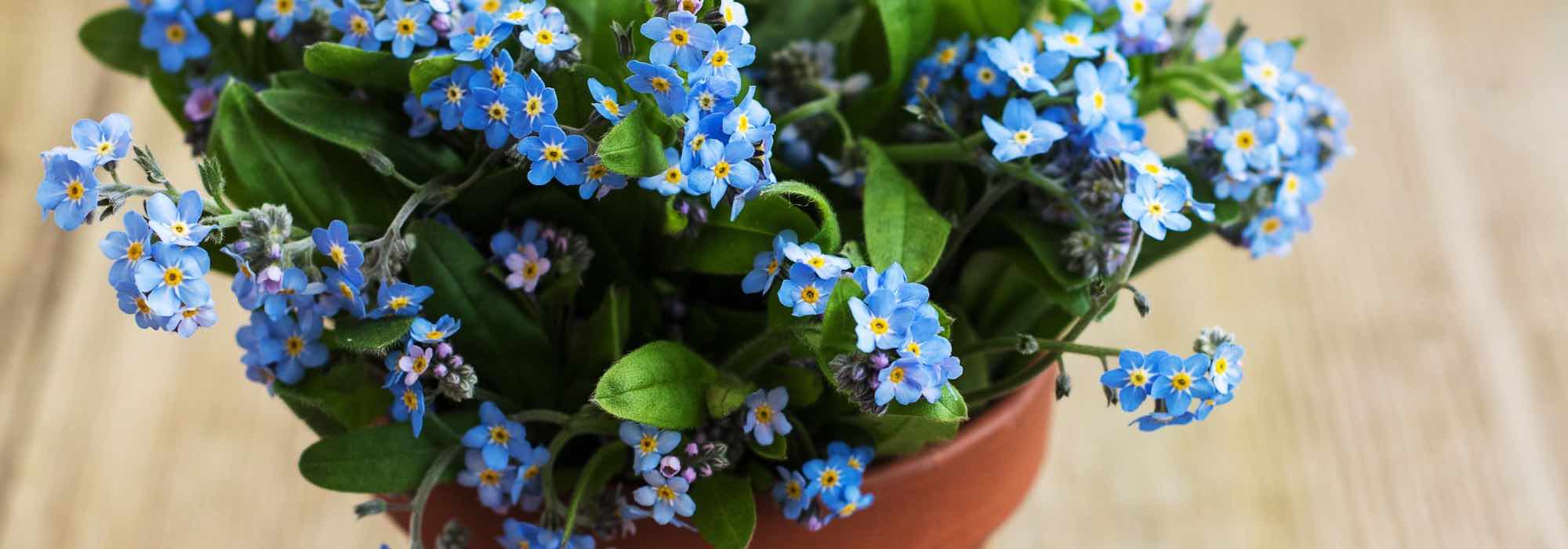
How to grow forget-me-nots in pots?
Effortlessly grow and care for this pretty blue-flowering plant
Contents
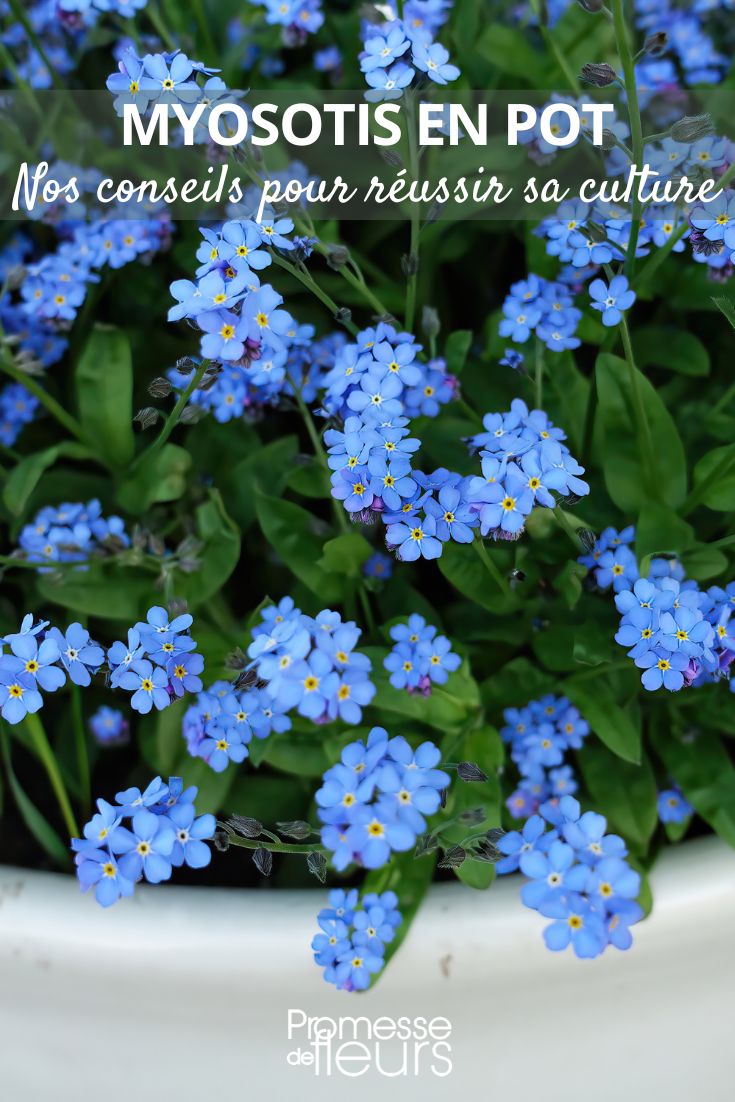
Forget-me-nots are those plants known for their sprays of small spring flowers, usually blue, with a very delicate and romantic appearance. They form adorable little cushions that are easy to grow, often grown as annuals.
Forget-me-nots brighten up borders, rockeries and flowerbeds, but also containers. Indeed, they lend themselves very well to container growing, so you can enjoy them even without a garden and brighten terraces or balconies. So discover how to grow and care for forget-me-nots in pots.
And to learn more about the cultivation of forget-me-nots, head to our guide “Myosotis: Planting and sowing“.

Which Myosotis varieties should I choose to grow in pots?
All forget-me-not species lend themselves to pot culture, thanks to their compact habit, typically reaching between 15 and 60 cm in height.
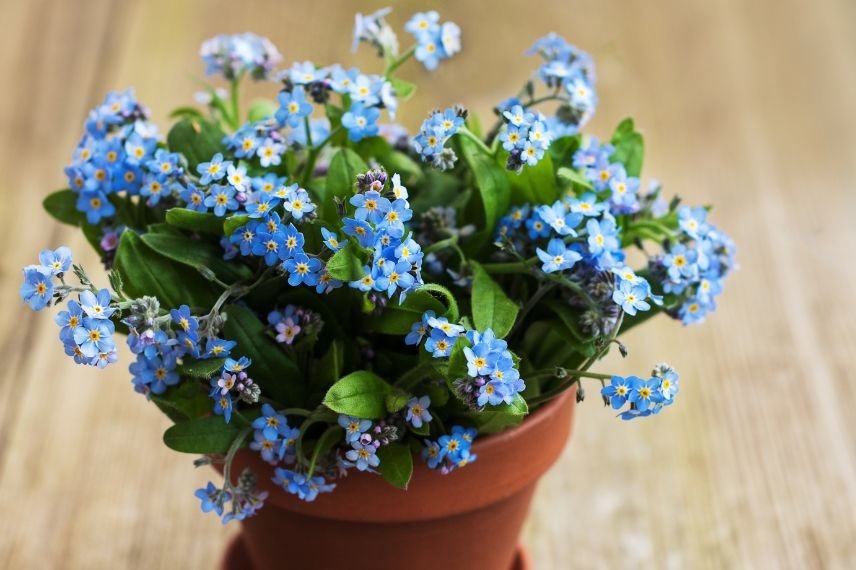
For example, opt for the woodland forget-me-not M. sylvatica ‘Savoie Blue’ or ‘Blue Sylva’, with their electric-blue flowers contrasting with a yellow eye.
Discover also other less common flower colours, such as:
- the Myosotis sylvatica ‘Snowsylva’, which produces a profusion of white flowers;
- ‘Savoie Boreal’, which flowers in autumn in a pale blue-pink hues;
- ‘Rosylva’, which graces us with vivid pink flowers;
- ‘Roi des Carmins’, which flowers in carmine pink.
Only the marsh forget-me-not marsh forget-me-not M. scorpioides will be more challenging to grow in pots, as it requires a consistently damp substrate.
On the packaging side, you will have the choice between pots or plug plants, often sold in packs (young plants). You can also obtain forget-me-not seeds to sow yourself.
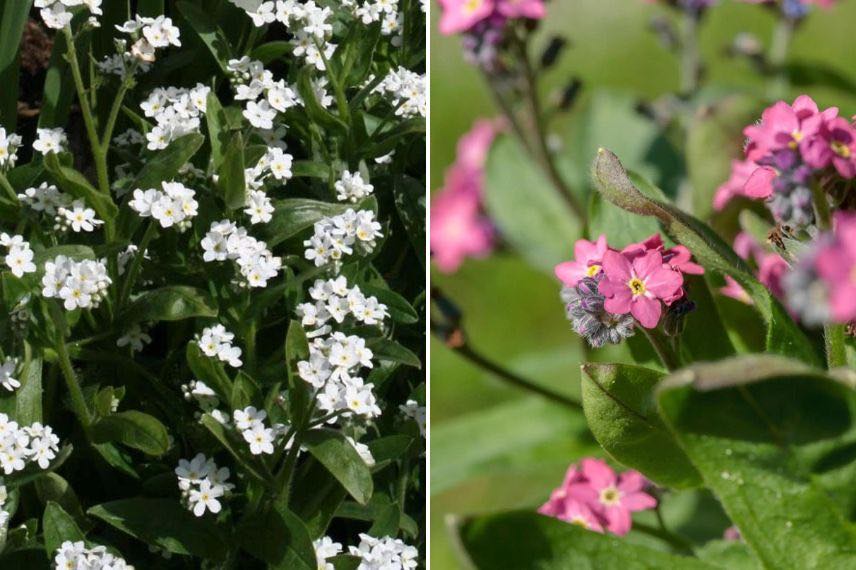
Beyond the superb blue of forget-me-nots, you can also choose varieties with white flowers such as ‘Snowsylva’ and pink ones like ‘Rosylva’
Read also
5 annuals for a spring-flowering gardenWhen should you plant forget-me-nots in a pot?
Planting forget-me-nots in pots is best done in autumn, for flowering as early as the following spring.
Sowing takes place from spring to the end of summer under cover.
Planting forget-me-nots in pots
Container
You can grow forget-me-nots in pots or window boxes. Be sure to choose containers with drainage holes, so that water from watering or rain can drain away without stagnating.
Choose a container that is wider than it is deep, because the root system of forget-me-nots is fairly shallow. Calculate the width based on the number of plants you wish to grow, bearing in mind a spacing of 15 to 20 cm.
Substrate
Forget-me-nots can grow in all soil types, but they will prefer fertile substrates, rich in organic matter, always well drained (water should not stagnate there).
You can choose a ready-made potting mix, for example for window boxes and pots or for flowering plants. If you prefer to make your own blend, use:
- 2/3 of horticultural potting mix of good quality or light garden soil;
- 1/3 of river sand or draining elements (clay balls, perlite, gravel…) ;
- 1 to 2 handfuls of compost household or well-decomposed manure.
For forget-me-not sowing, you can use seed-sowing and transplanting compost, lighter and therefore more suited than standard potting mix.
Planting
1. A few minutes before planting, rehydrate the root ball of your forget-me-nots by letting it soak in a container filled with water at room temperature.
2. Install a drainage layer 3 to 5 cm thick at the bottom of your container.
3. Top up by adding the substrate mix to half the height of the container.
4. Plant your forget-me-not, then top up with substrate until the root ball is well buried. If you are growing several (the mass effect is more aesthetic), plan a distance of about 15 to 20 cm between each plant.
5. Gently firm with your fingers to expel air pockets.
6. Water generously.
Forget-me-not seed sowing
1. Install a drainage layer at the bottom of a seed tray.
2. Fill it with well-drained substrate and level with the help of a board so the surface is flat.
3. Moisten the substrate using a spray bottle.
4. Broadcast the seeds (grab a handful of seeds and scatter them as a fine shower).
5. Cover the seeds with a thin layer of potting soil.
6. Place a lid on the seed tray (or, if preferred, a clear plastic bag) to encourage germination.
7. Keep it moist during germination (allow 15 to 30 days).
Place your forget-me-not seedlings in a bright location, at about 15 to 20 °C. Remove the lid once germination has occurred. When the young shoots have developed their first leaves, you can transplant them into individual pots or into window boxes.
Seedings sown in late summer will overwinter under cover, in a cool, frost-free place.
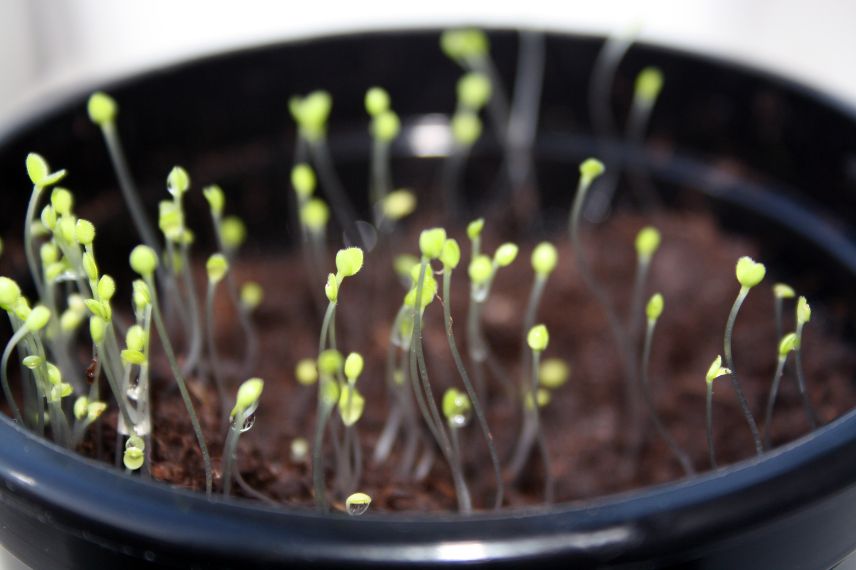
Forget-me-not seed sowing
Care for forget-me-nots in pots
Forget-me-nots are easy to grow plants that require little maintenance.
Exposure
Forget-me-nots prefer bright light, but not scorching sun, or dappled woodland shade. In the hottest parts of our region, provide them with a shaded exposure.
Watering
Forget-me-nots prefer soils that stay moist, i.e. never fully dry out. Water when the surface of the substrate is dry. Increase watering in hot weather and when rain is not forecast.
The marsh forget-me-not, however, is thirstier: it requires a moist, even marshy soil. If you choose to grow this species in a pot, do not let the substrate dry out. You can add a saucer to keep water in for longer.
Prefer rainwater to tap water. Avoid wetting the foliage to limit the risk of developing certain diseases (see dedicated paragraph below).
Fertilising
Forget-me-nots prefer soils rich in organic matter. In pots, the substrate tends to exhaust its nutrient reserves more quickly. To support flowering of your forget-me-nots, you can therefore choose a fertiliser rich in potash, specifically designed to stimulate flower production. Solid fertilisers will have a slow, but long-lasting effect. Liquid fertilisers have a rapid, but short-lived effect. For example, opt for a liquid fertiliser for geraniums. The dosage depends on the products: therefore follow the usage precautions indicated on the packaging.
Pruning
Forget-me-nots require only one pruning at the end of flowering. For this, use a sharp, previously disinfected pruning shear. Cut the flowering stems level with the soil. Keep one or two stems if you want forget-me-nots to reseed themselves spontaneously, but you will not have any guarantee that the seeds stay in the pot. Foliage dies back in winter, but can be pruned beforehand.
Pests and diseases
Forget-me-nots have few enemies. Watch for slugs in spring, which may feast on the foliage.
In hot and humid weather, forget-me-nots can be susceptible to powdery mildew, this cryptogamic disease that shows as a white powdery deposit on young shoots. As a preventive measure, ensure soil drainage and maintain proper spacing between forget-me-nots to promote natural aeration.
In addition, discover our articles “Slugs: 7 effective and natural ways to fight” and “Powdery mildew or white disease”.
Repotting
Forget-me-nots are often grown as an annual or biennial (flowering becomes less abundant thereafter). Therefore, repotting is not necessary.
- Subscribe!
- Contents
Comments