


How to grow Michelia in a pot successfully?
Our tips for planting this flowering evergreen shrub in a pot
Contents
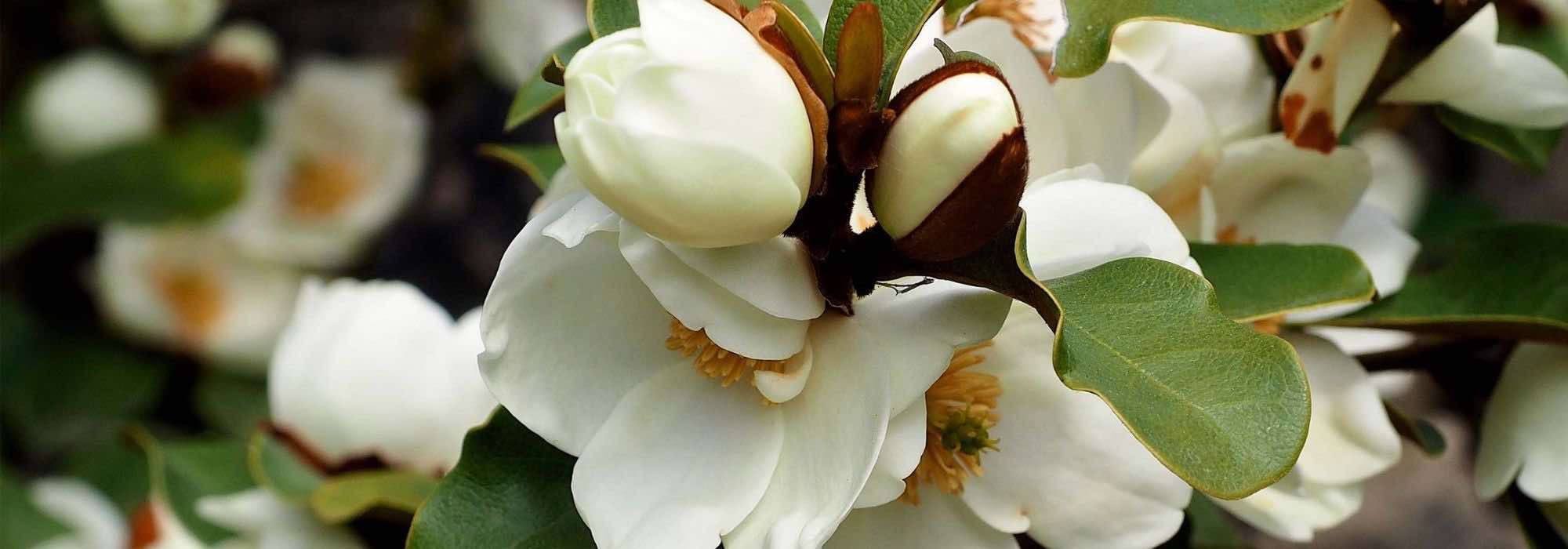
Michelia is a shrub with evergreen foliage related to Magnolias, which catches the eye with its exotic and fragrant flowers. This member of the Magnoliaceae family is ideal for those seeking an ornamental plant capable of adapting to compact spaces thanks to pot culture. Michelia makes an interesting choice for those with limited space or who wish to adorn a balcony or terrace, while enjoying glossy evergreen foliage all year round as well as lush, exotic flowering, from which fruity fragrances emanate. To ensure abundant and healthy flowering, it is important to pay attention to several aspects of its cultivation, as it is fairly forgiving when given the right growing conditions. Its hardiness is medium, but sufficiently robust for cultivation in many regions. Let’s consider the pot, substrate, planting and aftercare steps.
→ On our site, Michelia plants are in the Magnolia category. There is a sub-category Fragrant Magnolias which makes them easier to find. Another option is to search for them in the sub-category Evergreen Magnolias. Finally, some are now simply named Magnolias. You can see that it is Michelia only by opening and reading the listing. This is the case for Michelia figo ‘Stellar Ruby’.

Which Michelia species or varieties should be grown in pots?
All Michelias can be grown in pots. Plant growth is simply more limited than in the ground. Depending on the variety chosen, the plant will reach 1.5 m to 2.5 m in height for the largest varieties.
Width is around 1 m when in a pot, perhaps a little more. Michelia has dense foliage and forms a handsome bush, bearing leathery, glossy, ovate leaves along almost its entire height.
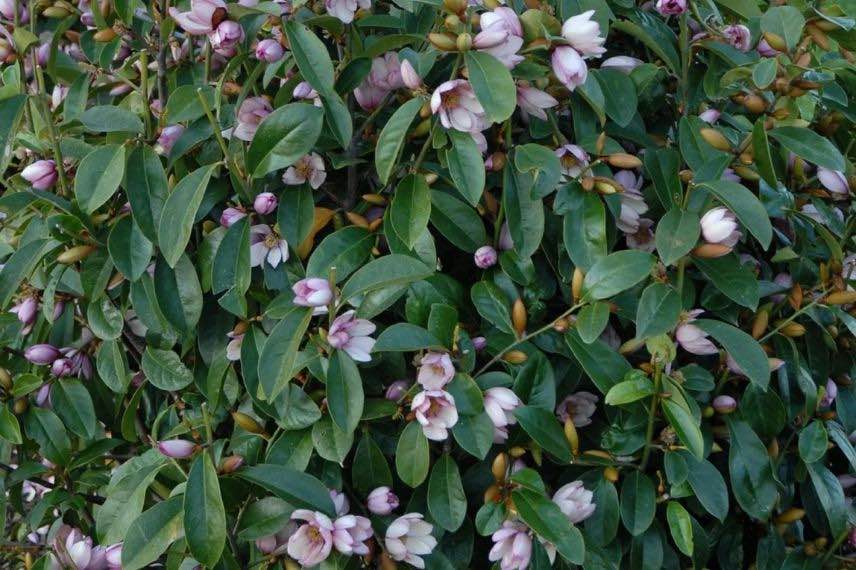
All Michelias can be grown in pots. Here, Michelia ‘Fairy Blush’
Read also
Magnolias: planting, pruning and careWhat type of pot? What size?
Choose a container wide enough and deep enough to accommodate the growth of this bush. A pot at least 40–50 cm deep and wide provides enough space for root growth.
Materials such as terracotta or plastic are suitable, but ensure that the pot has adequate drainage holes to prevent water stagnation.
Terracotta allows better aeration of the roots and minimises the risk of over-watering thanks to its porosity. Plastic retains water a little longer, which allows you to space out the watering a little more than with terracotta.
Michelia does not like stagnant moisture; the risks are greatly reduced with terracotta and you need to be a little more careful with plastic. By contrast, you may find that the substrate dries too quickly in terracotta. It is up to you to make the best choice based on your region and your watering habits.
What substrate should be used for Michelia in a pot?
The substrate for Michelia should be rich in organic matter and well-drained to prevent water accumulation around the roots. It should be slightly acidic, with a pH between 5.5 and 6.5, which is often the case with commercial potting mixes. This information is also available on the back of the bag or on the product description for online sales. You will also find the water retention capacity of the substrate makeup. Choose a high one.
Therefore, assemble a substrate based on a quality potting mix. To balance your blend well, add perlite or river sand at 10–20% to improve drainage. Thus, you obtain a substrate where water does not stagnate, but is well retained in the fibres that compose it. Also add compost if possible or a vermicompost at 10–20% of the total.
Provide drainage at the bottom of the pot using clay pellets, pouzzolane or gravel. Also plan an organic mulch to keep the substrate cool.
Read also
10 magnolias with evergreen foliageHow to plant a Michelia in a pot?
Michelia planting takes place from March to May depending on the region. In mild climate areas, you can also plant it in September or October.
To plant, proceed as follows:
- Remove the root ball from its nursery pot and, if necessary, tease out the roots.
- Dip it in a basin of water while you prepare your pot.
- Pour a drainage layer a few centimetres deep at the bottom of the pot, in the form of clay balls, gravel or pouzzolane.
- In a separate bowl, mix the different components of the substrate.
- Pour the substrate so that it covers about one third of the pot.
- Position the Michelia root ball, ensuring that the collar of the shrub is at the level of the pot surface.
- Check that you are happy with the shrub’s appearance and orientation and that it is upright.
- Top up with the substrate, gently firming it down evenly.
- Fill to within a few centimetres of the pot rim and tamp down again.
- Water thoroughly.
- When the water has been absorbed, add a little more substrate if necessary to fill any gaps.
- Mulch to a depth of a few centimetres, leaving the collar exposed.
What light exposure does Michelia in a pot require?
In a pot, Michelia prospers in a well-lit location, with a few hours of sun, but protected during the hottest hours of direct sunlight in summer. An east- or west-facing exposure, where the plant can benefit from the morning sun or late afternoon sun, is ideal. If you live in a particularly hot region, plan for partial shade to protect the plant during the hottest hours of the day.
That said, with regard to exposure, Michelia is accommodating! It can also grow more in shade, where it develops a habit that is more open and more pliant and darker foliage. If, on the other hand, it is exposed to sun, it shows a more compact habit, denser foliage, smaller leaves and lighter green colour.
In a pot, it will suffer heat and sun more quickly. Thus, while in open ground full sun exposure can be advised, it is better to protect it more in a pot.
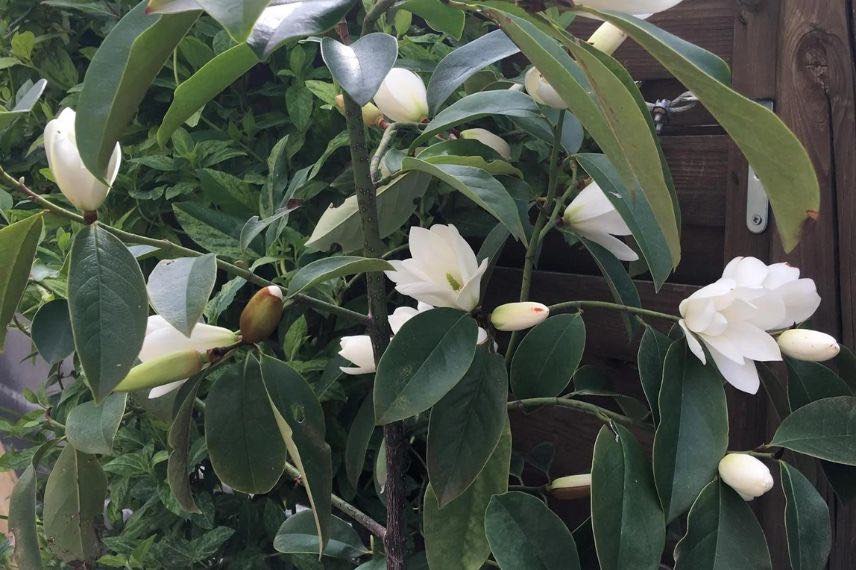
Michelia is quite accommodating with regard to exposure. Simply, it does not develop in the same way depending on the amount of sun or shade
Watering and fertilising Michelia in pots
Watering
Watering should be regular, but Michelia does not like to keep its roots in water. Ensure the pot provides good drainage and let the substrate dry slightly between waterings. During the growth period, keep the soil consistently cool and moist, but not saturated.
Watering is ideally carried out with water that is not overly hard. They should be carefully monitored in summer to support flowering and foliage. Keep the substrate moist, or water as soon as the top few centimetres of the substrate are dry.
In winter, waterings are more spaced out, you can allow the substrate to dry a little more.
Fertiliser
The use of fertiliser is recommended to support the flowering and growth of Michelia. During the growing season, from March to September, apply a fertiliser for flowering plants every month. Stop the feeding in winter, the period during which the plant is in vegetative rest.
Care and overwintering of potted Michelia
- The bush can be pruned easily after flowering. In late winter, before growth resumes, remove deadwood and tangled branches to keep only the vigorous branches and maintain a neat growth habit.
- When the plant becomes too large for its current pot, consider repotting every two to three years to provide fresh, nutrient-rich potting compost.
Winter protection
Michelias have a hardiness around -10 to -12°C depending on species and varieties. Some are hardy down to -15°C. And others are less hardy, such as Michelia foggii ‘Allspice’, which can be damaged by frost as low as -7°C. These figures apply to plants grown in the ground. In a pot, Michelia will suffer frost more quickly. Subtract 2, or even 3 degrees from the indicated temperatures. Its hardiness also depends on growing conditions and site. In a well-sheltered position, it will suffer frost less quickly.
If necessary, apply some protective measures such as a thick mulch at the base of the bush and protection of the aerial parts with a winter protection fleece. If you fear harsher frosts, you can also move it into a conservatory or greenhouse.
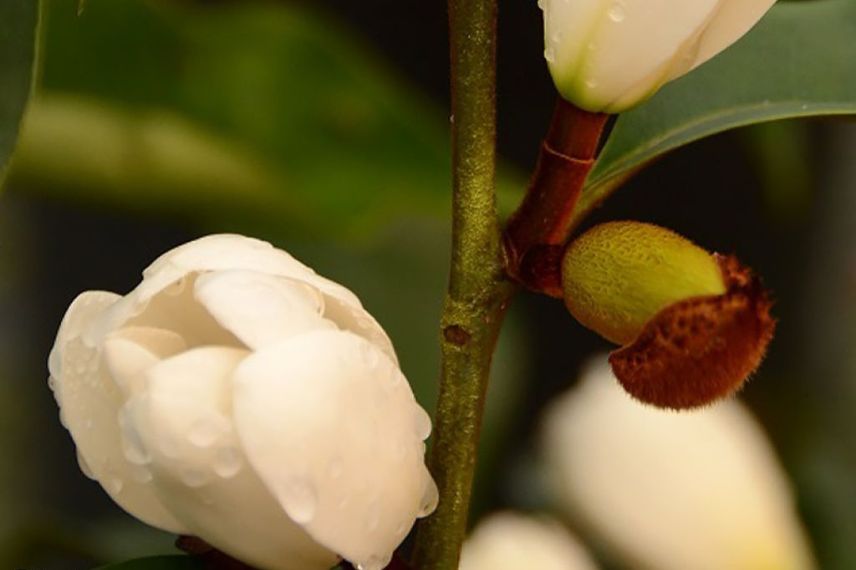
Michelia ‘Allspice’ is the least hardy; it tolerates frost down to only -7°C
- Subscribe!
- Contents
Comments