





























How to harvest pine nuts?
Harvest, storage, culinary uses and benefits
Contents
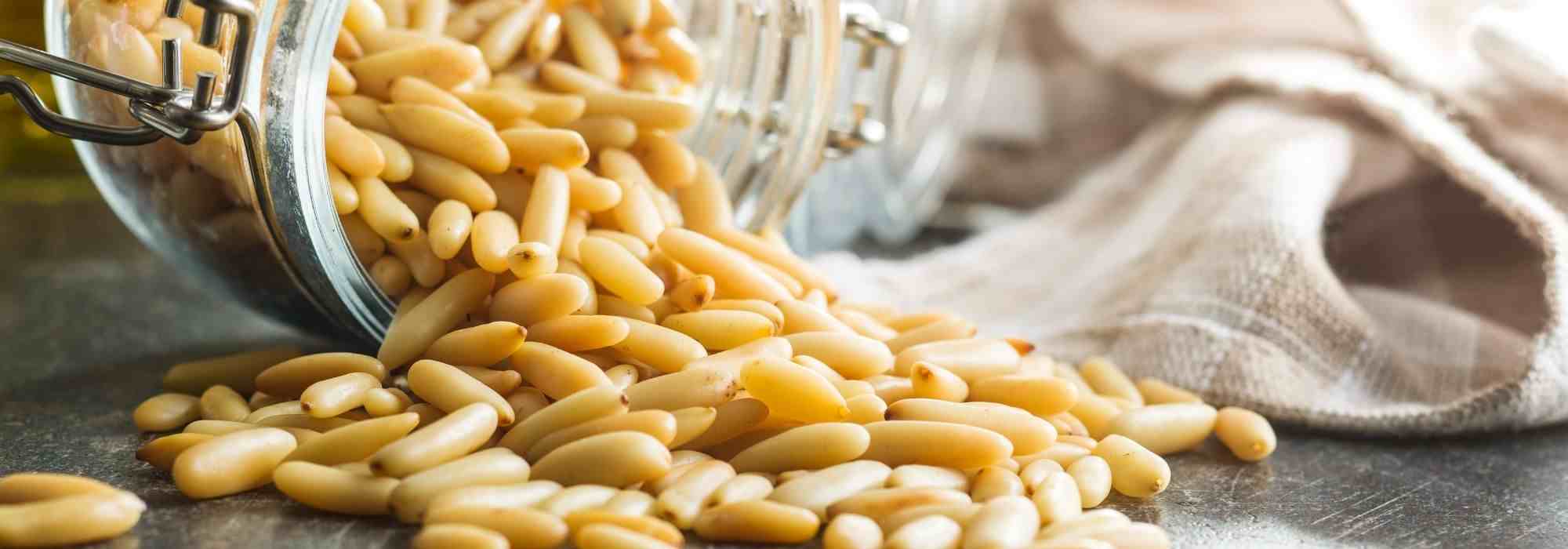
Key ingredient in traditional pesto, pine nuts or pignoli have many other culinary uses, especially in Mediterranean cuisine.
And this is nothing new: these oblong, ivory-coloured seeds have been consumed in Europe and Asia since the Paleolithic era. They are also believed to have been used as a form of currency, as well as natural remedies for various ailments, thanks to the properties attributed to them.
While pine nuts can be easily found in stores, they are often quite expensive. But did you know that it is entirely possible to harvest them yourself? Let’s explore how to do this, as well as how to properly store pine seeds to enhance your dishes almost all year round.

The harvest of pine nuts
Which Trees to Harvest From?
Among the various varieties of pines, not all allow for the harvesting of precious edible seeds. In our territory, it is the umbrella pine Pinus pinea that produces pine nuts. This majestic large conifer, a symbol of sunny seaside gardens and southern regions, is also known as the “pine nut tree.”
The tree is easily recognised by its imposing and characteristic silhouette, shaped like a large ovate umbrella. The foliage consists of soft, non-spiky evergreen needles, measuring 10 to 20 cm in length, with a bright light green colour. Flowering occurs in spring: male and female cones coexist on the tree. After pollination, the female cones transform into large globular pine cones, about ten centimetres in size. It is these cones, or pine cones, that contain the famous seeds. The pine nuts are located between the scales of the cone, protected by a shell. The tree generally needs to be at least 2 years old before it can produce them.
These pines can be found in the wild in mild regions, where winters do not drop below -10°C. The tree is a true symbol of Mediterranean landscapes! However, it is possible to see specimens of umbrella pines as far north as southern Paris when they are cultivated in well-sunny, sheltered locations from cold winds. You will also find umbrella pines in other southern European countries (Spain, Italy, etc.).
Other varieties of pines, such as the Korean pine Pinus koraensis, Siberian pine Pinus sibirica (all native to Asia), or the grey pine of California Pinus sabiniana (native to North America), also produce pine nuts. It is the seeds of the first four species that are permitted for commercialisation for food use in France.
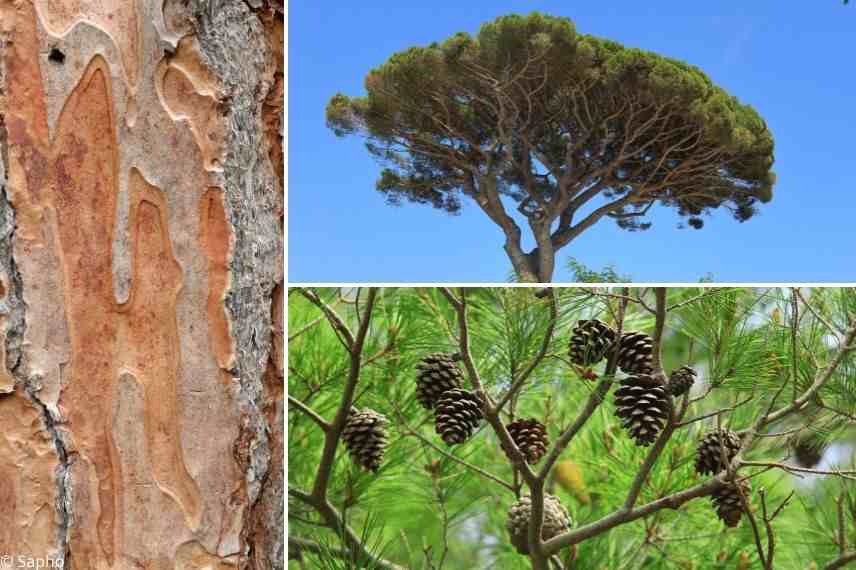 Pinus pinea
When to Harvest?
Pine cones begin to open when the seeds are ripe and temperatures rise sufficiently, in conjunction with dry weather.
Harvesting usually occurs in summer, depending on the climate, and can last several weeks.
How to Harvest?
Harvest pine cones that are not yet fully open, either directly from the tree or from the ground. Cones that are already well opened are likely to have been previously visited by birds or small mammals, who are also very fond of them.
Place the pine cones in a warm, dry location, ideally in full sunlight, so they can open completely naturally. Depending on the temperatures, this process can take 2 to 3 weeks.
Some more impatient gatherers stack them on the ground before lighting a small fire around them, which, thanks to the heat, will allow for the rapid opening of the pine cones. Others opt for an oven method.
The pine cones are then broken by hand or with a hammer to access the seeds. Another technique involves placing the opened pine cones in a bag and shaking vigorously to naturally release the seeds.
Before consumption, the scale of the pine nuts must be removed. If this protective covering is soft, simply use your fingers. If the shell is too hard, use a small stone, a mallet, or a rolling pin to crack it open and access the seed. This task requires patience and precision, but brings satisfaction!
Our advice: during the shelling process, wear gloves if you don’t want to end up with black dust and sticky resin that is difficult to remove from your hands.
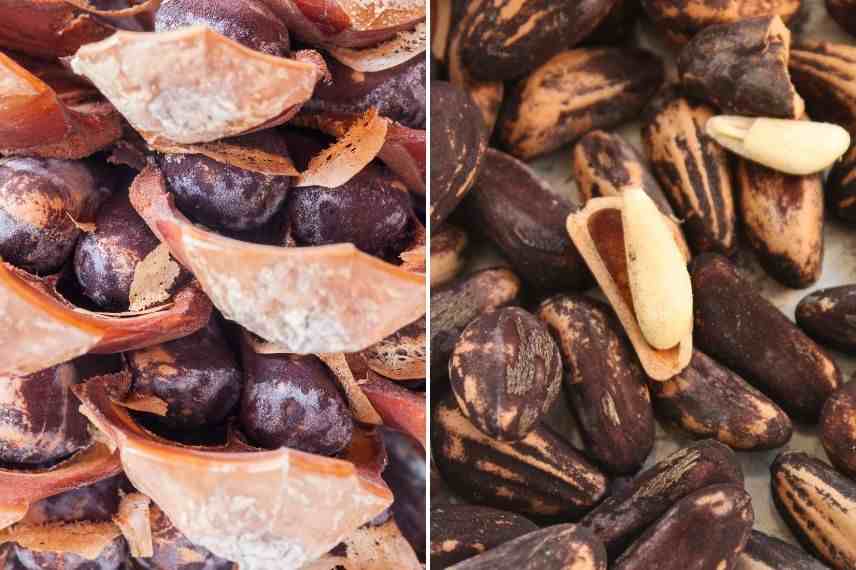 On the left, the pine nuts inserted between the scales of the pine cone. Remove the covering around the pine nuts for consumption.
Read also
Pines: planting, pruning and careThe preservation of pine nuts
Pine nut is also known as “pine seed,” indicating its belonging to the family of oleaginous plants. Its high content of fatty acids and oil explains its fragility: it has the disadvantage of going rancid quickly.
To keep your seeds for longer, store them in their protective shell. Place them in an airtight container, kept in a cool, dry, and well-ventilated place, away from sunlight. This way, you can preserve them for several weeks.
We recommend shelling only the amount of pine nuts you need for immediate or quick consumption in the following days. In this latter case, place the shelled seeds in the refrigerator, in an airtight container.
It is also possible to freeze them, although the texture and flavour may be altered.
Finally, if you have enough space and a suitable room, such as a pantry, you can also choose to keep the closed pine cones whole for an even longer shelf life.
To determine if your pine nuts are still good and fresh, rely on your senses. If the texture is soft, the seed emits an unusual smell, or you notice any signs of mould, do not take any risks and avoid consumption.
Discover other Pinus - Pine
View all →
Available in 1 sizes
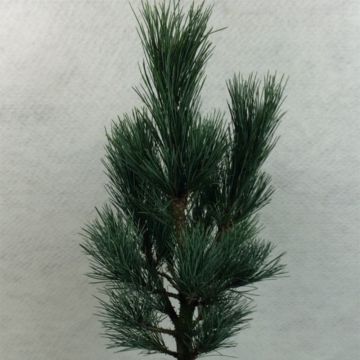
Available in 1 sizes
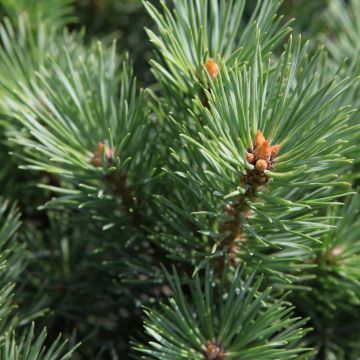
Available in 2 sizes
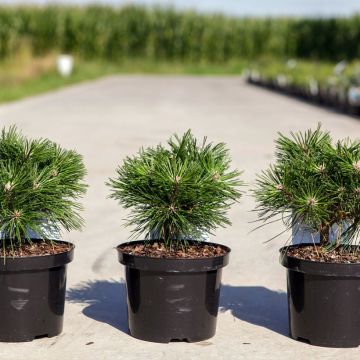
Available in 2 sizes
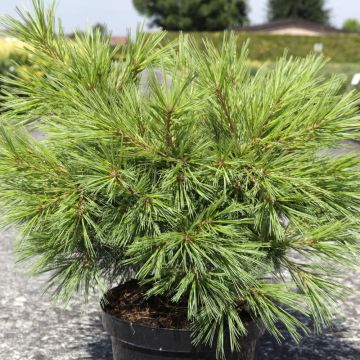
Available in 2 sizes
Available in 2 sizes
Available in 1 sizes
Available in 1 sizes
Available in 2 sizes
Available in 1 sizes
The use of pine nuts
Flavour and Culinary Interests
Pine nuts have a rather mild flavour reminiscent of almonds. Some pine nuts may also have a slightly resinous aroma.
Easy to use, pine nuts can be seamlessly incorporated into many dishes. They can be consumed in all their forms: raw, roasted, salted, sweetened, whole or crushed.
Raw and crushed, they are an essential ingredient in traditional pesto, but they can also be used in indulgent spreads or as a coating.
Whole roasted pine nuts, simply sautéed in a pan, can enhance most dishes: salads, soups, pies, vegetable stir-fries, pasta, risottos, stuffings, en papillote, stews, couscous, … They can also be enjoyed as an aperitif or as a snack alongside other oleaginous nuts.
In sweet dishes, they can be added to desserts such as tarts, cakes, or crumbles, but can also elevate a fresh fruit salad. Blended into juices, they provide texture and add a subtle note.
In summary, pine nuts adapt to all situations in the kitchen, with only your creativity as their limit. However, there’s no need to overdo it, they have a powerful aromatic quality and are also very calorific!
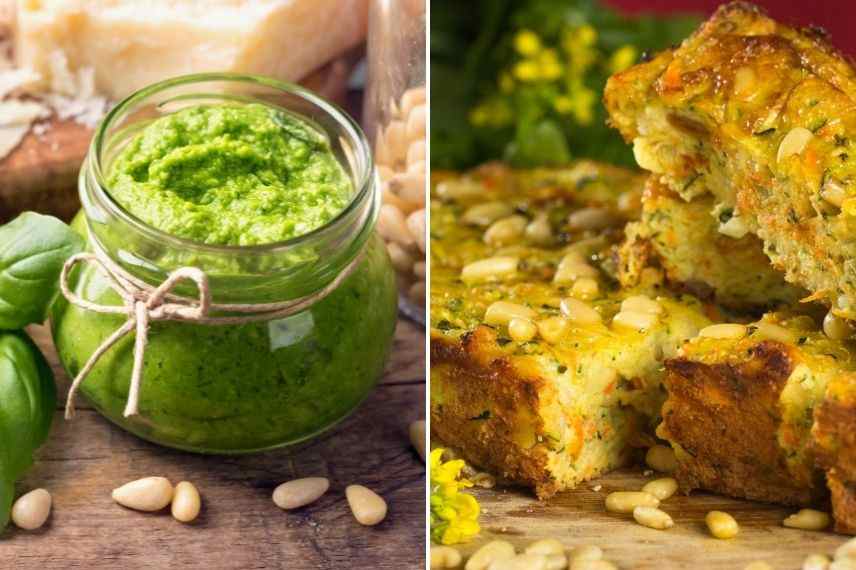 Pesto with pine nuts and tart with courgettes and pine nuts
Alleged Benefits
Pine nuts are renowned for their nutritional qualities, stemming from their richness in essential fatty acids. They are also said to be rich in minerals, trace elements, proteins, and fibres.
Many cultures attribute medicinal virtues to them and used them to treat various ailments. In alternative medicine, their natural properties are believed to promote cardiovascular health, stimulate digestion, improve growth and tissue regeneration, and support the immune system.
- Subscribe!
- Contents
Comments