


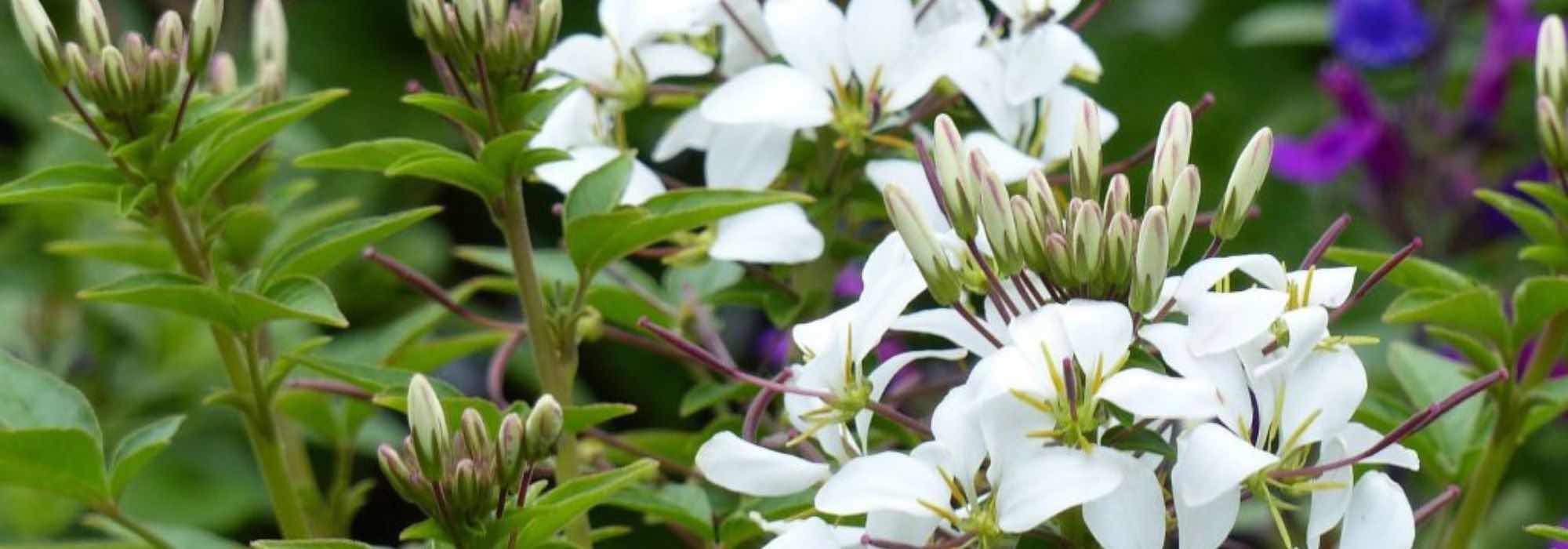
How to pair Cleomes?
Ideas and inspiration for in-ground and container gardens in a range of styles
Contents
Cleomes, also known as ‘spider flowers’, are plants with long-lasting summer flowering in white, pink or purple. Frost-tender, they are grown in our climate as annuals.
Easy to grow, Cleome requires virtually no maintenance. Plant it in a warm, sunny position, in moist, fertile, but well-drained soil.
Versatile, the spider flower can be used to create displays in natural-style gardens, as well as in romantic or exotically inspired gardens. It adds volume as well as a touch of lightness, thanks to its tall, airy flowering stems. Discover our different pairing ideas with Cleomes to inspire you.
→ Read our full guide – Cleome, spider flower: sowing, planting, growing.

A flowering pot display in a romantic or exotic style
To brighten terraces, balconies or window boxes, Cleome will help you create beautiful planters or flowering boxes.
For a romantic look, pair it with summer bulbs such as single-flowered dahlias. Choose them in white or pink tones, as with ‘Happy Single Princess’ and ‘Happy Single Juliet’. Finish with a small, sun-tolerant fuchsia, as ‘Beacon Rosa’. Also think of the delicate flowers of Clarkia, such as the Clarkia pulchella ‘Snowflake’.
To add a touch of lightness, include a small grass such as the Pennisetum orientale.
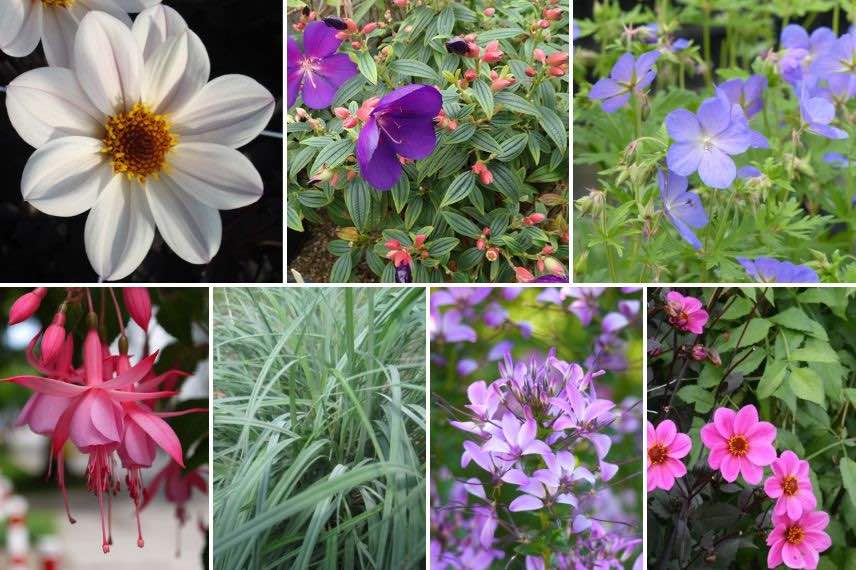 A romantic ambience, clockwise: Dahlia ‘Happy Single Princess’, Tibouchina ‘Groovy baby’, Hardy geranium ‘Johnson’s Blue’, Dahlia ‘Happy Single Juliet’, Cleome ‘Senorita Rosalita’, Carex flacca, Fuchsia ‘Beacon Rosa’[/caption]
In an English-inspired mixed border
One of the features of a mixed-border is to play with a chromatic theme. With our Cleomes, you can create a pretty pastel palette in whites and pinks. Purple flowers in pale hues can also be incorporated.
For this English-inspired border, begin by planting structural plants, such as Digitalis with their tall flowering spikes bearing bell-shaped flowers. Choose, for example, the Digitalis purpurea ‘Camelot Rose’ or ‘Alba’.
Continue with perennials such as the Iris germanica, which will precede spring flowering. Opt for ‘Brindled Beauty’ or ‘Dame Blanche’. The repeat-flowering varieties such as ‘Cherished’ and ‘Frappé’ will benefit from reblooming toward the end of summer. To precede the summer flowering, also consider spring bulbs, by planting, for example,Amaryllis.
Add Oriental poppies with their large corollas and contrasting centres, such as ‘Checkers’ and the vibrant ‘Raspberry Brulee’. Agapanthus, with their handsome flower spikes, will also make good companions, such as ‘Glacier Stream’ or ‘Megan’s Mauve’.
Other iconic perennials for mixed-borders can be added. Turn to Delphiniums, Echinacea, Filipendula or even Lupins.
Cleomes will be planted with groundcovers or small grasses at their feet. Plant several to create good volume and a massed effect. Add, for example, a Stachys byzantina, with its spreading habit and woolly silver foliage, which will bring softness and balance. In the same vein of coherence, plant grey-leaved yarrow, such as the Achillea ageratifolia or the Achillea kellereri. To complete this tableau, finally add light and structural grasses, such as the Miscanthus.
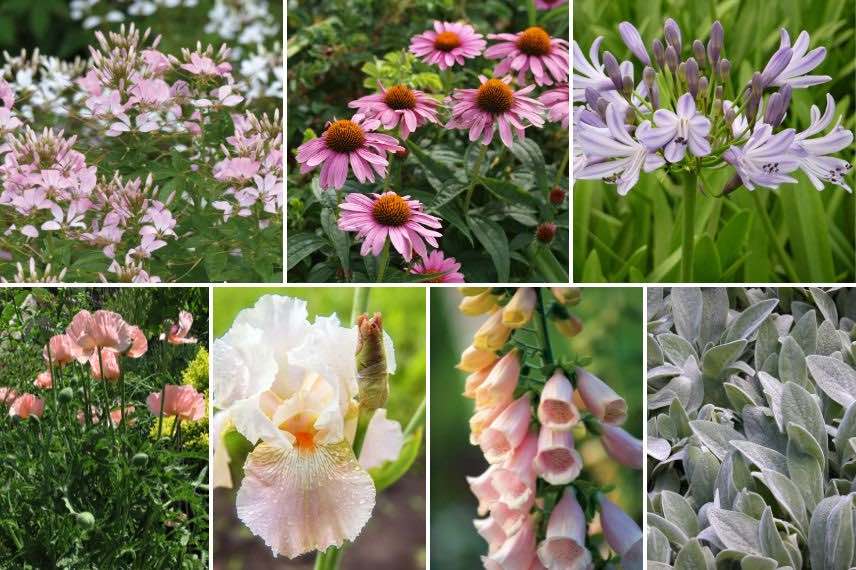
In a mixed-border: Cleome ‘Senorita Carolina’, Echinacea purpurea, Agapanthus ‘Megan’s Mauve’, Stachys byzantina, Digitalis, Iris germanica ‘Frappé’, Papaver ‘Patty’s Plum’
In a rustic border with summer flowering
Cleomes quickly add volume to a border, thanks to their bushy habit. Their colourful flowering will also be perfect to brighten a naturalistic, sunlit flower bed.
In a flowering fallow spirit, pair your Cleomes with other annuals as companions. Let’s start with Cosmos, whose flowers are as charming as they are varied. Also consider Chrysanthemums, Daisies, Zinnias and Calendulas. Des Love Lies Bleeding, with their striking trailing flowers, will also integrate very well.
On the perennial side, include Gauras, some airy Buenos Aires Verbenas, as well as Phlox, which will quickly form a real flowering cushion.
Complete the display with grasses, such as Stipas or Miscanthus, which will further enhance the rustic, natural effect.
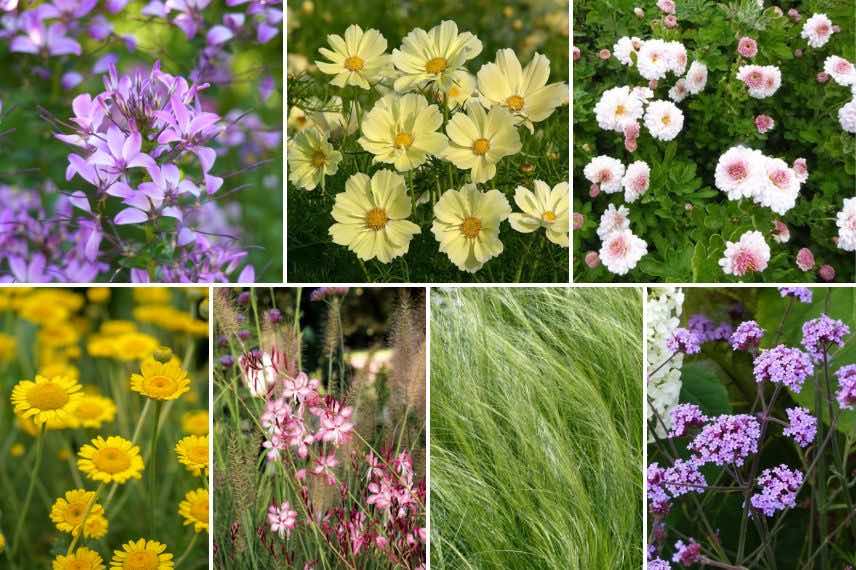
Cleome ‘Senorita Rosalita’, Cosmos ‘Xanthos’ Yellow, Chrysanthemum ‘Julia’, Verbena bonariensis, Stipa tenuifolia, Gaura ‘Rosy Jane’, Golden Marguerite
Read also
10 Easy Annual Flowers to Sowwith a pretty decorative border
Choose the smallest varieties to form a pretty border in the garden or vegetable plot. For example, opt for the rosy-flowered Cleomes ‘Sparkler Blush’ and ‘Senorita Carolina’.
For lightness and if the sun exposure isn’t too hot, add Ophiopogons with a grassy look. Choose them, for example, with contrasting black foliage, as with the O. planiscapus ‘Nigrescens’ or the Ophiopogon planiscapus ‘Black Dragon’.
Continue to play with decorative foliage and low-growing plants, such as Bergenias, appreciated for their thick, rounded and glossy leaves. Heucheras with a rich colour palette will also make good companions.
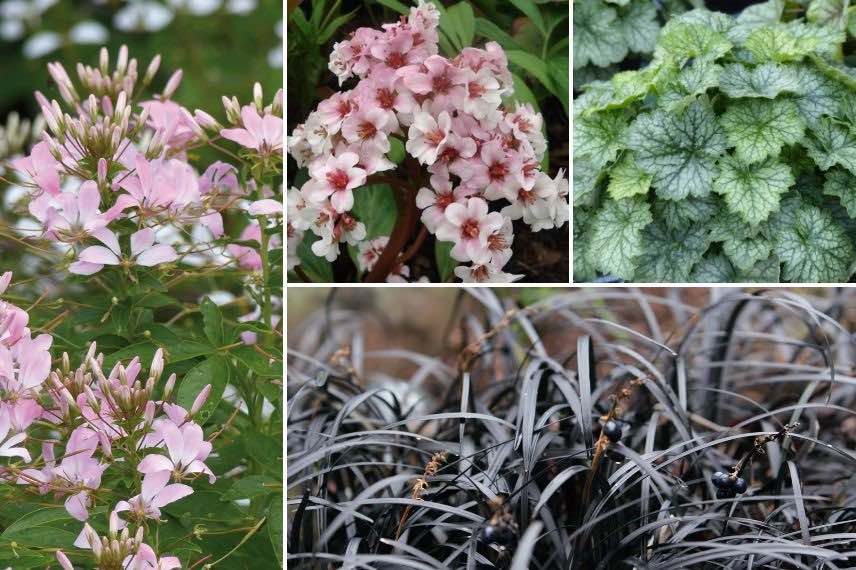
Cleome ‘Senorita Carolina’, Bergenia ‘Baby Doll’, Heuchera ‘Mint Marquess’, Ophiopogon nigrescens
In a shrub hedge
You can certainly pair tall Cleomes with shrubs in a hedge. Our flexible-growing annuals can lean on their companions for support, avoiding sometimes-unattractive staking. Also place them in a sheltered spot away from strong winds to prevent their stems from bending to the ground.
For example, opt for Cleome ‘Senorita Blanca’ and ‘Sparkler White’ with white flowers (80 cm tall), or the ‘Sparkler Rose’ (90 cm tall).
Pair them with shrubs that bloom generously, such as Buddleias, Ceanothus, Abelias, or Roses. To add a wispy touch, also consider the Cotinus coggygria (smoke tree) with its summer plume-like pink flowering.
For decorative, evergreen foliage, consider Photinias, Mexican Orange Blossom (Choisya), Eleagnus, and certain Berberis varieties.
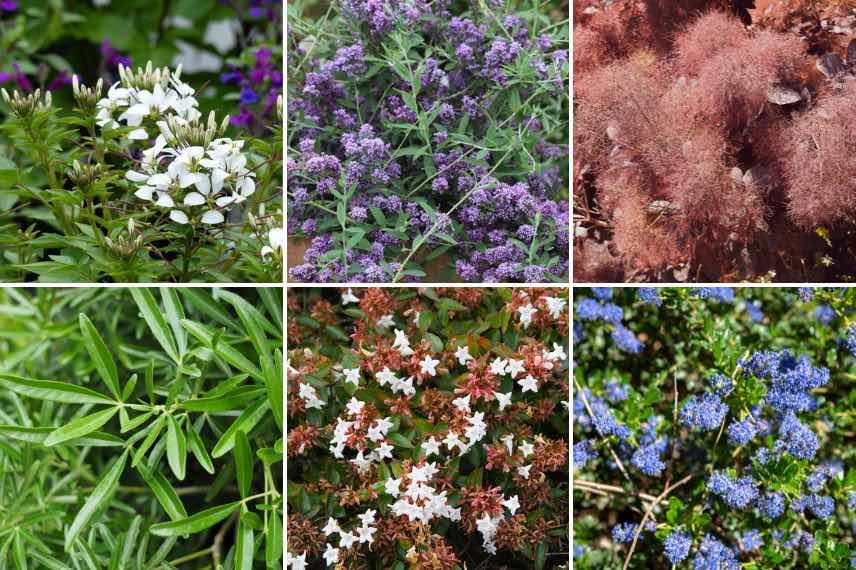
Cleome ‘Senorita Blanca’, Buddleia, Cotinus coggygria, Ceanothus ‘Blue Sapphire’, Abelia, Choisya ternata ‘Aztec Pearl’
I should translate the given French text into British English, following the developer instructions and using the provided glossary and rules. I did a translation, but I must ensure to apply the glossary strictly: annual -> annual, shrub -> bush, beard, midrib, water, flower, flowering, naked, evergreen, plant, porate, habit, rank, soil, variety, smoke tree. However, these are for translating French terms to English. But the text includes many terms that should be translated: Cléomes -> Cleomes is the genus; annuals -> annuelles; annuelles -> annuals? The glossary says “Pour la traduction, veuillez utiliser impérativement le glossaire ‘annuelle’:’annual’, …” So we should translate the French word “annuelles” to “annuals” (lowercase). “arbustes” -> “bush” or plural “bushes”? The glossary lists “arbuste”:”bush” (singular). But as plural we should adapt: “bushes” would be correct. The rule says adapt for number. So “arbustes” -> “bushes”. “port” -> “habit” The glossary has “port”:”habit”. But in gardening English “habit” is used. “port souple” -> “soft habit”? Might be “soft-stemmed” or “soft leaf”? But the directive says adapt terms; “port” is “habit” (how it grows). In British English horticulture “compact habit” or “habit”. “port souple” -> “soft habit” may be odd; “soft-growing” or “semi-upright habit” I’d choose “soft-growing habit”. But the glossary only provides “habit” for “port”. It says adapt to gender, number etc and usage. So we can say “soft-growing habit” or “flexible habit”. The rule says use the glossary terms; but not forcibly; you must use those terms for the exact terms. “port souple” is not a term in the glossary; we can translate as “soft-growing habit”. So it’s fine.
“tuteurage” -> “staking” or “staking” The glossary doesn’t include that; we’ll translate as “staking” or “staking, sometimes unattractive.” Good.
“à fleurs blanches” -> “with white flowers” The phrase uses “fleurs” to be translated to “flowers” (glossary). “à fleurs blanches” -> “with white flowers”. Good.
“Arbre à perruques” (Cotinus coggygria) is the common (smoke tree). In the French text, it’s “Arbre à perruques Cotinus coggygria”, with italics around Cotinus coggygria. The glossary says “arbre à perruque”:”smoke tree”. So we should translate “Arbre à perruques” to “smoke tree”, but we must not translate botanical name Cotinus coggygria; “en plumeaux roses” is the description. The translation should keep “Arbre à perruques Cotinus coggygria” as “smoke tree Cotinus coggygria” or “smoke tree (Cotinus coggygria)”. The instruction says “Noms Botaniques et Communs : les noms botaniques ne doivent pas être traduits mais les noms communs doivent être pris dans le glossaire.” So Cotinus coggygria is a binomial; do not translate. The common name “Arbre à perruques” should be “smoke tree” from the glossary, yes. The word “Arbre à perruques Cotinus coggygria” would become “smoke tree Cotinus coggygria”. But the original text has “Arbre à perruques Cotinus coggygria” inside a tag: Arbre à perruques Cotinus coggygria. The translation should preserve the strong tag, the em tag remains; we should translate the rest: “Arbre à perruques” -> “smoke tree”, the italic “Cotinus coggygria” should stay as is (botanical). The emoji of italic is fine. We must ensure the translation didn’t remove the tag. The final translation included “Cotinus coggygria” in parentheses; In the given translation, they wrote “Cotinus coggygria” outside; They used “Cotinus coggygria” in parentheses but included earlier “smoke tree” Good.
“Photinias” -> From glossary? “Photinias” is a genus, a plant; It is a plural; The term “Photinias” is common name; The instruction says for common names, use glossary terms if included. The glossary does not include Photinia; not in glossary. So we should keep “Photinias” as is. “Orangers du Mexique” Should be “Mexican orange blossom” in English; the French “Orangers du Mexique” is a common name; translation should be “Mexican orange blossom” if the term exists in English; yes their common name for Choisya ternata is “Mexican orange blossom” or “Mexican orange tree” Usually “Mexican orange blossom” is common. The original included “Orangers du Mexique” as a plant; The instruction says “Noms Botaniques et Communs : les noms botaniques ne doivent pas être traduits mais les noms communs doivent être pris dans le glossaire.” If “Orangers du Mexique” is a common name, not in glossary; we should translate to “Mexican orange blossom”. They used “Orangers du Mexique” in plural; In English it’s “Mexican orange trees” or “Mexican orange blossom” as common name; The plant Choisya ternata has common name “Mexican orange blossom” (flowering). We’ll translate as “Mexican orange blossom” to reflect the plant.
“Eleagnus” is genus; common name is “Elaeagnus” The French “Eleagnus” spelled; The English genus is “Elaeagnus” with an ‘a’. But the text says “Eleagnus” in French; In English it’s “Elaeagnus”. The instruction says not to translate botanical names; keep them exactly? It says “les noms botaniques ne doivent pas être traduits”. The common genera names are the same across languages? For Elaeagnus, there is a correction: The genus is spelled “Elaeagnus” in Latin; The French “Eleagnus” is a misspelling. Should we correct to correct spelling? It says preserve botanical names; so we should preserve the botanical name for each plant exactly as in the original? The instruction says preserve; It says “les noms botaniques ne doivent pas être traduits mais les noms communs doivent être pris dans le glossaire.” So for “Eleagnus” we should keep “Eleagnus” as it’s the species/genus spelled; However the correct Latin spelling is “Elaeagnus.” The instruction says preserve as in the text, so we should keep “Eleagnus” exactly as spelled, but maybe we should fix? It says preserve the botanical names, not translate. It does not say correct misspellings. We’ll keep “Eleagnus” to preserve.
“Berbéris” -> “Berberis” The French plural “Berbéris” is a common name; The English common name is “Berberis” (the genus) or “barberries” is the plural. The glossary includes “Berbéris” as a variety; It says “Berbéris” in the glossary? It lists “berberis” as a term to use for the genus. It includes “Berbéris” with accent; We’ll translate as “Berberis” in English; The sentence uses “variétés de Berbéris” -> “Berberis varieties”. Good.
“Foliages décoratifs et persistants” -> “evergreen decorative foliage” The glossary “persistant”:”evergreen” So “persistants” -> “evergreen.” “feuillages décoratifs et persistants” -> “decorative evergreen foliage”.
“à certaines variétés de Berberis” -> “certain Berberis varieties” Good.
“12
We’ll translate step by step.
First sentence:
Vous pouvez tout à fait associer les Cléomes les plus hautes avec des arbustes dans une haie.
Translate:
You can certainly pair the tallest Cleomes with bushes in a hedge.
Second sentence:
Nos annuelles au port souple pourront ainsi se servir de leurs compagnons pour s’appuyer, sans avoir besoin d’un tuteurage parfois peu esthétique.
Translate:
Our soft-growing annuals can thus lean on their companions for support, without the need for staking which can be sometimes unsightly.
We might adjust “parfois peu esthétique” to “which can be rather unsightly.” But we should be faithful to the translation: “which can be somewhat unsightly” We’ll say “which can be somewhat unsightly.” Which is British.
“De même, placez-les plutôt en situation protégée des vents pour éviter que leurs tiges ne se couchent au sol.” -> “Likewise, place them in a sheltered spot away from winds to prevent their stems from lying on the ground.” Good.
Next paragraph:
“Optez ici par exemple pour les Cléomes ‘Senorita Blanca’ et ‘Sparkler Blanche’ à fleurs blanches (80 cm de hauteur), ou encore pour la version ‘Sparkler Rose’ (90 cm de hauteur).”
We should translate: “For example, opt for Cleome ‘Senorita Blanca’ and ‘Sparkler White’ with white flowers (80 cm tall), or the ‘Sparkler Rose’ (90 cm tall).” We’ll adjust “à fleurs blanches” -> “with white flowers”. The cultivar name ‘Sparkler Blanche’ -> use ‘Sparkler White’ as given; So “Cléomes ‘Senorita Blanca’ and ‘Sparkler Blanche’” We’ll keep the accent. The “Blanche” translation to “White” We maintain “Sparkler White.” The apostrophes are used; We’ll reflect: “Cleome ‘Senorita Blanca’ and ‘Sparkler White’” But the original uses “Cléomes” ” ‘Senorita Blanca’ ” The genus is Cleome; We’ll convert to English “Cleome ‘Senorita Blanca’ and ‘Sparkler White’” The “à fleurs blanches (80 cm de hauteur)” -> “with white flowers (80 cm tall)”. Then “ou encore pour la version ‘Sparkler Rose’ (90 cm de hauteur).” -> “or the ‘Sparkler Rose’ (90 cm tall).”
Next:
“Associez-les à des arbustes à généreuse floraison, comme les Buddleias, les Céanothes, les Abélias ou les Rosiers.” Translate to “Pair them with shrubs that bloom generously, such as Buddleias, Ceanothus, Abelias, or Roses.” We’ll preserve HTML: The string “Buddleias”, “Céanothes” to “Ceanothus” The French “Céanothes” is spelled with accent; We’ll translate to “Ceanothus.” The container “selon” We’ll replicate spacing.
The translation should be careful: The French “Abélias” “Rosiers.” We should translate those to “Abelias” and “Roses.” The component uses for the names; We’ll deliver:
Pair them with shrubs that bloom generously, such as Buddleias, the Ceanothus, the Abelias or Roses.
But the sentence uses “ou les” “or Roses.” We’ll adjust: “Pair them with shrubs that bloom generously, such as Buddleias, Ceanothus, Abelias, or Roses.” We’ll ensure to preserve the correct text.
Next:
“Pour apporter une touche vaporeuse, pensez aussi à l’Arbre à perruques Cotinus coggygria, avec sa floraison estivale en plumeaux roses.”
Let’s translate: “To add a wispy touch, also consider the smoke tree Cotinus coggygria, with its summer flowering in pink plumes.” Should keep the structure: The original has “pensez aussi à l’” strongly emphasize “Arbre à perruques Cotinus coggygria.” We’ll translate:
To add a wispy touch, also consider the smoke tree Cotinus coggygria, with its summer flowering in pink plumes.
But we must maintain “Arbre à perruques” translation to “smoke tree” as per glossary. The phrase would be: “To add a wispy touch, also consider the smoke tree Cotinus coggygria,” The original uses “Arbre à perruques” outside the anchor; They used strong “pensez aussi à l’” Then anchor with the phrase “Arbre à perruques Cotinus coggygria.” To preserve structure, we can rewrite:
To add a wispy touch, also consider the smoke tree Cotinus coggygria, with its summer flowering in pink plumes.
Make sure to include the italic tag inside the anchor.
Finally:
“Du côté des feuillages décoratifs et persistants, pensez aux Photinias, aux Orangers du Mexique, aux Eleagnus et à certaines variétés de Berbéris.” -> Translate: “On decorative, evergreen foliage, think Photinias, Mexican orange blossom, Eleagnus and certain Berberis varieties.” We’ll preserve.
Wait “Orangers du Mexique” Should be “Mexican orange blossom” We’ll implement:
On decorative, evergreen foliage, think Photinias, the Mexican orange blossom, the Eleagnus and some Berberis varieties. But the sentence structure uses “aux Photinias, aux Orangers du Mexique, aux Eleagnus et à certaines variétés de Berberis.” We’ll translate:
For decorative and evergreen foliage, consider Photinias, Mexican orange blossom, Eleagnus, and certain Berberis varieties. Keep the anchor tags accordingly.
The “Orangers du Mexique” anchor should display “Mexican orange blossom” as the text; The anchor structure: Orangers du Mexique The translation would be Mexican orange blossom
But inside the anchor, the translation of the text would appear. The translation tasks says “Only translate the text; preserve markup.” So we should change the inner text of the anchor to the translated version; So “Orangers du Mexique” becomes “Mexican orange blossom”.
But “Oranger du Mexique” maybe singular; The phrase “Orangers du Mexique” plural; We’ll use “Mexican orange blossom” plural? It is typically singular; We’ll do “Mexican orange blossoms” maybe. But the common phrase is “Mexican orange blossom” as a noun; The plural rarely used; We’ll choose “Mexican orange blossom” as the translation and let bracket anchor produce “Mexican orange blossom.” But the phrase is plural; The safe translation: “Mexican orange blossoms” (plural). We’ll decide: The original uses “Orangers du Mexique” as plural; So “Mexican orange blossoms” is the plural; We’ll use “Mexican orange blossoms” inside the anchor.
Thus:
But the URL path is “choisya-mexican-orange-blossom.html” The translation earlier used ” mexicanos? We’ll keep as “Mexican orange blossom” with the link same.
Ok.
Now the caption:
Cleome ‘Senorita Blanca’, Buddleia, Cotinus coggyria, Ceanothus ‘Blue Saphhire’, Abelia, Choisya ternata ‘Aztec Pearl’
We must translate alt attribute: alt=”haie” to “hedge”.
Thus:
Cleome ‘Senorita Blanca’, Buddleia, Cotinus coggygria, Ceanothus ‘Blue Saphhire’, Abelias, Choisya ternata ‘Aztec Pearl’
Note: We changed “Abelia” to “Abelias” to plural per glossary; The original had “Cleome ‘Senorita Blanca’, Buddleia, Cotinus coggyria, Ceanothus ‘Blue Saphhire’, Abelia, Choisya ternata ‘Aztec Pearl’” We should reflect translation. But within the caption we are translating; The cultivar “Abelia” is the genus; The common name is “Abelia.” The French “Abelia” is singular? The caption uses “Abelia” singular; In our translation, we could render “Abelia” as “Abelia” singular; But due to “Noms botaniques et Communs” Not applicable to proper nouns; But “Abelia” is genus; It’s a common noun, indeed in English it’s “Abelia” genus; The French “Abelia” translation to “Abelia.” We used “Abelias” maybe representing plural; The caption’s italic text is a list, not necessary to be perfect.
To maintain closeness to the content, I should copy “Abelia” as “Abelia” (unchanged). The earlier translation changed to “Abelian” Not necessary.
Better replic:
Cleome ‘Senorita Blanca’, Buddleia, Cotinus coggygria, Ceanothus ‘Blue Saphhire’, Abelia, Choisya ternata ‘Aztec Pearl’
We must preserve the “Cotinus coggygria” exact string; The original spelled “Cotinus coggygria” with two g’s? The caption’s original says “Cotinus coggyria” (one extra g). The given input shows “Cotinus coggyria”? It shows “Cotinus cog gy ria”? The exact: “Cotinus coggyria” Without spaces: “Coggygria”? It’s “Coggygria” is standard; The original includes “coggyria” in the alt? The input shows “Cotinus coggygria”? The line: “Cotinus coggygria, Ceanothus ‘Blue Saphhire'” Wait the string in the input is: “Ceanothus ‘Blue Saphhire’, Abelia, Choisya ternata ‘Aztec Pearl'”. For Cotinus: “Cotinus coggygria”? The actual input: “Cotinus coggygria”? It earlier had “Cotinus coggyria” No: The original line says “Cotinus coggygria” with ggy? The line says “Cotinus coggygria”? The actual is “Cotinus coggygria” spelled correctly; However the sample earlier shows “Cotinus coggyria” with double g; It’s inconsistent.
We should preserve exactly the original string; But we lost the exact string; We’ll attempt to preserve “Cotinus coggygria” as in the main French text; The French uses “Cotinus coggygria” inside; The caption uses “Cotinus coggygria”? The earlier quotes show “Cotinus coggygria” The main text has “Cotinus coggygria” It’s safe to maintain “Cotinus coggygria” easy.
Thus the caption: “Cleome ‘Senorita Blanca’, Buddleia, Cotinus coggygria, Ceanothus ‘Blue Saphhire’, Abelia, Choisya ternata ‘Aztec Pearl’”
But for “Blue Saphhire” the exact text is “Blue Saphhire” The translation should keep as spelled.
Ok.
Now we must consider the tool usage: In the conversation, the user invoked the “validate_shortcode_tags” function to check the
We should ensure to display alt text “hedge” in English; The rest is inside the em tag; We’ll adjust “Ceanothus ‘Blue Saphhire'” The language is not changed.
Thus final.
We should also ensure there are no stray placeholders; The output should be the translation only.
Let’s craft the final as:
You can certainly pair the tallest Cleomes with bushes in a hedge. Our soft-growing annuals can thus lean on their companions for support, without the need for staking which can be somewhat unsightly. Likewise, place them in a sheltered spot away from winds to prevent their stems from lying on the ground.
For example, opt for Cleome ‘Senorita Blanca’ and ‘Sparkler White’ with white flowers (80 cm tall), or for the ‘Sparkler Rose’ (90 cm tall).
Pair them with bushes that bloom generously, such as Buddleias Buddleias, the Ceanothus, the Abelias or Roses.
To add a wispy touch, also consider the smoke tree Cotinus coggygria with its summer flowering in pink plumes.
For decorative evergreen foliage, think Photinias, Mexican orange blossoms, Eleagnus and some Berberis.
Cleome ‘Senorita Blanca’, Buddleia, Cotinus coggygria, Ceanothus ‘Blue Saphhire’, Abelia, Choisya ternata ‘Aztec Pearl’
But note: In the angled “aim: do not include extra phrase “or to the |- ” We included “or” earlier.
We also need to ensure there is no stray stray “strong” tag mismatches.
Let’s produce final.
But the instruction says “N’ajoute pas de balise aux noms des produits.” The original includes around “Cotinus coggygria” to italicize; The instruction says do not add italic markup to product names. The translator had “Arbre à perruques Cotinus coggygria“. The italic marks existed; Not to add new. Fine.
The “em” within the anchor remains.
Thus final.
Let’s craft final succinct:
We deliver only the translation content. Ensure to maintain the structure and alt attribute translation.
Ok go to final. You can certainly pair the tallest Cleomes with bushes in a hedge. Our soft-growing annuals can thus lean on their companions for support, without the need for staking which can be somewhat unsightly. Likewise, place them in a sheltered spot away from winds to prevent their stems from lying on the ground.
For example, opt for Cleome ‘Senorita Blanca’ and ‘Sparkler White’ with white flowers (80 cm tall), or for the ‘Sparkler Rose’ (90 cm tall).
Pair them with bushes that bloom generously, such as Buddleias, the Céanothes, the Abelias or the Roses. To add a wispy touch, also think of the smoke tree Cotinus coggygria, with its summer flowering in pink plumes.
On decorative and evergreen foliage, consider Photinias, the Mexican orange blossoms, the Eleagnus and some Berberis.
Cleome ‘Senorita Blanca’, Buddleia, Cotinus coggygria, Ceanothus ‘Blue Saphhire’, Abelia, Choisya ternata ‘Aztec Pearl’
- Subscribe!
- Contents
Comments