


How to pair Kolkwitzia?
Ideas and inspiration for different garden styles
Contents
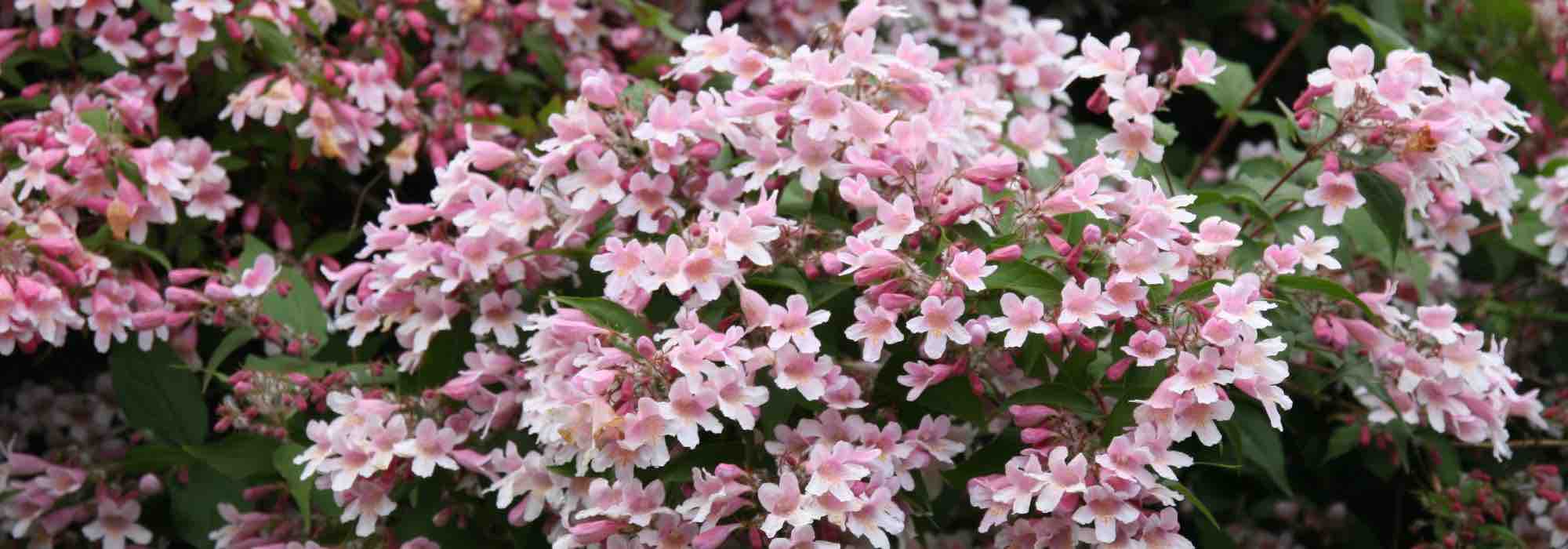
Kolwitzia is also known as “the beauty bush”, which says a lot about its ornamental qualities! Late spring, this bush is indeed covered with a profusion of white or pink bell-shaped flowers, transforming its arching habit into a real cascade.
Hardy and low-maintenance, it’s a shrub that is easy to grow, it tolerates all climates and stands up to cold and drought.
Its delicate flowering and long arching shoots make it a perfect choice for romantic gardens, but Kolwitzia can also easily blend into other settings. So discover our various planting combinations to inspire you with this bush, which deserves a bit more space in our gardens.

Cottage hedge with spring flowering
Kolkwitzia will work wonders in an informal hedge with other spring-flowering shrubs. Its spreading habit, its tendency to sucker and its rapid growth are assets for quickly dressing and densifying a space. It will integrate smoothly into a rustic, natural setting.
Alongside it, cultivate shrubs with a low and compact habit, which will help showcase its arching silhouette. Consider, for example, a small Mexican orange shrub as ‘Little Bee’ or ‘Apple Blossom’. Also think of the Japanese quince ‘Yukigoten’ with its small white-cream flowers, or the Aronia melanocarpa ‘Hugin’.
Add small Deutzias such as the Deutzia gracilis ‘Nikko’ or ‘Yuki Cherry Blossom’. A dwarf cherry laurel such as the Prunus laurocerasus ‘Miniredia’ and a bushy potentilla such as the Potentilla fruticosa ‘Lovely Pink’ will also make good companions.
The yellow foliage of Kolkwitzia amabilis ‘Maradco’ will pair very well with complementary blue blooms. Therefore install it beside a Ceanothus.
Pensez aussi aux véroniques arbustives such as Hebe ‘Claret Crush’ or Hebe ‘Autumn Glory’. Additionally, a small Rhododendron russatum Lauretta ‘Lauretta’, with its clusters of small blue-violet flowers, will also make a good candidate.
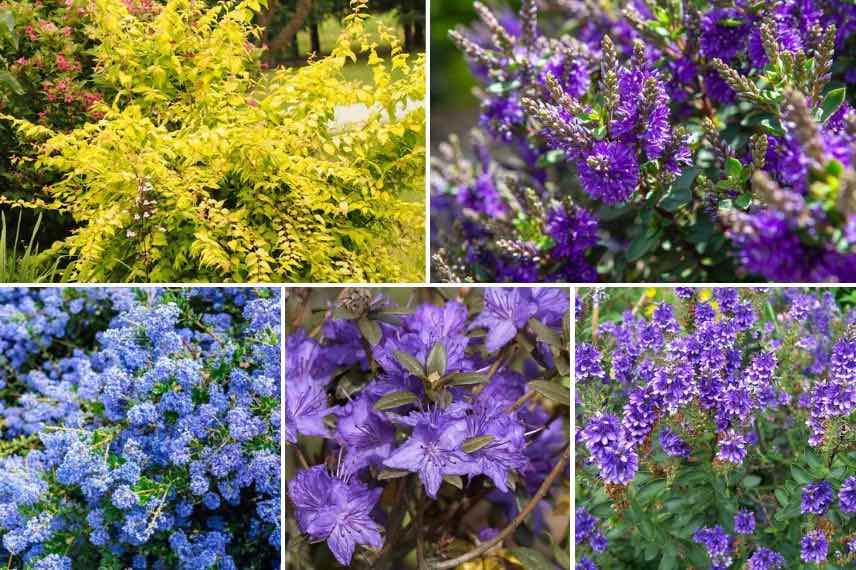
Possible companions for Kolkwitzia amabilis ‘Maradco’ with yellow foliage. In clockwise order: Hebe ‘Claret Crush’, Hebe ‘Autumn Glory’, Rhododendron russatum ‘Lauretta’ and Ceanothus.
Read also
Kolkwitzia : planting, pruning and careWith other bushes bearing decorative bark
With age, the brown bark of Kolwitzia peels away in strips and takes on cream tones. Let’s make the most of decorative bark, which brightens the winter months and adds colour in winter.
Pair Kolwitzia with a Physocarpus, a shrub with attractive coloured foliage, but also prized for its decorative bark that peels in winter.
The Prunus serrula or Tibetan cherry is also valued for its caramel-coloured or mahogany-coloured bark, which shines and peels in long ribbons.
Birches are essential when discussing decorative bark. If you have a large garden, consider including, for example, a Betula nigra ‘Heritage’, which over time will take on a brown-rose to cream hue.
You can also play with decorative branches to complement, such as coloured-wood dogwoods.
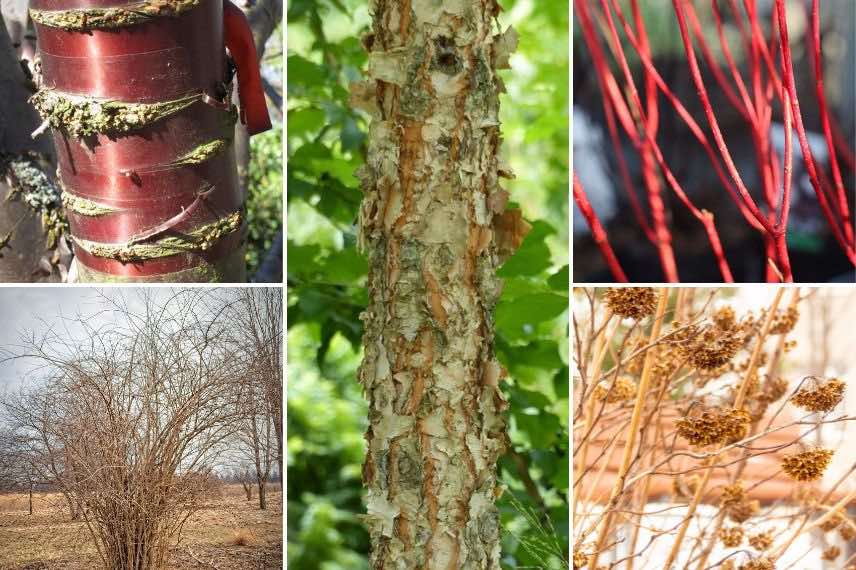
In winter: Prunus serrula, Betula nigra ‘Heritage’, Cornus alba ‘Baton Rouge’, Physocarpus, Kolkwitzia (photo F.D.Richards)
In a Mediterranean-inspired border
Kolkwitzia is a very forgiving bush. It is not among water-hungry plants and tolerates dry soils if they are deep enough, which allows it to be paired with other drought-tolerant plants.
For a Mediterranean ambience, we will pair it with iconic aromatics, such as rosemary, thyme, savory and sage.
Other shrubs will keep them company, such as the pretty rockroses with their cup-shaped flowers having a crumpled appearance. Choose varieties producing flowers in white or pink.
Also think of broom, such as the early-blooming Cytisus praecox ‘Albus’, which will reveal its white flowering at the start of spring. For its part, the Cytisus scoparius ‘Moyclare Pink’ will accompany the flowering of our Kolkwitzia. It will pair beautifully with the cultivar ‘Pink Cloud’ with pink flowers.
In mild climates (frosts down to -5°C), adopt without hesitation a Duranta repens or Cayenne vanilla shrub. Its long flowering, which begins in mid-spring, will accompany our Kolkwitzia. It consists of small blue-violet flowers margined with white.
Add grasses to bring a touch of lightness, such as blue oat grass Helictotrichon sempervirens or a delightful Briza maxima with its spikelets in the shape of hearts.
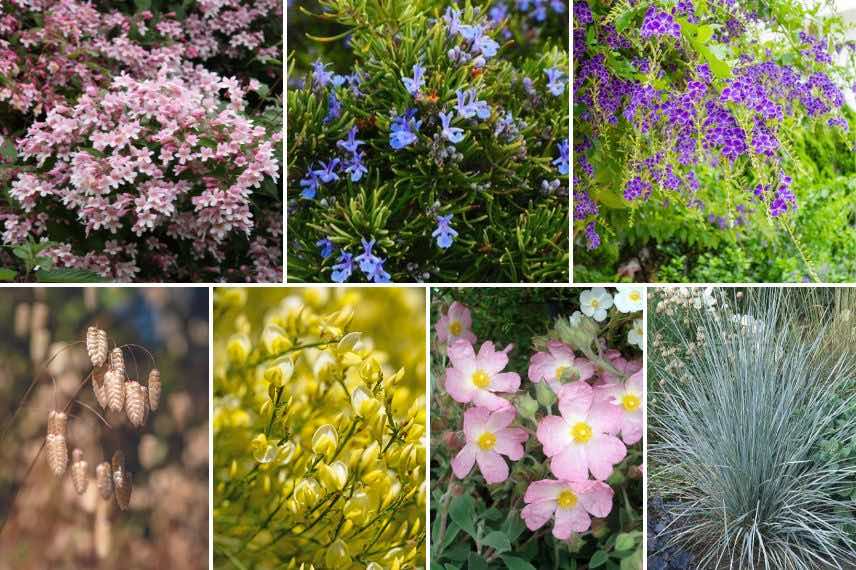
Kolkwitzia, Rosemary, Duranta repens, Blue oat grass, Cistus ‘Silver Pink’, Broom and Briza media
Read also
How to propagate Kolkwitzia?A beautiful autumn scene
Kolwitzia produces small, ovate leaves in a dull green colour. But in autumn they can take on pretty purple hues before falling. This is the opportunity to showcase these colours to create a beautiful autumn display, in the company of other shrubs revealing showy foliage at this time.
As companions, consider Hydrangea paniculata, with their beautiful autumn-colour-changing foliage. Add deciduous spindle trees, with leaves in various colours and decorative fruit. This is the case, for example, with the popular Euonymus alatus. Also think of Liquidambar, with its dazzling autumn colours, but also amélanchiers and Cotinus. Don’t forget the must-have viburnums and Japanese maples too.
To avoid a too busy effect, think of incorporating foliage in more neutral colours, greens or silvery tones, such as with conifers. Grasses will also add a light touch and give the whole display room to breathe.
Finally, think of autumn-flowering perennials to complete this display, such as Asters and Saxifraga cortusifolia.

Autumn foliage of Kolkwitzia (photo F.D. Richards) and of Hydrangea paniculata, Abies koreana, Liquidambar, Aster ‘Rosa Erfullung’, Euonymus alatus, Chamaecyparissus
In a romantic and fragrant garden
Kolwitzia also makes a wonderful specimen when grown as a standalone plant, drawing all eyes and being perfectly showcased. In a refined-looking garden that showcases a variety of fragrances, it will sit alongside many other plants. The flowering branches of our bush can also be used to make pretty bouquets.
First of all, honeysuckles, these climbing plants with multiple qualities. Some varieties will accompany the Kolwitzia’s flowering in late spring. Choose pink-flowering and white-toned blossoms, such as with the Lonicera heckrotii ‘American Beauty’ or the Lonicera (x) henryi ‘Venloma’.
Don’t forget the generous Abelias, which will take over the summer flowering, diffusing a light fragrance. The Philadelphus, whose gentle nickname of “poet’s jasmine” refers to their fragrance, as well as the lilacs with their lovely clusters of fragrant flowers will be just as interesting in late spring. Gardenias will be marvellous, with their pure white, delicately fragrant blossoms of great refinement. And for late winter and early spring, think of Daphnes with intense fragrance, such as the Daphne odora ‘Aureomarginata’ or ‘Perfume Princess’. You will thus have a flowering and fragrant garden for many months, thanks to these staggered bloomings.
A must-have for romantic gardens, roses will also take centre stage. Among the well-scented varieties, try, for example, the large-flowered rose ‘Gérard Depardieu’ in pink, the delicate rose ‘Tobago Odore’ or the adorable ‘Sweet Love’, all with white flowering.
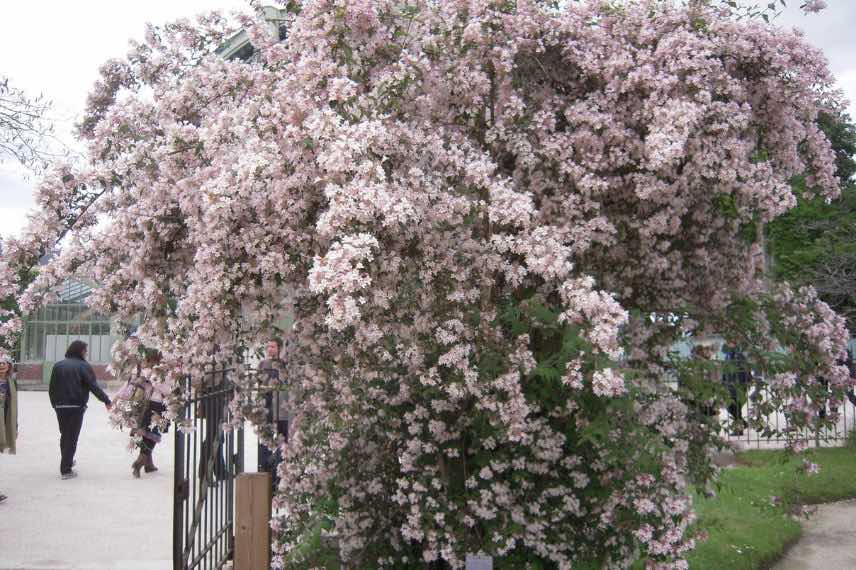
The Kolkwitzia makes a stunning specimen when grown as a stand-alone plant in a garden with a romantic atmosphere (photo: Patrick Janicek)
- Subscribe!
- Contents
Comments