





























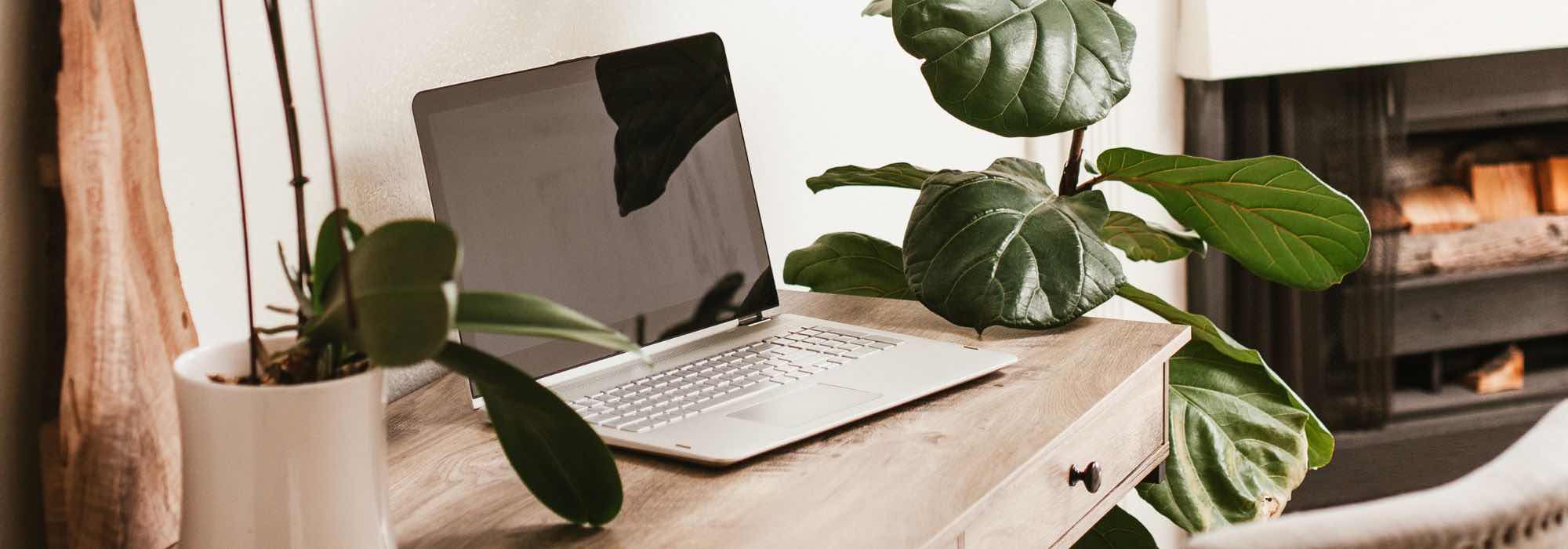
Ideal indoor plants for your office
Our tips to easily green and brighten your workplace
Contents
Whether you work from home, work remotely a few days a week, in an open-plan office or in a private office, the place where you work should be pleasant. This comes down to the layout of the space, as well as the décor. So to brighten up your workspace with ease, why not install a few indoor green plants there?
Here are our tips for choosing the plants to grow in the office and for easily arranging your workspace.

The benefits of indoor plants in the office
The presence of plants in our interiors is first and foremost ornamental. It is indeed easy to brighten and dress a space with just one or two plants, which will bring colour and structure to the space. You can easily create all kinds of ambience: exotic, graphic or rustic. Having plants helps us stay connected to nature. Caring for them is a soothing, screen-free activity, away from screens that demand our attention throughout the day.
Introducing a few plants into a workspace isn’t difficult and will contribute to the overall well-being of all staff. Even better: the presence of natural elements would increase productivity and stimulate creativity, according to a 2015 study by Sir Cary Cooper, Professor of organisational psychology and health at Lancaster University.
Some indoor plants also have air-purifying properties, which would help improve air quality naturally. They would thus contribute to the absorption of electromagnetic radiation produced by our electrical devices and also help reduce pollutants released by the materials around us. These substances include VOCs (volatile organic compounds) such as benzene, formaldehyde or xylene, present as gases in our atmosphere. Carbon monoxide is also an indoor pollutant. These harmful substances can originate from cleaning products, paints, floor coverings, cooking appliances, or cigarette smoke. In addition to regular ventilation, plants will help neutralise these pollutants by storing them in their tissues to provide healthier air.
To learn more, discover:
Read also
The easiest indoor plants to growChoosing the right plants for a workplace
To help you select the right plants for your desk at work, several criteria should be considered.
- The light exposure at your workspace. Is the light bright all day long? Do you have windows that let in sunlight? Or, is your desk a dim space that requires artificial lighting?
- Available space. The choice of plants will, of course, depend on the space you can allocate to them. In a large office, go ahead and opt for XXL plants. In a smaller space, many small plants will fit in without taking up too much room.
- Ease of growing. The aim is not to choose demanding plants that will need a lot of human intervention to thrive indoors. Nor do we select plants to watch them fade away after a few weeks due to inadequate care. The choice should therefore lean towards robust, low-maintenance plants.
- Tolerance to pot culture. Unless your office has outdoor space in the ground, the chosen plants will be grown in pots. So make sure they tolerate this more constrained growing method and that their habit is suited to it. Prefer plants that do not have excessively rapid growth, if you do not want to have to pot up too often.
- Resistance to frequently dry atmospheres. An office contains many electronic devices: computers, phones, printers, air conditioning, fans, etc. They tend to dry the air more quickly, so it is best to avoid plants that require high humidity (ambient humidity).

Selection of plants for a sunlit office
If your workspace has plenty of light and a sunny exposure, you can keep many plants. That’s the case if you work near a south-facing bay window or a large window. Note, however, that most plants won’t enjoy being directly exposed to the sun’s rays. Move them a few centimetres away from the window.
Among perfect office plants for bright light, here is our selection.
- The succulent plants, such as Aloe vera, known for their many virtues. Also considerEcheverias, perfect for cramped spaces. They are particularly attractive, thanks to their fleshy, architectural and often colourful foliage.Crassulas are equally interesting, with their varied leaf textures. These undemanding plants require little care. Water simply when the foliage begins to lose its fleshy texture.
- Some cacti, such as Cereus peruvianus, would have a very good capacity to absorb electromagnetic radiation, particularly intense in an office. Also consider the Cereus forbesii ‘Spiralis’. These pillar cacti have a vertical silhouette easy to incorporate indoors, bringing graphic interest and elegance. Just like succulent plants, they don’t require much care. Water them occasionally when the substrate is dry.
- Dwarf palms. Some palm species have a compact habit suitable for pot cultivation, and also tolerate the air in our interiors. They will therefore be perfect for adding an exotic note to an office. For example, the dwarf date palm dwarf date palm Phoenix roebelinii, which will tolerate occasional overwatering or forgetfulness. The Areca and the Kentia are also good candidates, easy to care for. They will appreciate regular misting of their foliage.
- Finally, why not try a fruiting plant in the office? Calamondin is one of the few citrus trees to tolerate indoor conditions. It will bring colour and fragrance, thanks to its long flowering and fruiting, both particularly decorative. It is a plant that will, however, require more care: watering as soon as the top of the substrate is dry and regular misting of the foliage. You can also place it on a bed of clay pebbles to optimise humidity.
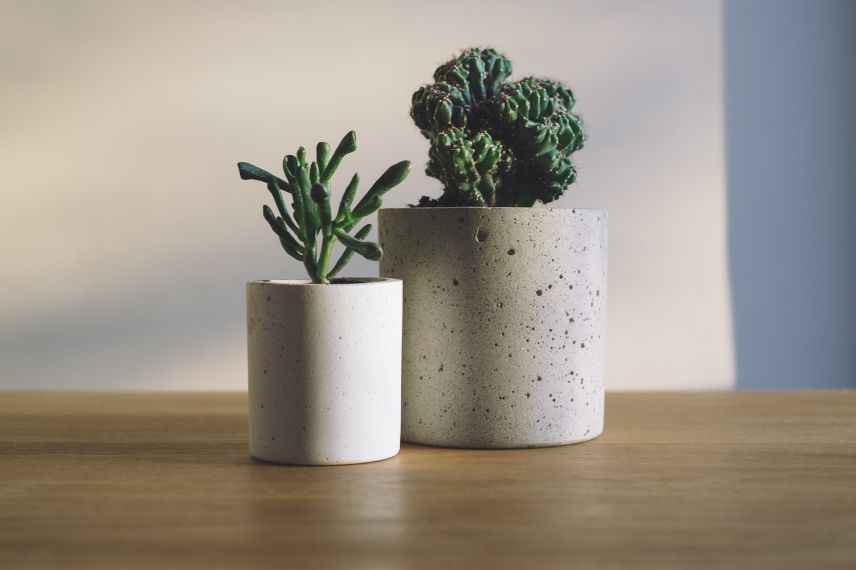
Succulent plants and cacti such as Cereus are very easy to care for, suitable for the office provided that daylight is strong
Read also
XXL indoor plantsA selection of plants for a more softly lit office
These are offices that receive partial light for a few hours a day, for example with west-facing exposure. They have windows, but are rather set back.
Here is our selection of plants for semi-shaded exposure and offices with subdued light.
- Chlorophytum or spider plant, ideal for dressing shelves or for hanging, thanks to its trailing habit. It takes up little space and only needs watering when the surface of the potting mix is dry.
- Dracaenas, these plants with pretty ribbon-like foliage, sometimes variegated.
- Ficus, such as the rubber plant (Ficus elastica). Its large leaves add lushness and the plant is easy to care for.
- Philodendrons and Monstera (false Philodendron): popular green plants in our interiors, thanks to their attractive foliage and their habit of rapidly forming large lianas. They should be trained on a support (trellis, stake…).
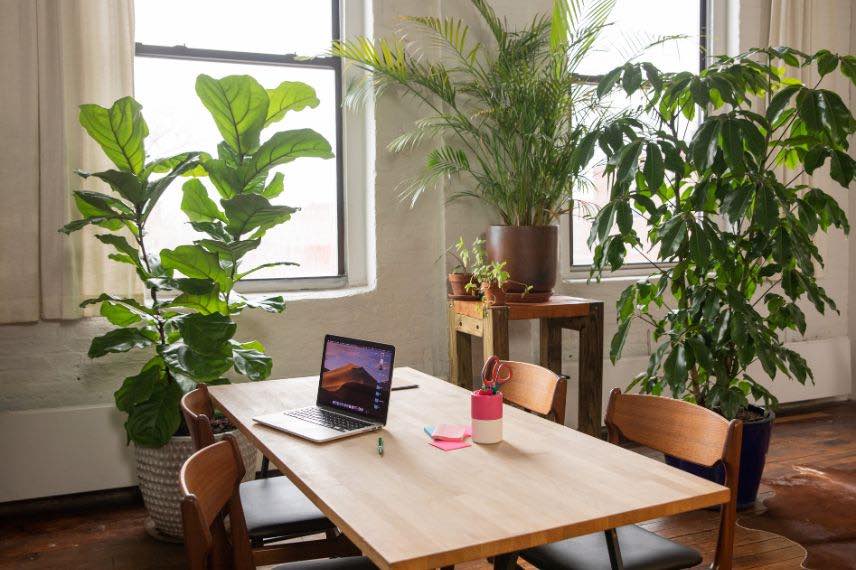
Here, two Ficus and a palm form handsome focal points around the workspace
A selection of plants for a dimly lit office
This exposure concerns offices that are far from windows and receive little natural light. They may face east or north, in a shaded location. However, note that even shade-loving plants require a minimum amount of light to survive. If your office is in a closed room, with no opening and no natural light during the day, the plants will struggle to thrive (unless suitable artificial lighting is installed).
Here are a few low-light plants for dark offices.
- The common ivy Hedera helix, a plant that is commonly found in nature, very easy to care for and aesthetically pleasing. It can be grown as a climber or used as a hanging plant. It will simply require regular watering to prevent the soil from drying out.
- Sansevieria, a very graphic houseplant, with its lanceolate leaves that grow vertically. This succulent is really easy to care for and can even be left unattended without suffering. It is, in fact, more susceptible to overwatering than to drought.
- Ferns. While many ferns are accustomed to damp woodland understories, some species can adapt to indoor spaces. This is the case of the Asplenium nidus or of the Phlebodium pseudoaureum, with very ornamental foliage.

Sansevierias are very forgiving when it comes to light levels
How to arrange your plants in the office?
To arrange the plants harmoniously in the office, follow these simple tips.
- Place your plants away from drafts, which are generally unfriendly to plants (entry doors, ventilation, air outlets, etc.).
- Protect sensitive surfaces. Add saucers or cachepots to prevent staining or damage to certain surfaces (carpets, parquet flooring, etc.) or your desks.
- Group the plants in pairs or threes in a room, to create a more aesthetically pleasing mass. This will also favour natural humidity, with the plants benefiting from each other’s evapotranspiration.
- Use different supports to add variety: standard pots, troughs, hanging baskets, etc.
- Place large plants on a rolling stand, to make moving them easier.
Caring for indoor plants
To keep plants in good health at the office, you’ll need to carry out some basic care.
- Regular watering. You can choose to place your plants near a water source (for example, a sink) to make this step easier. In any case, plan for easy-to-access watering to minimise the risk of forgetfulness.
- Leaf cleaning. At least twice a year, in spring and autumn, dust the leaves of the plants with a clean, slightly damp cloth. This helps remove dust and will enable the plant to photosynthesise more effectively.
- Fertilisation. It isn’t necessary for the most undemanding plants, but can give a boost to the growth of some indoor plants. In pot culture, the substrate depletes its nutrient reserves more quickly. Choose a liquid fertiliser that is easy to dilute in the watering water, or a fertiliser in the form of a stick or granules that can be incorporated into the substrate. Fertiliser application can take place from spring to autumn.
- Pruning. It will often be limited to removing faded, yellowing or damaged leaves. Proceed with a pruning shear always disinfected beforehand.
- Repotting. It will take place every 2–3 years, depending on the plant’s growth.
Regular observation of your plants will help you manage any parasitic attacks, which can be common indoors (scale insects, aphids, thrips, etc.). If an infestation occurs, use a natural insecticidal soap.
Finally, plan for your absences. If you’re alone in the office, ask a friend or relative for help or install systems to water the plants automatically (drip tubing, ollas…). If you have several colleagues, you can create a rota and organise rotations for plant care.
For more information:
- Subscribe!
- Contents
Comments