





























Indoor palm: how to grow Areca palm?
Growing tips and care of the florist's Areca palm
Contents
Fancy an indoor plant with lush foliage to give your living room a touch of paradise-like jungle? Areca is the plant you need, as its palmate leaves form a beautiful, erect and dense tuft. With a channelled feather grass stalk, the Areca is in fact a palm in the family Arecaceae, a beautiful family that includes among its members other palms such as Copernicia, Phoenix, Sabal, Trachycarpus or Washingtonia. Unlike its cousins, the Areca proves a touch frost-prone, which means, in our latitudes, it should be grown indoors only. It will be a hit with its green, evergreen leaves.
Discover how to plant, grow and care for the Areca, a palm with decidedly exotic foliage.

Areca palm, a palm with luxuriant foliage for indoor use.
Let’s start with a quick introduction to this famous palm that should easily find a place in your home. The plant commonly known as Areca is actually l’Areca lutescens, which also bears the scientific names Chrysalidocarpus lutescens or Dypsis lutescens. But it can also be found under vernacular names such as Areca palm, golden palm, florist’s palm or multipinnate palm. But, to keep things simple, we will simply call it Areca.
A palm tree over 10 m tall in its natural habitat
Originating from Madagascar and the Comoros, the Areca is therefore a tree palm in the Arecaceae family that thrives particularly in well-watered rainforests. There it easily reaches 10–12 m in height. Under our latitudes, its growth will be much more modest and it will not exceed 2–3 m in height, with a relatively narrow spread, since the Areca palm has an upright, erect habit, rather tufted and dense. In its natural habitat, this palm bears yellow flower clusters that hang beneath the crown, followed by elongated fruit that turn from yellow to brown. Obviously, indoor growing conditions do not permit the Areca palm to flower and fruit, but it will offer you luxuriant foliage in a bright green that lasts year-round.
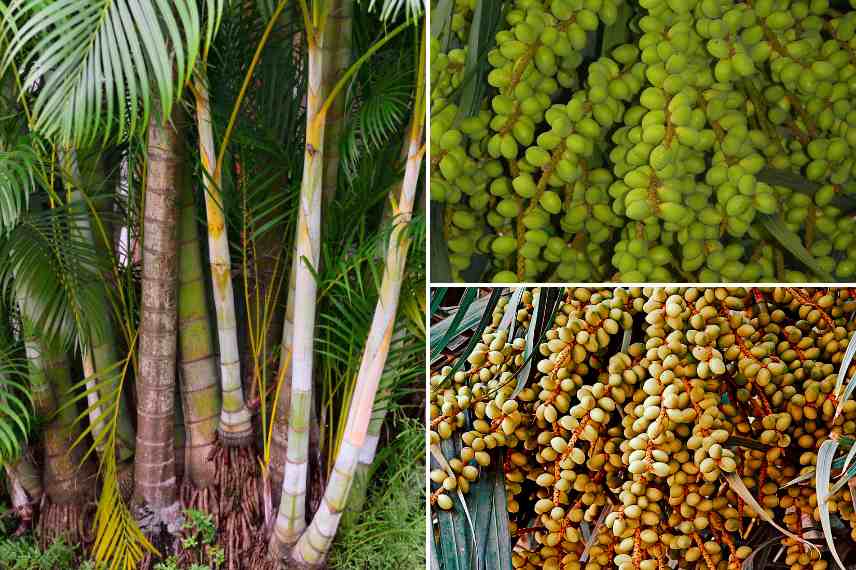
In its natural habitat, the Areca can reach 10–12 m, flowering and fruiting
A plant with handsome, dense, palmate foliage
Because the Areca’s main asset is, of course, its palm-like foliage. Its long fronds, pinnate and dissected into lanceolate leaflets, grow in a crown from a rather fine stipe (trunk). In young plants, the fronds are quite soft and irregular, but they become thick and regular with time. The fronds of the Areca are green, but can take on a yellow tint. The oldest fronds can even turn golden yellow. Hence its vernacular name the golden palm.
As for the trunk, it is marked with rings where leaves have recently fallen. Sometimes, black spots form at the base of the trunks.
With age, the Areca produces suckers that enlarge the clump. Over time, the trunks multiply and the Areca becomes a plant with very dense foliage.
With its exuberance, the Areca palm is therefore an ideal plant for bringing an exotic touch to interiors. Moreover, the foliage is not at all toxic to children or pets. It is also a plant that is said to have air-purifying and cleansing properties. However, its oldest leaves can be sharp to the touch.
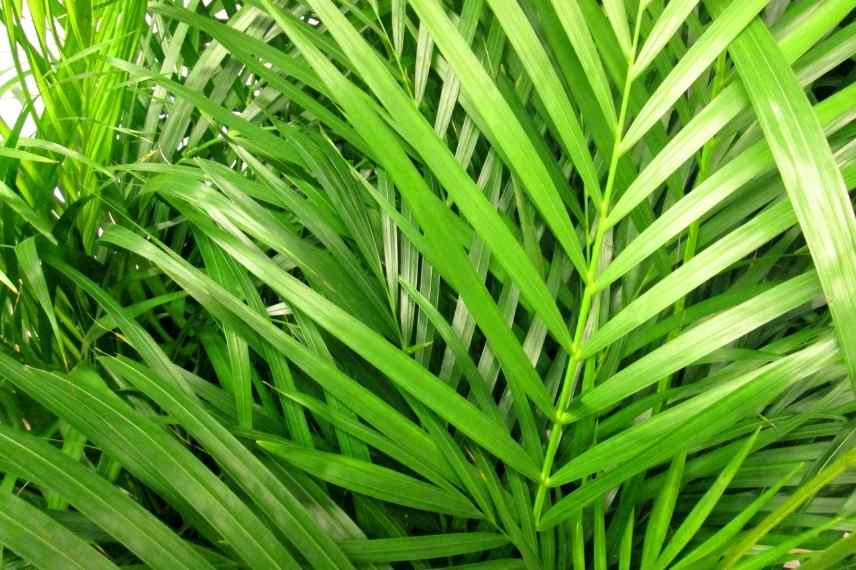
The Areca features lush, palmate foliage
Read also
The easiest indoor plants to growPlanting Areca Palms
As a reminder, Areca palm is endemic to Madagascar. That means it requires cultural conditions specific to exotic plants. It will therefore need bright light and warmth, but ordinary soil. In its natural habitat, soil-wise it tolerates poor soil.
What pot should you use?
Most palms prefer to be pot-bound. That’s why, after purchase, a pot the same size as the original pot is more than adequate. It is preferable to choose a terracotta pot, a material that is noticeably more breathable and airy than plastic. As the Areca fears excess moisture, this material is therefore more suitable.
The pot should have drainage holes to ensure good drainage of the potting mix.
It is best to wait until spring to plant your newly purchased Areca. It can wait a little longer in its temporary plastic pot.
What substrate?
The Areca palm grows in unforgiving conditions in its natural habitat. That said, a simple indoor potting mix will do nicely. Even if you have some well-rotted compost, it won’t hurt to use it.
An ordinary garden soil can also be used as substrate, provided you lighten it with the addition of sand. For its part, be sure to fertilise your Areca regularly.
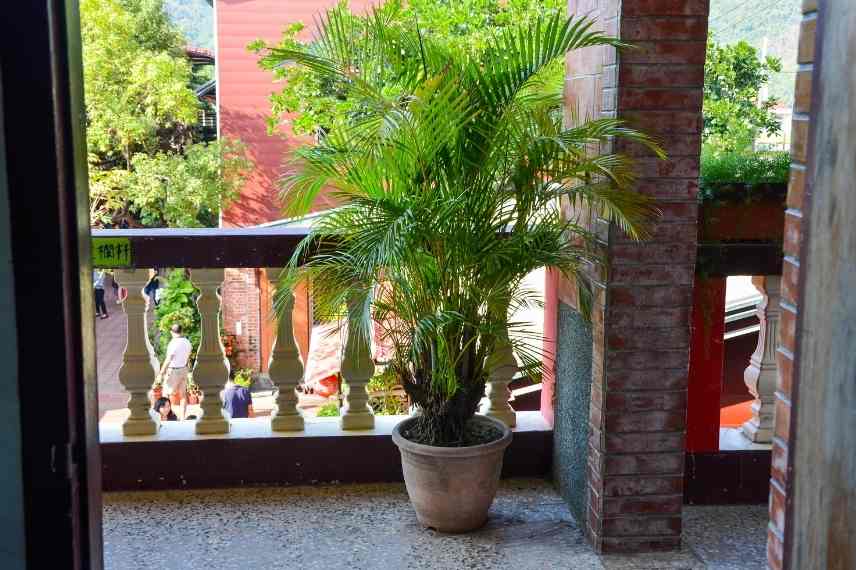
Areca loves warmth and bright light
How to plant it?
- Soak the Areca’s root ball in a basin of water
- Place at the bottom of the chosen pot a layer of clay pebbles or coarse gravel
- Fill the pot halfway with indoor plant potting mix
- Set the Areca’s root ball
- Fill with the remaining potting mix
- Firm the soil with the tips of your fingers to expel air pockets
- Water thoroughly
- Remove any water left in the saucer or cachepot.
Where to plant Areca palm?
Originating from Madagascar, this palm species requires excellent light and warmth, two essentials for its well-being. That’s why it’s essential to place your Areca in a room that receives sufficient light. However, it should not be exposed to direct sunlight. A spot near a south-facing window is perfect, provided that a sheer curtain filters the sun.
A conservatory will also suit your Areca thanks to its brightness. However, in winter you must monitor the temperature. Indeed, the Areca is a cold-sensitive palm that won’t tolerate temperatures below 15°C. Therefore, in a conservatory that isn’t heated, you must monitor the temperature, especially at night.
In summer, from June to September, the Areca palm will enjoy a spell outdoors in the garden. Position it in a shaded but bright spot, or in partial shade, illuminated by the morning sun. Your Areca will appreciate the summer warmth and the afternoon thunderstorms. However, you must remove the saucer or drip tray to prevent water from stagnating.
Because of its cold sensitivity, the Areca cannot be planted in the ground in our latitudes, even in milder climate regions.
Our Areca palm care tips
If your Areca benefits from good cultural conditions, it is not very demanding. As a tropical plant, there are nevertheless a few imperatives to observe, particularly with regard to humidity.
Watering
To determine the correct watering frequency, note that the Areca requires a moist potting mix, but never waterlogged. In spring and summer, during the plant’s vegetative growth period, waterings occur roughly every 2–3 days, in moderate amounts. It is essential to remove any water remaining in the saucer or cache-pot, as the Areca does not tolerate standing water.
In autumn and winter, watering will be more spaced out as the Areca enters its vegetative rest period. One watering per week should be sufficient.
Preferably use water that is not very calcareous, such as rainwater, at room temperature. If you use tap water, let it come to room temperature so the calcium carbonate has time to settle.
Foliage misting
To recreate the ambient humidity of the Areca’s native habitat, foliage misting is advised. Again, use water that is not calcareous, at room temperature. Mist the foliage over and around the leaves to increase ambient humidity.
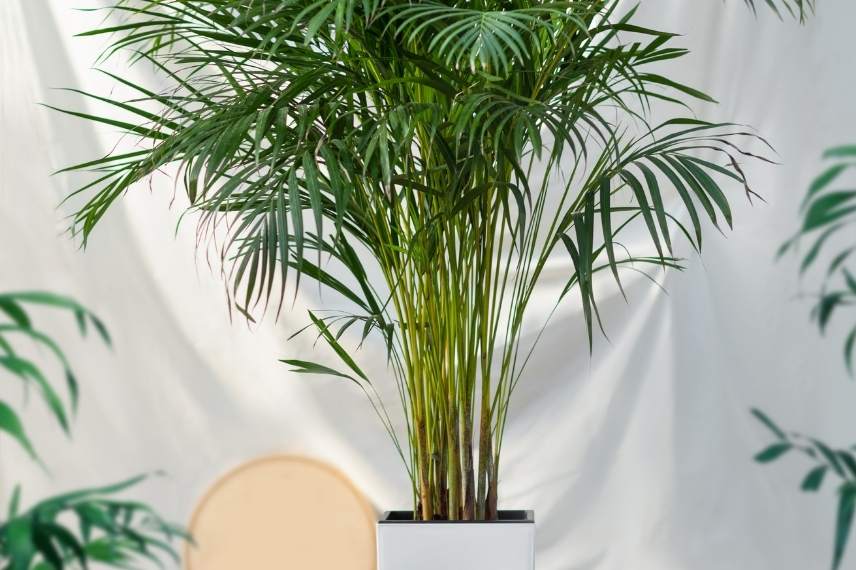
The Areca palm should receive moderate watering and regular foliage misting
Fertilising
We can apply a soluble fertiliser for houseplants, at least once a month, at minimum, in late summer. However, fertiliser applications should be stopped from October to April.
Repotting
The Areca should be repotted every 2–3 years into fresh potting mix that provides nutrients. This repotting takes place in spring.
Pruning
No pruning is necessary. Simply remove any dead or dry leaves at the level of the stipe.
Also read: Areca palm indoor care through the seasons
Main pests and cultivation problems of the Areca palm
The Areca palm is not prone to diseases and pests. However, when humidity levels are not properly maintained, parasitic pests such as red spider mites may appear. Similarly, the Areca palm may suffer scale insect attacks, common on houseplants.
To learn more about the Areca palm
Discover our other articles:
- Subscribe!
- Contents
Comments