





























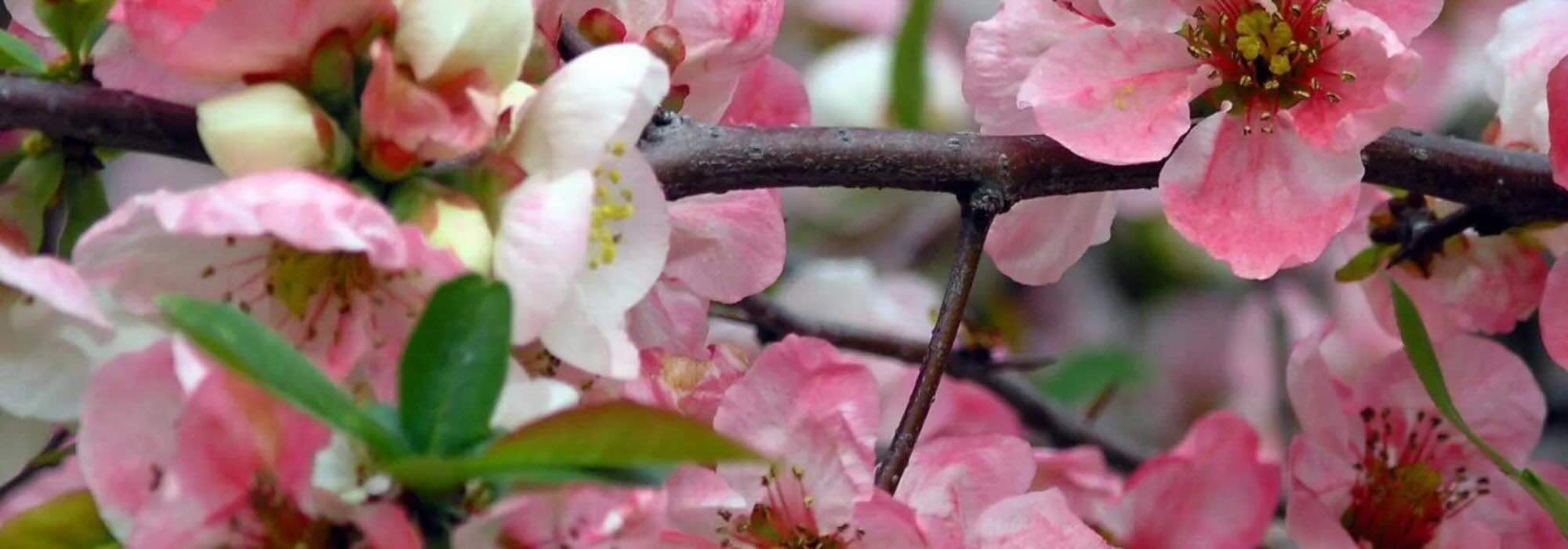
Japanese quinces with pink flowers: the garden's spring awakening
Ideal varieties for hedges, beds and borders and more besides
Contents
Japanese quince is a little marvel in the garden, especially appreciated for its flowering that heralds the end of winter. At a time when most plants are still asleep, it is adorned with bright blooms that warm the outdoor ambience. Pink-flowering varieties offer shades of pink ranging from soft pastel pink to vibrant fuchsia, which catch the eye and provide a unique display, even under a grey winter sky.
Discover the best Japanese quince varieties with pink flowering and how to pair them in the garden, as well as a bonus question about the fruits produced by these shrubs with numerous treasures.

Portrait of the pink-flowering Japanese quince
The Japanese quince or Chaenomeles is a deciduous shrub, meaning it loses its leaves in winter, but it is precisely at that moment that it stands out ! Indeed, its flowers appear directly on the bare branches, making them all the more spectacular. With an average height and width of 1.5 to 2 metres (sometimes more depending on varieties), it has a dense and ramified silhouette that can form impenetrable hedges thanks to its often thorny shoots. It adapts to most soils and is happy in either full sun or partial shade, making it an easy plant to grow.
It’s the flowers that make all the difference! They appear from the end of winter, often in March, and sometimes even earlier if the climate is mild. The flowers of the Japanese quince are like small wild roses, with five thick petals surrounding a heart of golden stamens. The shades of pink vary by variety, ranging from delicate pale pink to intense fuchsia pink, including coral pink or magenta tones.
Each flower becomes a point of light on the dark canvas of the branches. As the first soft green leaves appear, the display is renewed, adding a touch of freshness and renewal to the garden.
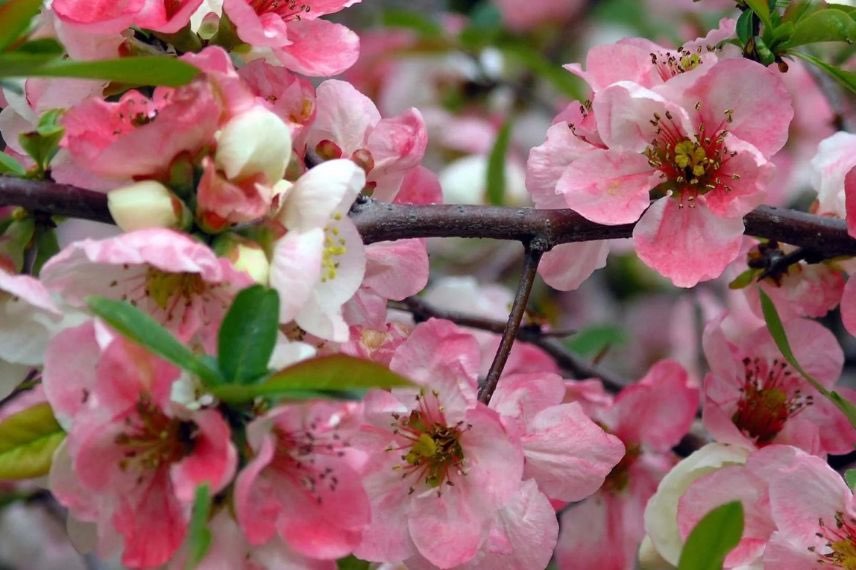
Cultivar ‘Toyo-Nishiki’
Best pink-flowered varieties
The Chaenomeles speciosa ‘Toyo-Nishiki’ is a Japanese variety with a unique charm, as its flowers transition from pale red to deep pink and then white on a single shrub. This changing display runs from February to April on bare, thorny shoots. With a bushy, dense habit, it reaches 3 m high by 2 m wide. Melliferous and hardy, it brightens hedges and borders through the heart of winter.
The Chaenomeles superba ‘Pink Lady’ stands out for its cup-shaped flowers in a vivid, bright pink, which appear in abundance from March to April before the foliage. With a spreading, compact habit, it measures about 1.5 m in height and width. This quince, awarded the RHS (Award of Garden Merit), is ideal as a low hedge, border or bed. Its thorny shoots reinforce its role as a defensive hedge.
The Chaenomeles speciosa ‘Falconnet Charlet‘, ideal for romantic gardens, offers semi-double flowers with crinkled salmon-pink petals that give it a soft and poetic appearance. This dense shrub reaches 2 m high by 1.5 m wide and flowers from March to April. Perfect as a flowering hedge or in a border; it pairs very well with old roses or spring perennials.
The Chaenomeles x superba ‘Pink Trail‘ attracts with its compact habit and extended flowering from March to June. This small shrub, 70 cm to 1.1 m in all directions, offers scented flowers in a vivid pink with a hint of salmon, often grouped in threes to fives on thorny shoots. Its compact size makes it perfect for small gardens, low hedges and even container growing.
The Chaenomeles cathayensis or Cathay quince is a large, vigorous shrub of Chinese origin, still little known but full of promise. With its large pink and white flowers in early spring and autumn fruiting, it delights keen gardeners. Its large yellow, fragrant and edible quinces are harvested in October. Bigger than other quinces, it can reach 4 to 6 m tall and forms a dense, formidable defensive hedge thanks to its sharp thorns.
The Chaenomeles speciosa ‘Pink Storm’ is a true explosion of vivid pink double flowers that evoke camellias. This quince from the “Storm” series is exceptionally hardy and drought-tolerant. It grows to 1.5–2 m tall and wide, forming a dense shrub, but without thorns, which makes it easy to care for. Its lush flowering from March to May makes it a focal point of flowering hedges and colourful borders.
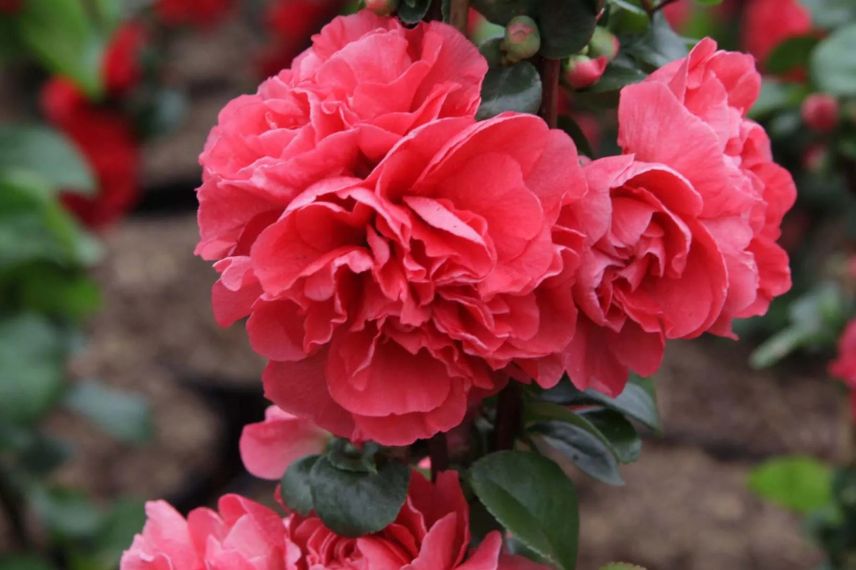
Chaenomeles ‘Pink Storm’
How should you pair them in the garden?
Japanese quince with pink blossoms blend effortlessly into a wide range of planting combinations, whether in a hedge, in a border, as a specimen or on a bank. Their early, colourful flowering, at the heart of winter or at the very start of spring, allows you to create vibrant and ever-changing scenes, at a time when the garden still lacks colour. Their hardy nature and their ability to adapt to different soil types and climates make them compatible with a wide range of plants.
In a cottage-style hedge or a defensive hedge, Japanese quince pair with shrubs that bloom in winter or spring. They can be paired with winter honeysuckle or Lonicera fragrantissima, which precedes their flowering with its small, fragrant white flowers, or with Forsythias, whose bright yellow blooms contrast with the pink of the quinces. The Japanese Kerria, with its golden pom-poms, and the Abeliophyllum, often called “white forsythia”, form harmonious and luminous combinations. To strengthen the defensive effect, spiny shrubs such as hawthorn, blackthorn or Poncirus trifoliata can be included. This type of hedge, both decorative and protective, attracts local wildlife and provides a refuge for birds.
As a specimen plant, Japanese quince become true focal points in the garden. Planted at the centre of a lawn or near a path, they draw the eye with their spectacular flowering.
To highlight their bare branches, surround them with evergreen foliage plants such as laurestines, euonymus or holly, which create a contrast of colour and texture.
In shrub borders, the quinces pair with other shrubs whose flowering follows throughout the season. One can imagine scenes where the quince flowers give way to those of Deutzia gracilis and to dwarf Philadelphus, which take over from the end of spring. Shrub roses, for their part, bring summer flowering and decorative fruit in autumn. Among them, botanical species or Rugosa roses, with their red hips, add extra colour in autumn. Purple-leaved shrubs, such as Physocarpus, add interesting coloured foliage.
On a bank, the quinces help stabilise the soil while adding colour. Their dense, bushy habit helps to mask slopes effectively, and their bright flowering enlivens these spaces often left to neglect. For a Mediterranean look, pair them with drought-tolerant plants such as creeping ceanothus, rosemary and rockroses. Groundcover roses also fit very well on this type of ground, forming a colourful and flowering carpet that prolongs the ornamental effect throughout the year.
Japanese quince respond well to trellising on a sunny wall or façade. By pairing them with climbing plants, such as winter jasmine, which flowers before them, or Clematis montana, which takes over, you can create an evolving floral mural. The contrast between the blossoms of the quinces and light-coloured walls or stone walls is striking. This type of staging is perfect near an entrance, a terrace or a path where you can enjoy the floral explosion at every pass.
Finally, do not forget the potential of quince branches cut for vases. Paired with forsythia sprigs, Japanese cherry or Prunus, they make bright and graphic bouquets that bring a poetic touch to the interior of the home.
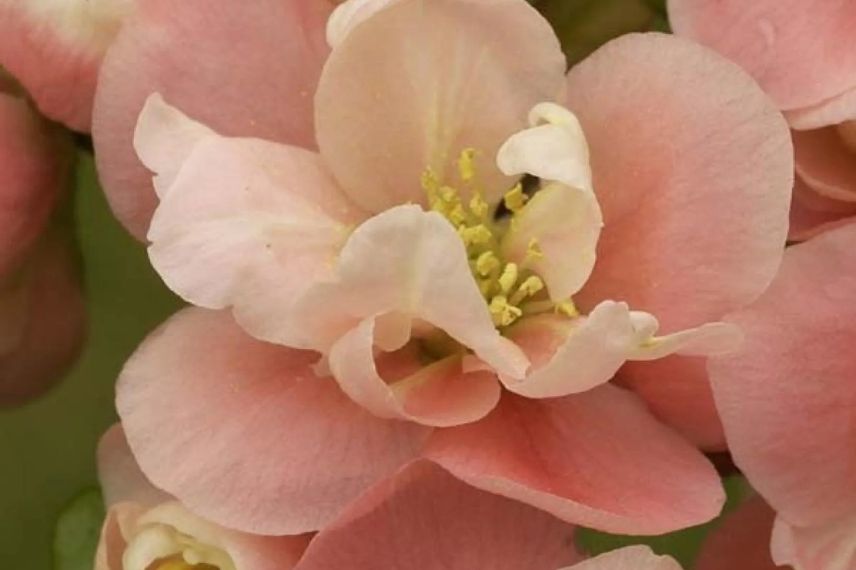
The flowers of ‘Falconnet’ are at home in a romantic border
Further reading: Is the fruit of the Japanese quince edible?
These fruits are generally edible, although their flesh is much firmer and more acidic than that of common quinces. Raw, they are not pleasant to eat, as they are very astringent. However, when cooked, their richness in pectin makes them a prime ingredient for jellies, jams and fruit pastes. When paired with other fruits such as apples or pears, they naturally thicken preparations without the need to add artificial pectin. Their powerful fragrance gives jams and jellies a flavour that is both sweet and tangy.
Among varieties with pink flowers, Cathay quince fruits are the most interesting. This Chinese quince, very close to its Japanese cousin, offers fruits that are no less impressive than the quinces in our orchards.
Also mention the Pseudocydonia sinensis, also a Chinese quince, with pink flowers appearing from April to May. Of great ornamental value, it too yields tasty and highly aromatic fruits.
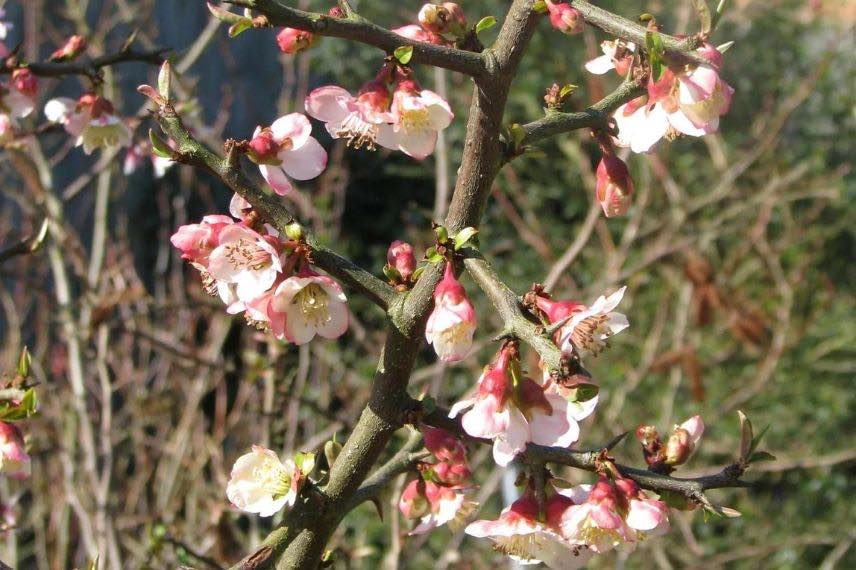
The Cathay quince also yields tasty fruit
- Subscribe!
- Contents
Comments