



Marcescent foliage: an asset for the garden in winter
Definition, role, and benefits of these trees and bushes that retain their foliage in winter
Contents
Generally, two types of foliage are distinguished in plants: those that remain on the plant and those that fall in autumn. However, marcescent foliage trees and bushes have the unique characteristic of being neither truly evergreen nor completely deciduous. This specificity of their foliage, which dies but still clings to the branches during winter, has several advantages in the garden. Let’s explore these advantages and rediscover the most popular species.

Marcescence: an intriguing botanical phenomenon
Let’s start by recalling that deciduous foliage refers to a plant that loses its leaves each year in autumn. With the decrease in light and temperatures, deciduous plants enter a period of vegetative dormancy. They first limit their energy needs by shedding their foliage. However, the loss of leaves also helps to reduce evapotranspiration, which is the loss of water through the stomata of the leaves, at a time when a frozen soil makes water resources less accessible. This is also why the phenomenon of leaf loss can be observed during dry summers. Finally, it is a good way to better protect against frost, to which water-rich leaves are very sensitive.
For their part, plants that retain their foliage throughout the year are evergreen. In reality, they lose their leaves gradually. However, the continuous renewal of foliage gives the impression of permanence. These leaves are generally thicker and tougher. This type of plant, which is less hardy, is more common in regions with mild winters. By extension, semi-evergreens are those that retain their foliage only if winter temperatures are not too severe.
Marcescence is a variant of deciduousness. It refers to a type of foliage that dies in autumn but remains attached to the branches throughout winter, without falling (except in strong winds or heavy rain). It is only in spring, when the young shoots appear, that they detach from the tree or bush. Since the leaves are dead, this helps to reduce energy needs during the cold season. However, the phenomenon is still not well understood, and researchers are still questioning the utility of this in-between state. This type of foliage would provide additional protection against cold and wind while limiting browsing by herbivores (dead leaves have little nutritional value).
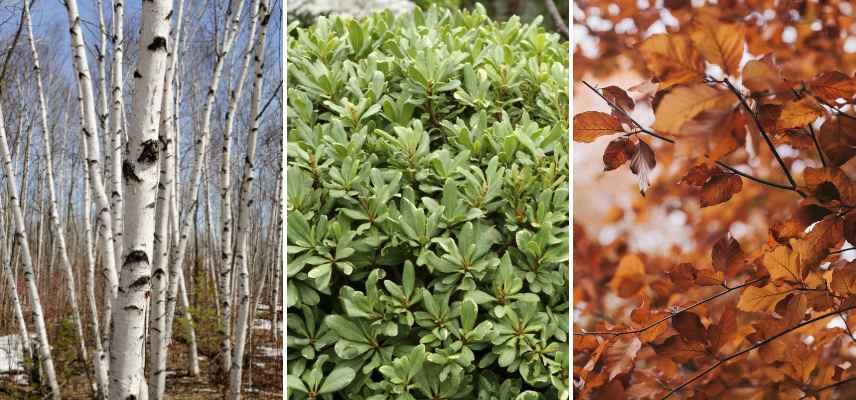
Deciduous birches, Pittosporum tobira ‘Variegata’ evergreen, and marcescent hornbeam
Leaves that deteriorate late
These trees and bushes therefore lose their leaves later, usually at the end of winter. This delays the decomposition process, which is not particularly beneficial for a plant in dormancy and thus allows them to better utilise the nutrients generated at a more opportune time. Early spring is indeed the season for the resurgence of vegetation, the moment when plants often have the greatest nutritional needs to ensure their growth. This is therefore a way for trees and bushes to make the most of the natural fertilisation of their leaves. Furthermore, the leaves benefit from a two-step decomposition process: they will have already begun a first photodegradation by remaining on the branches. Under the influence of winter light, the woody substances would indeed already start to decompose.
Marcescent trees and bushes thus ensure part of their own spring fertilisation, which promotes their growth.
An effective screen or windbreak even in winter
As the foliage dries but remains in place, these plants will continue to act as true protective screens. They are particularly interesting as a privacy or windbreak hedge, allowing for protection from prying eyes or filtering gusts. However, they let through a bit more light than evergreen foliage, creating a sort of light veil that plays with transparency effects. This is a particularly appealing advantage in winter, when the sun is lower and more scarce, adding a touch of poetry and magic.
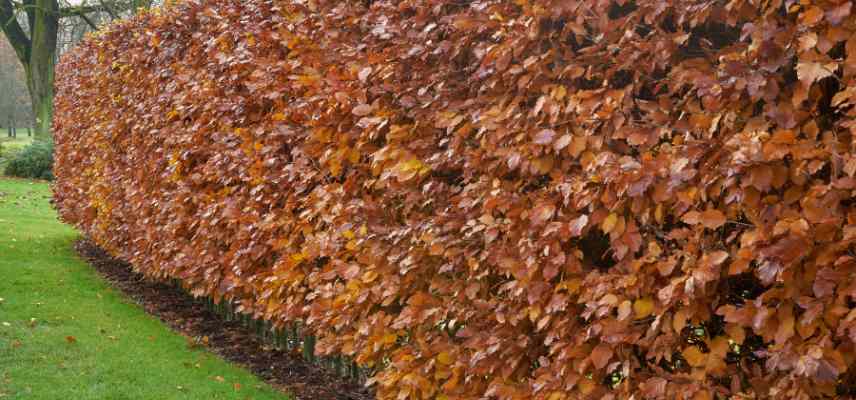
Hornbeam makes a lovely winter privacy screen
Read also
What is marcescence?Easier leaf maintenance
Deciduous plants can require very time-consuming and regular maintenance in autumn. Dead leaves should be collected for various safety reasons (risk of slipping, risk of blocking gutters…) or for aesthetic purposes. With marcescent foliage, there’s no real chore of leaf collection in autumn. In spring, when these plants shed their leaves, the leaves will decompose more quickly due to rising temperatures and the resurgence of activity in the soil’s microcosm. They can even remain in place, providing an interesting nutritious mulch.
A garden that remains lively during the cold season
Deciduous foliage can still change colour. As autumn arrives, leaves take on golden, purple, or brown hues before wilting. However, wilting can also display russet, honey, and copper tones, adding a touch of warm colours to the garden during a more monotonous and less lively period. These trees and bushes therefore have real ornamental value during the cold season.
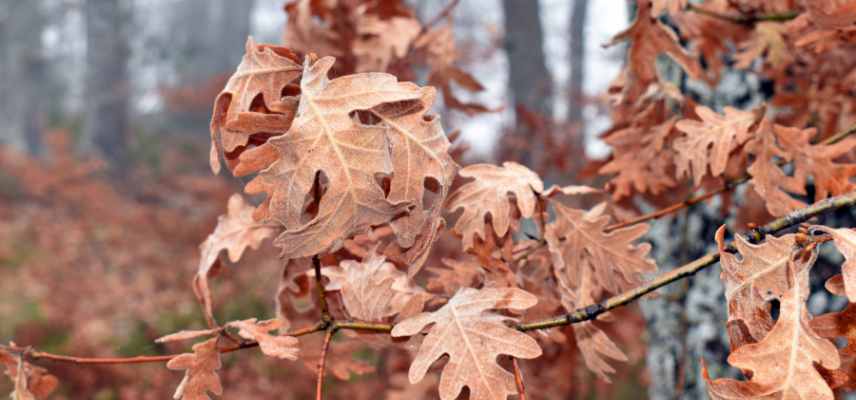
Quercus pyreanica or tauzin oak
Our favourite trees and bushes with marcescent foliage
You are probably already familiar with the marcescent foliage trees that populate our forests in Europe.
Let’s start with the pedunculate oak or common oak (Quercus robur), known for its typical foliage with asymmetrical rounded lobes. It has given rise to many varied cultivars, which are also marcescent. This includes ‘Posnania’, which produces very fine foliage, and ‘Variegata’, with variegated leaves.
Let’s also mention the common hornbeam (Carpinus betulus), an excellent hedge tree, along with its cultivars like ‘Globulus’, a smaller, well-compact version, perfect for small gardens.
Let’s not forget the common beech (Fagus sylvatica), a cousin of the oak. Marcescent foliage can also be found in ‘Marmor Star’, a variegated beech, or in ‘Atropurpurea’, a purple beech.
It is worth noting that marcescence also occurs in some trees when they are young, such as chestnuts (Castanea sativa) or willows.
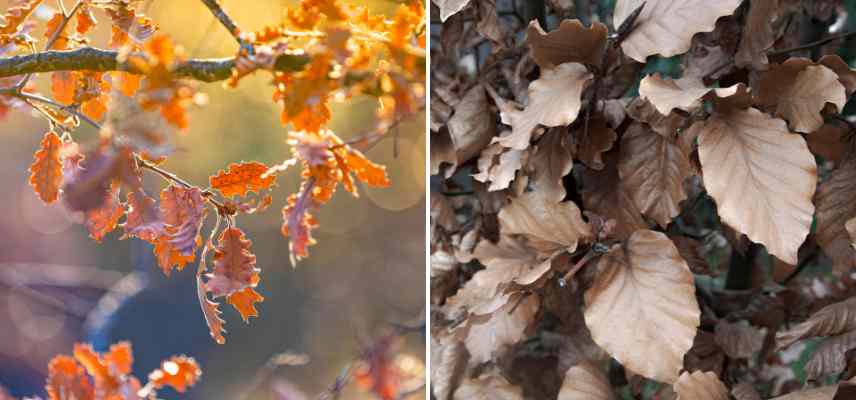
Quercus robur and Fagus sylvatica ‘Atropurpurea’
- Subscribe!
- Contents

Comments