





























Original and fascinating: black-flowered perennials
Rare and captivating, these flowers will not go unnoticed in the garden or in pots
Contents
It is an uncommon colour in the plant world: yet, there are indeed flowering displays or foliage with hues so dark that they appear black. This is the case with many black-flowering perennials. Discover these unique varieties and our tips on how to choose them, for growing in the garden or in pots.

Why choose black flowers?
Black flowers are as mysterious as they are elegant. Fascinating, they cannot fail to impress in the garden. If they must, of course be used sparingly, in small touches, to avoid risking a scene that is too sad and artificial, they allow the creation of unique settings.
Rappelons que The true colour black does not exist in horticulture. They are in fact very dark shades which, depending on the light, will appear almost black. This is the case with purples, reds, violets or even particularly dark and intense browns.
If this colour may seem difficult to pair with the garden, it can actually create striking contrasts and highlight other shades. This will be the case with white, of course, but also with silver foliage.
Black also helps to temper the sometimes a little too naive pastel colours, such as pink, blue or mauve. It adds a modern touch.
If you prefer to play on a beautiful harmony, opt for flowers and foliage in violet, burgundy or purple shades, but in lighter tones.
Ideally, perennials with black flowering should be grown in a bright position, but without too intense sun. The idea is to bring out all their reflections, without breaking the sombre charm of these plants, which will make them even more enchanting. In too dark exposure, however, the flowering is likely to be less noticeable.
For winter
Is there a more fascinating contrast than watching the white of the snow brush against a black flower? Certainly there is, but admit that the scene would still have plenty of charm and elegance!
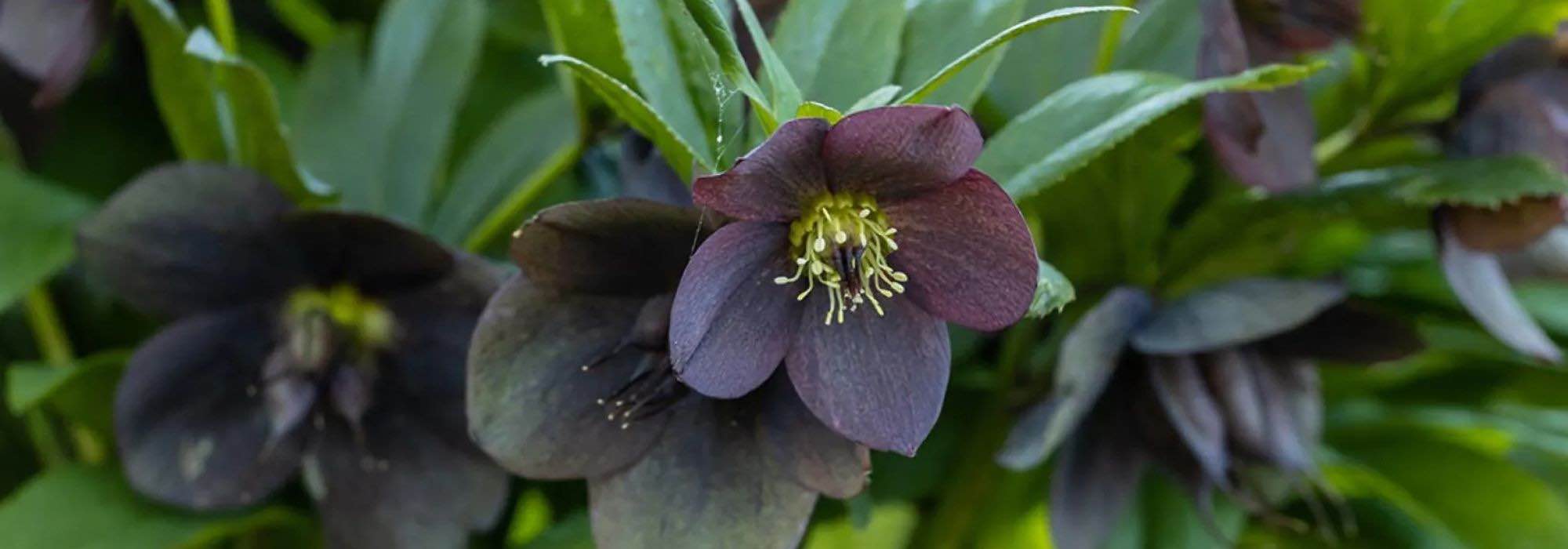
And it’s timely, since hellebores are among those perennials that prefer the cold of winter to the gentle warmth of spring and to the heat of summer in order to bloom. Several varieties of black Oriental hellebores bloom therefore during the cold season, from February to April.
This is the case with the aptly named ‘Black’, whose cup-shaped flowers display a colour almost black, warmed only by orange and red reflections. This very dark shade contrasts nicely with the heart of stamens almost white.
With Helleborus orientalis ‘ViV Luisa’, flowering begins as early as January. It then treats us to double flowers in a purple so dark that it seems black. Here again, the contrast is very interesting with the yellow stamens.
The same goes for ‘Slaty Blue’, which blooms for its part until the early spring, in April. This Lenten rose reveals flowers in slate-black veined with plum. Here again, the cup-shaped, inclined flowers let a nest of very pale stamens be seen, which plays well on the contrasts.
Let us also mention ‘Double Noire’, ‘Anémone Noire’ or ‘Black Chocolate’.
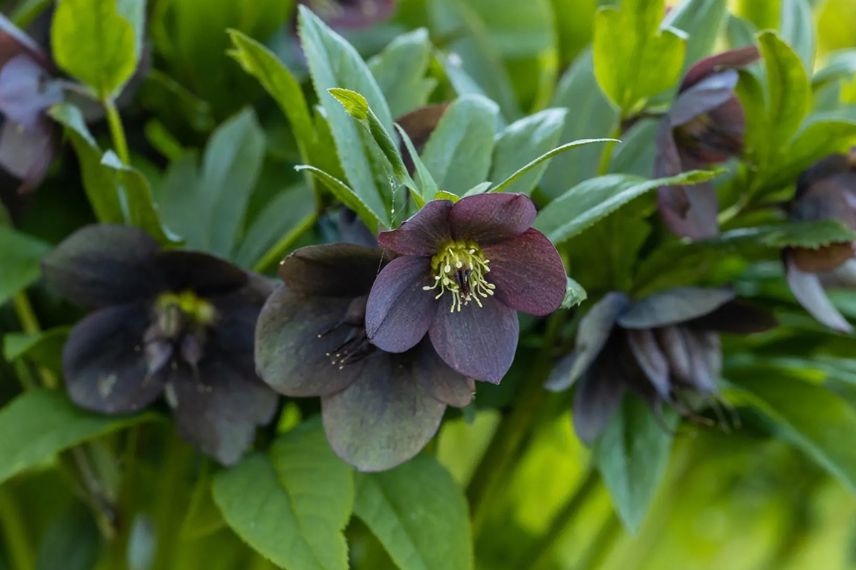
Helleborus ‘Black’
For spring
In spring, daylight lasts longer each day, temperatures rise and the garden awakens. To bring a touch of originality to a border and create volume, why not incorporate a few perennials with black flowers?
You’ll find them first among the Iris germanica. Many varieties play on the captivating charm of dark flowers, paired with the striking geometry of these plants. Together they make real little works of art that catch the eye in the garden or in pots.
‘Black Suited’ flowers in late spring, offering one of the darkest flowers among the large garden bearded irises. Its petals and undulated sepals display a very dark violet, along with a beard of an equally dark shade. Vigorous and floriferous, it’s a variety that does not disappoint. ‘Ghost Train’ isn’t actually frightening: its colour ranges between midnight blue and purple, which gives the impression of a glossy black depending on the light. Flowering also occurs between May and June.
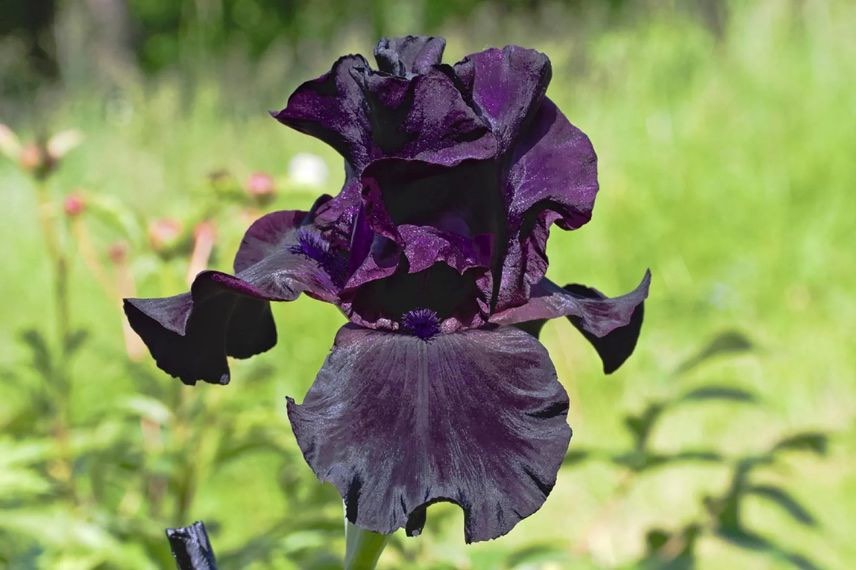
Iris ‘Black Suited’
Earlier, ‘Devil Baby’ is an adorable dwarf variety that measures about twenty centimetres in all directions. Its flowers, a very dark burgundy, offer a silky texture and reveal bronze beards that are very elegant.
In May, it is the Iris germanica ‘Black Watch’ that graces us with flowers of a very dark violet, almost black. Its modest silhouette (about 60 cm tall) makes it less prone to wind than taller varieties.
Let us also mention ‘Old Black Magic’, whose flowers look silk-like and wear a coal-black shade with particularly bright reflections. This contrasts with a mustard-coloured beard.
But irises are not the only black flowers to appear in spring. Viola cornuta Viola cornuta ‘Molly Sanderson’ is, for example, a small creeping plant that flowers for a long time between April and September (thanks to its self-seeding). It tirelessly produces an abundance of small flowers with satin-black petals, warmed by a yellow eye.
The indigo lupin ‘Twilight Prairie Blues’ also flowers in late spring. It then reveals stiff flower spikes in a dark violet colour almost black, with a fine yellow edging.
Finally, even if they are more usually listed among spring bulbs, how could we not mention black tulips? With stunning elegance, they will provide a striking contrast in borders. Choose from:
- the fringed (dentate) tulip ‘Vincent Van Gogh’ with black petals and violet reflections;
- the parrot tulip ‘Black Parrot’ with black petals and red reflections;
- ‘Palmyra’ with velvety dark purple-black double flowers;
- the tulip triumph ‘Black Jack’, bearing a very dark purple.
Read also
Oriental Hellebores: the darkest onesFor summer
From late spring to early summer, admire the Black Sprite Centaurea. These graphically striking flowers have a tousled look that adds a lot of charm, on top of their burgundy colouring with black reflections.
The same flowering period between May and July for the Columbine ‘Chocolate Soldier’.
For a long summer flowering, choose Nonea pulla, a small wild-looking plant, which produces flowers in a very dark purple, almost black.
Among primroses, some varieties also feature flowers with a black-edged collar of petals, enhanced by a white edging and a bright yellow heart. This is the case with the lovely Primula elatior ‘Mister Silver Laced’ and ‘Black Laced’.
Between July and August, it’s the agapanthus ‘Black Magic’ that will turn heads. It possesses one of the floraisons regarded as the darkest ever observed. Its black buds open into bells displaying a very dark indigo blue.
With an equally brooding charm, the black hollyhock stands out from the usual light, sparkling colours of its sisters, offering a flowering of a very dark brown leaning towards black. It provides the spectacle from July to September.
At Rudbeckia occidentalis Rudbeckia occidentalis ‘Green Wizard’, the flowering is quite striking. In summer, this perennial produces a green collar, from which emerges a large spherical cone in black. A particularly graphic variety, enjoyed as much in the garden as in a pot or a cut flower arrangement.
Fans of truly astonishing flowers? Discover the bat flower (Tacca chantrieri). It is primarily its colour—a very dark purple—that is rare. But its name also derives from its strange shape, as it appears to be winged, with long trailing filaments covering small flowers. Slightly demanding in cultivation and temperamental, it will be reserved for enthusiasts.
Finally, returning to irises with Iris chrysographes ‘Black Knight’, which flowers from June to September. Its architectural flowers display a black with purple-tinged and violet reflections.
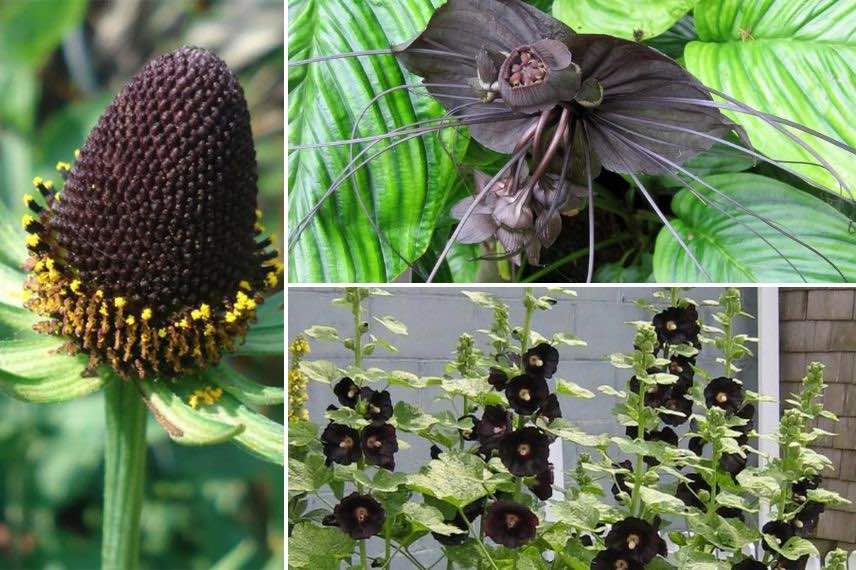
Rudbeckia ‘Green Wizard’, Tacca chantrieri at the top, Black Hollyhock at the bottom
Most fragrant dark-flowering varieties
The blackcurrant sage (Salvia discolor) already has the characteristic of producing small flowers throughout the summer in a deep indigo blue, almost black.
It also stands out for the fruity, tangy fragrance of its leaves, which gives its name to this perennial.
Among scented black flowers, the irises are also worth mentioning: musky in ‘Black Suited’, chocolaty in ‘Black Watch’, or powdery and indulgent in ‘Old Black Magic’.
Very hardy perennials with black flowers.
Do you live in a region with harsh winters, yet still want to enjoy the charm of perennials with black flowers? Opt in this case for black hellebores, able to withstand frosts down to -25°C, just like the indigo lupin and the black cornflower.
Evergreen foliage
Some perennials with black flowering are also evergreen. Their foliage remains decorative year-round. Here again, let us mention hellebores, but also the black pansy or the Cassis sage.
Those for moist soil
On the edge of a bank or a small pond, you can easily plant the Juncus ensifolius. This small rush forms a tuft about forty centimetres across. In summer, it bears small flowers that rise above the foliage, showing their striking dark brown, almost black colour.
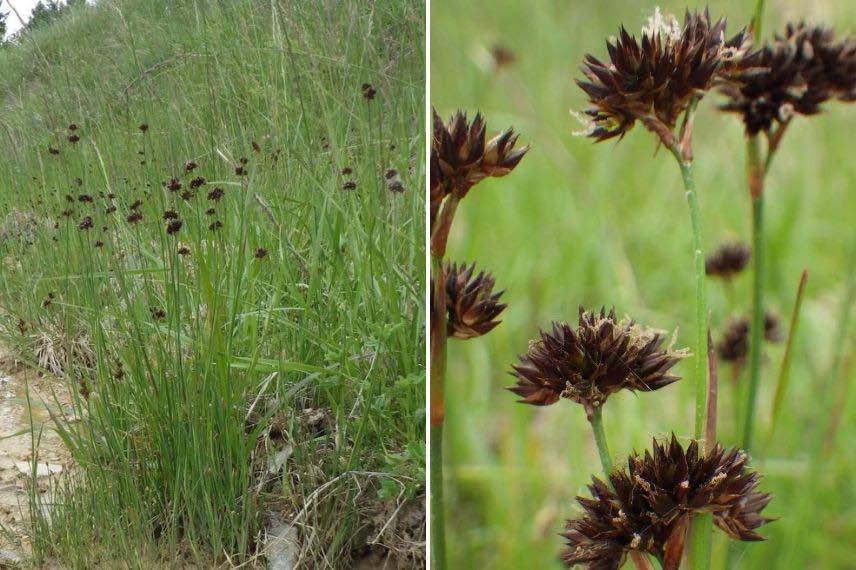
Juncus ensifolius
- Subscribe!
- Contents
Comments