


Our selection of summer-blooming bulbs that thrive in shade or partial shade
Little gems for shaded areas
Contents
Although many gardens benefit from sunny areas where most plants bloom, some shaded corners can sometimes seem neglected and less vibrant. However, shade or semi-shade does not mean an absence of floral beauty. There is a range of summer bulbs that thrive specifically in these gentler light conditions, bringing colour, texture and vitality to these often undervalued spaces.
In this article, we have carefully curated a range of summer bulbs that can flourish in shade or semi-shade. These plants are perfect for completing your garden by offering abundant flowering even without full sun. From the Himalayan giant lily to the charming little Chinese lilies of the valley, our selection promises to transform your shaded areas into a captivating visual display.

Partial shade
Here’s a selection of bulbous plants that don’t just bloom gently in partial shade, but truly thrive there.
Begonia ‘Tuberhybrida Bertini’
Begonias thrive in pots or in the garden, and bloom in summer in partial shade. They also tolerate shaded exposure. The Begonia ‘Tuberhybrida Bertini’ possesses a large tuber, guaranteeing exceptional vigour and a abundant, long-lasting bright red bloom. This plant, which grows in a clumping tuft, continually produces hundreds of flowers grouped in light, trailing clusters, from simple to semi-double.
This cultivar flowers from July to October. At maturity, it reaches 35 to 45 cm in width and 40 to 50 cm in height, forming a densely leafy ball. Its deciduous, fleshy, dark green foliage is alternate, heart-shaped, with dentate margins. Its cup-shaped flowers, not fully opened, are a vivid red around a heart of yellow stamens. After flowering, the plant goes into dormancy and the tubers are grown like dahlia tubers, as it is not hardy.
Begonias do well in well-kept borders, paired with light-flowered plants such as compact gaura and gypsophilas.
Zantedeschia aethiopica ‘Pink Flamingo’ – Calla Lily
Calla lilies prefer warm sites, but in southern regions avoid scorching sun and opt for partial shade. The Zantedeschia aethiopica ‘Pink Flamingo’ is a captivating variant of the African arum, featuring velvety pink flowers that catch the eye. Less vigorous than the traditional arum, but almost as hardy, it tolerates temperatures down to -8/-10°C, which makes it suitable for many climates, though extra protection is needed in colder areas.
The Arum ‘Pink Flamingo’ thrives in rich and moist soils. It is particularly effective for enhancing the edges of water features and damp borders where its glossy foliage and vivid flowers can really shine. Its broad, sagittate leaves quickly form dense clumps, reaching 70 to 80 cm in height and width, providing a lush backdrop for its spectacular flowers which emerge from June to August. The flower opens from a bright pink bud to a pale pink on the outside and almost white inside once fully opened, surrounding a discreet yellow spadix.
Paired with plants such as ferns or astilbes, ‘Pink Flamingo’ adds a splash of colour and elegance and renews interest in arums in modern landscape design.
Cypripedium reginae – Venus’s Slipper
The Cypripedium reginae, or Royal Cypripedium, is a terrestrial orchid also known as Venus’s slipper. Very hardy, it is the largest and most spectacular orchid native to North America. This perennial slowly forms clumps and produces in early summer a few large white flowers with a pale pink to magenta lip. As with many orchids, it thrives when its biotope is meticulously recreated.
Hardy to -30 °C, this Cypripedium dislikes drought and dense shade. It enjoys cold winters and moderately warm summers. It forms tufts of stems with large bright-green leaves, oval to elliptical, with pronounced parallel veins and measures 50 to 70 cm in height. Flowering occurs from late May to early July, sometimes absent in some years, and begins when the plant is at least 4 or 5 years old. The 10 cm flowers have white sepals and petals surrounding a pink to magenta slipper-shaped lip.
Plant it in light woodland shade or on the water’s edge, in partial shade, in well-prepared soil. It pairs well with Trillium, hostas or Rodgersias.
Roscoea purpurea
The Roscoea purpurea, sometimes called False Orchid or Ginger Orchid, with its violet flowers striped with white, evokes the elegance of orchids while being suited to outdoor cultivation. Native to the Himalayas, it thrives in moist, slightly acidic, well-drained soil, preferring sites in partial shade for optimum growth.
This perennial, reaching about 40 cm in height, forms clumps of sturdy tubular stems topped with linear, deciduous leaves. The leaves, a dark green, measure 15 to 25 cm long. In June, the flowers unfold in short spikes, each flower with a long curved tube and three distinct petals, the upper petal rising like a protective helmet and the lower petal, called the labellum, recalling the shape of orchids.
Roscoea purpurea is very hardy and can survive temperatures down to -20°C with light soil and thick mulch for optimal winter protection. Borders with hydrangeas, rhododendrons or azaleas, where the soil tends to be neutral to acidic, are ideal planting sites.
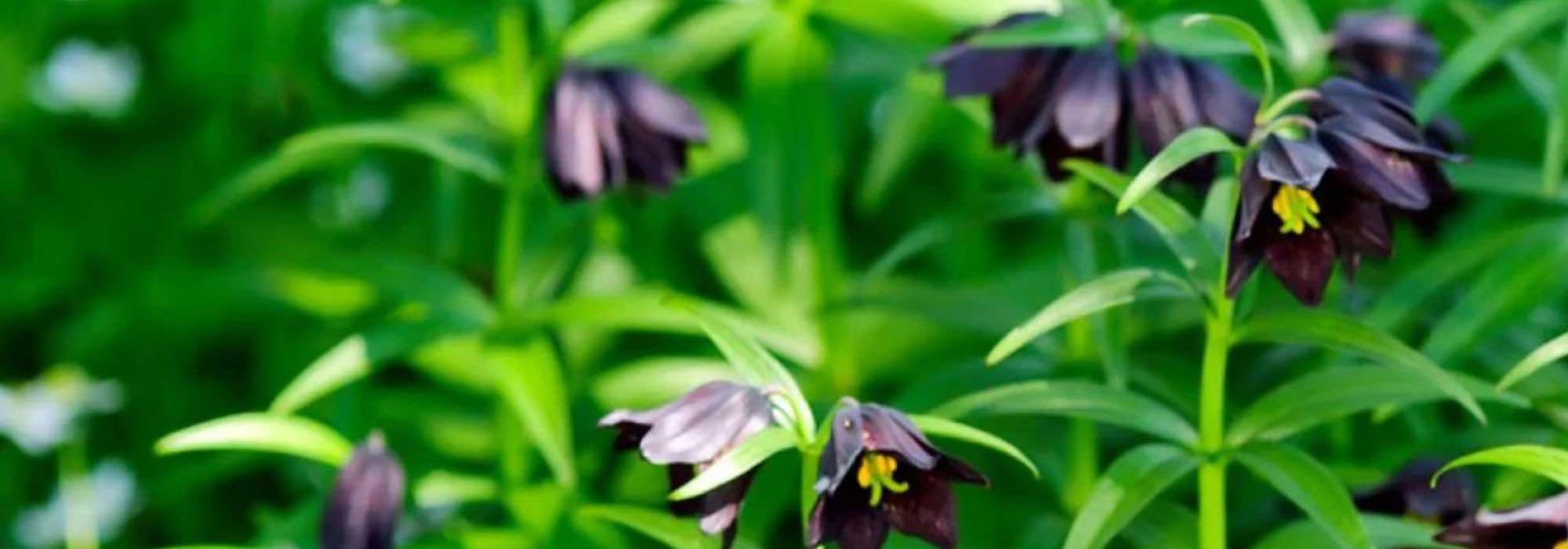
→ Also view Oxalis and Fritillaria camschatcensis or Kamchatka Lily. All alstroemerias prefer partial shade, especially in the southern regions.
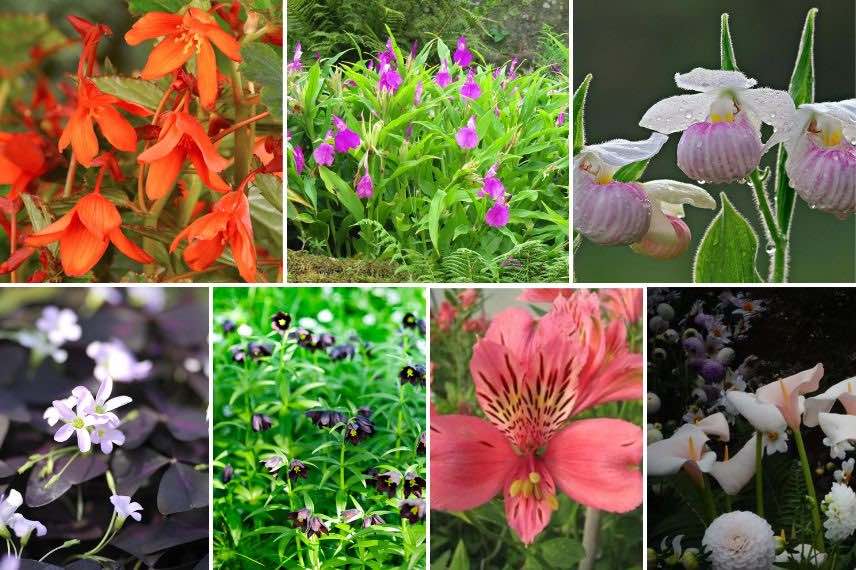
Clockwise from the top: Begonia ‘Tuberhybrida Bertini’, Roscoea purpurea, Cypripedium reginae, Arums, Alstroemerias, Fritillaria camschatcensis, Oxalis triangularis
Read also
10 bulbous plants with XXL flowersIn the shade
The bulbous plants you may encounter in shade in midsummer are more botanical curiosities, rare species, which does not mean they are difficult to grow, but they can also be collector’s plants that are quite demanding to cultivate.
Crinum moorei
The Crinum moorei is a bulbous perennial that captivates with its summer flowering and its captivating fragrance, reminiscent of white lilies. In early spring, pale green foliage appears, followed in July or August by flowering stalks bearing up to ten large white-pink flowers. This plant is hardy to -5°C, and to -10°C in well-drained, dry, and sheltered soils in winter.
Although the foliage tends to disappear as flowering begins, the plant retains a slender and exotic appearance. Easy to grow, Crinum moorei prefers shaded positions and loose, well-drained soils. This plant is particularly suited to light woodland where the soil stays cool. Pair it with plants such as the Tricyrtis formosana or Arisaemas.
For gardeners in regions with harsh winters, pot cultivation is an excellent alternative. With minimal maintenance, including good fertilisation and regular watering during the summer, the Crinum moorei can live for many years.
Reineckea carnea – Chinese Lily-of-the-Valley, Japanese Lily-of-the-Valley
The Reineckea carnea, often called Chinese Lily-of-the-Valley or Japanese Lily-of-the-Valley, is a creeping perennial that blends perfectly into shaded areas of the garden thanks to its evergreen foliage and summer flowering. This plant develops small pale pink stars that bloom late in the season on cherry-red flower stalks, and small bright red berries that appear after flowering.
The Reineckea carnea thrives in firm soils, even under trees where the soil can become very dry in summer. With its slender, grass-like leaves evoking a grass, it generally does not exceed 40 cm in height. Its ability to spread rapidly via its rootstocks makes it an excellent groundcover for woodlands and lightly shaded borders.
For optimal flowering, Reineckea carnea requires warm summers and some shade to prevent foliage wilting. Its ideal growing conditions are a half-shaded or shaded position, in cool, well-drained soil.
Reineckea carnea pairs well with small ferns such as the Asplenium scolopendrium or periwinkles, for example. This plant was awarded the Courson Award in 2005.
Cardiocrinum giganteum – Giant Himalayan Lily
The Cardiocrinum giganteum or Giant Himalayan Lily, is a bulbous plant that attracts attention with its impressive flowering spikes during the summer. Each spike can bear up to twenty trumpet-shaped flowers, measuring 15–20 cm long, a true spectacle for any garden. However, this plant is monocarpic, meaning it flowers only once before dying, although it self-seeds to perpetuate its presence in the garden.
Growing Cardiocrinum requires a certain degree of know‑how and is therefore often recommended for experienced gardeners. It prefers a shaded and cool environment, typically under trees or in shaded borders where the soil is rich in humus and well-drained. Plant the bulbs in autumn just beneath the soil surface, ensuring the soil stays cool during dry periods without waterlogging.
Although the bulblets produced by the parent plant take several years to flower, patience is rewarded with spectacular flowering. Gardeners should be aware that flowering is not annual; each new bulblet requires about five years to reach flowering maturity.
Cardiocrinum is a majestic addition to any garden, offering a unique gardening experience and ephemeral beauty that will captivate all visitors to your garden.
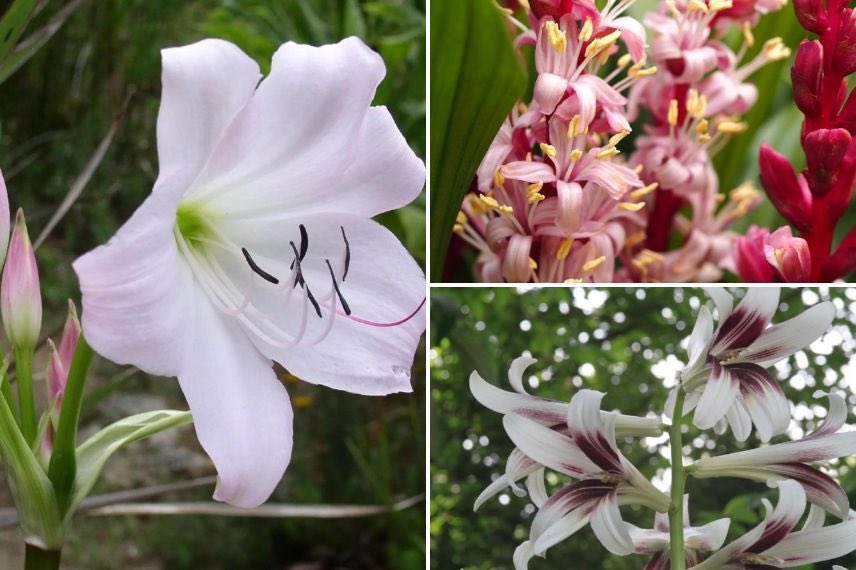
From the top clockwise: Crinum moorei, Reineckea carnea, Cardiocrinum giganteum
- Subscribe!
- Contents
Comments