
























Get 10% off your first order with the code: FIRST-10
Our top 7 red-flowered annuals

Our top 7 red-flowered annuals

Incandescent flowering

Contents

Modified the 2 February 2026  by Leïla 6 min.

In gardens, red flowers bring passion, energy and unparalleled visual dynamism. Among them, annuals promise generous flowering and long-lasting display, sometimes for several months. These annuals promise to create striking focal points and contribute to the aesthetic appeal of your outdoor spaces. Let’s discover seven red-flowering annuals to enchant your garden or balcony for a season, or longer if they self-seed and spread.

Difficulty

Poppy or Papaver rhoeas

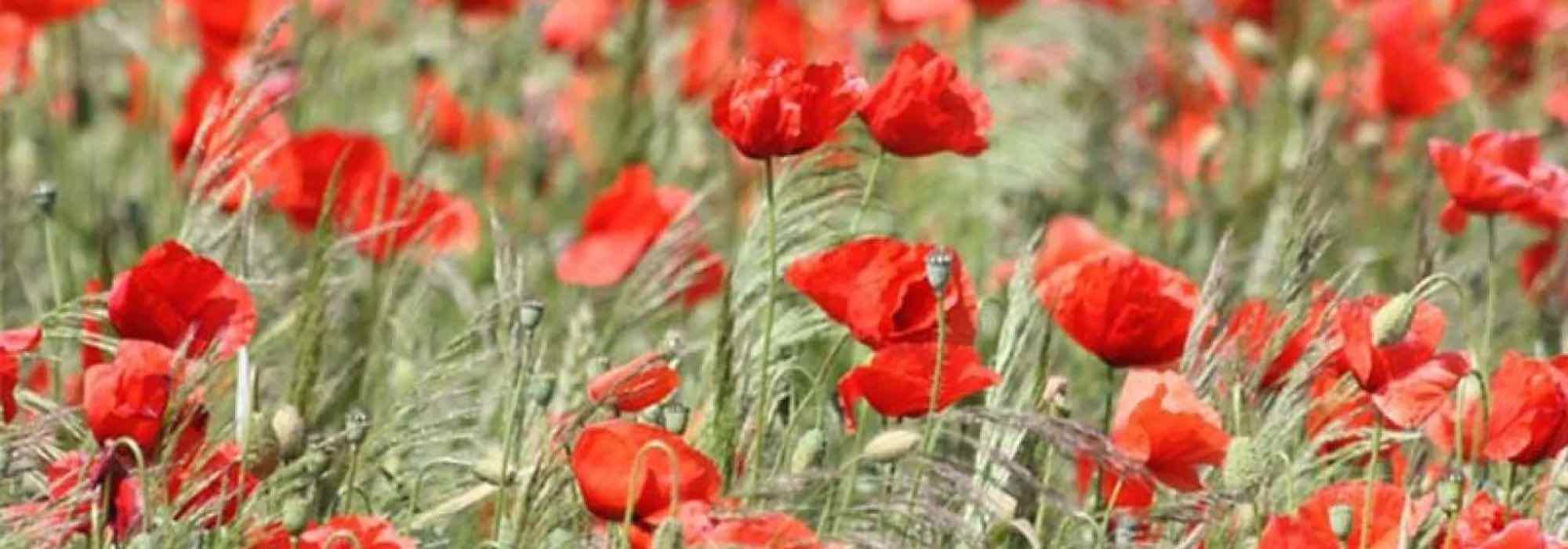
The Papaver rhoeas, commonly known as the red poppy or corn poppy, is a charming annual that once abundantly adorned our countryside. In summer, it reveals its scarlet petals, gently crumpled, emerging spontaneously from the soil like a brilliant surprise. Simple and short-lived, the poppy is perfect for adding a splash of colour and life to new gardens or natural spaces, thanks to its ability to self-seed readily. It thrives in full sun and adapts to poorer quality soils, including heavy, chalky and degraded soils, offering reliable germination.
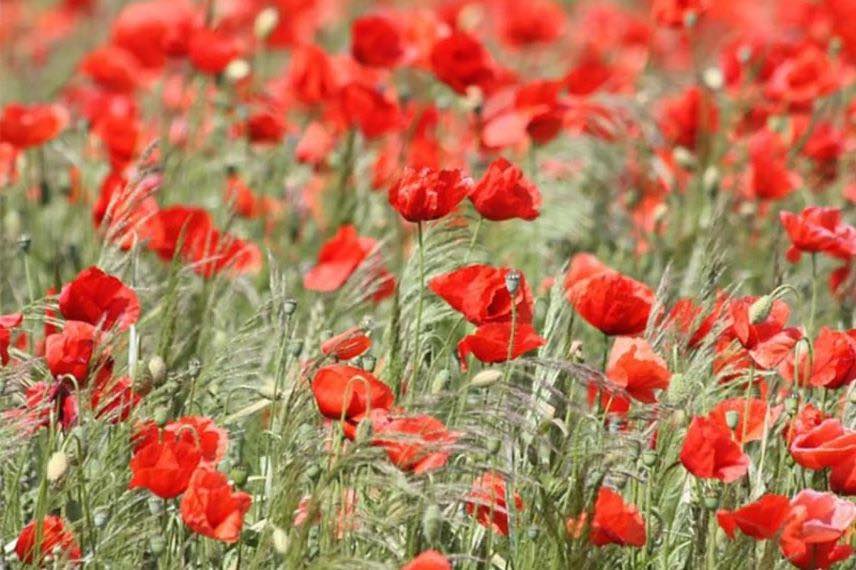
Originating from Asia Minor, this fast-growing annual can reach 60 cm tall by 30 cm wide in a season. Despite its delicate appearance, it forms a robust tuft of alternate leaves, lobed with narrow lobes and dentate margins, capable of arising from recently worked soils.

Poppies excel in wild gardens, cottage gardens, and low-maintenance spaces, easily creating waves of bright, uplifting flowers. Their presence is spectacular in borders, iris, the Shasta daisies, or the dancing foliage of the grasses.

red poppies

scarlet flax or Linum grandiflorum 'Rubrum'

Red flax, or Linum grandiflorum ‘Rubrum, known for its large, bright red flowers, stands out as one of the easiest to grow hardy annuals. Originating from southern regions, this variety is adorned, from summer to autumn, with flowers in a deep crimson red, gleaming with a satin sheen, contrasting with its delicate green-silver foliage. Its flowering, with simple and touching beauty reminiscent of poppies, plays a key role in the rapid creation of a cottage-garden display or the beautification of sun-drenched borders and rockeries. It is easily planted in the ground and self-seeds, preferring well-drained, light soil.

Native to North Africa, red flax is suited to hot, dry conditions typical of a Mediterranean climate. Its life cycle enables it to germinate, grow, flower and reproduce before the arrival of the hottest heat. In our milder regions, it offers continuous flowering throughout the summer. From spring, it develops a compact tuft with ramified stems, rising to a height of 40 cm and a width of 15–20 cm. Flowers, 2–3 cm in diameter, consist of five blood-red petals around a darker centre. Although each flower lasts only a day, they bloom in succession from early summer to autumn.

Large-flowered flax thrives in sun and is fairly drought-tolerant. It is ideal in sun-exposed borders or rockeries, where it helps to create cottage-garden atmospheres or spaces with natural charm. It pairs harmoniously with the Damask nigella, the Ammi visnaga, and the California poppies.
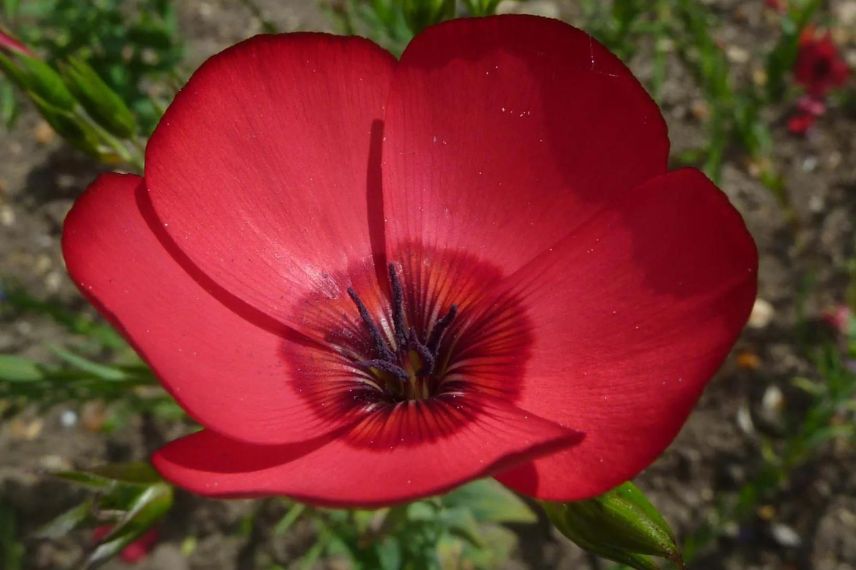
red-flowered flax

Poet's carnation or Dianthus barbatus nigrescens 'Sooty'
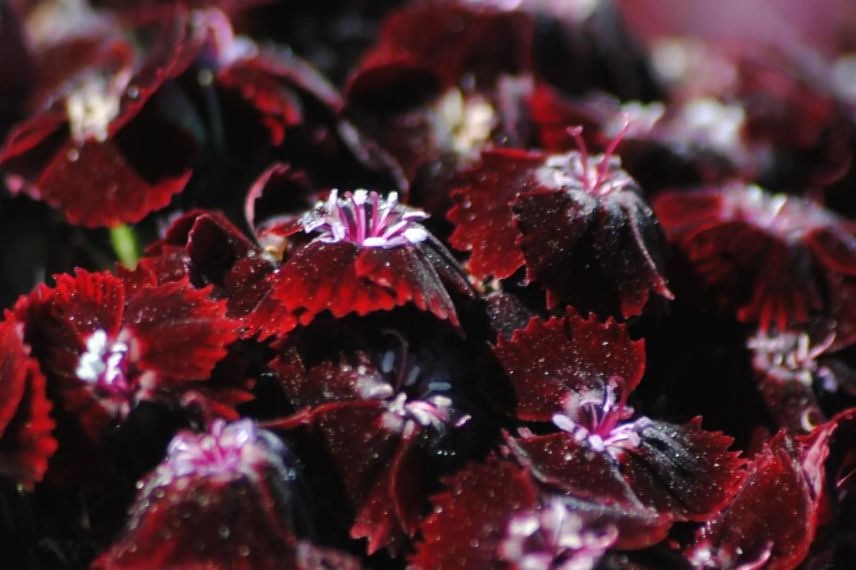
Poet’s Carnation ‘Sooty’ stands out for its spectacular red and captivating black hues. This plant, with green leaves adorned with metallic red-tinged and black-tinged reflections and purple stems bearing flowers so deep red that they appear black in the sun, begins flowering in May. Its flowering can continue for up to two months if spent flowers are regularly removed.

Treated as a biennial due to its low hardiness, it forms a dense basal clump in the first year, with purple-black leaves elegant in winter. The flowering of ‘Sooty’, from May to July, offers red-brown flowers with pinker nuances, reputed for their vase life and spicy-sweet fragrance.

Easy to grow with little maintenance, the Poet’s Carnation ‘Sooty’ enriches any garden or cut-flower bouquet with its poetry and mystique. Ideal along borders or near entrances to enjoy its fragrance, it creates striking colour accents in the border, especially paired with the Black Ophiopogon, to the ‘Oxalis triangularis, to dark sedums, to the Pennisetum setaceum ‘Rubrum’. It is also suitable for container cultivation, with good drainage, regular watering and feeding.

Red flowers of the Poet's Carnation


Black-eyed Susan vine or Thunbergia 'Tangerine Slice'

The Thunbergia ‘Tangerine Slice’ offers two-toned flowers with unique markings. Nicknamed Black-eyed Susan for its dark purple eye, its red-orange petals striped with yellow create a starry effect. Although invasive in its natural habitat, it becomes a charming annual climber in our latitudes, captivating with its long flowering period lasting until the first frosts. Self-clinging, it grips supports, ideal for pots or decorative hanging baskets that should be kept warm. It prefers sunny spots and rich, cool, well-drained soil.
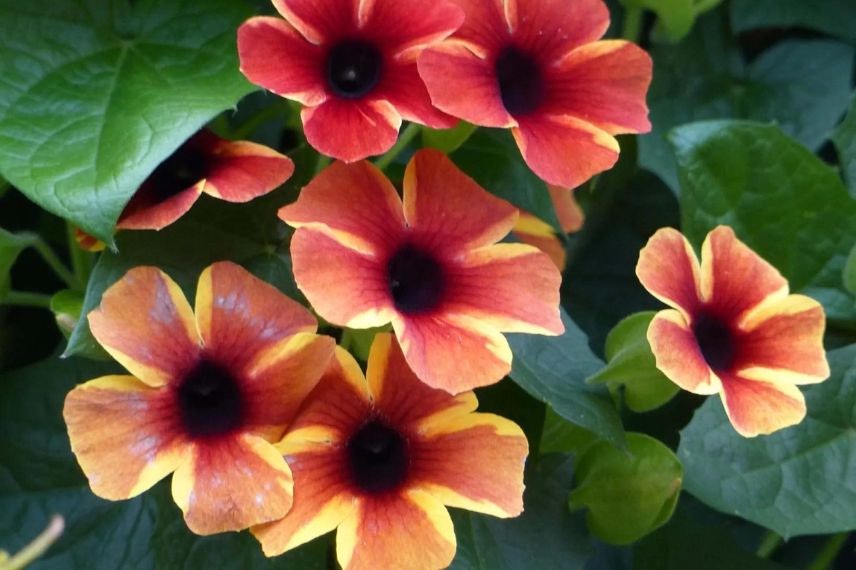
The ‘Tangerine Slice’ can quickly reach 2 metres, with dark green foliage, smaller and darker than the classic varieties. Flowering from June to October, its tubular flowers 3–4 cm in diameter feature a dark purple eye that attracts pollinators, with colours evolving throughout the day.

Easy to grow in pots or in sunny garden soil, the Black-eyed Susan vine pairs elegantly with herbaceous clematis or serves as groundcover. It entwines with gladioli to energise borders and create a show in large hanging baskets, bringing a touch of originality and colour.

two-toned Thunbergia flowers

Poppy or Papaver rhoeas 'Pandora'

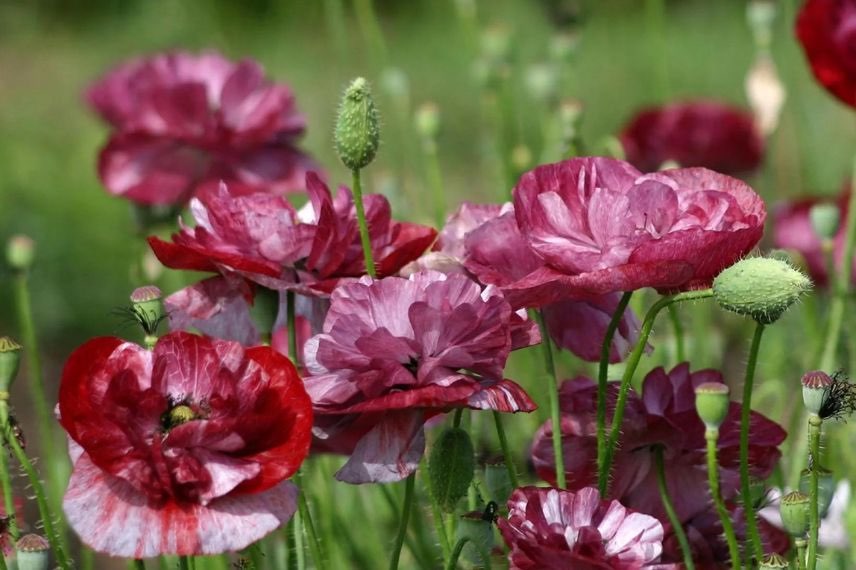
The Papaver rhoeas ‘Pandora’ is a poppy quite different from our modest, yet brilliant red poppy, offering large double flowers with crumpled petals, in a colour range extending from deep red to almost white pink and pale grey-pink. Each flower is unique, with varied patterns: variegated, flamed, mottled or speckled. These annual poppies, hardy and low-maintenance, thrive in full sun and tolerate poor soils, including heavy, calcareous and degraded soils.

‘Pandora’ is a spring-germinating selection, flowering in summer and dying after seed production, reaching 50 cm in height and 30 cm in breadth in a single season. Its slender stems and leaves lobed into narrow lobes characterise this plant, which yields a milky juice if the stem is broken. Flowering from June to August, it bears flowers with silky petals and slightly crumpled, in elegant shades of red, with a black-blue heart of stamens.

The Pandora poppy enhances wild gardens. Although ephemeral in bouquets, these flowers add undeniable charm to borders, accompanying the peonies or grasses. Ideal for vacant spaces or as a prelude to late-flowering blooms such as daylilies, the Pandora poppy enriches any sunny garden. For bouquets, sealing the cut stems helps prolong the flowers’ freshness.

poppy with double-coloured flowers

Trailing Begonia Summerwings 'Dark Elegance'

The Begonia Summerwings ‘Dark Elegance’, with its dark and alluring appearance, offers a cascading display of vermilion-red flowers, beautifully contrasting with its almost black green-purple foliage.
This robust, abundantly flowering variety has a semi-trailing habit, perfect for window boxes and hanging baskets, and flowers continuously from summer through to autumn, wind-tolerant and able to withstand cool temperatures, with minimal maintenance.
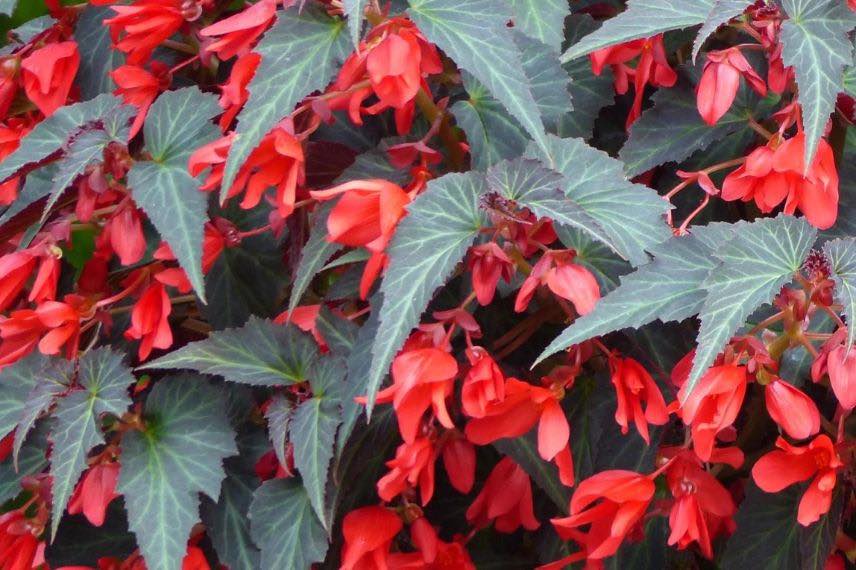
The Begonia ‘Dark Elegance’ is an herbaceous annual derived from a series of recent hybrids, prized for its rapid growth, abundant flowering, compact and trailing habit, and bright colours. Reaching 30 cm tall by 40 cm wide, it bears from June through to the first frosts single and vibrant, wing-shaped flowers, against a backdrop of oblong, pointed leaves. This plant thrives in both partial shade and full sun, and tolerates climatic variations, from cool, wet summers to heatwaves.

The Begonia Summerwings ‘Dark Elegance’ is ideal for brightening up a range of containers such as planters, balcony boxes or hanging baskets. It pairs perfectly with Impatiens and lobelias, and finds its place in both showy borders and pots on a terrace, offering a touch of elegance and enduring colour.

red-flowered begonia

Annual scabious or Scabiosa atropurpurea 'Fire King'
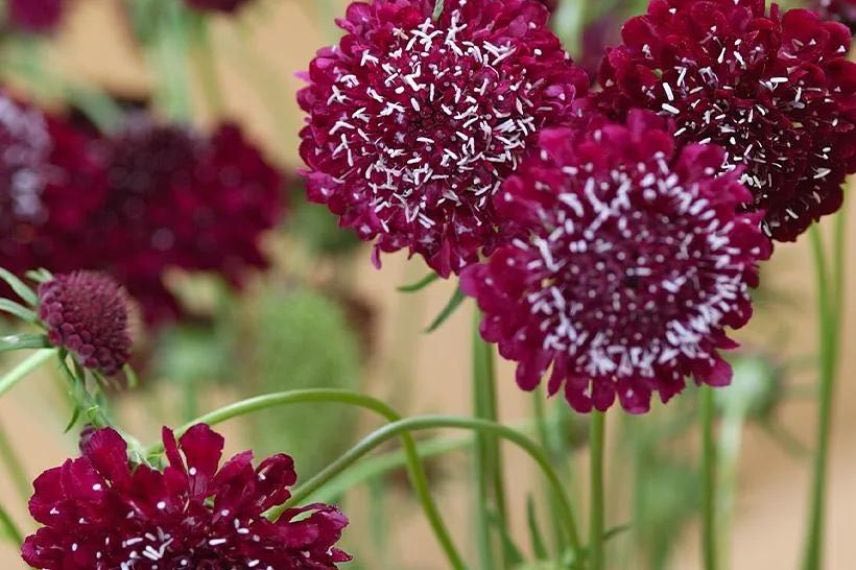
The Scabiosa atropurpurea ‘Fire King’ is a highly floriferous annual, with a discreet and elegant habit, displaying red flowers on long, sturdy stems, perfect in cottage garden borders and then as cut flowers. Easy to grow in light soil, it self-seeds and adds a light touch to the garden, yet visually very present.

Dark purple scabious is a short-lived perennial, often grown as an annual. ‘Fire King’ is a cultivar selected for its sturdy flowering stems and inflorescences in a deep red with touches of white. It features deciduous, finely cut bright green foliage in a basal rosette. Generous, it produces up to 400 flowers of 5 cm in diameter per plant from July to October, reaching 70–80 cm in height. Very nectariferous, it blends well in small groups among grasses or larger flowers to which it adds its strong colour in small touches.

Harvest the flowers to encourage renewed flowering, or leave them to dry in place; they add a lot of charm to a winter display. Its blooms last a long time in a vase.

deep red scabious flowers

Comments

Poppy shell