





























Pairing Cannas
5 ideas to showcase Heliconias
Contents
Majestic and imposing, the Canna or Canna Lily is an exotic plant with a striking design. Planted for its large and generous green leaves, but also sometimes purple or variegated, and for its summer flowering in warm shades of yellow, orange, or red, it grows quickly and deserves a prominent place in the garden.
Fond of warm environments, its hardiness is moderate, but once established, some varieties can withstand temperatures as low as -10 °C. With rapid growth, it lends itself to various types of landscaping and the creation of atmospheres where its vibrant colours and tall stature do not go unnoticed. What companion plants should you offer it? Discover 5 suitable associations for large spaces or terraces and bring a tropical and colourful style to your garden!

In a perennial bed
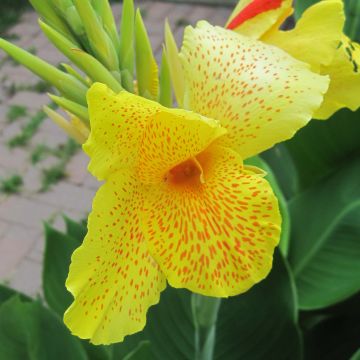
Large rhizomatous perennial reaching heights of 90 cm to 1 m, the Canna ‘Picasso’ produces stunning bright yellow flowers from July to November, uniquely speckled with red. Its generous blue-green foliage resembles that of a banana plant. This plant is drought-resistant but will thrive better in cool soil, in full sun or partial shade. Plant it in a large bed with cheerful, fresh colours, alongside Rudbeckia fulgida ‘Goldsturm’; these melliferous perennial plants are among the garden’s “must-haves”! Vigorous and highly decorative, they are adorned with large lemon-yellow daisy-like flowers with a black centre, blooming from July to October-November. The Daylily ‘Indy Reflections’, compact (40 cm tall), will come to the forefront to showcase its lovely crinkled flowers in a very soft apricot hue.
The foliage of Phormium tenax ‘Yellow Wave’, light yellow edged with soft green, and the purple fountain grass Pennisetum x advena ‘Rubrum’ will add lightness and structure to the bed. The latter features entirely deep purple to chocolate-coloured foliage, with intensity varying by exposure: in full sun, the foliage is very dark, almost black, while in partial shade, it takes on a purplish-red hue. Its feathery spike-like inflorescences are stunning in dried bouquets.
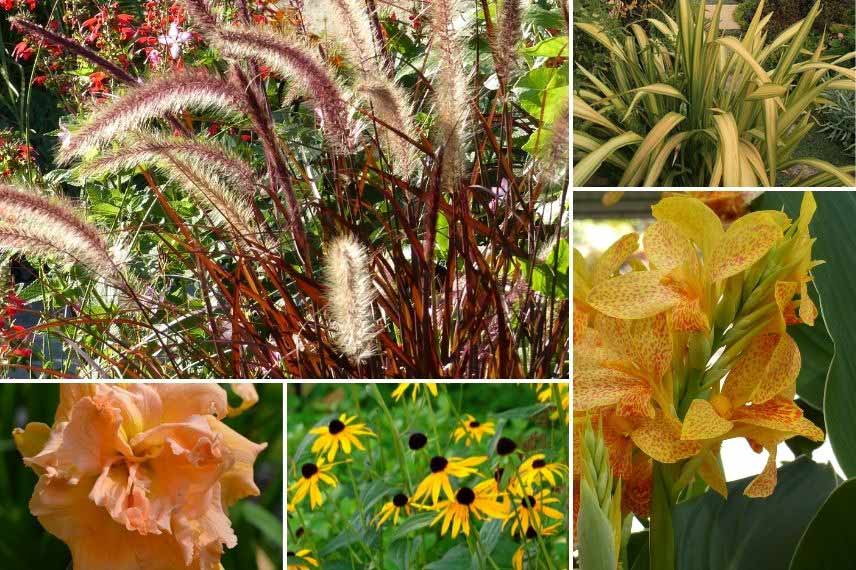
Pennisetum x advena ‘Rubrum’, Phormium tenax ‘Yellow Wave’, Daylily ‘Indy Reflections’, Rudbeckia fulgida ‘Goldsturm’, and Canna ‘Picasso’
Read also
Canna: planting, growing and careIn a south-facing garden
The Canna thrives in warm situations typically found in the southernmost latitudes of our Hexagon. It can therefore be included in a garden on the Côte d’Azur or the Atlantic coast, provided it is sheltered from prevailing winds that can damage its large leaves. To keep it company, plants like Phormium or New Zealand Flax, with their striking appearance, make a lovely combination. They enjoy bright, sheltered exposures and develop a tuft of lance-shaped leaves, with colours varying from one species and variety to another. Evergreen, the Pistacia lentiscus with its spring flowering followed by small edible red fruits, or the Oleander, with summer corollas in various colours, provide permanent structure. Among the perennials, Agapanthus and their spherical heads will rhythmically enhance the bed alongside the Prickly Pears like Opuntia engelmannii var.lindheimeri, a vigorous cactus that can reach up to 2 m in all directions, very floriferous and hardy!
Among all these sun-loving plants, it may be interesting to insert some grasses to add a lovely lightness. If you have enough space, why not consider the Cane of Provence and its bright, variegated variety Arundo donax ‘Variegata’? The Miscanthus are also appreciated for their lovely fountain-like habit, with some taking on beautiful autumn hues, such as Miscanthus sinensis ‘Malepartus’.
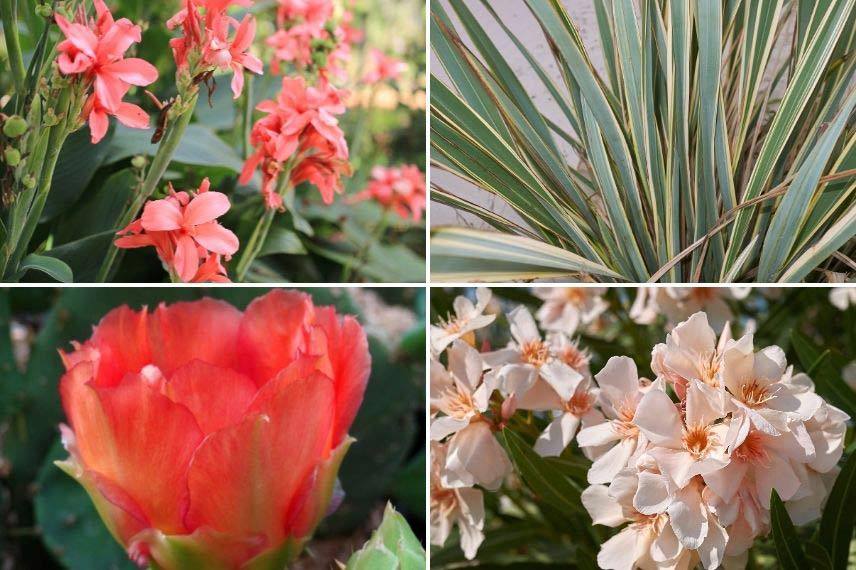
Canna, Phormium, flower of Opuntia engelmannii var. lindheimeri and Oleander
Discover other Cannas
View all →
Available in 2 sizes

Available in 1 sizes
Available in 2 sizes
Available in 1 sizes
Available in 2 sizes
Available in 0 sizes
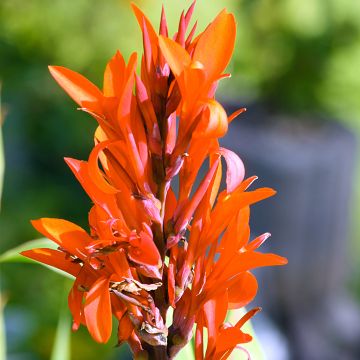
Available in 2 sizes
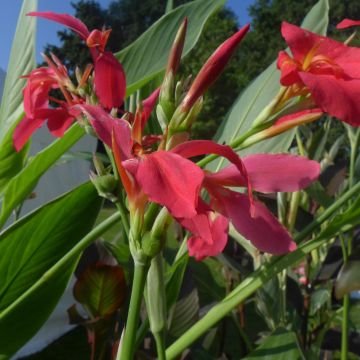
Available in 1 sizes
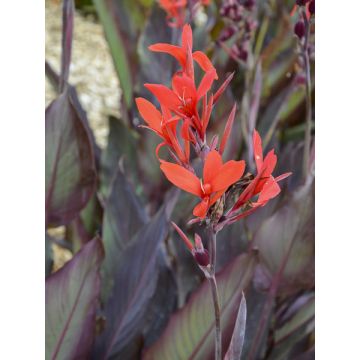
Available in 1 sizes
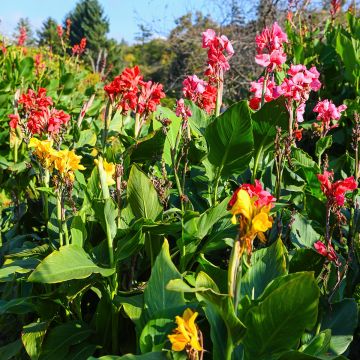
Available in 1 sizes
In a tropical atmosphere
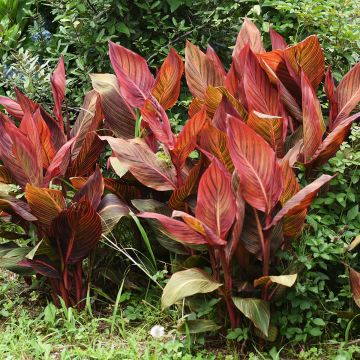
The imposing foliage of Cannas invites exoticism, accompanied by plants with a similarly tropical appearance, such as the essential palms. Behind magnificent Canna striata, the tallest should be placed in the background and can provide beneficial shade for your other plants. This is the case, for example, with the Trachycarpus fortunei, hardy down to -15°C, or the more tender Washingtonia robusta, which grows quickly. Don’t forget the Banana plants, which are also heavily imbued with exoticism. The Musa basjoo is the most common in our gardens due to its good hardiness (-15°C), but in a milder climate, try the Musa velutina, with its pink flowers.
Very hardy, the Yucca are appreciated for their graphic foliage and white flowering, and you should place them in a sunny spot. Also consider the Fatsia japonica, a structuring shrub with large, glossy, lush leaves. Finally, adorn a wall or structure with the beautiful and vigorous liana Passiflora vitifolia, which exudes exoticism with its large bright red flowers featuring elongated, pointed petals, topped with yellow and red stamens.
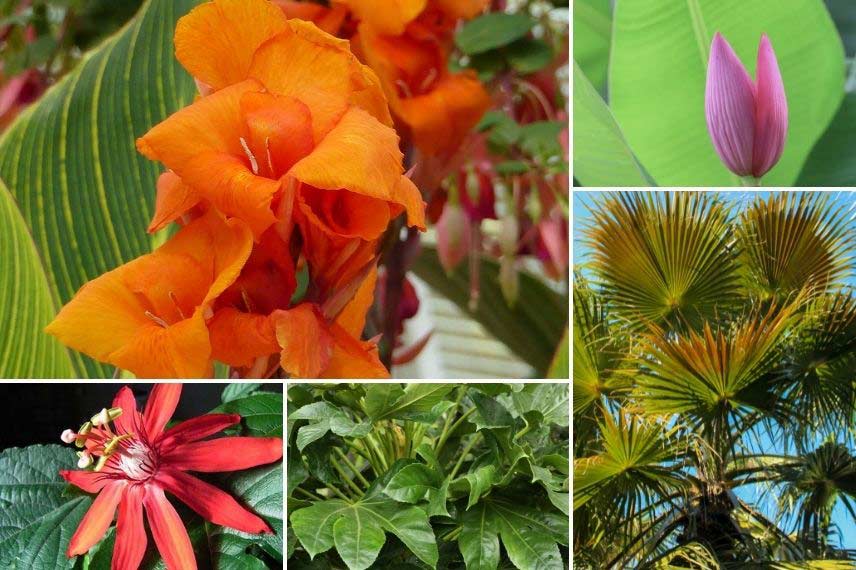
Canna striata, Musa velutina, Passiflora vitifolia, Fatsia japonica and Trachycarpus fortunei
In pots, for a welcoming terrace
Beautiful plant combinations are not just for large gardens; patios, terraces, and even urban balconies provide opportunities to create green oases. Compact, dwarf and highly floriferous variety, with bright red flowers edged in golden yellow, the Canna ‘Lucifer’ is particularly suited for pot or container cultivation. It requires companions that, like it, enjoy a warm and sunny location, such as the dwarf Alstroemeria ‘Pitchounes Noah’. This vibrant Inca lily is adorned with pale yellow flowers striped with brown. Particularly compact and highly floriferous from May-June to October, this bushy plant will make a statement in a lovely pot or basket on the terrace.
Combine several pots together, for example by including non-running bamboos, excellent candidates that often adopt a very flexible habit, like Fargesia. The Chimonobambusa tumidissinoda ‘Microphylla’ will adopt a charming, almost weeping habit. Also consider the decorative foliage of Hostas, as well as bulbs, which are easy to grow and reliably return each year.
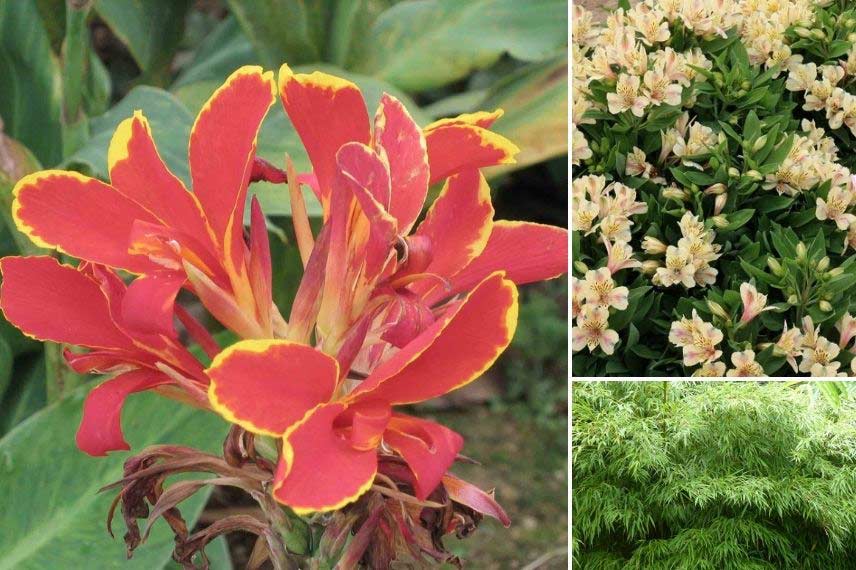
Canna ‘Lucifer’, Alstroemeria ‘Pitchounes Noah’ and Chimonobambusa tumidissinoda ‘Microphylla’
In a pond
Aquatic Canna, the Canna glauca ‘Endeavour’ is a water hybrid with lush, prolonged bright red flowering. It will add an exotic touch to a pond throughout the summer season. Plant it in 10 to 20 cm of water or in consistently moist soil. Pair it with the lovely Papyrus Cyperus alternifolius. This beautiful evergreen perennial of moist medium is more resilient and less demanding in terms of moisture than its Egyptian cousin. With its graphic appearance and long stems topped with starry tufts, it is easy to grow in wet conditions.
Near water, where it enjoys soaking its roots, the Pontederia cordata will display its stunning deep lavender blue inflorescences from June to September alongside the Water Clover Menyanthes trifoliata, which will have flowered from April to June.
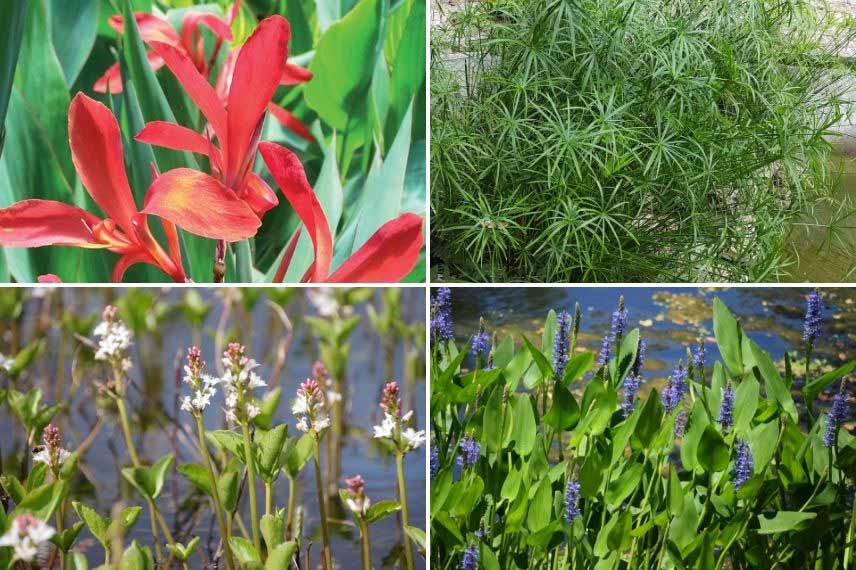
Canna glauca ‘Endeavour’, Cyperus alternifolius, Menyanthes trifoliata and Pontederia cordata

- Subscribe!
- Contents
![[plant_association plant1="cannas" plant2="in the garden"]](https://en.promessedefleurs.eu/blogwp/wp-content/uploads/2022/06/Associer-les-cannas.jpg "Associate the {glossary} Cannas.")
Comments