





























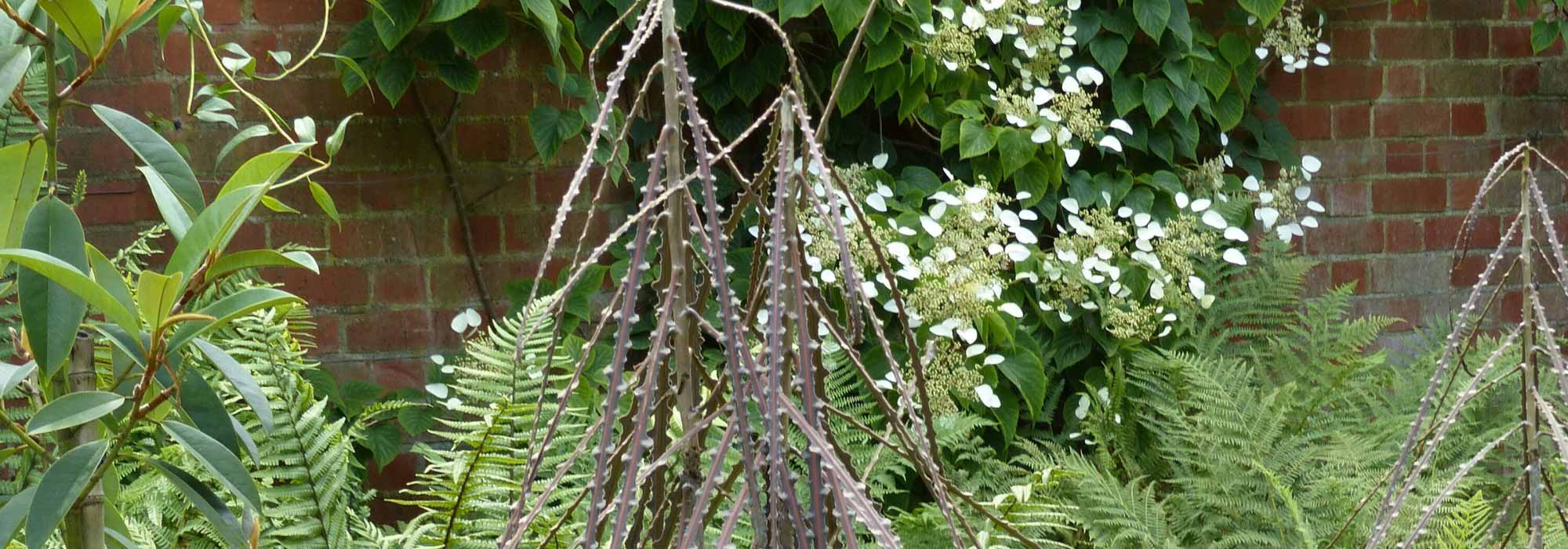
Pairing Pseudopanax
5 companion planting ideas to enhance Pseudopanax in the garden
Contents
Pseudopanax are evergreen shrubs native to New Zealand, notable for their exotic appearance and their unique foliage. Their leaves come in a variety of shapes, sometimes unusual: some species, such as Pseudopanax crassifolius display narrow and dentate leaves, while others, such as the Pseudopanax ferox, boast remarkable sawtoothed leaves, or large palmately and variegated leaves, as with the Pseudopanax lessonii. They typically reach around 2.5 to 3 m in height, sometimes climbing to 6 or 7 m. A little frost-tender (hardy down to about -5 to -7 °C), they thrive in an oceanic, mild and humid climate, in light shade and in humus-bearing, fertile, very well-drained, and rather acidic soil. A little tricky to pair due to their strong personality, but very on-trend, they will bring a lot of character to even the most modest setting. Discover 5 pairing ideas to grow a Pseudopanax in the garden, on a balcony or terrace!

In a jungle garden
To create a lush jungle atmosphere, Pseudopanax are interesting due to their striking foliage and distinctive growth habit. They can be planted in full sun or partial shade, in acidic soil (no lime), with excellent drainage and staying cool in summer. For example, pair Pseudopanax laetus, a lush species with large palmately-veined leaves in a glossy green, with tree ferns, which add height and will create a beautiful canopy effect. Complete this display with Cycas, whose silhouette evokes a palm tree, Colocasias with heart-shaped foliage, and Hostas ‘Patriot’. The Fatsia japonica, and a Tetrapanax with their large palmately-veined leaves, add volume and texture. Punctuate the scene with lush tufts of Phormiums to emphasise the exotic feel of the whole. For an even more primitive jungle effect, don’t hesitate to incorporate the Pseudopanax ferox, this quirky species rescued from antediluvian forests. Incorporate Restios, such as Baloskion tetraphyllum, these tall, rare perennials that form tufts of finely cut leaves, with rush-like or feathery, bamboo-like appearances. And if you have space, consider planting a Wollemi Pine, a large conifer from the Jurassic, with a trunk clad in lumpy bark, bearing fern-like fronds and globose cones. By varying heights, textures and leaf forms, you will enhance the dense, lush, intensely tropical atmosphere.
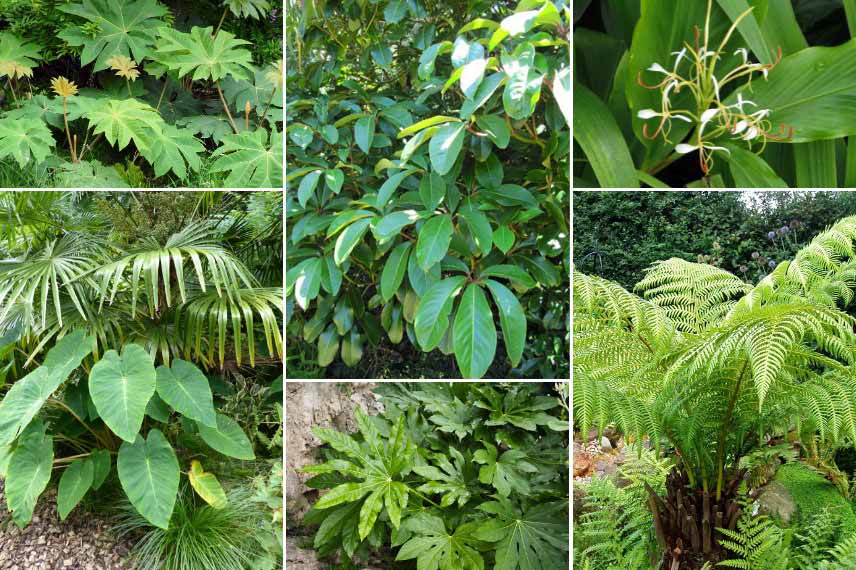
Tetrapanax papyrifera ‘Rex’, Pseudopanax laetus (photo: Leonora Enking), Hedychium spicatum (photo: Peganum), Colocasia esculenta and Trachycarpus fortunei, Fatsia japonica, Dicksonia antarctica (photo: Amanda Slater)
In a minimalist ambience
With its unusual skeletal silhouette, Pseudopanax ferox is perfect for creating a modern, graphic garden. Its vertical habit and dentate leaves, reminiscent of saw blades, provide a strong, sculptural structure to any display. To showcase this curious bush, create a planting bed with clean lines and understated hues such as green, bronze, purple, black, white and grey. Pair it with the Elegia tectorum ‘Fish Hoek’, another botanical curiosity. This tall perennial, resembling a horsetail, echoes the Pseudopanax with its stiff, green-grey stems, streaked with brown.
Dwarf bamboos, such as the Sasa tessellata and the Pleioblastus fortunei, help structure the space while remaining compact. Add small Miscanthus and Carex for their fine, delicate foliage, as well as ferns for a soft contrasting effect. The spherical, light flowering of Alliums and the elegance of Agapanthus, two perennials familiar in contemporary gardens, provide relief and breathing space without breaking the minimalist harmony.
To reinforce the graphic effect, install Pseudopanax ferox beside perennials with a light, lower habit, such as Alchemilla and Hakonechloa macra, or Astelia nervosa ‘Westland’, a wonderful perennial for a modern garden with clean lines whose graceful, flowing forms will provide counterpoint to its vertical, sculptural silhouette.
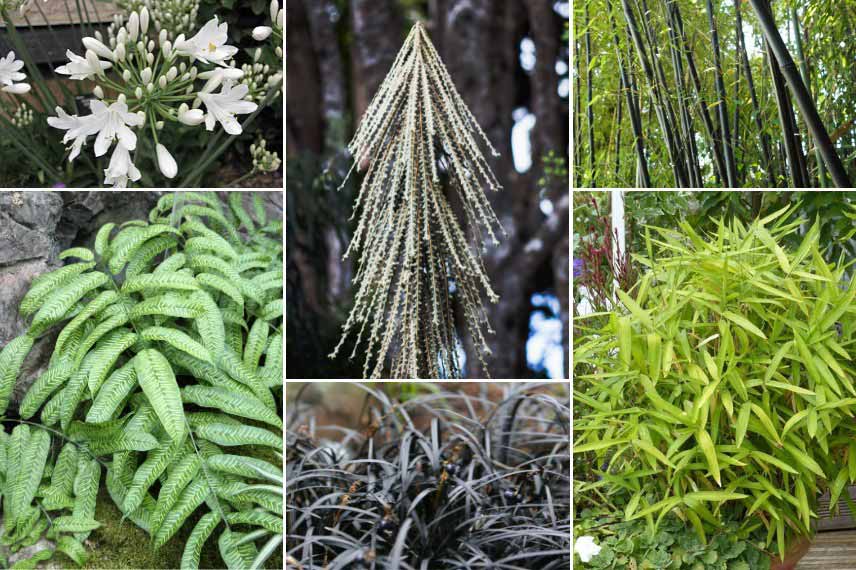 Agapanthus africanus ‘Albus’, Pseudopanax ferox, Phyllostachys nigra, Coniogramme emeiensis, Ophiopogon planiscapus ‘Nigrescens’ (photo: brewbooks) and Pleioblastus pygmaeus ‘Distichus’
In a garden of Australian plants.
Pseudopanax is native to New Zealand, where it grows naturally in forests and coastal areas. This slender and surprising bush has its rightful place in a large exotic border, in the company of its southern-hemisphere counterparts. In mild climates, create an Australasian scene by pairing a Pseudopanax crassifolium with equally graphic, linear and tough foliage in the cordylines, the dasylirion or the New Zealand flax (Phormium tenax), a lush evergreen perennial recommended for coastal regions.
Awaken its grey-brown to purple foliage with the flowering of shrubs such as Boronia, a charming small Australian shrub with heath-like habit, adorned with large pink-magenta scented bells. It will also pair with Gomphostigma virgatum, a South African broom-like shrub with fine silvery foliage dotted with starry white flowers, for a delicate and luminous contrast. To enrich the plant palette, incorporate Leucadendrons, evergreen shrubs with coloured bracts, as well as the Polygala, known for its long purple flowering and its tolerance to mild climates. Also consider Protea and Grevillea which offer spectacular flowering.
If you choose the Pseudopanax lessonii ‘Dark Star’, a hybrid with magnificent cut purple almost black foliage, its colour coordinates perfectly with Ensete ventricosum ‘Maurelii’, a very handsome red banana, to be paired with cordylines and Phormium in closely related colourings.
Punctuate these plantings from Australia, New Zealand and South Africa, for example with South African bulbs such as Watsonia, not forgetting the graceful angel’s fishing rods (Dierama), with their arched flowering stems and pendulous bell-shaped flowers.
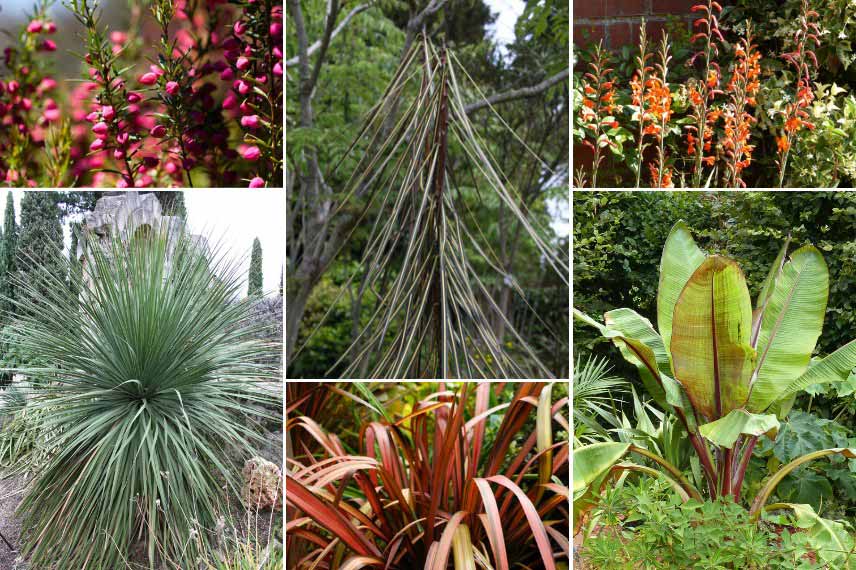
Boronia, Pseudopanax crassifolius, Watsonia ‘Stanford Scarlet’, Dasylirion acrotrichum, Phormium ‘Pink Panther’, Ensete ventricosum ‘Maurelii’
Read also
Choosing a PseudopanaxIn a beautiful golden scene.
To create a pretty bright display, especially in semi-shaded areas, opt for Pseudopanax ‘Gecko Gold’ or ‘Goldsplash’, both featuring splendid green, dissected leaves margined with gold. Pair them with other plants in yellow and gold tones to create a rich, exotic tapestry of foliage. The Lysimachia nummularia ‘Aurea’ spreads into a vivid yellow carpet, while the Carex oshimensis ‘Evergold’ forms graceful clumps of trailing green leaves striped with cream. The golden foliage of the‘Agastache ‘Golden Jubilee’ is crowned in summer with long candle-like spikes of purple flowers.
Add more exotically styled plants, such as the handsome Yucca flaccida ‘Golden Sword’, whose yellow foliage is margined with blue-green, and the Eucomis, whose pineapple-shaped flowers heighten the tropical feel. To accentuate these golden tones, create striking contrasts by incorporating plants with dark leaves. The ‘Ophiopogon planiscapus ‘Nigrescens’ forms a carpet of leaves that are almost black, while the Phormium ‘Dark Delight’ and l Heuchera ‘Obsidian’ add deep purple hues. Physocarpus ‘Midnight’ completes the scene with its dark purple foliage.
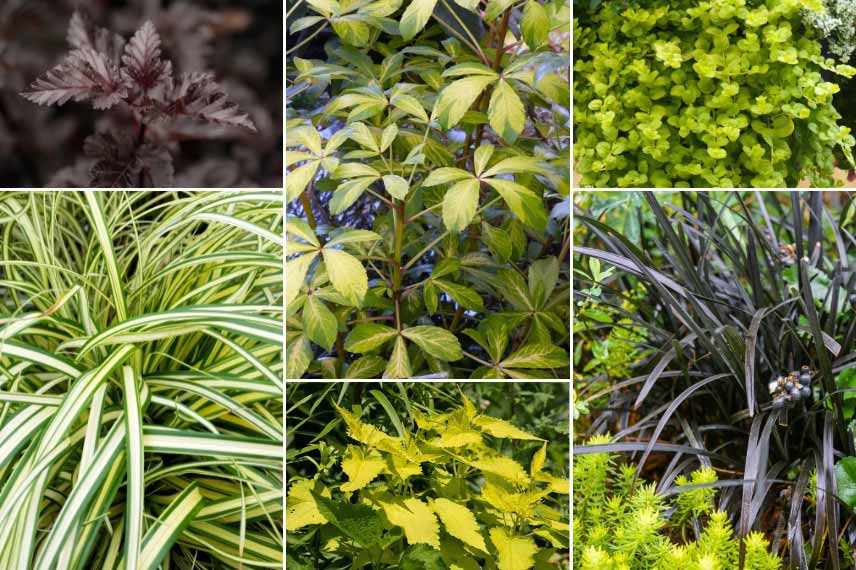
Physocarpus ‘Midnight’, Pseudopanax lessonii ‘Goldsplash’, Lysimachia nummularia ‘Goldilocks’, Carex oshimensis ‘Evergold’, Agastache ‘Golden Jubilee’ (photo: David J. Stang), Ophiopogon planiscapus ‘Nigrescens’ and Sedum ‘Angelina’
A container garden on a terrace
Pseudopanax makes for a stunning specimen on the terrace or balcony, planted in a large container, especially in colder regions where you can bring it indoors in autumn and take it back outside in spring. We pictured placing it in large raised planters. For a sophisticated display, pair it with the Astelia chathamica with silvery foliage and the tree fern Dicksonia antarctica, thus creating a lush trio. To add verticality and greenery to the background, let the Fuchsia magellanica var. gracilis climb, which can green walls gracefully with its handsome evergreen foliage and red and purple-pink bells. At the base, play on texture contrasts by pairing the Pseudopanax with the Sophora prostrata ‘Little Baby‘, another curious bush native to New Zealand. This one wows with its twisted silhouette and zigzag branches. Also trail a Acaena buchananii, a light and distinctive creeping perennial with finely divided, parsley-like foliage.
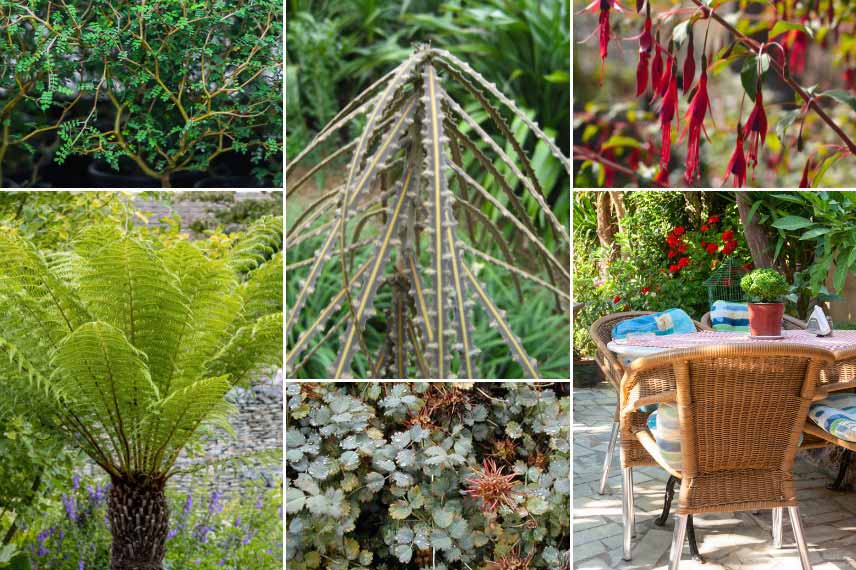
Sophora prostrata ‘Little Baby’, Pseudopanax ferox, Fuchsia magellanica var. gracilis, Dicksonia antarctica, Acaena buchananii (photo : Sten Porse)
- Subscribe!
- Contents
Comments