





























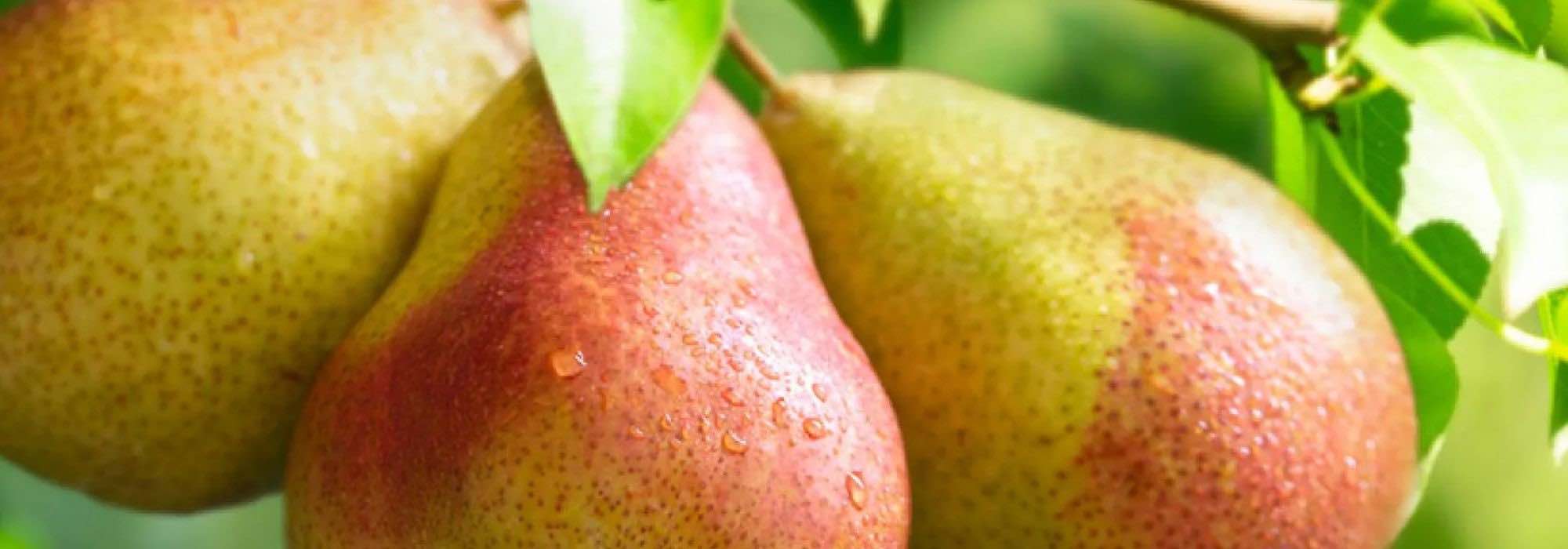
Pear trees: Why choosing heritage and local varieties?
Natural resistance, biodiversity promoted and heritage safeguarded
Contents
The pear tree is one of the most popular fruit trees. Among the hundreds of existing varieties, only a small minority is grown in France for production and sale in conventional shops. Yet, there are many old and local pear varieties that would deserve to be in the spotlight as well.
Let’s look at why it is important to work towards safeguarding these pear trees and which varieties are involved.
In addition, to learn all about growing pear trees, discover our comprehensive guide: Pear tree: planting, pruning and care.

The origin of pear trees
Pear trees (Pyrus) are fruit trees whose distribution range extends from temperate Eurasia to North Africa. For its part, the common pear (Pyrus communis) is native to Central Asia and has been cultivated in China for more than 6,000 years. It was not until the 6th century that it was introduced to Europe. It then began to be propagated by grafting to obtain new varieties. About 200 different varieties were already obtained by the Renaissance.
Pear trees belong to the Rosaceae family (apple trees, plum trees, cherry trees, roses…). They are among the most widely grown fruits in France, due to their adaptability to most of our regions. Their flowering takes place in March and April, with harvest from summer to autumn, depending on the varieties. Some store well, but the fruits remain quite fragile, requiring care at harvest. Wild forms of pear trees can reach up to 15 metres in height, while cultivated varieties rarely exceed 5 metres. There are still native varieties today, although their numbers have declined sharply over time due to changing conditions and human intervention. This is the case, for example, in the Breton countryside.
Among the most appreciated pears in France, first is the ‘Conference’, with its characteristic teardrop shape. Its flesh is sweet, juicy and slightly grainy in the core. It can be eaten as is or transformed to feature in many recipes. It also stores very well. This is a variety developed in England in the mid-19th century.
Another very widespread pear: the ‘Williams Bon Chrétien’. It is the most widely grown variety in the world. It produces large fruits that are harvested in late summer. Its flesh is fine, melt-in-the-mouth and sweet. This is a variety originating from the United Kingdom, developed in the late eighteenth century.
If pear cultivation is limited to only a few varieties, despite the great existing diversity, it is mainly a matter of yield. They are the easiest-to-grow pear trees that are favoured. They offer rapid fruiting, abundant and regular harvests from year to year, as well as good disease resistance (notably scab). The fruits are attractive, large and sweet. This is also a matter of taste: our palates are accustomed to a particular texture and flavour in pears that we look for in shops. As consumers, for example, we are not used to pears with a firm flesh, containing many small grain-like cells, which would need to ripen in hay.
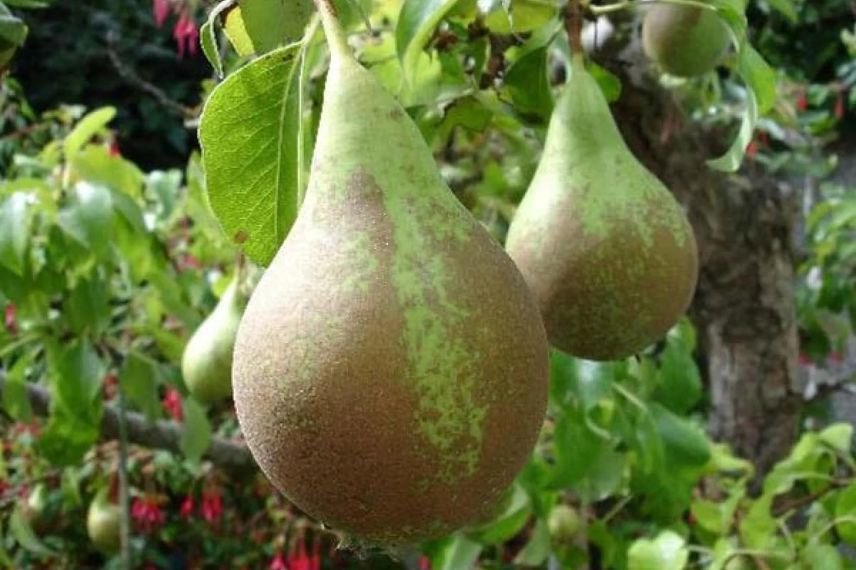
Pears ‘Conference’
Read also
Where do our fruits come from?Heritage and local pears: a natural resistance
When it grows naturally in a given territory, a plant will inevitably have to adapt to cultivation conditions. This includes soil type, climate, exposure, or pests and diseases. By natural selection, only the hardiest varieties will be able to survive. In a region with harsh winters, they will need to be hardy and bloom once the last risk of frost has passed. In a damp region, they will need to resist fungal diseases (fungi).
Old, local pear trees are thus naturally adapted to a medium and resistant to these conditions. That is therefore primarily why it is worth giving them priority in the garden: by choosing a variety that grows in our region, we ensure it is made to withstand the cultivation conditions there. It will thus require less maintenance and fewer inputs.
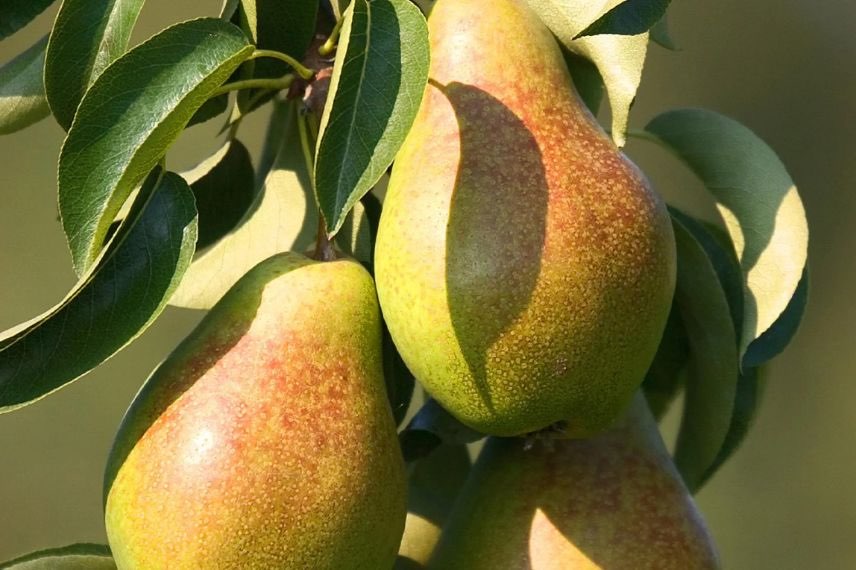
Pear tree ‘Epine du Mas’
Varieties that promote biodiversity.
Nature relies on a perfect balance among all living beings that comprise it. Each has its place and will promote the development of one, or limit the proliferation of the other. Native plants, originating from a given medium, sit squarely within this sometimes precarious balance. In the case of pear trees, their flowering will benefit local insects and promote pollination of other native plants, their fruiting will serve birds and other animals present in the medium, etc. In this sense, the choice of a local variety is beneficial for biodiversity of the territory.
A cultural and gastronomic heritage not to be missed.
To safeguard old and local pear trees is, first and foremost, a matter of food diversity. It allows us to rediscover tastes and textures that change, to avoid flavour uniformity, and to recall the flavours of yesteryear. It is also a way to showcase a territory and traditional recipes, some pears being used in traditional dishes. For example, the Toussaint pear pâté is inseparable from the heritage of the Pays de Caux and Bray, and is prepared with Poire de Fisée.
Moreover, these pears, which are also known as ‘peasant pears’, carry a genetic heritage that would be a pity to let die out. Studying them helps to highlight certain adaptation capabilities and also proves useful for obtaining new varieties.
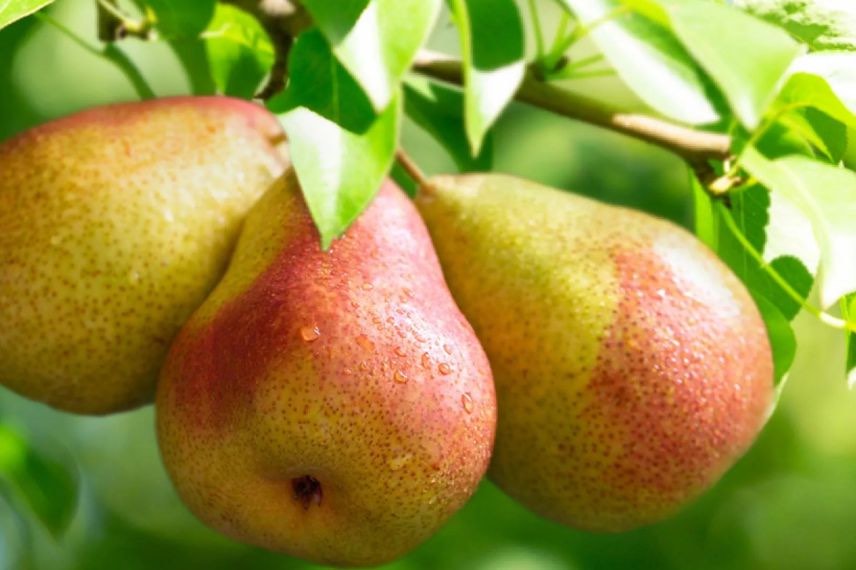
Pear tree ‘Figue d’Alençon’
What are the old and local pear tree varieties?
Old pear trees can be purchased from online garden centres (such as Promesse de Fleurs), but also from nurseries or local growers. Some associations also make the conservation of local and old fruit trees their flagship endeavour. Finally, there are conservation orchards, which highlight varieties at risk of disappearing.
- ‘Beurre Hardy’ produces pears with flesh that is particularly melting. Its fruiting is a little late, but it is then quite productive. The fruits are juicy and sweet, very fragrant. Harvest occurs between September and October.
- ‘Doyenné du Comice’ treats us with large, plump fruits, green with a yellow tint. Their flesh is juicy and tasty. These pears are harvested at the start of autumn and store well.
- Pear tree ‘St Jean’ is one of the earliest varieties, with harvest from mid-June to July. It bears medium-sized, plump fruits, with juicy and sweet flesh, with musky notes. They should be eaten or processed promptly after harvest.
- ‘Duchesse d’Angoulême’ is a late-harvest variety, which occurs in October–November. It has the advantage of being able to grow up to 1,000 metres above sea level. Its large round fruits have flesh that is semi-fine, sweet and melting. They store well.
- ‘Doyenné d’hiver’ or ‘Bergamote de Pentecôte’ is an old late-season variety of Belgian origin. Its fruits reach maturity between December and January and can be kept until April. The pears are large, yellow with a brownish tint. Their flesh is fine, melting, sweet and a little grainy. To be eaten or cooked.
- ‘Épine du Mas’ or ‘Duc de Bordeaux’ yields fruits with yellow-green skin tinged pink on the sun-facing side. Their flesh is delicately fragrant, tart and rich in sugar. It’s a pear perfect for eating raw, but can also be cooked. Harvest starts in October.
- ‘Marguerite Marillat’ is an old variety that produces enormous pears weighing up to around 700 g. Their flavour blends sweet and tangy. Harvest occurs at the start of autumn. Ideal for both raw tasting and cooking.
- ‘Sœur Grégoire’ offers large, lumpy pears that have the advantage of containing very few seeds. Harvest takes place in November, with storage possible until January.
- ‘Figue d’Alençon’ is an old variety originating from Normandy. It owes its name to the shape of its fruits, reminiscent of the fig. It is an excellent keeping pear that can be kept until mid-February. In terms of flavour, it is melting, slightly grainy, and mildly astringent when the fruit is young.
- ‘Poirier Curé’ is a late variety, reaching maturity in December–January. Its fruits are large, with thick skins. The juicy, sweet and tangy flesh may reveal a slight astringency. A pear to be eaten raw or cooked.
- The ‘Poire de Fisée’ yields small fruits, well known in Normandy and Picardy. It is a pear for cooking, suitable for pies, jams or compotes. Harvest occurs between October and November.
- The ‘Poirier Fausset’ is fairly common in Normandy. As its name suggests, its small pears are used for juice and alcoholic beverages. Harvest takes place in November. It is a long-lived variety.
- ‘Plant de Blanc’ is another old pear tree variety used for perry, commonly found in the Normandy region. Its small pear-shaped fruits are used to make a drink. Harvest in October.
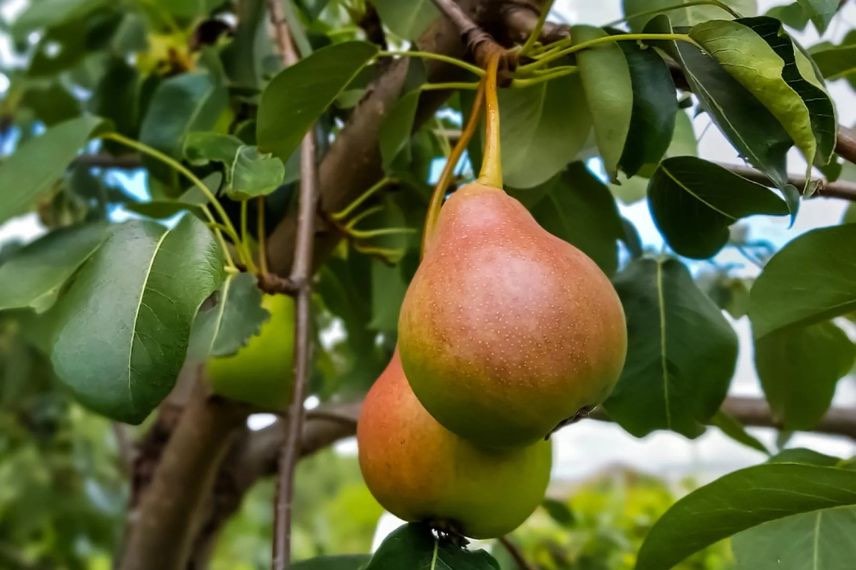
Pear tree ‘Sœur Grégoire’
- Subscribe!
- Contents
Comments