





























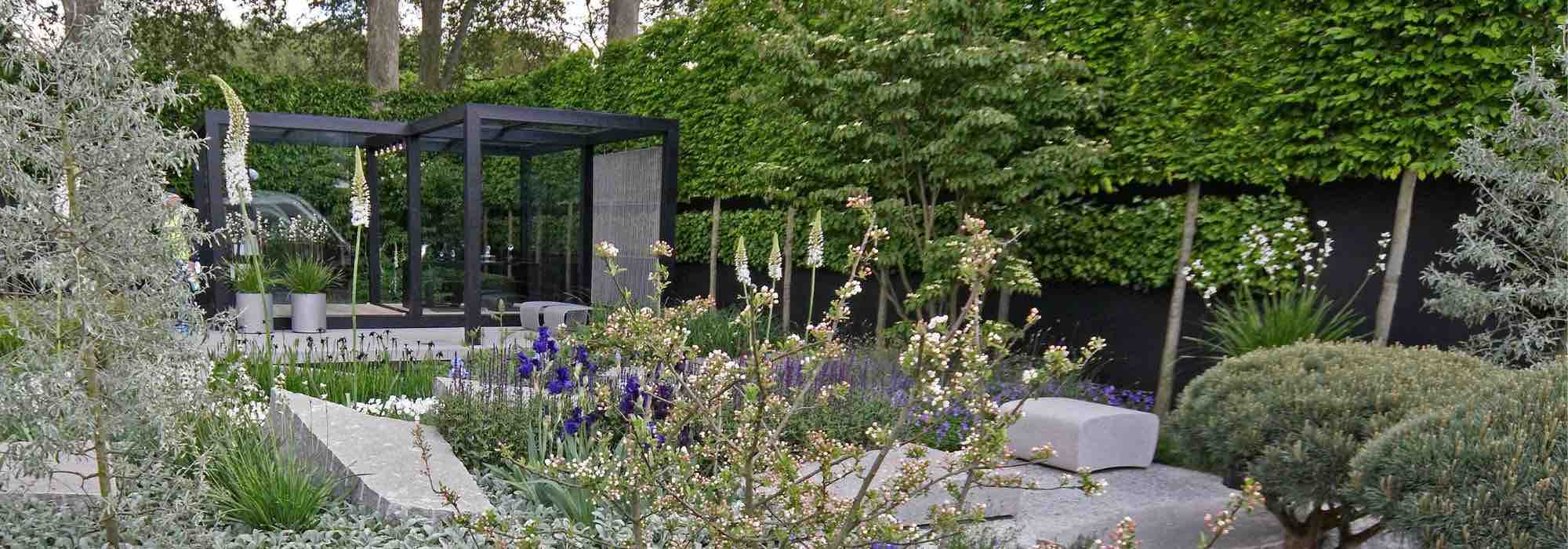
Perennial plants that tolerate drought and heat for a contemporary garden
A contemporary garden in dry soil
Contents
Several drought-tolerant perennial plants, suited to well-drained, dry soil and resistant to hot climates, possess beautiful graphic and structural qualities for contemporary-style gardens. To withstand drought with little or no watering, it is important to plant them in open ground. A potted plant is always more dependent on external water supply. It is also advisable, for hardy plants, to plant them in autumn. This allows them to benefit from three seasons before summer to establish themselves, which subsequently improves their resistance to summer droughts.
Discover some beautiful full-sun perennials for well-drained, dry soil, perfect for contemporary settings.

Stachys byzantina and other silver-grey foliage
With its distinctive colour and upright habit, Stachys byzantina is undoubtedly a contemporary garden plant and a perfect perennial for dry gardens. Several cultivars from this species are also very interesting. Its basal rosette leaves, lanceolate, soft, and woolly, in fluffy silver-grey, lighten in dry soil until they become almost white. The plant forms upright, cottony flower stems that bloom in summer with rather discreet pink flowers, bringing the overall height of the plant to about 60 cm. Quite hardy, Stachys byzantina is an outdoor plant for full sun or possibly partial shade in well-drained, poor soil. It tolerates sea spray and drought. Its foliage is evergreen to semi-evergreen in cold regions.
Other very bright perennials with a rare colour, drought-resistant plants, the Senecios ‘Angel Wings’ and ‘Donkey’s Ears’ boast beautiful silver and graphic foliage. However, they are less hardy, although ‘Donkey’s Ears’ can tolerate negative temperatures of around -12° C in very well-drained soil. Best reserved for mild climates.
The White Sacred Sage, Salvia alpina, is a very beautiful species of Sage with grey-blue leaves, which whiten with heat. A sun-loving perennial, its foliage is highly aromatic, and it is hardy down to -8 to -10° C in well-drained soil.
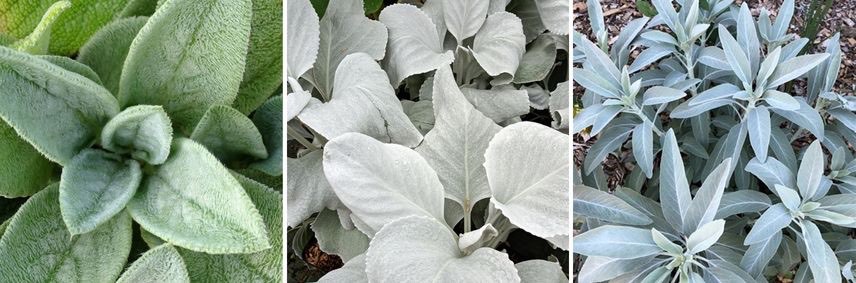
Stachys ‘Big Ears’, Senecio ‘Angel Wings’, Salvia alpina
Read also
Which plants for a contemporary balcony?Grasses
The simplicity and elegance of grasses complement the minimalism of contemporary gardens. Here, we will explore the most drought-tolerant grasses:
- The Schizachyrium scoparium or Andropogon is a beautiful, underused grass that is very tolerant of many situations, particularly dry soils. Its tuft is upright and quite flexible. Varying in height from 50 cm to 1.30 m, it changes colour throughout the season. For example, plant the Andropogon gerardii ‘Blackhawks’, which turns almost black in autumn.
- The Stipas are undoubtedly perfect grasses for dry soils and even coastal areas. From the small Stipa tenuifolia with its soft, blonde hair to the Stipa gigantea with its beautiful golden spikes, they enhance many garden scenes.
- The Carex oshimensis is not a grass, but resembles one, with gramineous yet lush foliage, making it a good choice for dry shade. There are several variegated varieties that are bright and well-suited to graphic gardens. For example, Carex oshimensis ‘Everlime’ features a duo of lime green and fresh green, shining brightly.
- The Panicums form very upright and compact tufts, sometimes tinged with red, purple, or black, depending on the variety.
- The Blue oat grass and blue fescues are appreciated for their glaucous colour in contemporary settings. They thrive in dry, well-drained soils.

Carex oshimensis ‘Everlime’, Schizachyrium scoparium, Helictotrichon sempervirens (Blue oat grass)
Discover other Drought-tolerant perennials
View all →
Available in 1 sizes
Available in 2 sizes
Available in 2 sizes
Available in 1 sizes
Available in 1 sizes
Available in 1 sizes
Available in 1 sizes
Available in 1 sizes
Available in 1 sizes
Available in 1 sizes
Eremurus
Some bulbs of Eremerus and their imposing stature are wonderful in a dry, contemporary garden. A plant that withstands summer drought, it requires some attention to establish well: it needs dry soil in summer and winter, prefers sandy, well-drained soil, but also likes the soil to be fairly rich; adding compost is beneficial, and it may need watering in spring when the leaves are forming. It hates winter moisture, as well as summer humidity. It is very hardy; once its planting needs are taken into account, it requires no maintenance. What a reward when it raises its gigantic flower spikes!
Choose species such as Eremurus robustus or Eremerus himalaicus, reaching heights of 2m to 2.5m. Be careful, their flower spikes are sensitive to wind. In a smaller garden or a windy space, varieties like Eremerus ‘Pinocchio’, which is 90cm tall, or Eremerus ‘Cleopatra’, which is 1.3m tall, are more suitable choices. Eremerus do not like competition; plant them in groups, alone, or in an airy border.
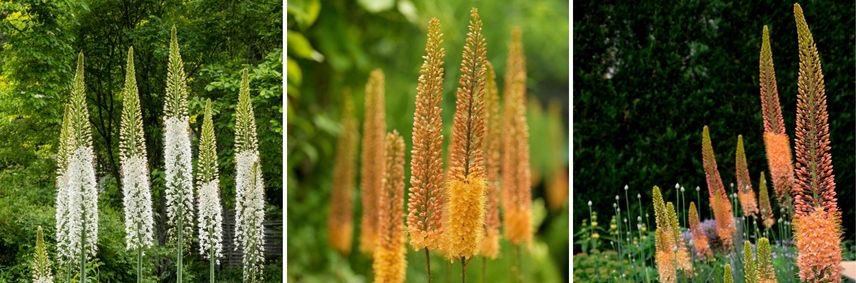
Eremerus robustus, Eremerus ‘Pinocchio’, Eremerus ‘Cleopatra’
Eryngiums
Eryngiums have everything to please in contemporary and dry gardens! They have very graphic appearances with their habit, stems, and leaves. In magnetic blue or silver white, they display fascinating colours. They thrive in dry, stony, well-drained soils. Choose the one that attracts you, whether larger or smaller, with variegated foliage, but be cautious of the thorns at times! Hardy, they are also seaside plants, tolerant of sea spray. Appreciate them for their foliage as much as for their summer flowering. Look at the Eryngium yuccifolium, spectacular. Smaller and with an intense blue, the Eryngium ‘Lapis Blue’ or the Eryngium zabelii ‘Big Blue’.
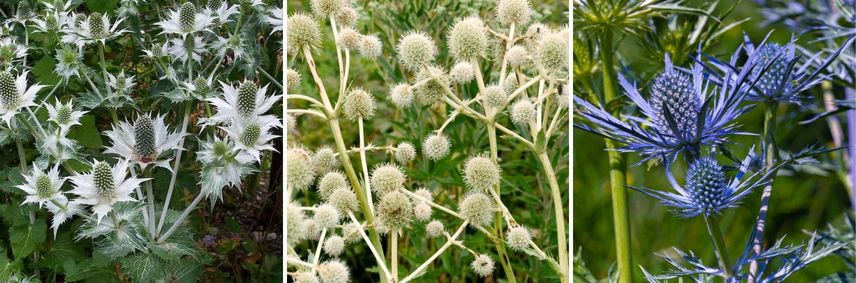
Eryngium giganteum, Eryngium yuccifolium, Eryngium ‘Lapis Blue’
The large Alliums
The large ornamental garlic subjects, the Alliums, make beautiful, simple and remarkable plants for a graphic and modern garden. They thrive in light, well-drained soils that are rather dry. In purple or white, choose the largest varieties with the biggest heads, such as the Allium ‘Ambassador’ with large globular purple umbels measuring 15 to 20 cm in diameter, or the Allium ‘Mount Everest’, which is very pretty in pure white. Prefer spring-flowering Alliums; they tolerate summer drought once flowering is over: the Allium rosenbachianum with mauve-pink flowers or the white varieties derived from Allium stipitatum: ‘White Giant’, for example. Less spectacular but very pretty, consider the Allium caeruleum with blue flowers, or the Allium aflatunense ‘Purple Sensation’, which reaches a height of 90 cm.
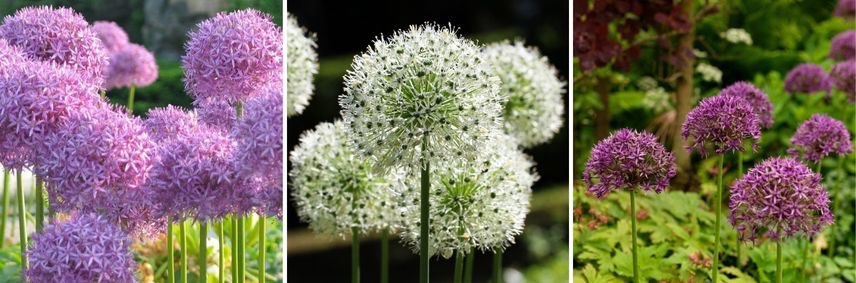
Allium rosenbachianum, Allium ‘Mount Everest’, Allium stipitatum ‘Violet Beauty’
Exotic plants, less hardy
Many exotic plants and succulents are cultivated for the beauty of their foliage and make stunning contemporary and graphic indoor plants. However, they are often less hardy due to their origins. They thrive in well-drained, dry soil. This is the case with Agaves, which can have variegated green or bluish foliage, varying in width. Depending on the species, they can withstand frosts of around -10° C in well-draining, dry conditions. For similar cultivation and hardiness, consider Aloe. The Mangaves, on the other hand, offer sophisticated foliage, tinted with grey, black, and purple. More sensitive to cold, they do not survive below -5° C. Check out our section on cacti and succulents, where you’ll find many plants with interesting graphics and astonishing foliage colours. Among the large full-sun perennial plants that are architectural, we mention Melianthus major, which makes a striking feature in a garden. A plant for dry soil, it is only hardy down to -6 or -7° C and does not like wind.
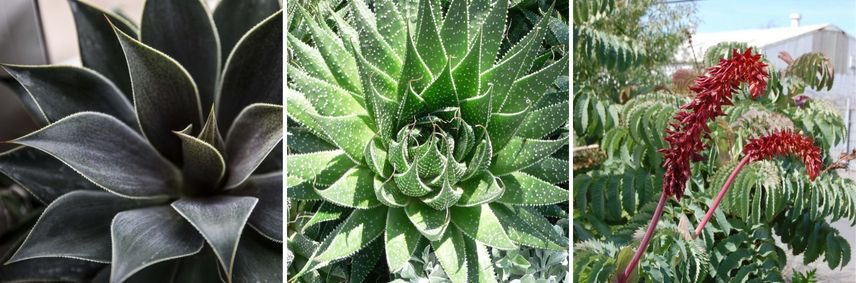
Mangave ‘Lavender Lady’, Aloe aristata, Melianthus Major
- Subscribe!
- Contents
Comments