





























Plants resistant to sea spray
What are the best options to green a seaside garden?
Contents
One only needs to stroll along the coastal paths of France and Navarre to see how the flora of the Atlantic coast adapts to challenging climatic and geological conditions: salty air laden with sea spray, sometimes violent winds, intense sunlight, and soil reduced to ungrateful sand… The plants found in seaside gardens must withstand all these inconveniences. They have developed effective strategies for survival: limited foliar surface, often shiny or rough in appearance, greyish or bluish hues, and deep rooting.
One can find species among trees, bushes, and perennials that remain highly ornamental. They will enhance all these coastal gardens, especially as they often prove to be both drought- and cold-resistant, and are predominantly evergreen.
Here is our selection of ultra-resistant plants to sea spray for the most exposed gardens.

Areas exposed to sea spray
It is important to distinguish three coastal zones, from the closest to several hundred metres from the shore, where the influence of sea spray will vary:
- the zone closest to the coast: these are the gardens most directly exposed to the seafront
- gardens near the shore but sheltered from sea spray as they are in the second line
- areas exposed to marine air but where the sea spray is attenuated by natural screens or buildings
In this advisory note, we mainly focus on zone 1, which is the gardens located along the coastline, most exposed to sea spray. The gardens of the Atlantic coast are particularly exposed. This zone includes certain salt-loving plants that can thrive in soils rich in sea salt, as well as a beautiful variety of plants to enhance this garden that may seem ungrateful at first glance!
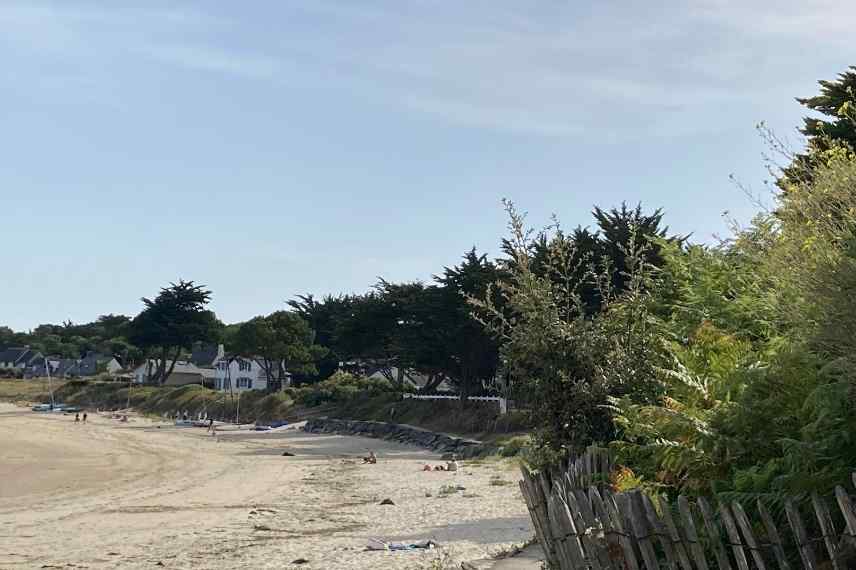
Gardens in the frontline of the Atlantic seafront face harsh conditions for plants (© Gwenaëlle David)
Read also
Coastal garden designTrees
-
Conifers
They prove to be insensitive to cold, and some are impervious to both salt spray and soil as well as drought.
Pines are an integral part of the coastal landscape, and their sometimes almost horizontal silhouette, distorted by the winds, adds a unique charm to seaside gardens. Prominently featured are the Pinus pinaster (or maritime pine) and Pinus laricio or Pinus nigra (also known as black pine or Corsican pine), as well as the Pinus insignis (or radiata), also called Monterey pine, perfect for the Atlantic coast.
Also consider the Lambert Cypress (Cupressus macrocarpa), stunning in large gardens, with a magnificent habit as it matures, featuring a taproot that does not fear drought.
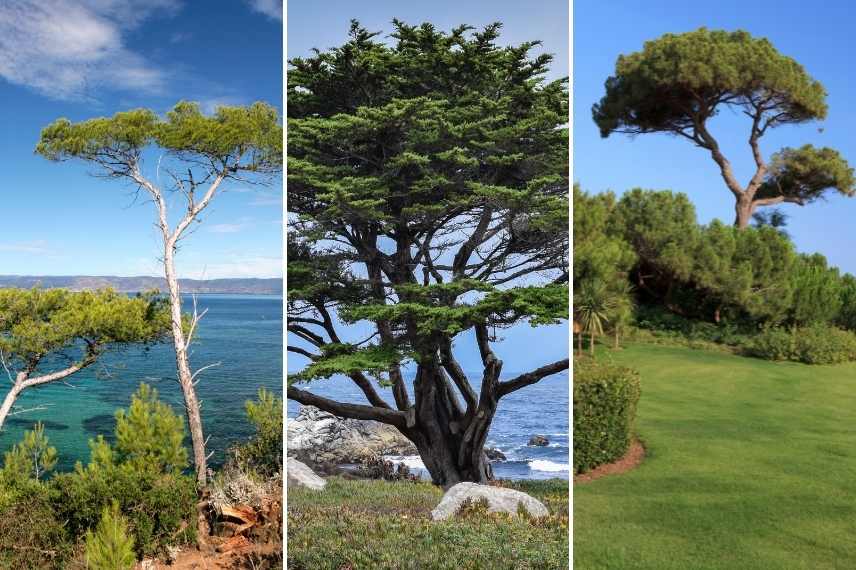 Among the iconic conifers of the seafront: Pinus pinaster, Cupressus macrocarpa, and Pinus pinea
-
Palms
Some palms can adapt to coastal areas, from Normandy to the Basque Country and further south, such as the Phoenix canariensis, Washingtonia, or Jubaea if they remain protected and not directly exposed, as they can be affected by salt in the early years. They are slow-growing. A low Chamareops humilis is also a lovely option. Be sure to check the hardiness of all these palms for your region. You may also consider a Cordyline, a reassuring and quality choice as it provides a similar exotic decor.
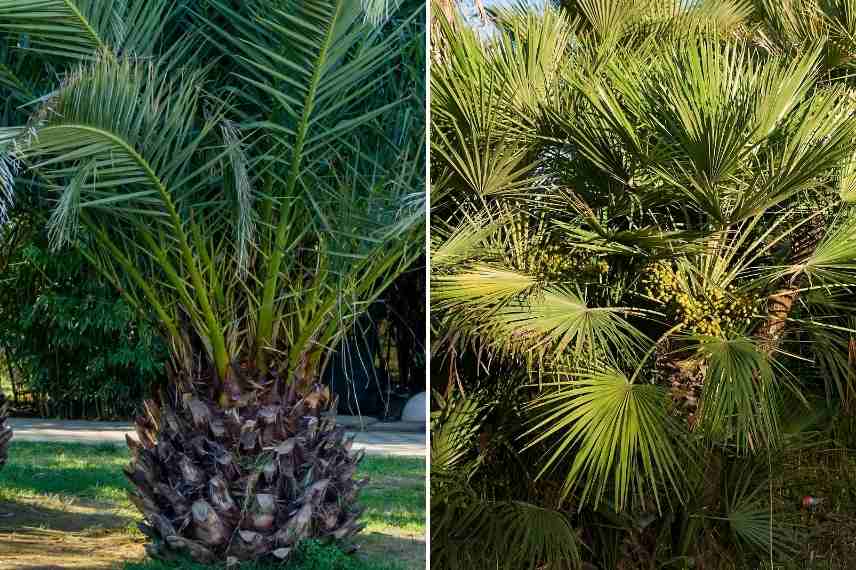 Pinnate foliage of a Phoenix canariensis and palmate leaves of Chamaerops humilis
-
Holm Oak (Quercus ilex)
Insensitive to salty and drying winds, the Holm Oak is a beautiful option for large gardens. Its foliage is decorative on both sides: leathery and dark green on the top, it is white and downy on the underside, allowing it to adapt excellently to the harsh conditions of the coast.
-
Tamarisk (Tamarix)
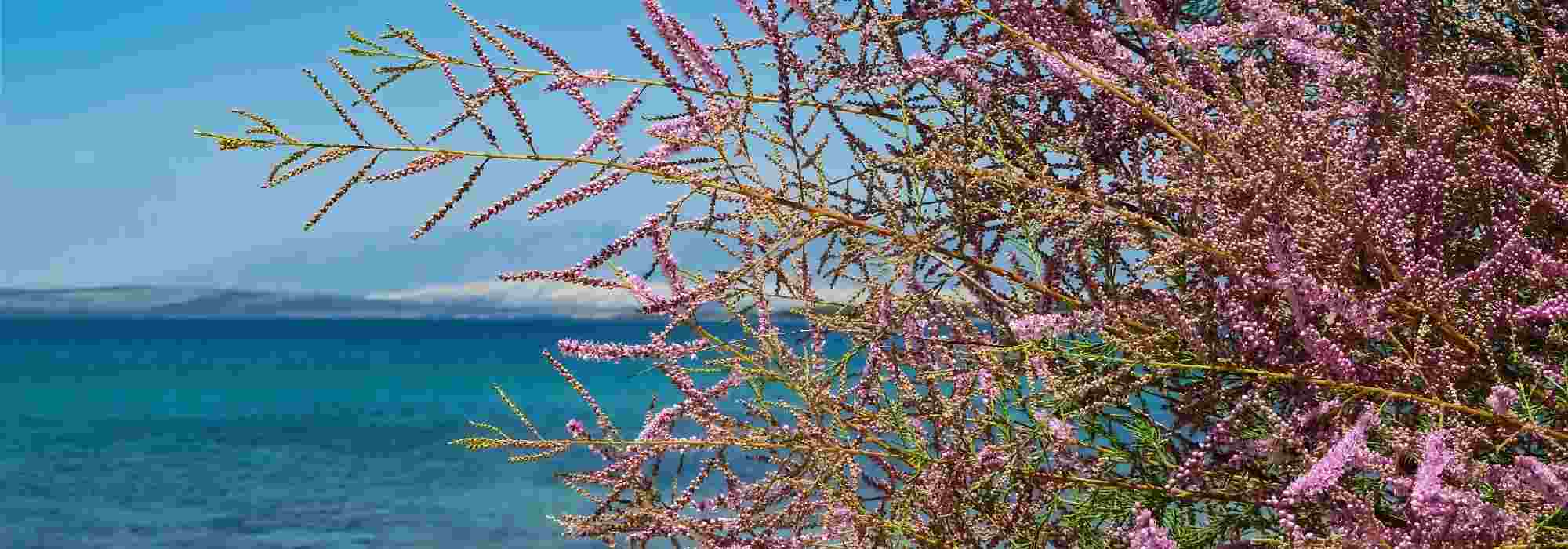
An emblematic tree of the coasts, where it displays an arching habit often contorted by strong winds. Its dark pink flowering, fading as it wilts, is remarkable, both on summer tamarisk (Tamarix ramosissima) and spring tamarisk (Tamarix tetrandra), and its light foliage, a soft bluish green, enhances its weeping appearance.
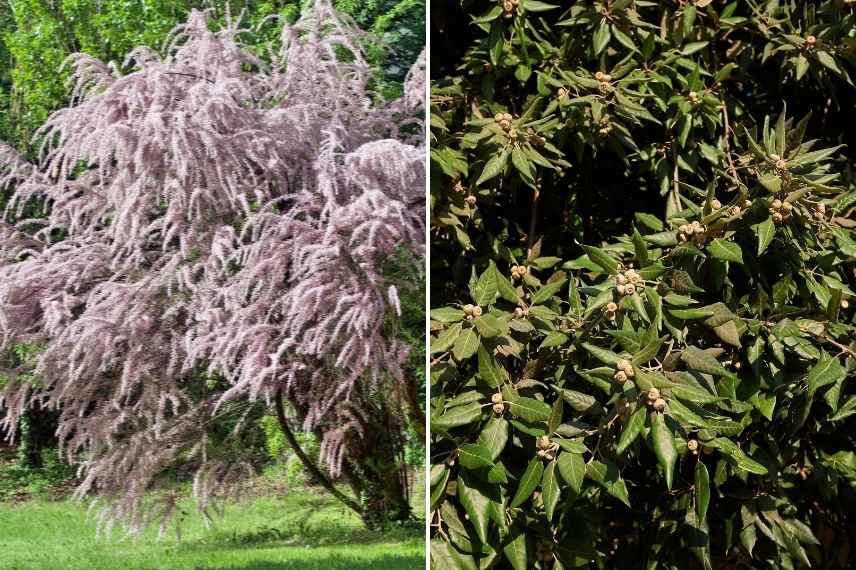 Two species particularly resistant to salt spray and wind: the tamarisk and the Holm Oak
Discover other Shrubs for oceanic and coastal climates
View all →
Available in 1 sizes
Available in 2 sizes
Available in 1 sizes
Available in 1 sizes
Available in 1 sizes
Available in 1 sizes
Available in 2 sizes
Available in 1 sizes
Available in 1 sizes
Available in 1 sizes
Shrubs
- The Yucca filamentosa or Yucca gloriosa: It’s almost a must-have as it brings both graphic appeal and exoticism! Ideal if you prefer not to have palms. Its leathery foliage is indeed spiky but truly exotic. Its creamy flowering in large bells also attracts all eyes. Hardy, it will thrive anywhere. The gloriosa species is taller.
- The Ulex europaeus: The gorse of Brittany grows up to 2 m high and offers so many advantages that it is one of the most interesting options for very exposed gardens: a bushy and compact habit, spiny, greyish evergreen foliage perfect for a defensive hedge, a long melliferous and fragrant flowering in a golden yellow spectacle in spring, and sometimes repeat flowering in autumn, along with excellent hardiness.
- The sea buckthorn or Hippophae rhamnoides: With its spiny branches and fine greyish leaves, it is one of the champions of coastal areas. We love its habit and colourful autumn fruiting. Measuring about 3 m high, it is interesting for defensive and screening hedges or to associate in a natural thicket.
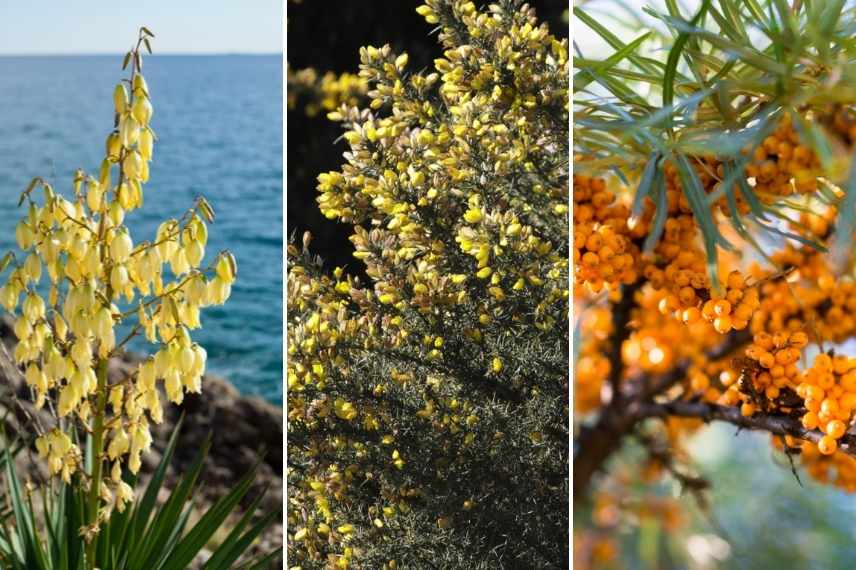 Among the colourful options, we find the Yucca, Ulex europaeus, and sea buckthorn.
- Teucrium fruticans: This bush has very beautiful greyish, slightly downy foliage and lavender-blue flowering in summer (persisting into winter in mild climates). Its irregular and spreading habit forms a lovely mass in a coastal garden. It is suitable wherever temperatures remain above -8°C.
- Eleagnus: An essential shrub! Its almost silver, shimmering leaves are ultra-resistant to the assaults of coastal conditions. Elaeagnus ebbingei is available in many variegated cultivars, allowing for varied aesthetics. Evergreen, it is often used in windbreak hedges.
- Atriplex halimus or orache: This evergreen shrub native to North Africa is found all along the Atlantic coast, proving it withstands sea spray better than any other. Fast-growing, it has greyish, leathery foliage that is ultra-resistant to wind and salt, as well as drought. It can be left in a free form to enjoy its bushy habit, planted in windbreak hedges (it grows up to 2 m), and even pruned into more structured shapes. Its pale pink flowering is very light but further brightens its foliage in summer.
- Myrtus communis : Familiar to southern gardeners, this superb shrub is appreciated for its bushy habit and lovely melliferous white flowering. It can thrive wherever temperatures remain above -9°C. Evergreen, it has a slow growth rate.
- The evergreen spindle trees: Euonymus fortunei and Euonymus japonicus, evergreen, with smooth, almost glossy leaves, are perfect subjects that do not fear sea spray. Versatile, they form dense hedges, but can also be planted as solitary specimens or in pots. The wide range of foliage, whether solid or variegated, is an additional asset.
- Pistacia lentiscus: An emblematic shrub of the Mediterranean, it also finds its place in gardens in Brittany and the southwest, provided it is protected in its early years; afterwards, it manages on its own and provides a lovely mass whether isolated or in a free hedge (though it grows quite slowly). Its foliage turns red during cold winters.
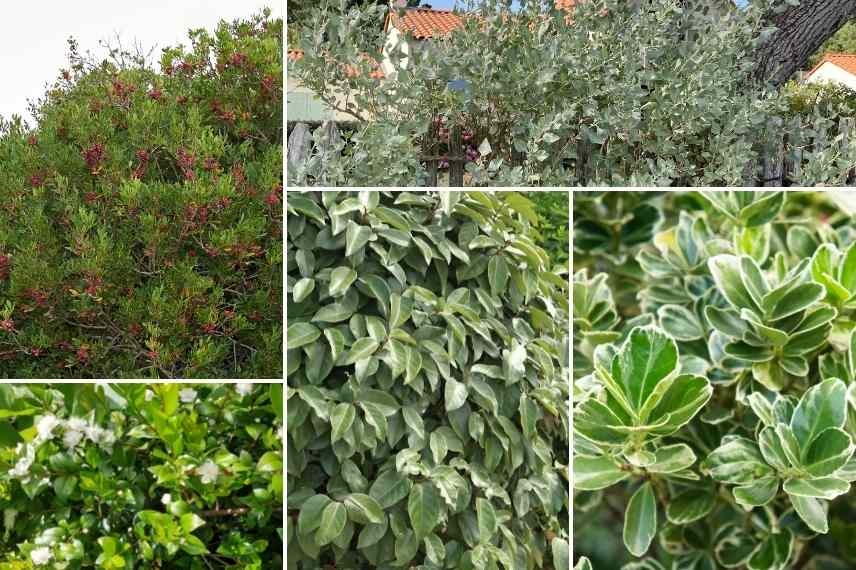 Pistacia lentiscus, Atriplex halimus, Myrtus communis, Eleagnus ebbingei, and Japanese spindle tree.
Read also
7 trees for coastal gardensUndershrubs
On finds a large number of undershrubs that withstand wind, sea spray, and strong sunlight. Due to their small size and often grey or powdery foliage, these low-stratum plants, reaching a maximum height of 1 m, are very useful for coastal conditions.
- Dorycnium hirsutum: this perennial, growing in rounded clumps up to 80 cm high, is unfazed by sea spray. It features evergreen, silvery-blue, silky leaves and white flowers starting in May.
- Halimium lasianthum: with its vibrant bright yellow flowers, this shrub with silver foliage, not exceeding 80 cm in height, is very useful in gardens in southern or western France. It thrives in full sun, takes on a beautiful spreading and compact habit, and flowers from May to June-July depending on the region.
- Muehlenbeckia complexa : an incredible little New Zealand shrub, with dark green, rounded evergreen leaves on reddish-brown stems, forming an extraordinary tangle. It can be used as groundcover or as a climber, or left free to reach nearly 2 metres high when trained on a structure. It grows quickly.
- Anthyllis barba-jovis: also known as Jupiter’s Beard in the south, this elegant, highly branched shrub has beautiful evergreen foliage with silver highlights and a compact upright habit. Its silky, compound leaves and pale yellow flowers from April to June are particularly appealing. It reaches about 1 m in height.
- Senecio cineraria : another undershrub with foliage that is almost white, so silvered is its grey leaves. This sea cineraria blooms with bright yellow flowers from May to July, and its finely cut leaves provide a marine decor even after the plant has finished flowering.
- Cytisus scoparius: broom thrives in western France, also offering golden yellow flowers, sometimes bicoloured red like the variety ‘Palette’.
- Santolines (Santolina chamaecyparissus or rosmarinifolia): forming dense clumps, they are interesting for their evergreen, aromatic foliage, their great hardiness, and their late spring flowering with small bright yellow flowers. Prune just after flowering to maintain a compact habit.
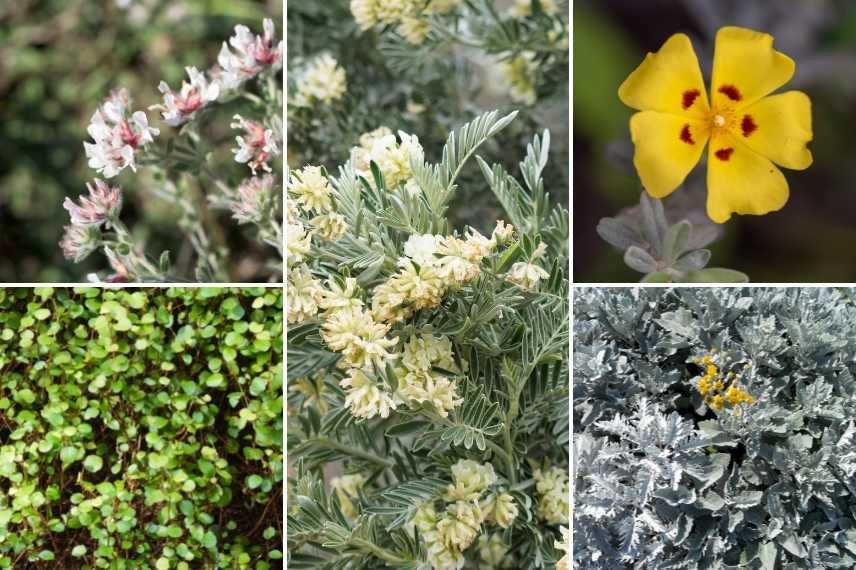
Dorycnium hirsutum, Muehlenbeckia complexa, Anthyllis barba-jovis, Halimium lasianthum, and Sea Cineraria
- Baccharis genistelloides: an original option as this small shrub (1 to 2 m maximum) resembles an upright green seaweed! It is graphic and bears small white flowers along the stems in summer. Plant it in the ground where it will form a beautiful clump or in a pot on the terrace. (Note: do not confuse with Baccharis halimifolia, which is very invasive)
- Heathers Erica carnea and Erica x darleyensis: these winter-flowering heathers are also valuable for their great resistance to wind and sea spray. They provide essential flowering during the coldest months for coastal gardens. Plant in acidic soil.
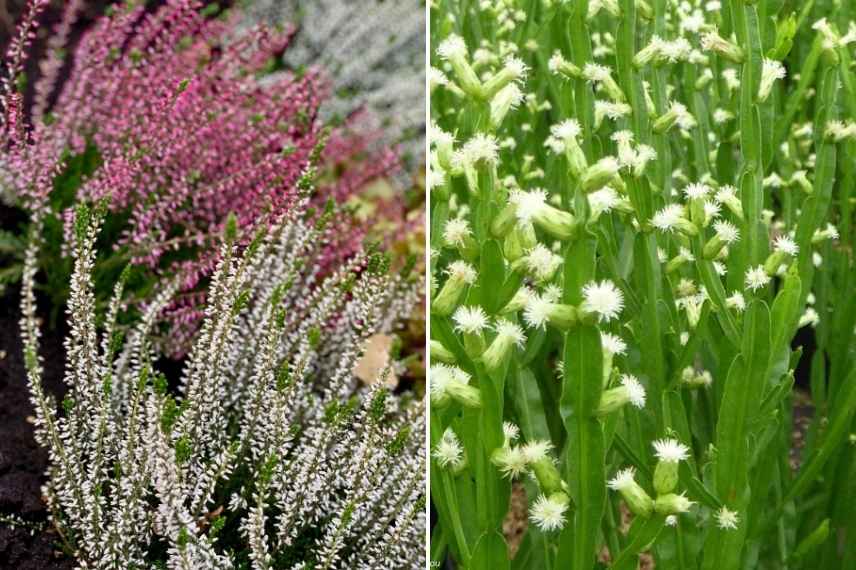
The classics Erica carnea or the surprising Baccharis genistelloides
Perennials and grasses
Often, it seems that few flowers can withstand the sea spray and conditions of coastal areas. Here are the most suitable plants, whether graceful or graphic… all truly ornamental:
- Phormium tenax: a must for coastal gardens! These impressive perennials from New Zealand provide exoticism and structure in the garden. They grow quite quickly and form an even taller mass when the flower spike emerges (up to 3 m in height). The type species can be planted anywhere along the coast, while the coloured varieties are more sensitive to cold.
- Agapanthus: these perennials are stunning by the sea, not fearing the wind once established, nor the sea spray. They are perfect in a west or south-facing position near the house. Chosen in blue, they respond magically to the blue of the sea. Be cautious of their variable hardiness depending on the planting region. The Agapanthus africanus with strong stems is to be preferred.
- Arundo donax: fast-growing, the giant reed is a regular in southern coastal gardens, bringing an interesting verticality. The variegated varieties are very ornamental. However, be cautious, as it is now considered invasive in New Caledonia. Plant it with a barrier, although in dry soil, its invasive character poses less of a problem.
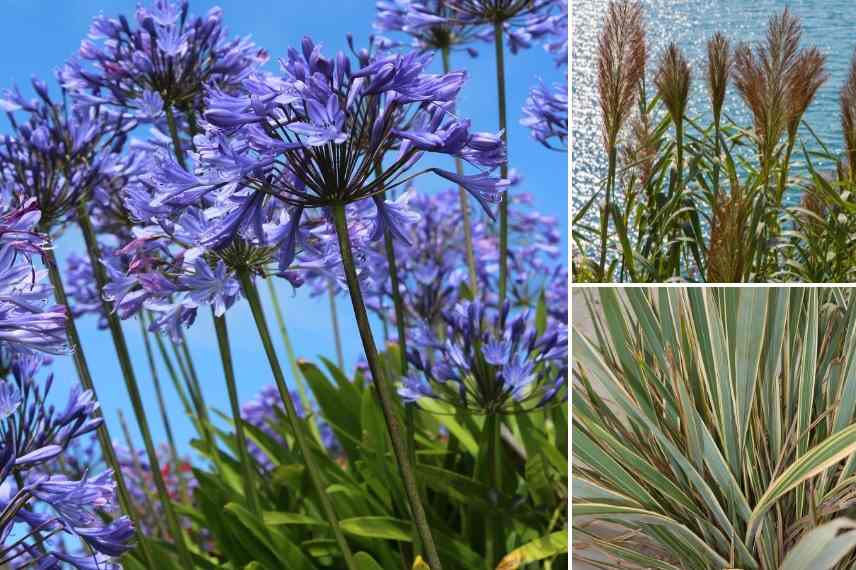 Among the easy-to-find plants: Agapanthus, Arundo donax, and Phormium
-
- Limonium (or sea lavender): this plant has its place in coastal gardens, displaying a violet cloud of tiny nectariferous flowers in mid-summer. It needs sunlight and is completely resistant to sea spray and drought.
-
- Ajania pacifica: the Pacific chrysanthemum is adorned with a myriad of small globular yellow flowers from late summer to autumn. Its persistent, bluish-green foliage edged in white is also very ornamental once flowering is over, as it forms dense cushions. Allow it to establish well, and it will withstand sea spray perfectly.
-
- Jacobinia: This perennial (Dicliptera squarrosa in Latin) boasts a beautiful and original summer flowering, tubular and dark orange. A must-see!
-
- Lagurus ovatus: the hare’s tail with its characteristic white pom-poms recalls coastal scrub and has a lovely scent of the sea. It is perfect in gardens where sand is prevalent. Sow at the beginning of spring.
-
- Sea fennel (Crithmum maritimum): a native perennial of our coastline, sea fennel has fleshy bluish-green foliage and yellow flowers resembling those of wild fennel (it is also called rock samphire) and is perfect for a wild coastal garden. It provides a natural link to the shore.
-
- Helichrysum italicum: the Italian everlasting also copes well with wind and sea spray due to its fine, bluish foliage. This undershrub, considered a shrubby perennial, withstands temperatures down to -12°C. Its yellow flowering in corymbs occurs in summer. It has a delightful curry scent!
-
- Carpobrotus: the ice plant, a South African succulent perennial, thrives in coastal gardens with the mildest climates. To avoid being overwhelmed, as it is considered invasive, prune it regularly, or better yet, plant it in a beautiful trough where it will be contained. Its Indian pink flowers are spectacular! It loves full sun.
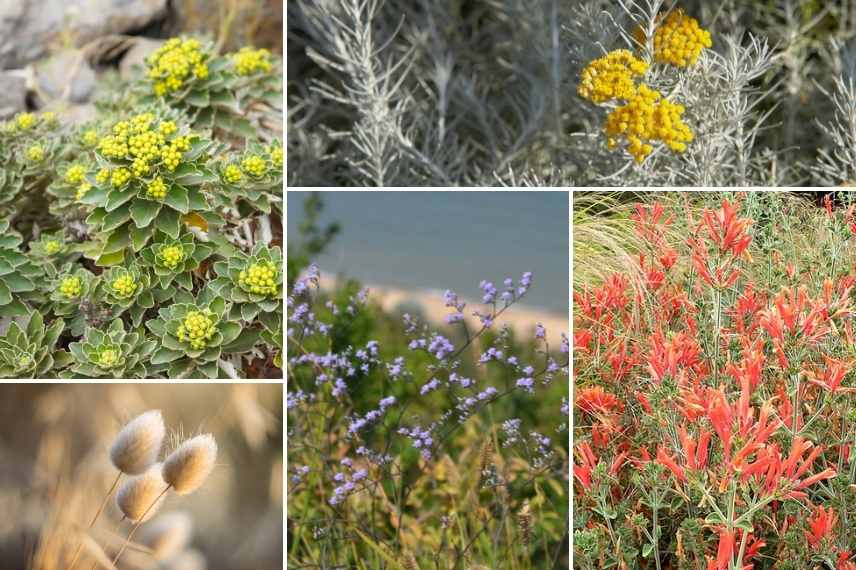 Ajania pacifica, Lagurus ovatus, Helichrysum italicum, Limonium, and Jacobinia
→ Also discover our article: “Perennials Resistant to Sea Spray for Coastal Gardens”.
Beyond this buffer zone...
A few metres back from the midrib, the range widens with some very beautiful plants:
Pittosporum tobira and Pittosporum tenuifolium, Escallonia, Bupleurum fruticosum, Leucophyllum, Ceanothus, bush veronicas, Erigeron karvinskianus, oleander, Abutilon, Dodonaea, Leptospermum, Abelia, Buddleia, Callistemon, Hypericum (St. John’s Wort), Olearia, Callistemon, Tulbaghia, Salix rosmarinifolia, Morus alba ‘Kagayamae’, Acacia, bignonia, Hydrangea macrophylla…
→ See our dedicated sheets below in the related articles for more details.
- Subscribe!
- Contents
Comments