





























Rare and spellbinding: embrace black shrubs and black roses
Fascinating flowering and foliage
Contents
It’s a colour rarely associated with the plant world. Yet black does exist in plants, whether in their flowering, foliage, or trunks. However, it’s not truly black: these are rather very dark colours, often in shades of burgundy, purple, brown or violet, which are so dark that they appear black in certain light.
Whether these are shrubs with dark foliage or black flowering, they will inevitably bring an original and mysterious touch to the garden, never failing to impress. Discover these unique plants and our tips for choosing them well, for growing in the garden or in a pot.

Why choosing black for the garden?
At first glance, black is not the colour you would instinctively think of when planning a border, a hedge, a rockery or a container planting. It is true that this colour can seem a little dull and difficult to fit into the garden. However, in small touches, it helps to create striking contrasts and add a touch of originality. We recommend using black bushes and roses sparingly to avoid venturing into a scene that is too dark. But it is also possible, in small areas, to create unique scenes, for example by pairing only black and white. Silver foliage also pairs very well with black plants.
In a garden that favours pastel colours (pinks, mauves, blues), black will bring a contemporary touch. It is also an opportunity to move towards tonal shades with purples, reds, crimsons or lighter browns.
Place your black bushes and roses in a bright spot, but not in excessive sunshine, to best bring out the intensity of their colour.
Black-flowering shrubs and roses
They are certainly among the most captivating flowering displays in the plant world. These dark, intense flowers are sure to catch the eye.
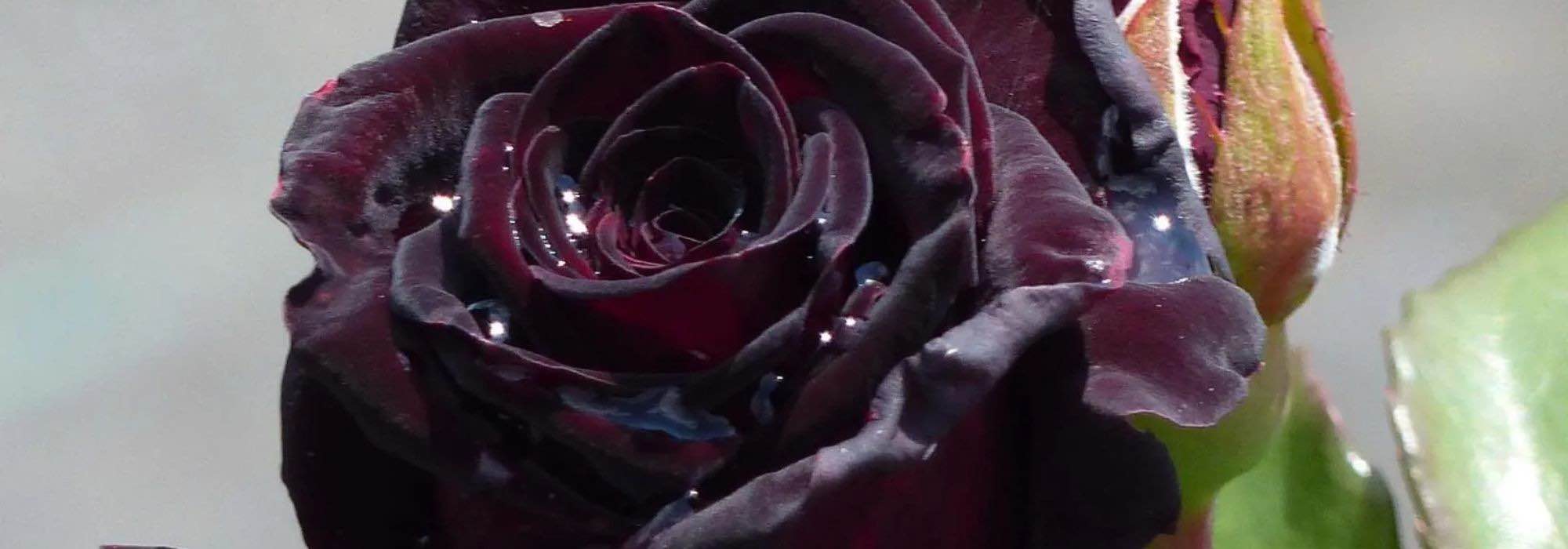
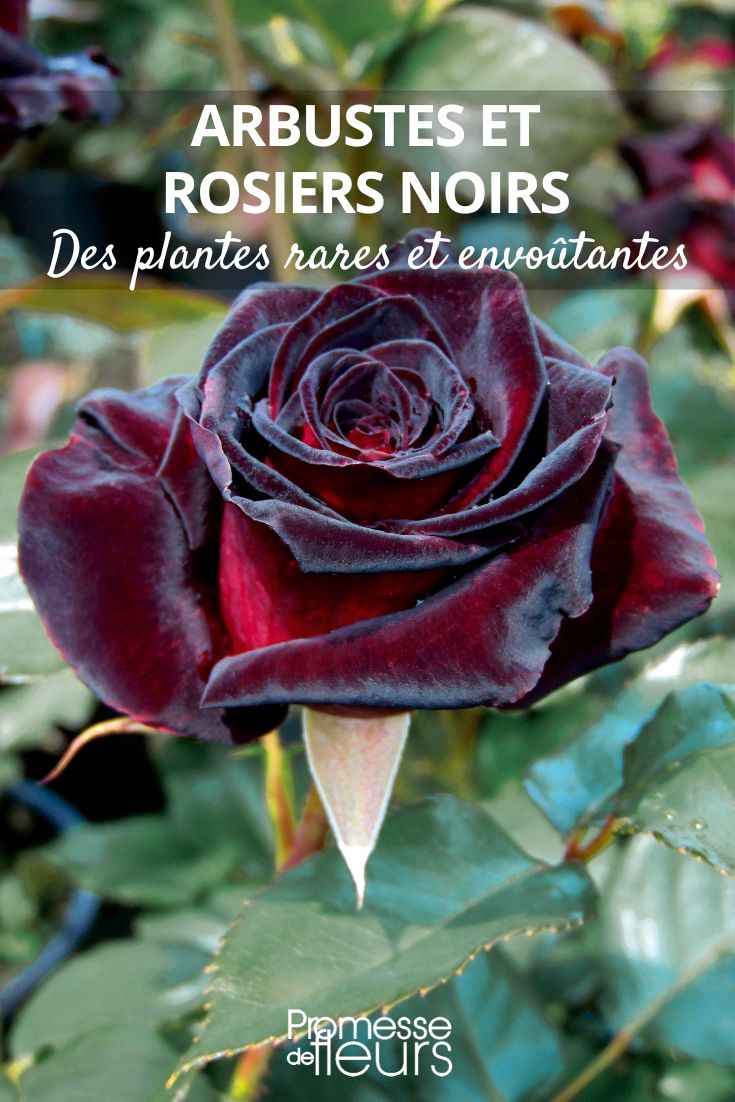
In this category, let us spotlight the incredible large-flowered rose ‘Black Baccara’. , bred in 2003 by Meilland, it produces large roses with a perfectly turbinate form, displaying a velvety garnet red so dark that it can appear black, depending on the light. It is a cut flower with excellent vase life. This flowering also exudes a delicate tea-rose fragrance. Repeat-flowering, it appears almost without a break throughout the summer. If this rose isn’t the easiest to grow, notably due to its susceptibility to diseases, we forgive its relatively low resistance for the beauty of its flowers, utterly captivating.
Another black-flowered rose: the hybrid tea ‘Paint It Black’, which literally displays the colour in its name. It is one of the darkest roses currently available on the market. Its flowers with impeccable form measure about 10 cm in diameter. They reward us with a deep red full of reflections giving the impression that they are black. Their light fragrance and good vase life are among the other merits of this rose, as is its good resistance to diseases and to cold.
Among the shrubs that have the peculiarity of flowering in black, let us also mention the wolf’s-claw willow (Salix gracilistyla). In early spring, between February and April, it produces large black, silky-looking catkins, which contrast with red anthers and the reddish shoots still naked. These catkins recalling claws are what earn it its nickname. Not fussy and hardy, this willow can be grown in sun or partial shade in moist soil. For its ornamental qualities, it has been recognised by the prestigious Royal Horticultural Society.
Finally, you will certainly know Buddleja or butterfly tree. But did you know that there exists a variety whose long flowering spikes are so dark that they can appear black? This is the aptly named ‘Black Knight’. Like its peers, it delights us with melliferous and well-scented flowering. It will thrive in sun, in any well-drained soil.
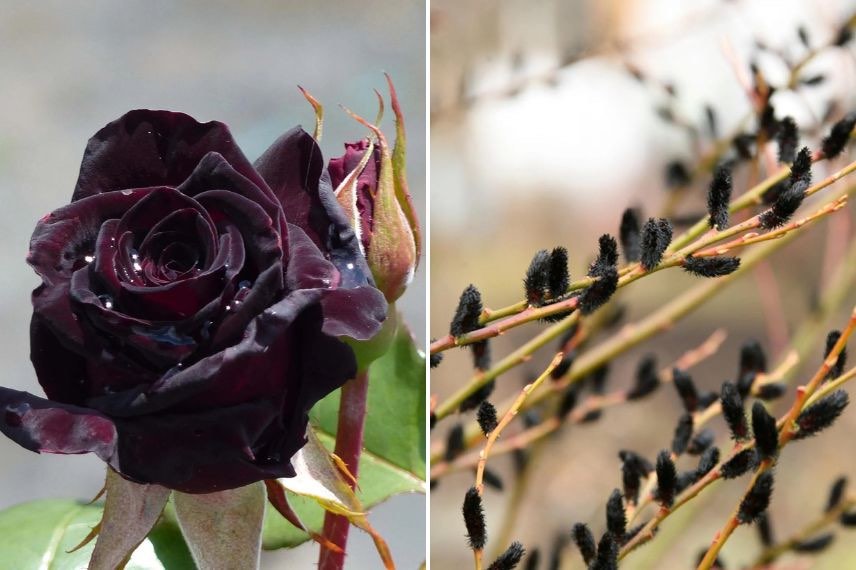
Large-flowered rose ‘Black Baccara’ and Wolf’s-Claw Willow
Black evergreen foliage
If you choose to adopt shrubs with dark foliage, you may wish to enjoy them all year round. No problem with these evergreen varieties, which keep their dark and elegant foliage year-round.
Phormiums are first up, those cousins of agaves that bring an exotic touch to the garden, thanks to their sword-shaped leaves held upright. ‘Dark Delight’ is among the darkest, with leaves ranging from chocolate to deep purple, almost black when viewed in silhouette. It is an ideal plant for Mediterranean-style gardens. For its part, ‘Black Adder’ offers a clump of evergreen foliage oscillating between dark purple and black. It will fare better on the Atlantic-facing, somewhat damper side of our territory.
In the same vein, with their leaves in coloured ribbons, let’s talk about cordylines. Not particularly hardy, these are plants to be reserved for gardens that do not endure hard frosts (below -6°C on average). Notably, Cordyline x banksii ‘Renegade’, with its very dark purple leaves, or Cordyline australis ‘Black Knight’, which also produces leaves just as dark.
Not very common, the Pseudopanax lessonii ‘Dark Star’ will also grace regions with mild winters with its beautiful, sculpted foliage, so the colour leans toward a nearly black purple.
Hardier (down to -10°C), the Pittosporum tenuifolium ‘Dark Diva’ offers us evergreen oval foliage. It is initially light green, then takes on very dark purple hues.
Creating a stunning contrast with its sky-blue panicle flowers in May, the Ceanothus thyrsiflorus ‘Tuxedo’ produces glossy evergreen foliage, a purple that is almost black.
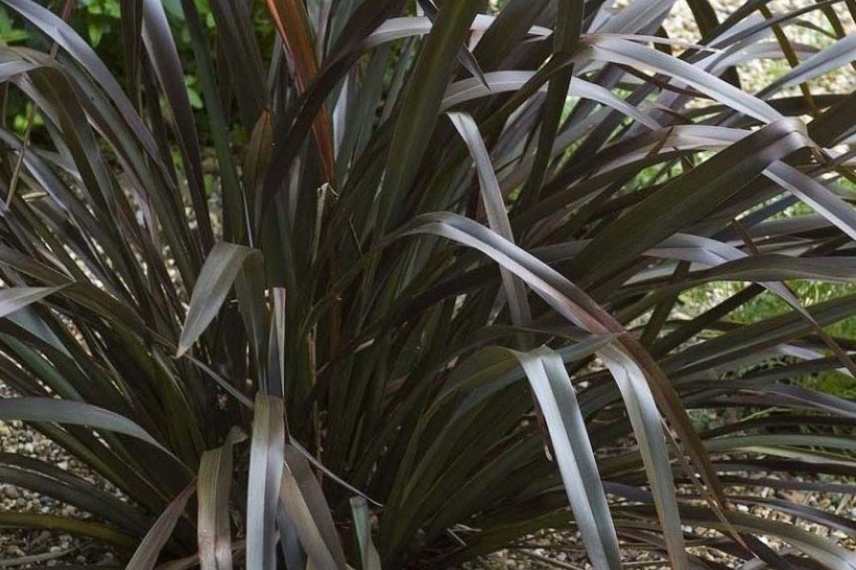 Phormium ‘Black Adder'</caption]
Read also
9 purple-leaved shrubsDark-leaved shrubs for pots
You don’t have a garden or you only have a small space, but would still like to enjoy the almost mystic charm of black shrubs? It’s possible with varieties that have a compact habit and can be grown in restricted spaces and in pots. But in cold regions, this also helps protect the less hardy black shrubs from the cold.
This is the case with Loropetalum, with their fountain-like sprays of foliage, which also enjoy playing with dark tones. Measuring only 80 cm in height, the Loropetalum chinense ‘Ever Red’ displays purple to deep violet foliage year‑round. It is also interesting for its spring flowering, in red ribbons with a tousled look. A little larger (around 1.5 m in height), ‘Pipa’s Red’ has purple to bronze foliage that is very dark, accompanied by bright pink flowers in late winter.
The Aeonium arboreum ‘Schwarzkopf’ will also thrive in pots thanks to its compact size (80 cm in height by 50 cm spread). This will help shelter it from frosts, as it is rather frost-prone (hardiness to -4°C). We like it for its succulent foliage with an exotic look, which consists of large glossy rosettes, a deep burgundy-brown, almost black.
Here again, phormiums will be good candidates, as with ‘Platts Black’ and its evergreen foliage in a very dark chocolate shade, appearing black depending on the light.
Let’s also mention shrub veronicas, such as ‘Turkish Delight’. This small evergreen shrub with a bushy habit does not exceed 1 metre in all directions. It stands out thanks to its glossy foliage, oscillating between bronze, brown and purple. At ‘Joan Mac’, the foliage is even darker and more intense, bearing a dark purplish-green. The leaves thus contrast beautifully with the flowering in pink-violet spikes. Also mention ‘Midnight Sky’, with leaves of a deep, glossy purple in winter.
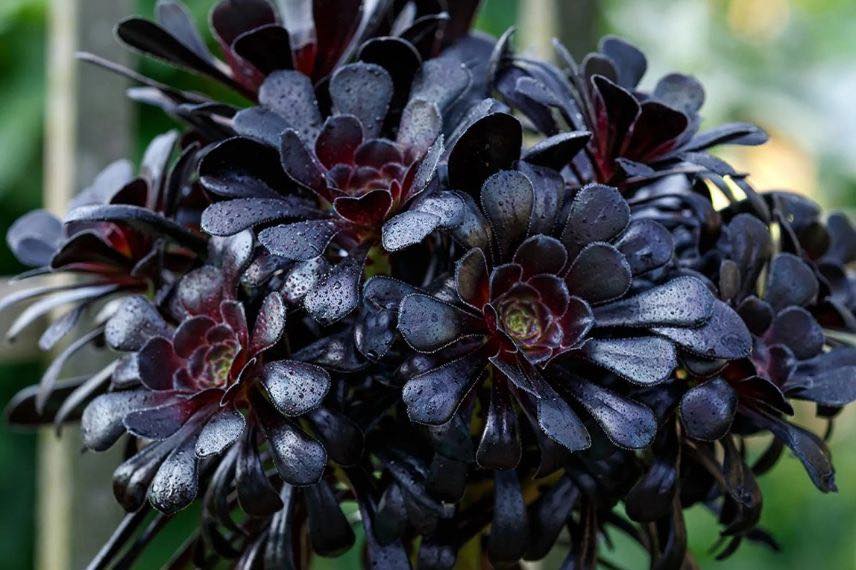
Aeonium arboreum ‘Schwarzkopf’
Hardy shrubs with black foliage
For gardens enduring harsh winters, you can also rely on shrubs with dark foliage. Hardy, some of them are able to withstand frosts down to -20°C.
That’s the case with black elder shrubs, as illustrated by the Sambucus nigra ‘Black Lace’. This deciduous shrub has foliage that is very finely cut, in a hue of purple that is almost black. It is also prized for its flowering in pink umbels at the end of spring. Equally striking, the dark foliage of ‘Black Beauty’ will grace borders and informal hedges.
We should also mention Corylus maxima ‘Purpurea’ or purple hazel, a handsome fruiting bush with several noteworthy traits: striking dark ornamental foliage, ament flowering from the end of winter, and delicious autumn fruit.
With weigelas, dark foliage is also prized, as shown by the variety ‘Alexandra’. It offers the darkest foliage in the family: seasonal, it ranges from very dark purple to purple tinged with green and black in summer, before taking on red tones in autumn. A sunny exposure will enhance the intensity of these colours. This shrub is also interesting for its spring flowering in pink-purple bells. Also mention the small ‘Minor Black’, whose dark foliage will fit in anywhere thanks to its small habit (about 60 cm across). Don’t forget ‘Ebony and Ivory’, which plays on contrasts with its dark green foliage beside white flowers.
Among the ninebarks (Physocarpus opulifolius), ornamental shrubs in more ways than one, it is the varieties ‘All Black’, ‘Black Light’ and ‘Panther’ that offer us almost black foliage.
Let us not forget the case of bamboos, which can sometimes reward us with very dark canes or culms, as with Phyllostachys nigra, the Fargesia nitida ‘Trifina Black’ or ‘Back Dragon’.
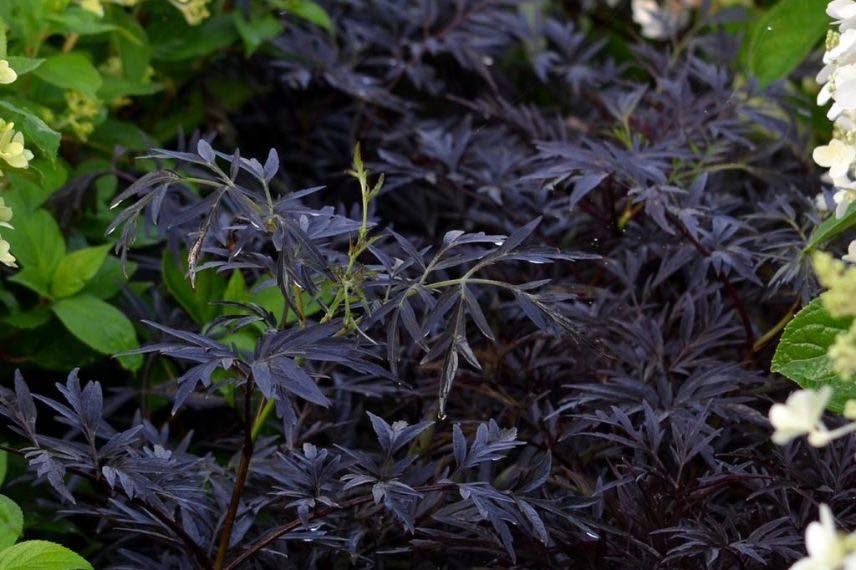
Sambucus ‘Black Lace’
- Subscribe!
- Contents
Comments