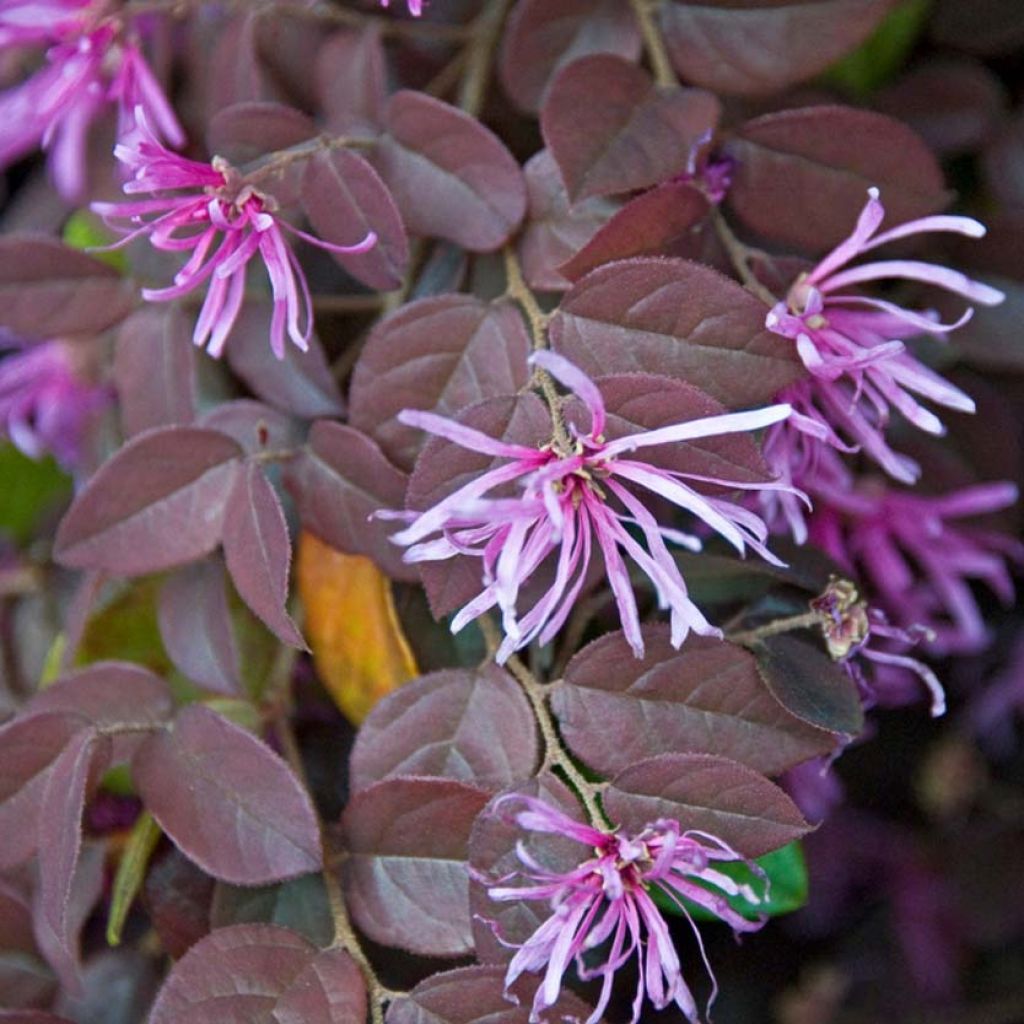
Loropetalum chinense var. rubrum Pipas Red - Chinese Witch Hazel
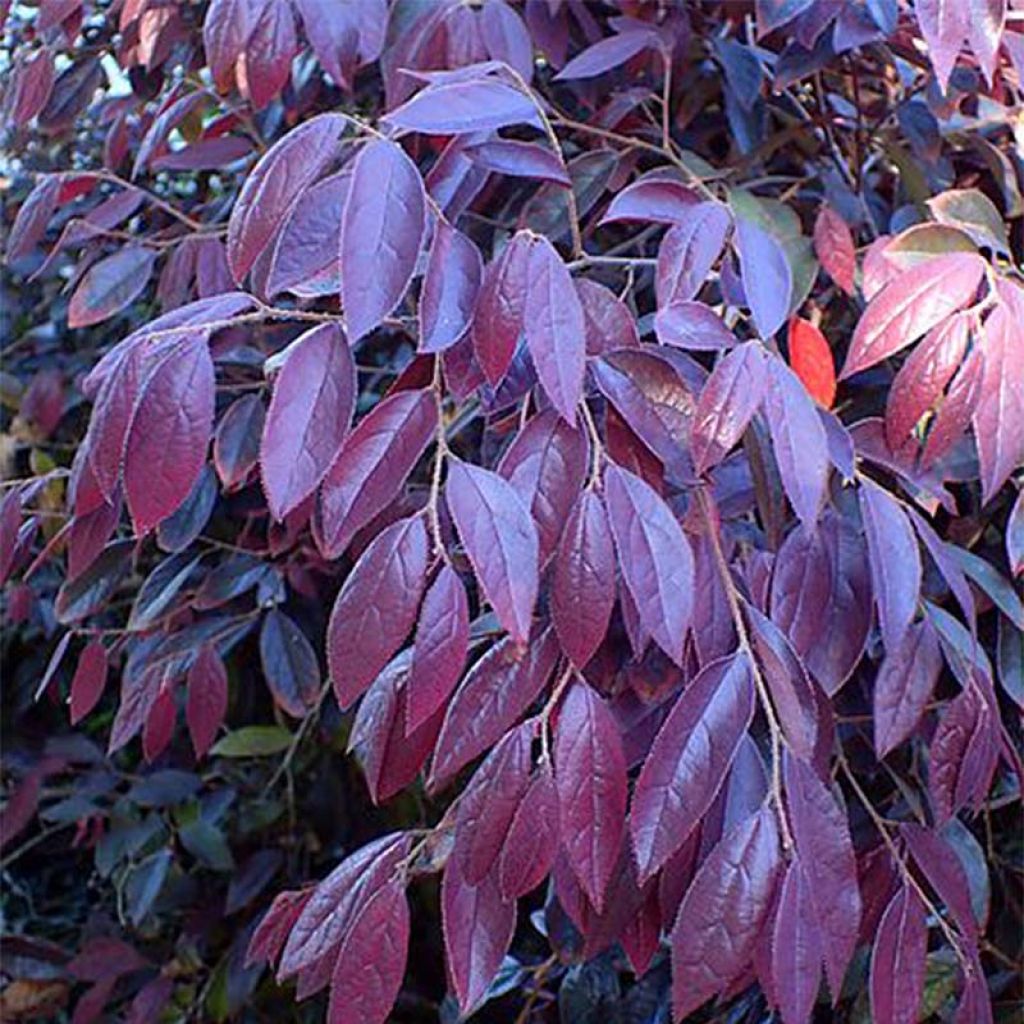
Loropetalum chinense var. rubrum Pipas Red - Chinese Witch Hazel
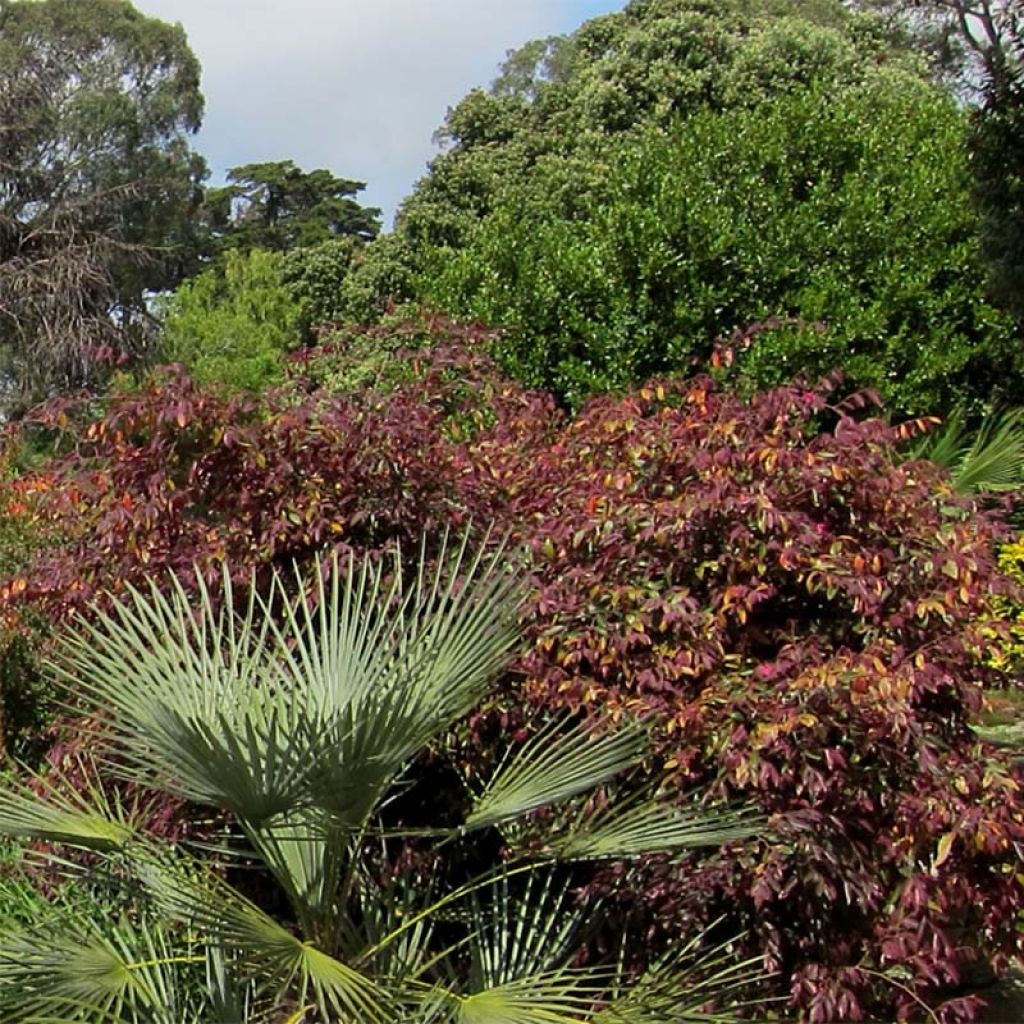
Loropetalum chinense var. rubrum Pipas Red - Chinese Witch Hazel
Loropetalum chinense var. rubrum Pipas Red - Chinese Witch Hazel
Loropetalum chinense var. rubrum Pipa's Red
Chinese Witch Hazel, Chinese Fringe Flower
Very beautiful plant, magnificent foliage better than expected. The shape of the bush is harmonious. Just need to water the young plant. Thank you very much!
Catherine, 12/11/2022
Back-to-school special offer!
Get €10 off for every €50 you spend! And get up to €40 off on a single order.
How does it work?
1. Shop your favourites
Add your favourite plants to your basket. For every €50 you spend (excluding delivery charges, store credit and the plastic-free option), you’ll receive a €10 voucher.
€50 spent = €10 voucher
€100 spent = €20 voucher
€150 spent = €30 voucher
€200 spent = €40 voucher
2. Place your order
Once your basket reaches one of the spending thresholds, place your order. You can even choose your delivery date!
3. Receive your voucher
As soon as your order has been shipped, you’ll receive an email containing your personal voucher code and its value.
4. Use it on your next order
Your voucher is valid for 90 days from the date you receive it. It can be used once only, on a new order worth at least the value of the voucher, excluding delivery charges.
Please note: Vouchers can be combined with other offers, but cannot be split or refunded.
Home or relay delivery (depending on size and destination)
Important: You may be charged customs duties by your country’s customs authorities upon delivery.
Schedule delivery date,
and select date in basket
This plant carries a 24 months recovery warranty
More information
We guarantee the quality of our plants for a full growing cycle, and will replace at our expense any plant that fails to recover under normal climatic and planting conditions.

Would this plant suit my garden?
Set up your Plantfit profile →
Description
Loropetalum chinense Pipa's Red is undoubtedly the darkest of the cultivars with purple foliage. This evergreen bush also charms with its flexible habit, slightly spreading, which gives it the appearance of a dark fountain. It is adorned with curious bright pink and slightly fragrant flowers, which bloom at the axil of the leaves usually in late winter and spring, and then more sporadically in late summer, depending on the climate. While it proves hardy and relatively tolerant to heat and drought once well established, it prefers mild, cool climates in summer, and soils devoid of limestone.
Loropetalum chinense var. rubrum, or Chinese Fringe Flower with purple leaves, is a bush of the Hamamelidaceae family, noted by its flowers with 4 long ribbon-like petals that resemble those of the Hamamelis. It is native to the forests and copses of the Himalayas, in China, and in the northern and eastern regions of India, where it grows up to an altitude of 1200m (3937 ft).
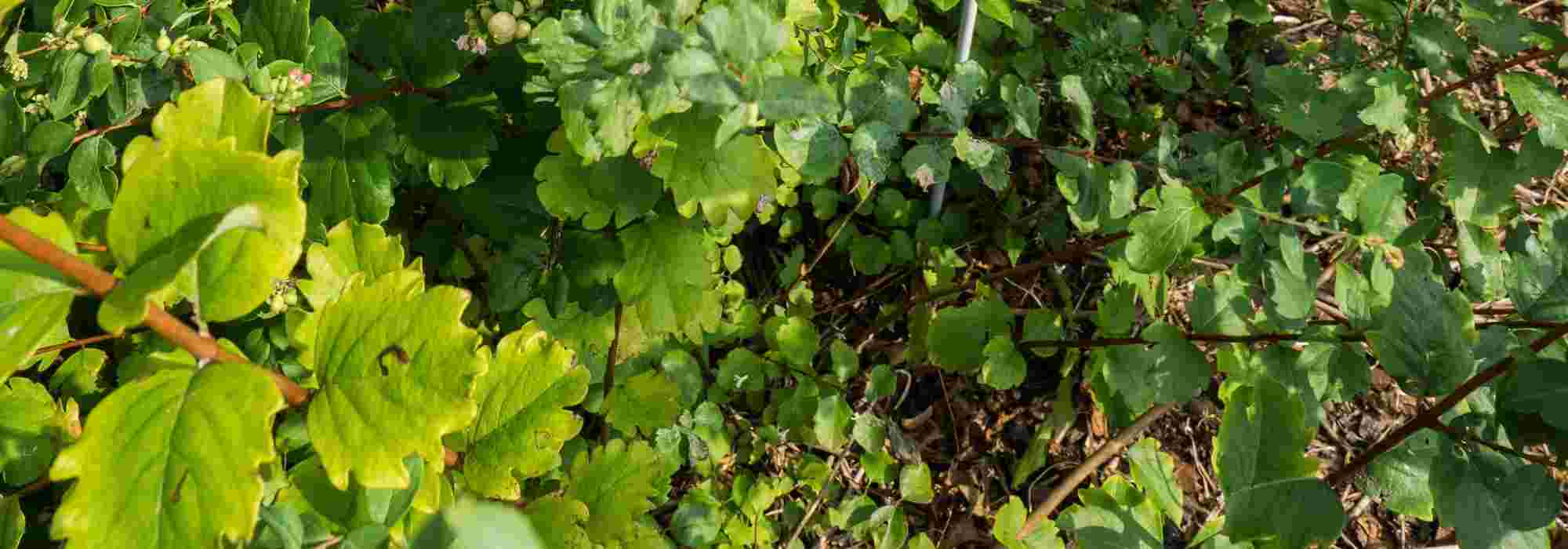
Pipa's Red is a recent cultivar derived from this shrub, with a bushy and spreading habit carried by slightly arched branches. It will reach a height of about 1.50m (4 ft 11 in) and a spread of 1.75m (5 ft 8 in) at maturity. It develops evergreen foliage in mild climates. The entire, ovate leaves, 2 to 5cm (0.8 to 2 in) long, are red when they bloom, then they gradually take on a dark purple-violet hue, before turning gradually to bronze-purple to bronze-green in winter. The leaves located in the shade tend to be greener than those that receive sunlight, even in the middle of summer. The abundant, melliferous and nectar-rich flowering takes place in March-April, more or less early depending on the climate. It lasts about 2 weeks and is renewed several times in this variety, in summer, and even sporadically in late summer. The flowers are grouped in 3 to 6 at the axil of the leaves, along the branches. They are composed of 4 slightly twisted, ribbon-like petals, bright pink in colour and slightly fragrant. The almost flashy pink tone of the flowers creates a magnificent contrast with the dark colour of the foliage.
Loropetalum are in fashion; beautifully coloured, compact and well adapted to pot culture, they seduce urban gardeners as well as lovers of English gardens. They stand out in spring scenes, beautifully coloured when the garden is still very little in bloom. Its melliferous flowers are also a good source of nectar for bees early in the season. While it is relatively hardy once well established, young plants can suffer from -6/-7°C (21.2/19.4 °F), so they will need to be protected from severe frost in northern France. You can grow it in pots in cold regions, in a non-limestone but fertile soil, to be stored in winter. It can be used in a free hedge or within a group of acid-loving shrubs with staggered flowering: camellias, heathers, witch hazels, azaleas and rhododendrons, andromedas and hydrangeas, for example.
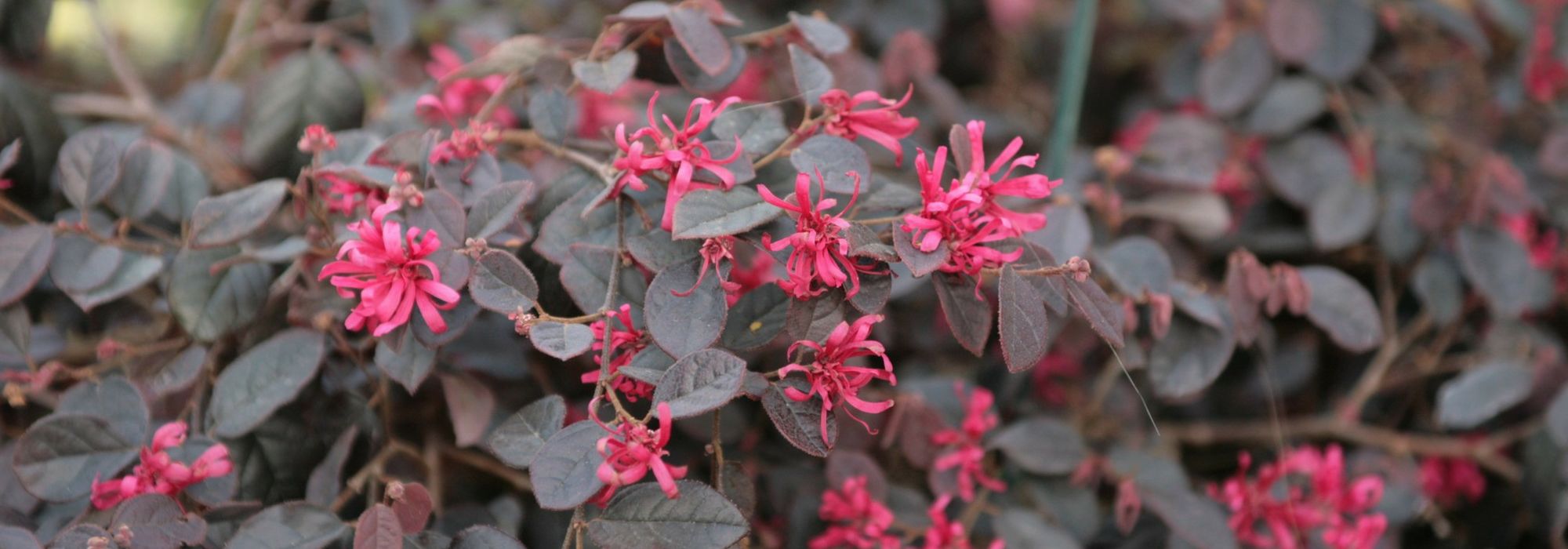
Loropetalum chinense var. rubrum Pipas Red - Chinese Witch Hazel in pictures
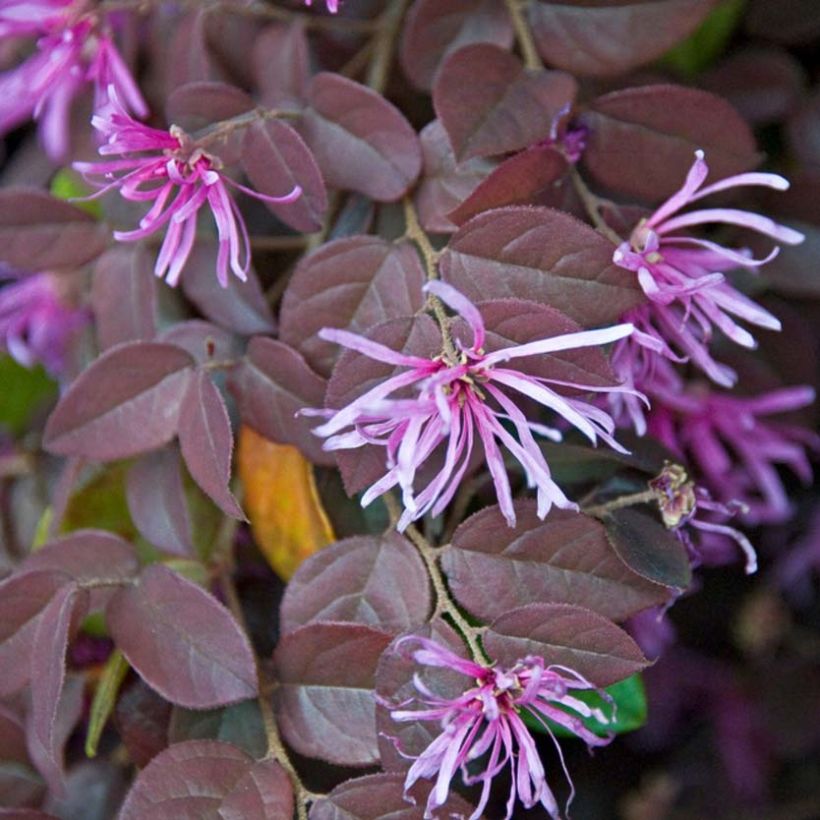
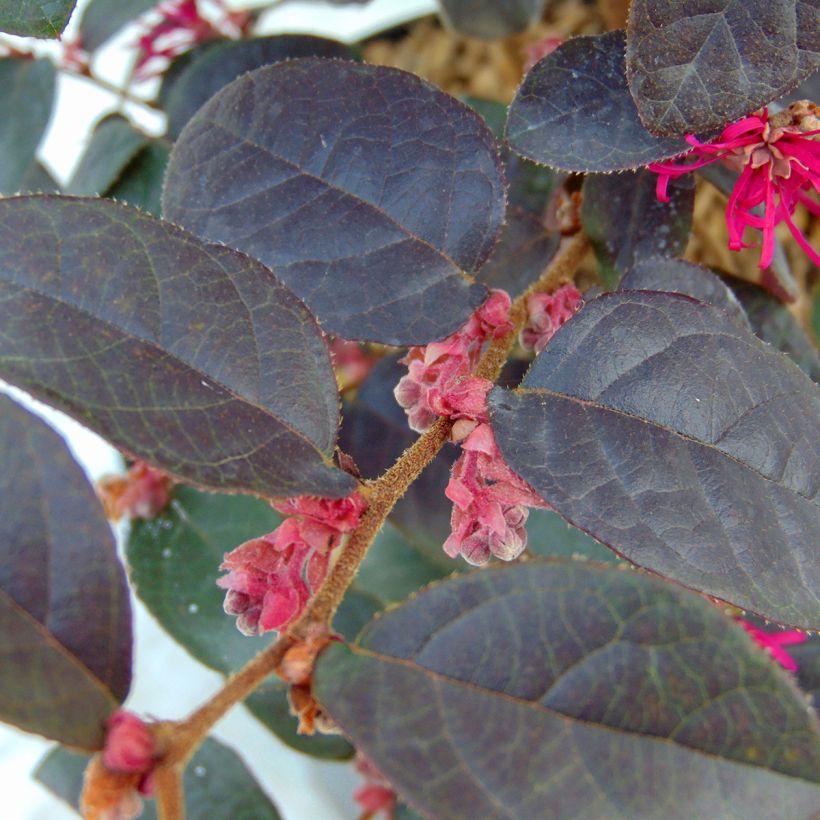
Plant habit
Flowering
Foliage
Botanical data
Loropetalum
chinense var. rubrum
Pipa's Red
Hamamelidaceae
Chinese Witch Hazel, Chinese Fringe Flower
Cultivar or hybrid
Planting and care
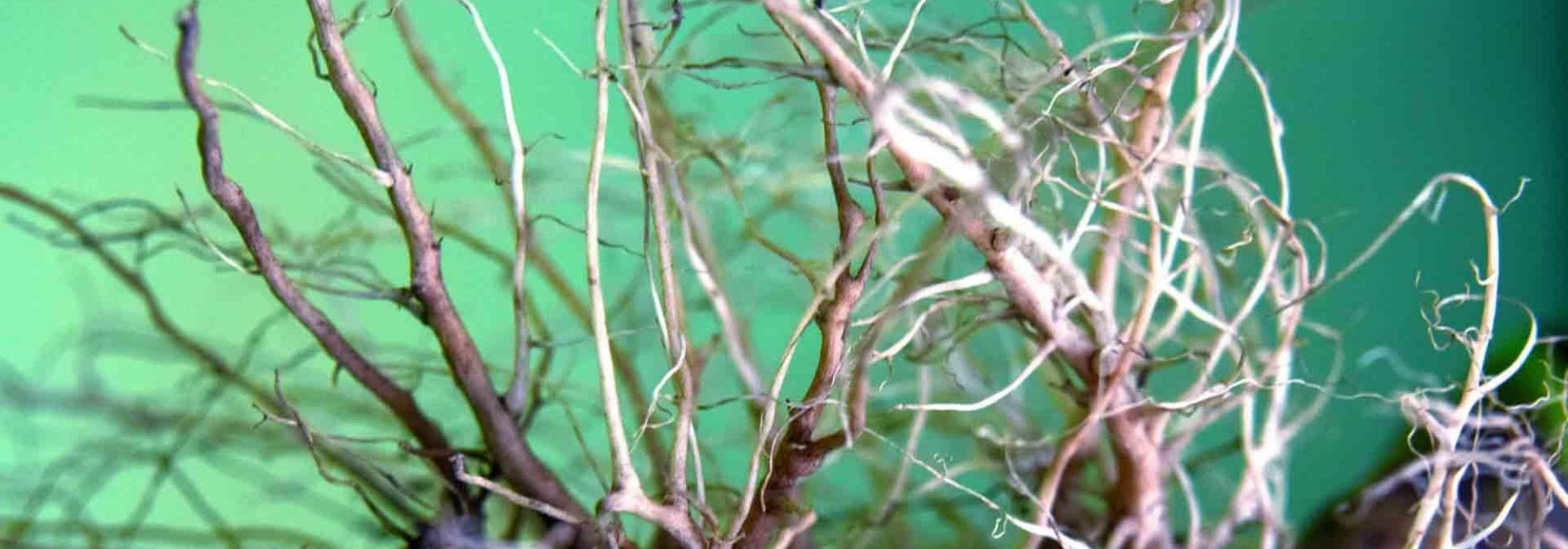
Plant Loropetalum in a sunny but not scorching, or a partially shaded location (especially in hot climates), in well-drained but moist soil. It requires fertile, light, slightly acidic or even slightly alkaline soil. However, Loropetalum chinense is robust and relatively tolerant of soil conditions. It can tolerate slightly alkaline soils and is fairly drought-tolerant once well-established in deep soil, with its base shaded by tall perennials or small shrubs. It does not tolerate excess water, which can cause its roots, which are curiously coloured red, to rot. Therefore, it requires good drainage: about twenty centimetres of coarse sand, clay pellets, non-calcareous gravel, or pumice should be placed at the bottom of the planting pit. Add compost to the garden soil, leaf mould and, optionally, a bit of sand to lighten it. This bushy shrub reaches a spread equivalent to its height, about 1.75m (5 ft 8 in) at maturity, so make sure to provide enough space when planting. In a pot, it is best to plant it in a large container, with the bottom carefully drained with gravel or broken pottery. Watering should preferably be done with only slightly alkaline water or rainwater.
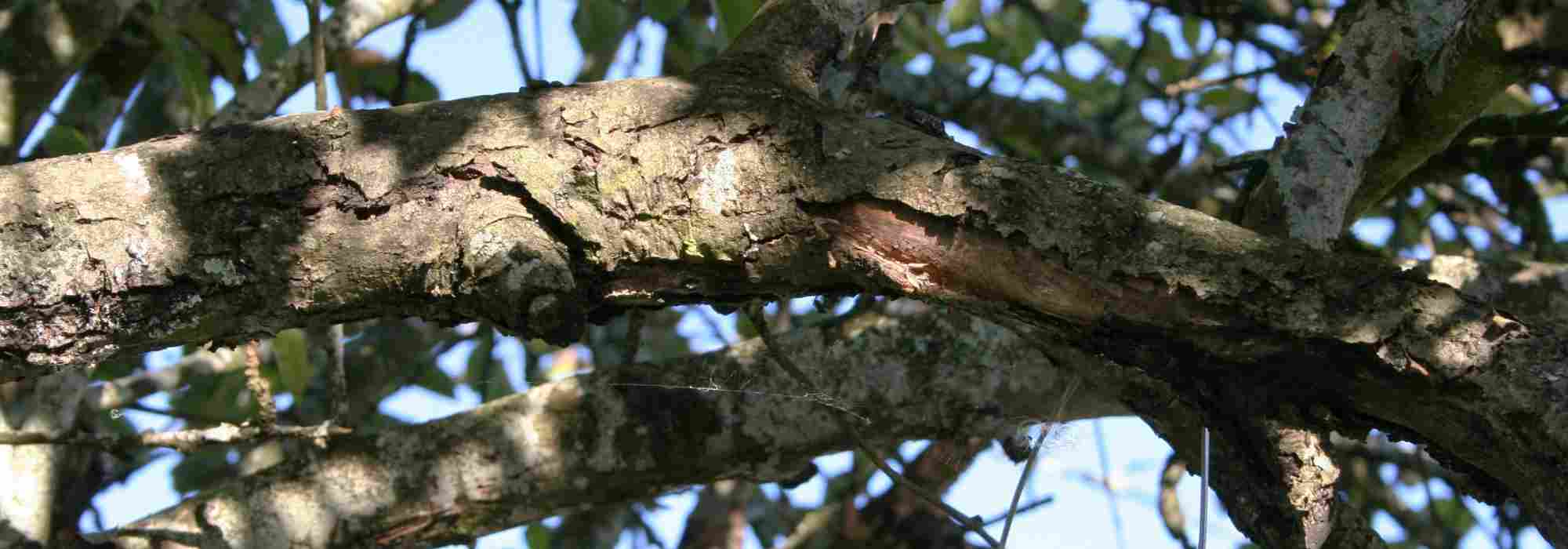
Diseases and parasites: This shrub is susceptible to root rot in poorly drained soil. It can also be attacked by olive knot gall, which can be fatal.
It is mainly propagated by propagation by cuttings, taken from the end of the stems in late summer.
Planting period
Intended location
Care
Planting & care advice
-

-
-
-

-
-
-

-
-
, onOrder confirmed
Reply from on Promesse de fleurs
Recently viewed products
Haven't found what you were looking for?
Hardiness is the lowest winter temperature a plant can endure without suffering serious damage or even dying. However, hardiness is affected by location (a sheltered area, such as a patio), protection (winter cover) and soil type (hardiness is improved by well-drained soil).

The flowering period indicated on our website applies to countries and regions located in USDA zone 8 (France, the United Kingdom, Ireland, the Netherlands, etc.)
It will vary according to where you live:- In zones 9 to 10 (Italy, Spain, Greece, etc.), flowering will occur about 2 to 4 weeks earlier.
- In zones 6 to 7 (Germany, Poland, Slovenia, and lower mountainous regions), flowering will be delayed by 2 to 3 weeks.
- In zone 5 (Central Europe, Scandinavia), blooming will be delayed by 3 to 5 weeks.
In temperate climates, pruning of spring-flowering shrubs (forsythia, spireas, etc.) should be done just after flowering.
Pruning of summer-flowering shrubs (Indian Lilac, Perovskia, etc.) can be done in winter or spring.
In cold regions as well as with frost-sensitive plants, avoid pruning too early when severe frosts may still occur.
The planting period indicated on our website applies to countries and regions located in USDA zone 8 (France, United Kingdom, Ireland, Netherlands).
It will vary according to where you live:
- In Mediterranean zones (Marseille, Madrid, Milan, etc.), autumn and winter are the best planting periods.
- In continental zones (Strasbourg, Munich, Vienna, etc.), delay planting by 2 to 3 weeks in spring and bring it forward by 2 to 4 weeks in autumn.
- In mountainous regions (the Alps, Pyrenees, Carpathians, etc.), it is best to plant in late spring (May-June) or late summer (August-September).
The harvesting period indicated on our website applies to countries and regions in USDA zone 8 (France, England, Ireland, the Netherlands).
In colder areas (Scandinavia, Poland, Austria...) fruit and vegetable harvests are likely to be delayed by 3-4 weeks.
In warmer areas (Italy, Spain, Greece, etc.), harvesting will probably take place earlier, depending on weather conditions.
The sowing periods indicated on our website apply to countries and regions within USDA Zone 8 (France, UK, Ireland, Netherlands).
In colder areas (Scandinavia, Poland, Austria...), delay any outdoor sowing by 3-4 weeks, or sow under glass.
In warmer climes (Italy, Spain, Greece, etc.), bring outdoor sowing forward by a few weeks.
Shipping country and language
Your country of residence may be:
Your country of residence is:
For a better user experience on our website, you can select:
Your shipping country:
-
 Austria
-
 Belgium
-
 Bosnia & Herzegovina
-
 Bulgaria
-
 Croatia
-
 Cyprus
-
 Czechia
-
 Denmark
-
 Estonia
-
 Finland
-
 France
-
 Germany
-
 Greece
-
 Hungary
-
 Iceland
-
 Ireland
-
 Italy
Italy
-
 Latvia
-
 Liechtenstein
-
 Lithuania
-
 Luxembourg
-
 Malta
Malta
-
 Netherlands
-
 Poland
-
 Portugal
-
 Romania
-
 Serbia
-
 Slovakia
-
 Slovenia
-
 Spain
Spain
-
 Sweden
-
 Switzerland
Language:
-
French
-
 English
-
Spanish
-
Italian
-
German
-
Portuguese
-
Dutch
-
Finnish
My Account
Hello
My wish lists
My cart
Log in / Register
Existing customer?
This form is protected by reCAPTCHA - the Google Privacy Policy and Terms of Service apply.
New customer?
Create an account to track your orders, access our customer service and, if you wish, make the most of our upcoming offers.