





























Shaded and dry areas: plant ornamental grasses to brighten them up!
Varieties that tolerate low light and water well
Contents
Ornamental grasses are among those plants with many advantages for the garden. They can tolerate conditions that are sometimes unfavourable, notably in dry, hot and windy conditions. Conversely, some species can also withstand severe frosts and damp soils. Whatever your growing conditions, you are likely to find grasses that can flourish!
If you have areas that receive little light and are sheltered from rainfall, the soil will be dry there and the exposure subdued, or even shaded. These are tough conditions, which few plants cope with. Fortunately, some grasses are unfazed by them, and you can use them to dress the space all year round. Discover these species and their various decorative attributes.
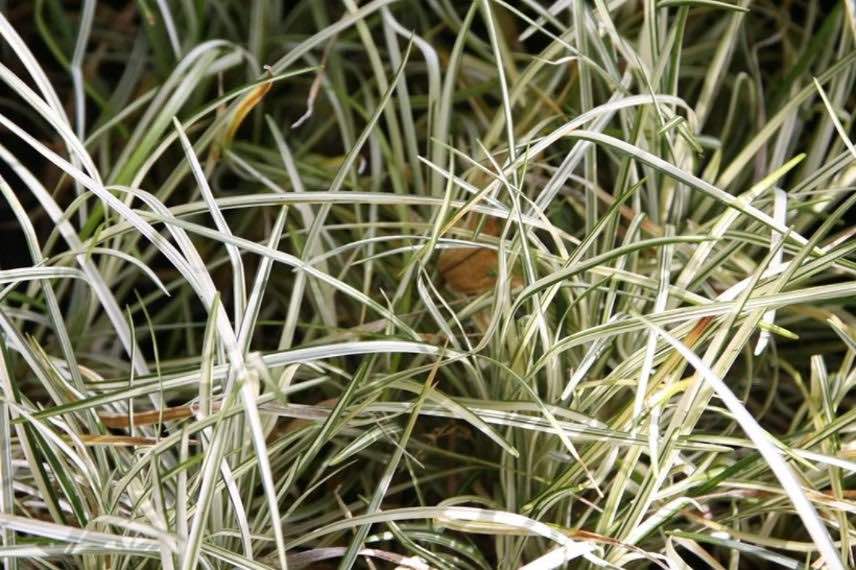
Ophiopogon japonicus‘Silver Mist’

What are the characteristics of dry-shade areas?
This exposure isn’t exactly easy to make the most of. Most plants that tolerate drought will actually need light, or even full sun, to thrive. Conversely, plants that prefer shady exposures, or even shade, often favour cooler soils, sometimes even damp. Difficult therefore to find plants that tolerate both drought and low light.
This is a type of exposure that is commonly found under trees or at the base of a hedge. To this, one must add strong root competition.
But this is also an exposure that can occur in an interior courtyard, protected from the elements and shaded by neighbouring buildings. A covered terrace can also be shaded and sheltered from rain, which will keep the soil dry.
Read also
Gardening in dry shadeWhy choosing ornamental grasses for this display?
In the large family of grasses, we have plenty to choose from. And that’s just as well, because these plants have plenty going for them and deserve pride of place in the garden.
- Many of them are evergreen. This means they keep their foliage and stay decorative all year round, even in winter.
- They are easy to grow. These are plants that often require little or no care, that will grow on their own and that are not particularly susceptible to pests or diseases.
- They add volume and structure to the garden. Whether in a border, along the edge, at the front of a shrub hedge or in containers, grasses provide a graphic and elegant touch. But they also bring movement and a sense of lightness, swaying with the wind. These are truly versatile plants.
- They suit all garden styles, from the most rustic and naturalistic to the most contemporary, including romantic or exotic influences.
- Grasses set off other plants thanks to their understated habit, whether they have flowers, ornamental foliage, coloured stems or decorative seed heads.
In a shaded and dry garden, grasses can be paired with many companions that also tolerate these difficult growing conditions:
- shrubs such as the Sarcococca, Mahonia, Skimmia, Pieris or the Aucuba;
- perennials such as geraniums, Aspidistra, the Stinking Iris, the Liriope, the Bergenia, the Epimedium, the Caucasian forget-me-not;
- ground covers such as the Greater periwinkle, the Creeping euonymus;
- bulbs such as Cyclamen coum, the snowdrop, the snowflake.
Coloured-leaved grasses for dry shade
To brighten a shaded area, nothing beats the colourful foliage of certain grasses.
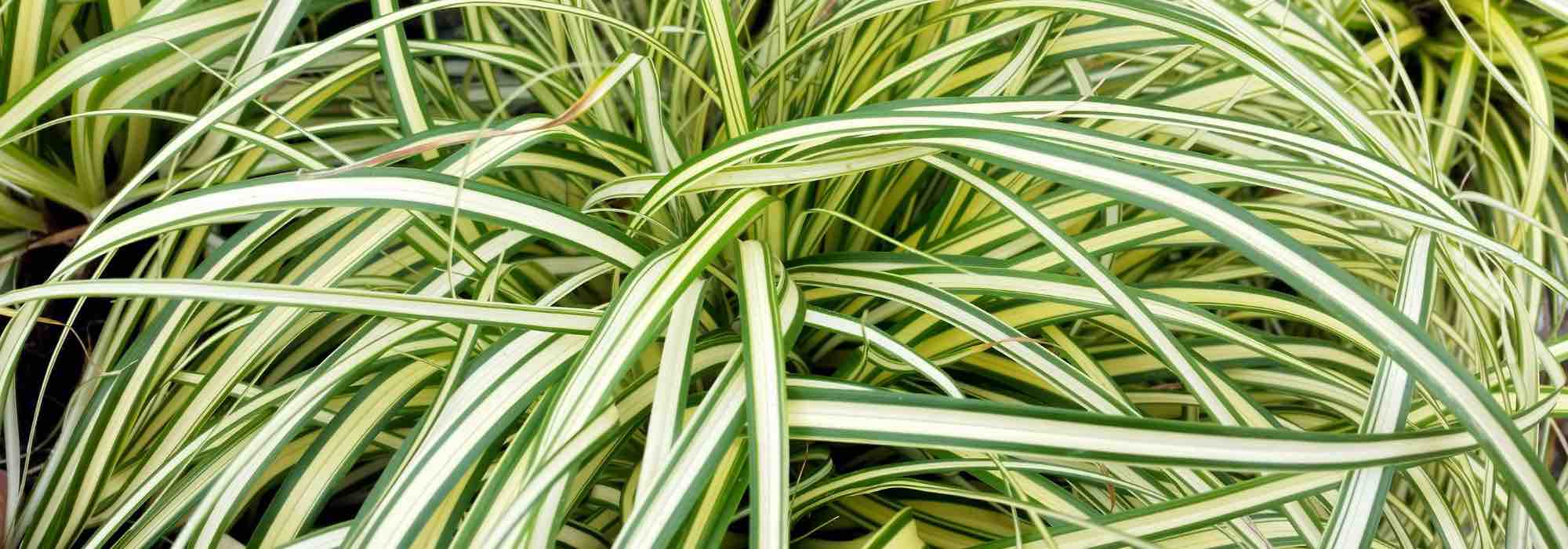
In this category, Carex are the first to stand out, these evergreen plants with slender foliage, commonly treated as grasses. The Carex oshimensis ‘Everillo’ offers, for example, ribbon-like foliage in lemon-yellow or lime-green, very bright. For variegated foliage, opt for the Everest variety, which forms a slightly untidy tuft with blue-green leaves edged with white. ‘Evergold’, for its part, tends to offer green foliage highlighted with broad cream-yellow stripes, perfect for brightening shaded and dry areas. Let’s also mention the Carex morrowii ‘Variegata’, with cream-edged green leaves.
For handsome ornamental foliage, let’s also mention the Ophiopogons. These perennials aren’t actually part of the grass family, but their physical characteristics give them the look. They indeed boast graphic, linear, graceful foliage, ribbon-like in shape. This is notably the case of the Ophiopogon jaburan ‘Albo Variegata’, which produces green and cream foliage. Let’s also mention the Ophiopogon japonicus ‘Silver Mist’, with its green foliage adorned with a central white stripe.
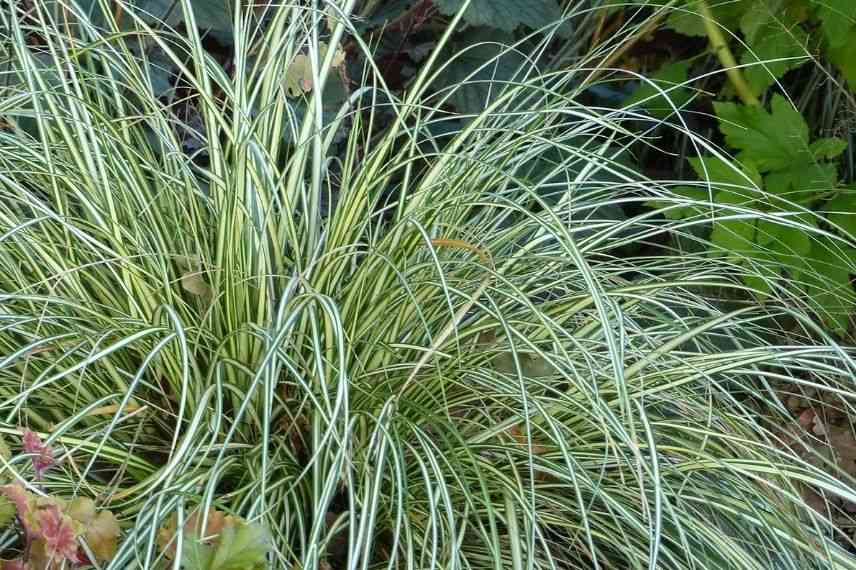
Carex ‘Evergold’
Read also
Perennials for dry shadeGrasses with interesting flowering for shaded and dry areas
In addition to their foliage, some grasses offer a pretty flowering display. While it is often fairly discreet, it nevertheless adds a touch of extra charm to shaded and dry spots.
First up is the Poa labillardieri, a tall grass reaching up to 1 metre in height. It produces very fine, green-blue foliage, which accompanies a spring flowering in the form of inflorescences tinged with purple and silvery. Graceful and light, they ripple in the breeze and catch the sun’s rays for a scene of poetry.
For its part, Hystrix patula Hystrix patula is also among the rare candidates able to flower in dry shade. It produces in summer erect and stiff inflorescences, in the form of golden tassels at maturity. Do not hesitate to incorporate them into your bouquets, fresh or dried.
For its part, the Ophiopogon jaburan Ophiopogon jaburan‘Albo Variegata’ delights us in summer with spikes of small white bells, which will then give way to decorative blue berries.
Ophiopogon chingii will flower predominantly white with a hint of mauve. After the summer flowering, you can, once again, enjoy pretty turquoise berries.
Blue fescue, appreciated for its evergreen grey-blue foliage as well as its drought tolerance. It can be planted in semi-shaded, filtered-light positions, though it will prefer sun. In summer, it produces charming silvery spikelets that cascade gracefully and are quite ornamental.
Finally, autumn Sesleria (Sesleria autumnalis) flowers later, as its name suggests. This tufted grass offers feathery white-silvery spikelets from August to October. It is also notable for its evolving foliage. Initially light green, it then takes on beautiful golden-yellow hues as the months pass. Tolerant of poor, dry soils and forming a perfect ground cover, this grass can also tolerate partial shade.
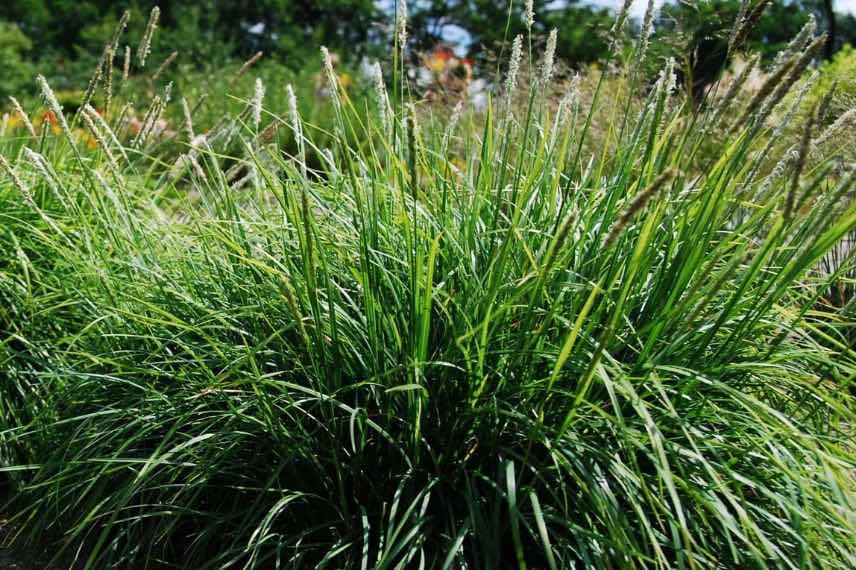
Sesleria autumnalis
Dwarf grasses for pots and small spaces, to grow in dry shade
Looking for miniature grasses to create a drought-tolerant container planting in low-light conditions? No problem! We offer, for example, the adorable Carex oshimensis ‘Evercream’, which stays under 25 cm tall. It will bring a touch of light thanks to its blue-green variegated foliage with cream, beautiful all year round.
For its part, Carex oshimensis ‘Everillo’ forms an adorable tuft with soft, graceful foliage, not exceeding 30 cm in height and spread. Easy to fit anywhere, even in the smallest spaces!
The Ophiopogon japonicus ‘Silver Mist’ is also among the smaller varieties, with its silhouette not exceeding 20 cm in height for 30 cm in spread.
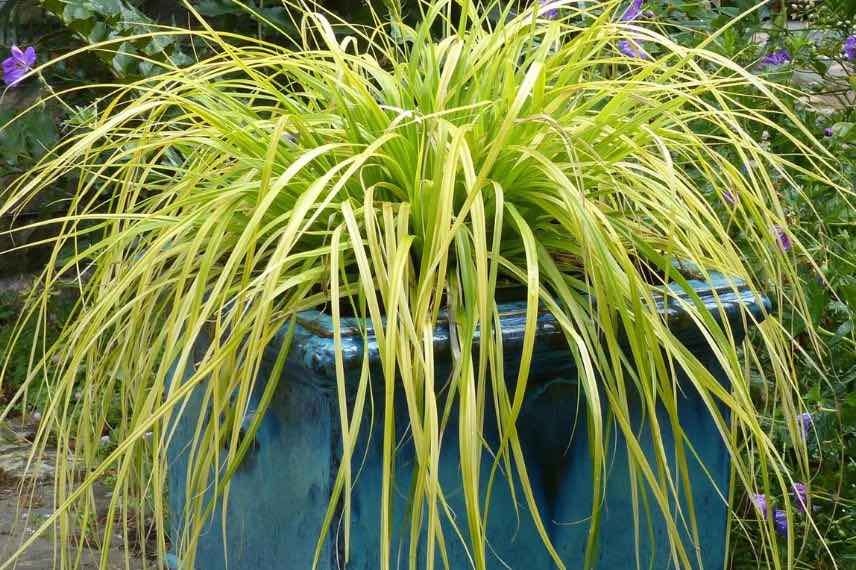
Carex oshimensis ‘Everillo’
The hardiest grasses for dry shade
Do you live in a region that experiences particularly harsh winters? Opt for dry-shade grasses that withstand frosts down to -20°C. This includes Carex grayi, Carex morrowii ‘Variegata’, Hystrix patula and Ophiopogon jaburan ‘Albo Variegata’.
Some tips to improve a dry, shady area in the garden
To make a shaded, dry area easier to cultivate, a few measures can be taken.
- Let in more light and rainwater. If the area is at the foot of trees, you can certainly carry out a thinning by pruning some branches. This will help both sunlight reach through and rain reach the ground. If it’s a hardscape, such as a terrace, you can choose to cover it temporarily rather than permanently, for example by installing an awning or a bioclimatic pergola (if your budget allows). Replacing a tiled or sheet metal roof with a climbing plant, which will provide pleasant shade but be less opaque, is also a solution.
- Enrich the soil. Add organic fertilisers (well-rotted compost, decomposed manure, fallen leaves, crushed horn…) which will help improve soil structure, which will retain water better and thus promote the plants’ growth. Do this in autumn or very early spring.
- Raise the soil level. If growing under a tree or at the base of a hedge, you can add a generous amount of potting soil or topsoil to give plants more room to flourish. They will then be able to spread their roots deeper. (also see our tips in How to hide an unsightly hedge).
- During the first two years after planting, you will need to water generously, even drought-tolerant plants, to help them establish well. Prefer thorough, infrequent waterings over several small surface waterings.
- Subscribe!
- Contents

Comments