





























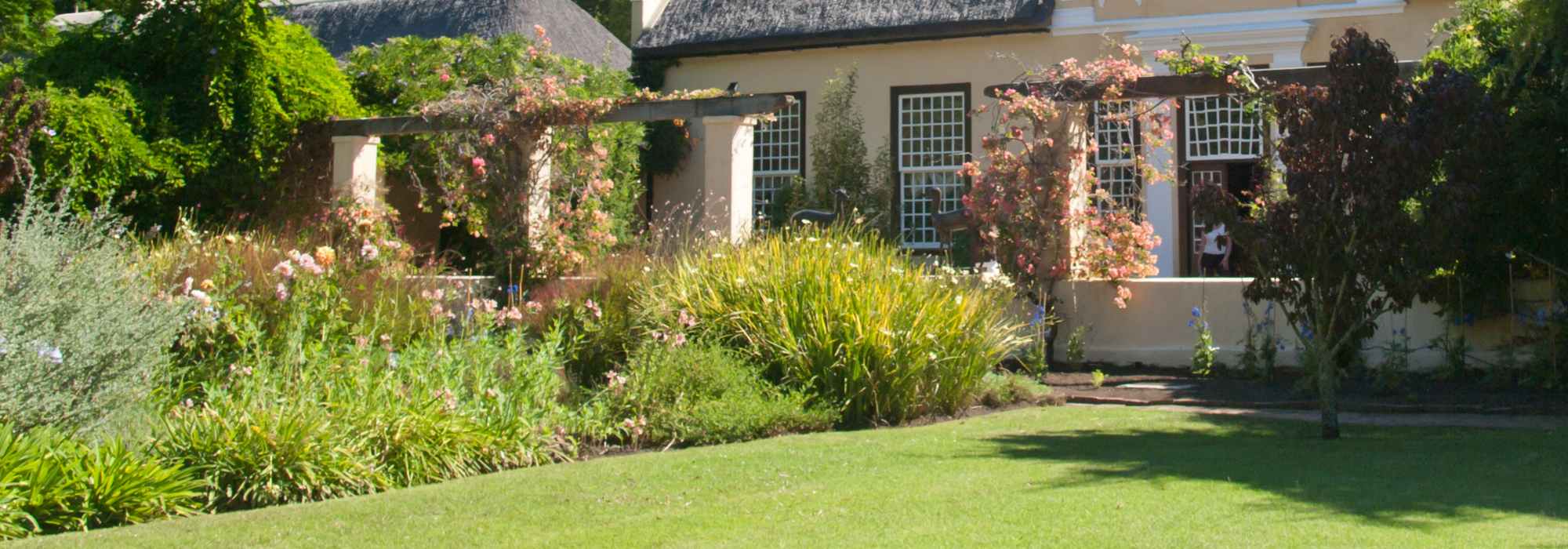
The nude, soft and neutral colours for the garden: our ideas
...and invite a touch of sweetness into the garden!
Contents
Among colour trends that have been prevalent for several years now, the “nude” is making its mark in many areas, including the garden. This champagne-coloured, slightly pink shade is the epitome of delicacy that suits the most romantic gardens.
Discover our ideas for properly incorporating pastel tones with cream, champagne and nude shades to draw from among the most subtle flowering and some foliage, to metamorphose or create new enveloping massifs, or to compose more widely an entire garden world and enjoy its soothing effect.

The Spirit of Nude in the Garden
When applied to the garden, the Nude is designed to be utterly relaxing. First through its very soft colours, but also through the shapes of the foliage and the lightness of the flowering, because we will rely heavily on climbing plants or grasses, for example, which add to the serenity with their opalescent colours.
These nude tones, a deft blend of iridescent pink and beige, are perfect colours for a garden of a particular kind: the city garden or a small urban garden. While they play a tranquilising role in how we view the garden, these light colours visually enlarge the space, which is what we aim to achieve in small gardens often enclosed by walls.
But Nude colours of some flowers, or even a few foliage, are also very at home in a contemporary-style garden for the softness they bring to lines that are sometimes a little cold, in a natural garden for the simplicity of certain wildflowers and grasses, and of course perfectly suited to a romantic garden!
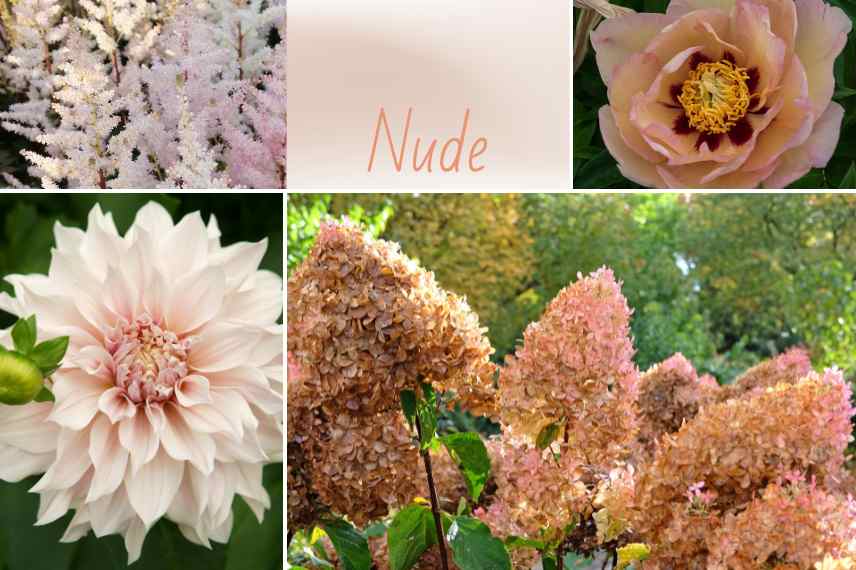
The Nude colour appears on a wide range of flowers and foliage. Here, we find the pearl-pink of Astilbe arendsii ‘Bumalda’, the very soft apricot of Itoh peony ‘Pastel Splendor’, the silky Dahlia ‘Café au Lait’ and the late-summer flowering of Hydrangea paniculata.
Nude Garden plant palette
Under this English term ‘nude’ (which, by the way, means naked), we think of diaphanous, powdery tones that indeed evoke the flesh.
It is a blend of pink and greige, sometimes edging toward peach tones.
In the floral world, as it is often the flowering that will inject this nude note, we will therefore select all tones from pale pink to peach-pink, the very pale peach and apricot tones, creams and parchment-yellow on flowers and on foliage, the shades often variegated or starting from rosy-white and evolving over time.
Some azaleas and rhododendrons dress themselves in these pastel shades, such as Rhododendron ‘Inkarho Brasilia‘ (tending toward peach-pink), ‘Horizon ‘Monarch‘, ‘Golden Torch‘, ou ‘Inkarho Bernstein‘, ou encore le rhododendron nain ‘Dusty Miller’ : tous hésitent entre le jaune pâle, le rose et le pêche, leur donnant cette touche irrésistible de rose poudré aux notes champagne.
Sans oublier des camélias enjôleurs dans cette série de plantes de mi-ombre et de terre acide comme le Camélia ‘Botanyuki’, crème avec une apparence nacrée, ‘High Fragrance’ ou ‘Virginia Robinson’.
On retrouve notamment dans les floraisons nude de nombreuses pivoines qui métamorphosent leurs grosses fleurs, comme la sublime pivoine ‘Madame Calot’, la Pivoine arbustive ‘Xue Ta’, la Pivoine Itoh ‘Pastel Splendor’, ou la Pivoine lactiflora ‘Reine Wilhelmine’.
Parmi les arbustes plus grands, l’irremplaçable laurier rose ‘Angiolo Pucci’, mais aussi des viornes hivernales ou printanières et certains cognassiers du Japon comme le Chaenomeles cathayensis. Certains hydrangeas américains virent à des teintes roses et légèrement roussies, juste parfaites !
N’oublions pas les rosiers qui déclinent des tons nude sur de très beaux cultivars : le rosier buisson ‘Princesse Astrid de Belgique’, le rosier ancien ‘Perle d’Or’, le rosier ‘Jardin des Tuileries’, le rosier nain ‘Sweet Dreams’, le rosier couvre-sol ‘Aspirin Rose’, le rosier ‘Isabelle Autissier’ et tant d’autres…
Les vivaces sont nombreuses à porter des coloris pastel très doux comme la merveilleuse digitale ‘Suttons Apricot’, les Astilbes (‘Bumalda‘, ‘Bressingham Beauty‘, ‘Pink Lightning‘ et ‘Rosa Perle‘), l’Achillea millefolium ‘Apfelblüte’, l’arum coloré Zantedeschia aethiopica ‘Pink Flamingo’, la Pimpinella major ‘Rosea’, la Linaria ‘Peachy’, ou l’indémodable Dahlia ‘Café au Lait’. Les tulipes précoces ou tardives s’ajoutent à cette liste non exhaustive, comme ‘Peace Flame’ complètement dans le ton.
Comptez aussi sur les hellébores qui arborent les plus belles fleurs ‘nude’ : L’Helleborus orientalis ‘Apricot’, ‘Apricot Spotted’, ou l’hellébore orientale ‘Magic Abricot guttatus’. Certaines grimpantes presque nacrées s’inviteront aussi parfaitement pour rajouter de la hauteur, comme la Clématite armandii ‘Apple Blossom’
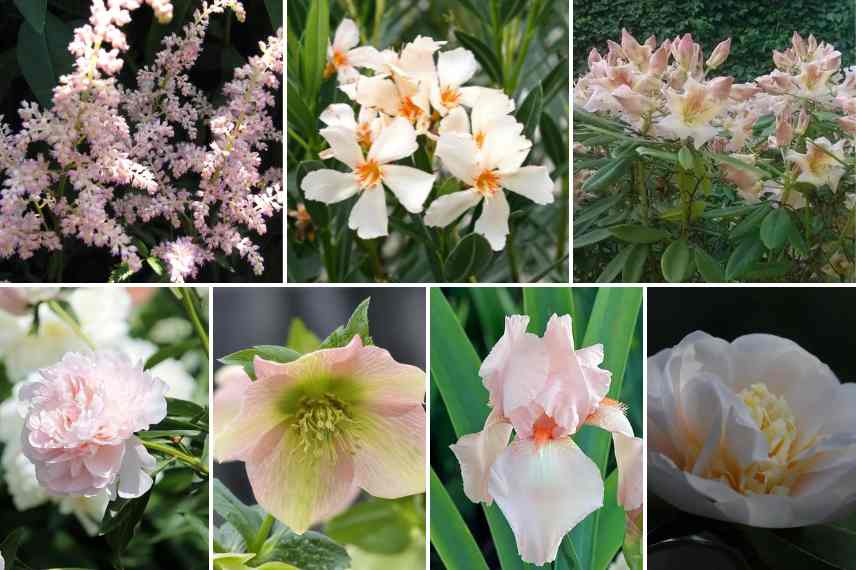
Astilbe arendsii ‘Rosa Perle’, Oleander ‘Angiolo Pucci’, Rhododendron ‘Inkarho Bernstein’, Peony ‘Madame Calot’, apricot hellebore, Garden iris ‘Flamant Rose’ and Camellia ‘Botanyuki’
Les iris sont un vivier formidable pour recréer dans son jardin la palette nude. Il y en a vraiment beaucoup qui arborent ce côté champagne et irisé, avec entre autres ‘Flamant rose’, ‘Peach Frost’, ‘Frappé’, ‘Poesie’, ‘Qualified’, ‘Coralina‘, ‘Bewitchment’, et ‘Comes The Dawn’.
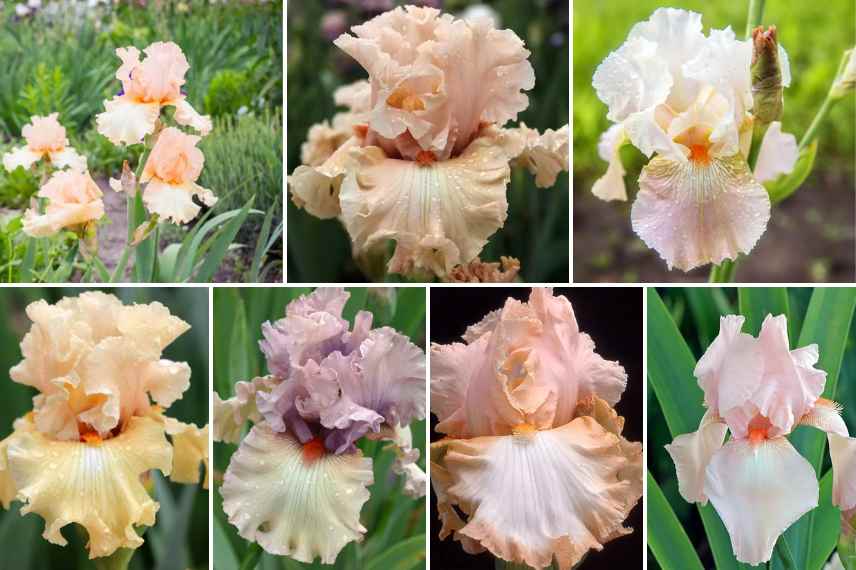
Iris germanica : ‘Qualified’, ‘Coralina’, ‘Frappé’, ‘Comes The Dawn’, ‘Bewitchment’, ‘Peach Frost’ et ‘Flamant Rose'</caption]
Côté feuillages, moins de possibilités, mais on trouve tout de même des arbustes ou des graminées très intéressants dans leur débourrement ou leur changement de couleur à l’automne. On peut volontiers regarder du côté des graminées et la couleur typique de leurs inflorescences plumeuses ou soyeuses, et de leurs chaumes, revêtant une teinte chamoisée en hiver : Molinia arundinacea ‘Windsaule’, Mulhenbergia capillaris, les inflorescences de nombreux Panicum si légères, offrant un nuage légèrement rosé, des Miscanthus, etc.
Les tons crevette, avec évidemment le saule du même nom (ou en latin le Salix integra ‘Flamingo’), moins à la mode désormais, mais offrant une coloration hésitante entre le blanc, le vert et le rose, sont complètement raccord dans notre mode nude. Regardez aussi du côté d’un Nandina domestica ‘Twilight’, d’une Acanthe ‘Tasmanian Angel’, et d’un Acer pseudoplatanus ‘Simon-Louis Frères’, qui jouent du panaché de leur feuillage.
→ Mon conseil : pour trouver des pépites dans ces couleurs uniques, faites des recherches avec les mots-clés : champagne, Peach, ou Apple Blossom.
[caption id="attachment_279175" align="aligncenter" width="856"]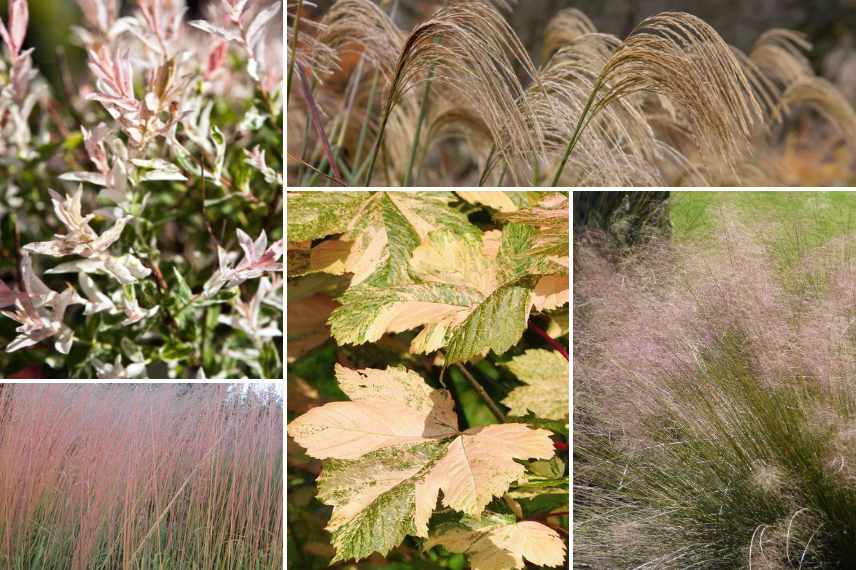 Salix integra ‘Flamingo’, Miscanthus nepalensis, Molinia arundinacea ‘Windsaule’, Acer pseudoplatanus ‘Simon Louis Frères’ et Mulhenbergia capillaris
→ Read also : 10 perfect plants for a private and calming garden and cozy plants, as well as our inspiration page on the nude garden!
Perfect pairings
This garden, based on very soft colours of pale pink and cream, pairs with all other cream tones, but also white and orange. Without ever trying to force the look, as greenery must also be very present to showcase these powdery tones. Think of pairing two close tonalities, one that supports the other, with for example two astilbes like ‘Bressingham Beauty’ and the Astilbe simplicifolia ‘Pink Lightning’. The orange will energise the whole (from peach to salmon-pink and coral), and harmonises with the apricot-toned effect.
To avoid these milky colours creating too pale an atmosphere, take care to enhance the overall foliage presence, either through their distinctive shapes or their colours, with silvery or anise-coloured leaves alongside darker leaves. Thus dare a touch of sophistication with purplish foliage: they literally elevate this nude palette by offering a contrast of great beauty!
Also think of the complementary colour to these vanilla tones: purple. It allows, in small touches and on delicate inflorescences, even pointillist, to vitalise without brusquing the softness of the nude garden.
Finally, as for the white garden or pink, think to use variegated colours of flowers or of leaves, as well as green flowers which ensure a subtle pairing.
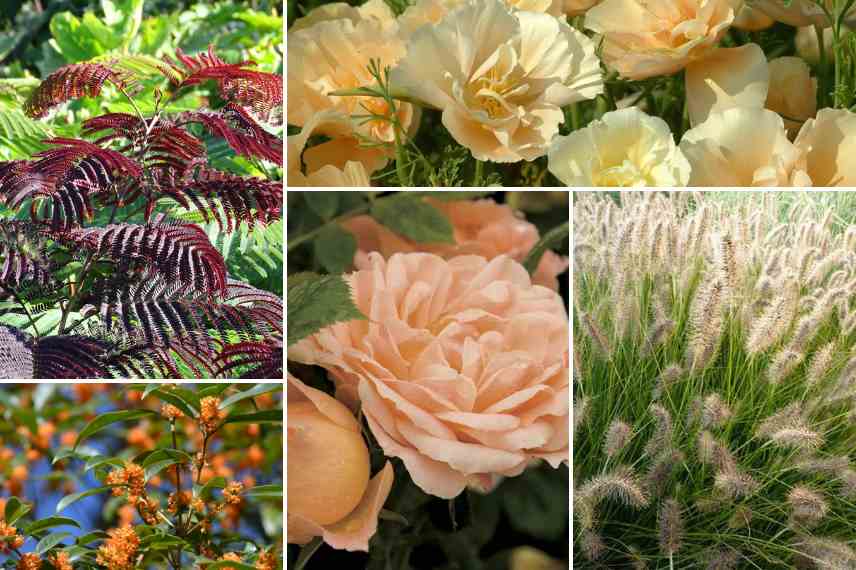
A single touch of purple, here an Albizia julibrissin ‘Summer Chocolate’, and an orange-osmanthus (bottom left) brighten the pastel side brought by Californian poppies, a ‘Sweet Dreams’ rose and Chinese fountain grasses.
A naked garden through the seasons
Don’t you fancy a garden in these pale, year‑round tones? Then choose one or two spring borders that will welcome sunny days with utmost gentleness and delicacy after the winter chill! This is the season when powdery tones stand out most beautifully, the sunlight still gentle but bright enough.
By pairing lightly apricot‑tinted tulips with a few perennials or bushes with white flowering washed with pink, such as viburnums or ornamental Prunus, you will achieve, as in our example below, a perfect ode to nature’s awakening.
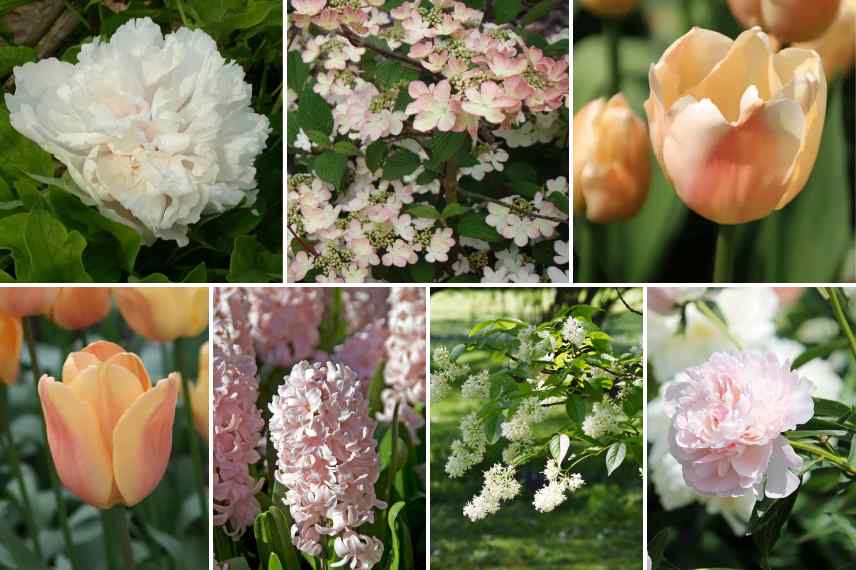
Bush peony ‘Xue Ta’, Viburnum plicatum ‘Kilimanjaro’, tulips ‘Apricot Pride’ and ‘Apricot Foxx’, hyacinth ‘China Pink’, Staphylea colchica and peony ‘Madame Calot’
En été, moult combinaisons sont possibles, comme par exemple ici une association de Dahlia, de rosier au teint de pêche, d’Alcea diaphana, de Verbascum dressés et d’heuchères marbrées ou pourpre pour asseoir les teintes nude, et venir les compléter de leur floraison si aérienne.
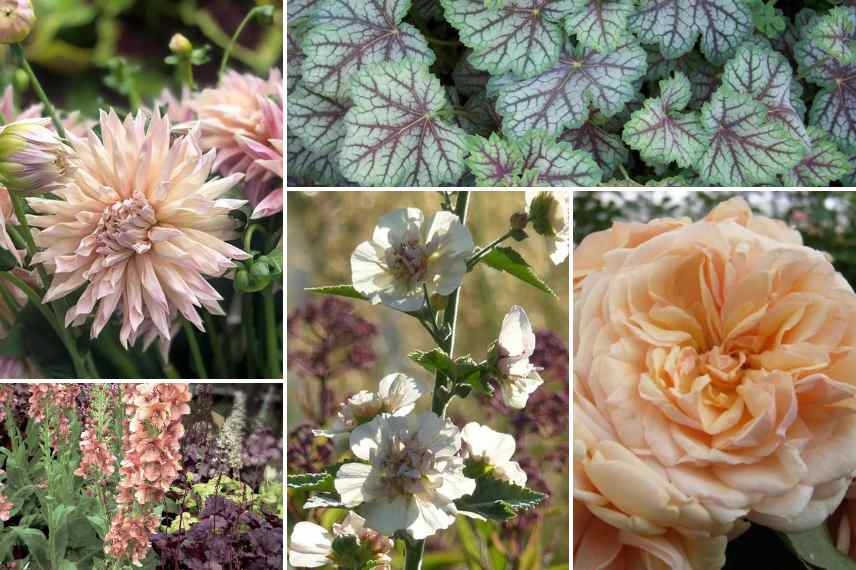
Dahlia ‘Café de Paris’, Verbascum ‘Jackie’, Alcea ‘Parkallee’, rose ‘Morabito’, and heucheras.
Le même border pourrait évoluer ainsi en automne, ayant ajouté à la précédente display une graminée d’ampleur comme Mulhenbergia, un Abelia pour sa durée de floraison et quelques Hydrangea paniculata pour leurs sublimes colorations changeantes en fin de saison.
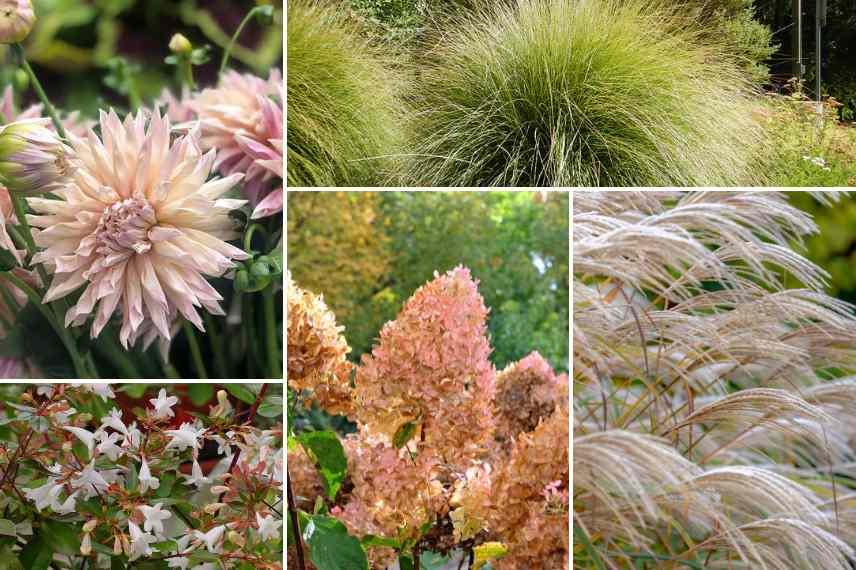
Dahlia ‘Café de Paris’, Mulhenbergia rigens, Abelia grandiflora, Hydrangea paniculata ‘Phantom’ and Miscanthus sinensis
Winter, with its low grey skies, is also a time of year when softer colours emerge in the garden, in rose-silver tones. They will bring the garden a cosy, cocooning atmosphere as the days begin to lengthen again. One can incorporate one or two striking pieces of bark to enhance the spaces!
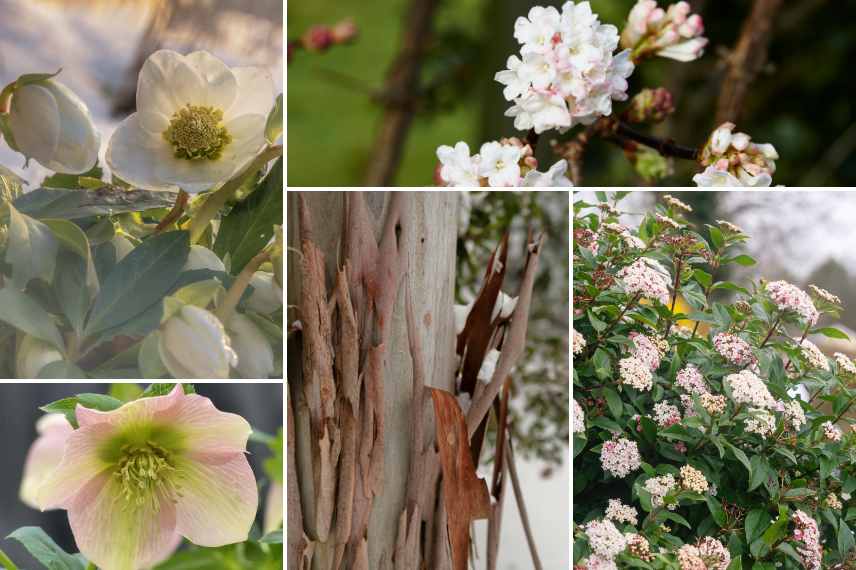
Helleborus niger, Viburnum bodnantense, Helleborus ‘Apricot’, bark of a eucalyptus, and laurustinus (Viburnum tinus)
Polish the décor.
No, the nude garden won’t be adorned with naked statues or antique sculptures in a French-style or Italianate garden!
Materials, furniture and decor question, we opt for terracotta which harmonises so well with nude tones, and which you often see in decor magazines. The orange hue in terracotta pots is indeed ideal, as with the use of terracotta, because it provides the right support, warms up and gives body to pastel flowers, while supporting them. Don’t go for pots in colours that are too pale.
Blue and green suit it well too, especially turquoise or celadon tones, which we can choose in a pair of large planters, for example. Purple as a partner colour on the colour wheel, as long as used sparingly, will play, for its part, the role of a highlight.
Design tips
Drawing on the raw-material codes of the bohemian garden, use hammocks with care, Dame Jeanne jars in glass to bring harmonious green reflections, glass and metal lanterns, corten steel for its coppery hue, perfect beside peach-coloured flowering, exotic wood in orange-toned and warm like acacia or the rattan, paper Chinese lanterns or braided rush lanterns, etc.
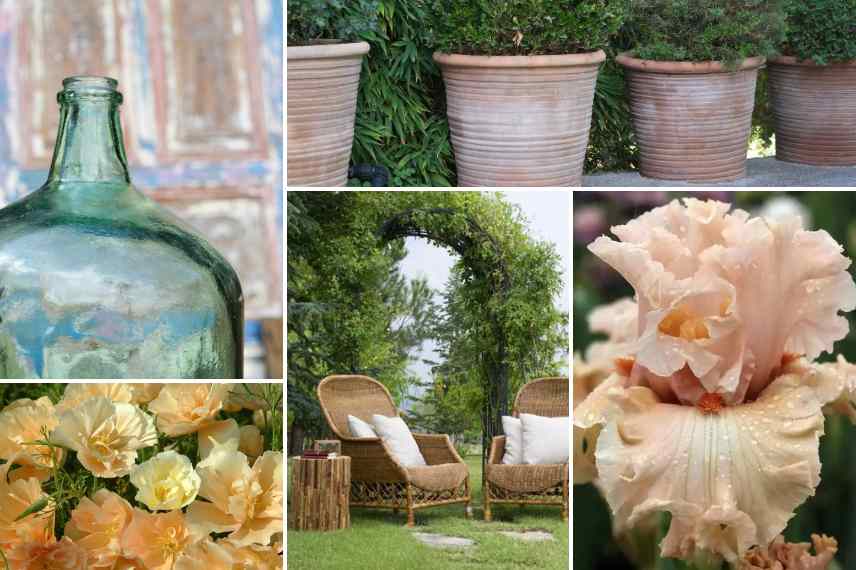
Dame Jeanne jars for the green colour and the shine of glass, terracotta pots, and lovely seating in rattan highlight the delicacy of the California poppies ‘Champagne’ and the Iris ‘Coralina’
- Subscribe!
- Contents
Comments