





























Square garden design ideas
Our tips to designing and showcase a square-shaped garden
Contents
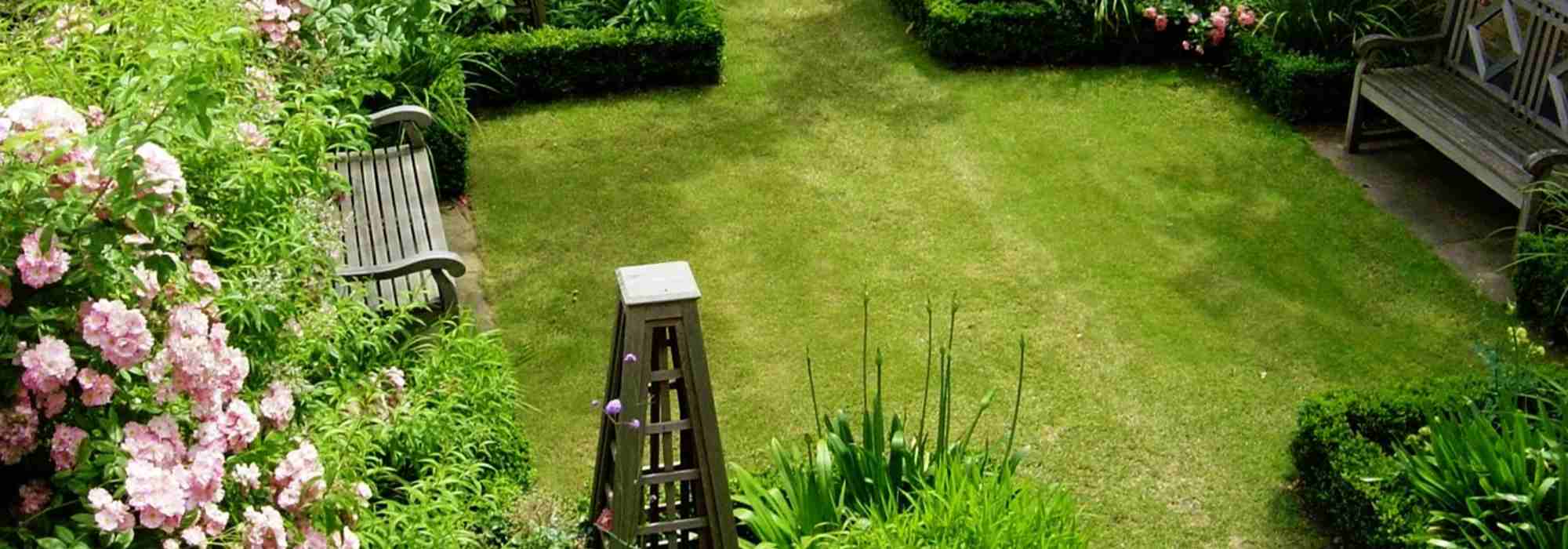
A square garden is often the type you inherit in urban gardens or small housing-estate plots. This shape isn’t the most practical, as it generally reveals the whole garden at a glance. At the same time, it is a format that conveys a sense of balance and calm. It is often simply laid out along its edges, while it lends itself to many other explorations.
How can the drawbacks of the square garden be countered to give it the appeal of a beautiful garden? We shed light on it and provide you with a few tips and examples to showcase it at its best.

Characteristics, advantages and disadvantages of the square shape in the garden
The square is the perfect shape and evokes the original garden and cloister gardens. This form with perfect proportions—four equal sides—has been used for centuries to create the physic gardens, those parson’s gardens where medicinal plants were grown, and enclosed medieval gardens. Nowadays, it is typically a garden that is entirely visible from the façade and the openings of a house.
Advantages
The symbolism of the square points to a strong, visually simple structure, and is often reflected in highly organised motifs and patterns. The square shape is thus frequently used to establish a vegetable garden, an orchard or a rose garden in the case of larger gardens, which are traditionally organised in perfect geometry. The square also has the advantage of allowing a circle or a perfect rhombus, or even a star or a triangle to be integrated into its lines. Its geometry allows it to be used in multiples, often in three or four squares, to create rhythmic and balanced scenes. It is a form that suits the classicism of French-style gardens.
Disadvantages
The square lives up to its name: a regular, neat and unequivocal quadrilateral! This simple geometric form can sometimes lack a touch of whimsy, and, on a small space, counteracts depth perception. The square garden is also typically presented as a single, continuous space, and the sharp-angled lines are not conducive to establishing a natural garden.
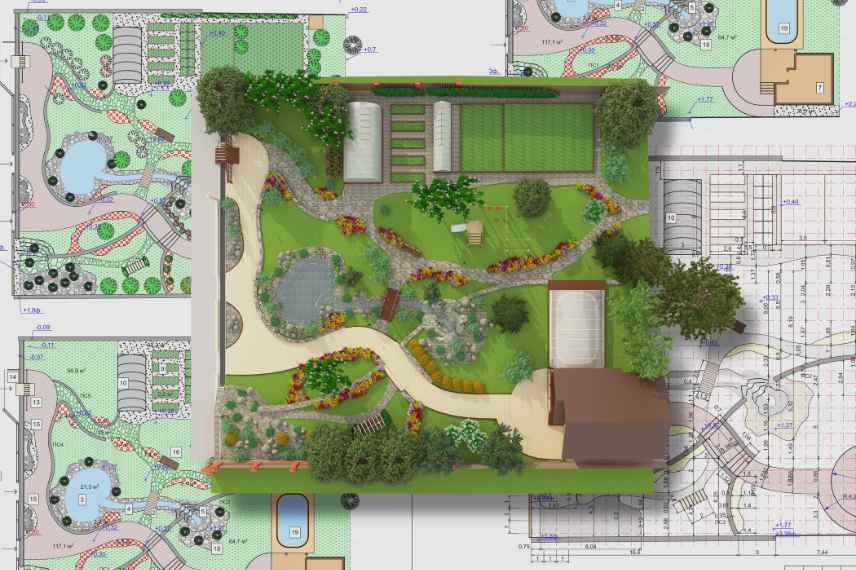
You can certainly create a drawer-style garden within a square-shaped garden: paths, borders, garden furniture, a vegetable plot, or even a pond!
Counter the square garden?
Should you rely on this square shape imposed by the garden’s boundaries, or free yourself from it and try to counteract its somewhat too sober or traditional appearance? It largely depends on the size of the garden, as there are far more possibilities in a larger space. Therefore the original square shape of a garden is not necessarily something to question or alter at any cost.
Concretely, with a square garden, one chooses either to lean into this shape to take advantage of its qualities (proportions, harmony), which will be charming in a small space or for certain garden styles, or conversely, one splits the square shape into two or three shapes—rectangular, oval, or even a triangular insert, for example, to draw new zones within the large square, which is very useful in large gardens.
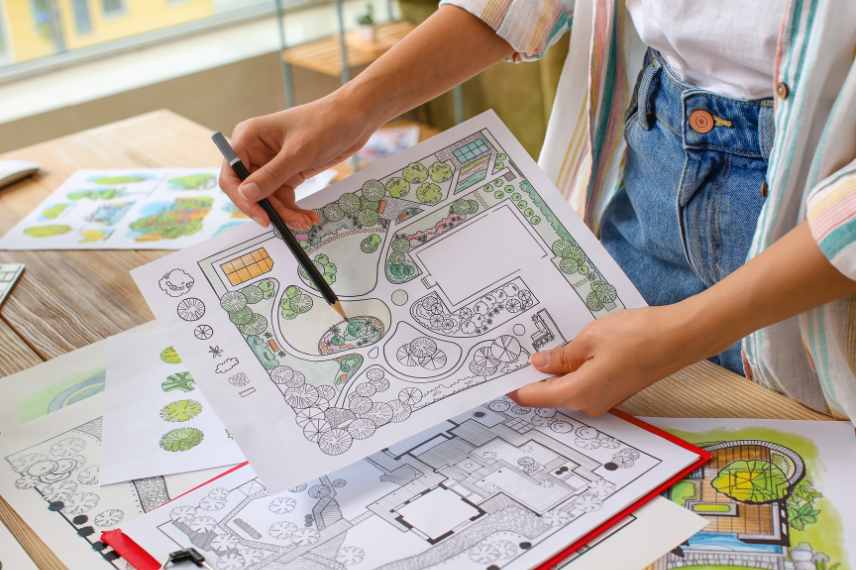
A plan is the starting point that always helps you establish zoning and the shapes to adopt.
What garden style suits a square garden?
It all depends on your taste in layout, but also on the environment, regional characteristics, and even the history of your garden. Some garden typologies perfectly suit the constraints of a square layout:
The small garden or patio
Pocket gardens, in towns, are often square-shaped and walled. You can also find courtyards or urban patios in this category. Here the aim is mainly to enhance the privacy and charm of a small garden by planting climbing plants to blur the boundaries (whether walls or a fence), and/or with the help of a pergola. Paradoxically, the profusion of plants as in the example below plays an essential role in visually enlarging the space, as boundaries such as a wall are erased.
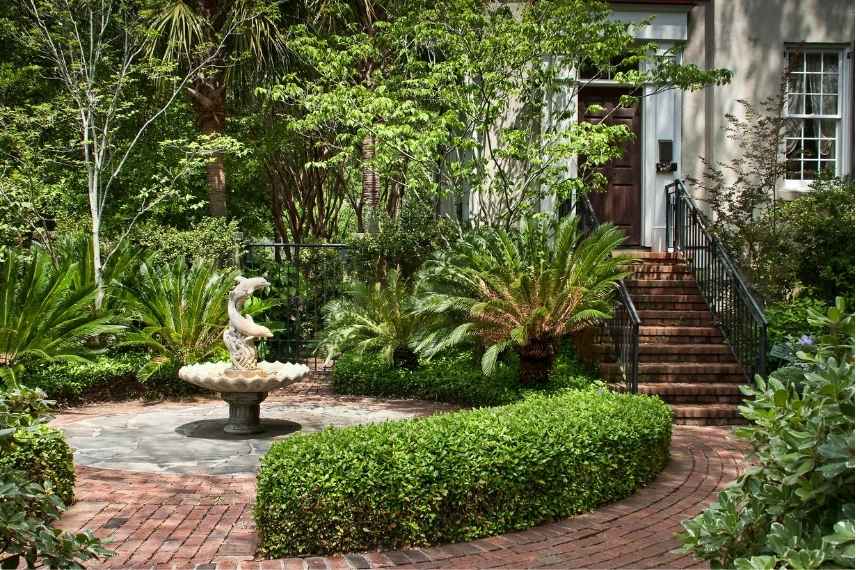
Photo: Liz West
The walled garden
In the same spirit, this garden is entirely enclosed by stone walls and often features a square layout. It is the perfect setting for the square garden. Read Alexandra’s advice on the topic in How to design a walled garden?
The classic garden, French-style or contemporary
The proportions of the classic garden tend to favour a square shape, and within the garden itself square or geometric motifs are highlighted, symbols of balance and symmetry. Topiary shrubs work wonderfully there. While they do not represent the majority of private gardens, large gardens often have square-shaped vegetable spaces. The contemporary garden can also be inspiring for a square layout, with the clean lines to which it echoes. Here are two examples in universes that are radically opposite:
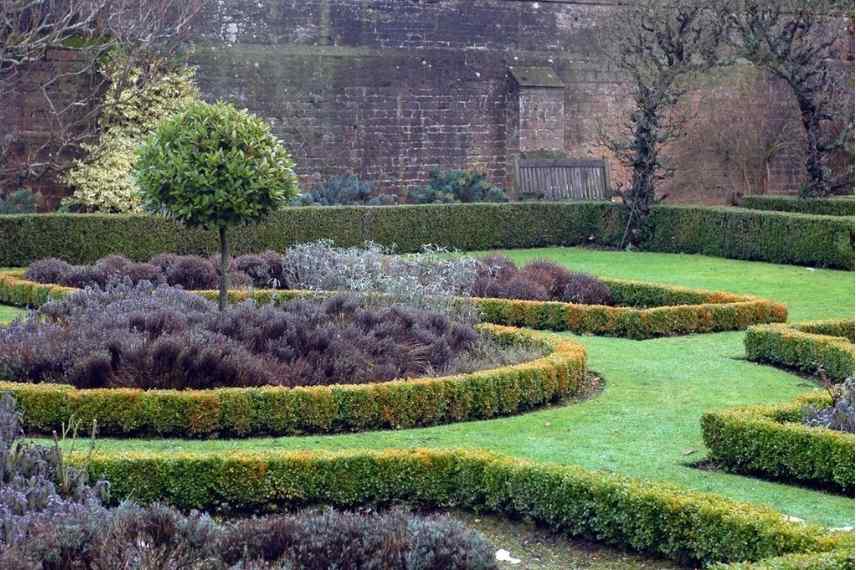
The square garden, accentuated in its outer and inner contours by low hedges clipped to a straight line, in a classic style.
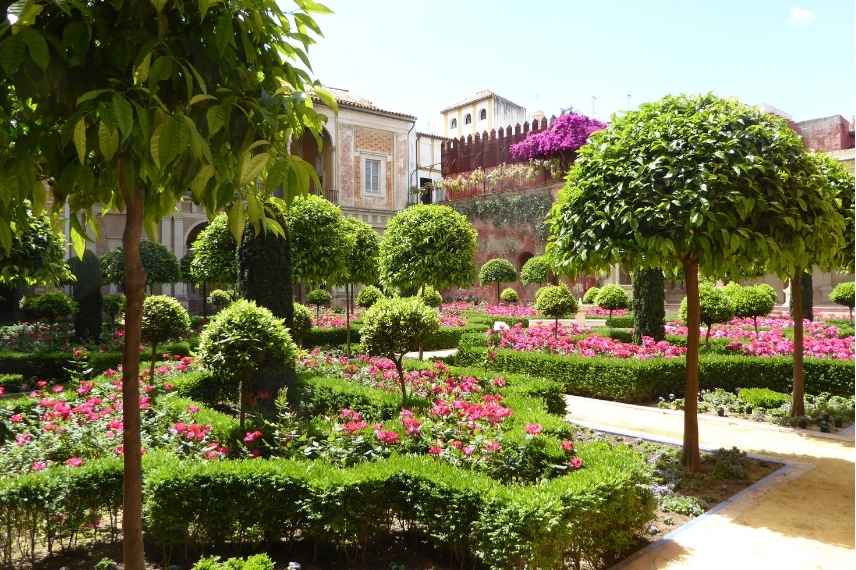
An Andalusian garden, square-shaped, halfway between the enclosed garden and the topiary garden, enhanced with box borders and Mediterranean plantings: its colours and the habit of shrubs on stems give it a lot of character (photo: Gwenaëlle David).
The seaside garden
Villa gardens by the sea are often square-shaped when located in an urban area. Here you may seek to occupy the space by planting numerous plants, for example exotic ones, to emphasise a holiday feel, leaving enough room for the dining area and sun loungers on the terrace, as the living space to prioritise. Also read Designing a second home garden.
The large garden
There, options are broader, and the layout is quite different, as one aims to create several ‘rooms’ within the garden, to create distinct scenes and gradually reveal the whole garden. I recommend Jean-Christophe’s article on the different spaces in the garden, but note that in this case the aim is to partition either with plants and small hedges, or with structures (fences, trellises or screens) to suggest surprise.
Read also
Designing a city gardenA few garden design tips
Developing a layout plan based on pathways
The square garden lends itself well to a circular path that winds round, leaving the centre occupied by a lawn area that can also accommodate a few plantings, or a seating area, or be entirely devoted to flora. This is especially suitable for small to medium-sized gardens. Avoid narrow borders where you can only plant a few species, for a dull result. Be creative! You then obtain an island of greenery where the circular path is highlighted to emphasise the softening of the square’s sharp angles. The path, in this case, plays an aesthetic role beyond its utilitarian function: take care of its surface (gravel, a wood-and-stone duo, etc.)
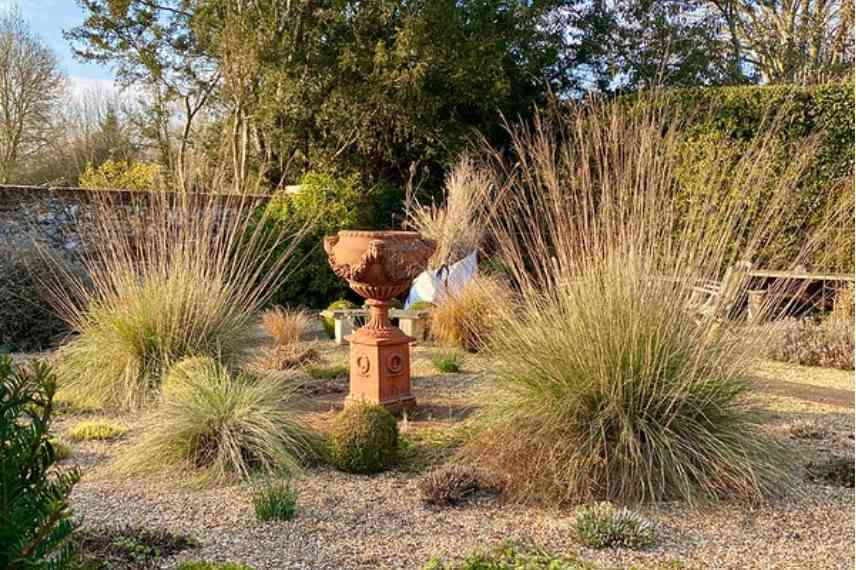 This English garden theatrically highlights the garden’s centre with a raised basin and a sequence of grasses, leaving the path around the edge: the square garden gains originality and an aesthetic based on golden and warm tones (photo by Harry Lawford).
Introducing curved lines to counter the geometric scheme
They appear in pathways and walks, of course, as well as in decorative elements of the garden such as a vegetated arch that softens the whole. Don’t forget the flora, which also has a corrective effect by attenuating strong lines: the weeping and arched forms, climbing plants, cascading flowers and plume-like inflorescences or those that bring a pointillist effect and a great deal of softness.
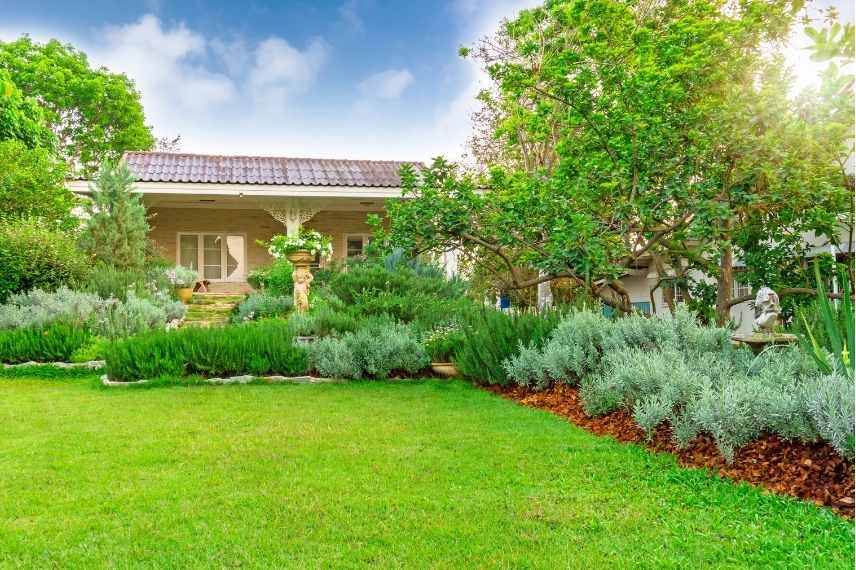 Try altering the lines by drawing rounded or wave-shaped beds (this will be possible in larger gardens).
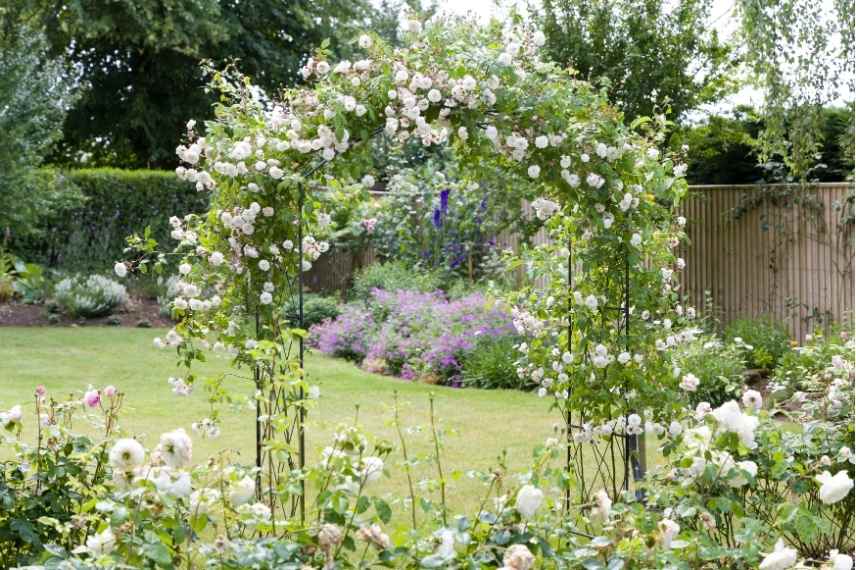 Here, a romantic arch softens the garden’s overly closed lines
Giving the terrace a major place
A terrace at the edge of the house creates a mineral contrast on the ground, often rectangular, which, in small gardens, naturally breaks the square layout by giving the eye two surfaces of different sizes, the garden generally taking up more space. It’s quite simple, but visually effective, especially if you dress the boundary between terrace and lawn (or gravel) with a few shrubs or perennials of small to medium height to create two distinct spaces (dining/relaxation area). The rhythm is then set by the shape you give to the ground.
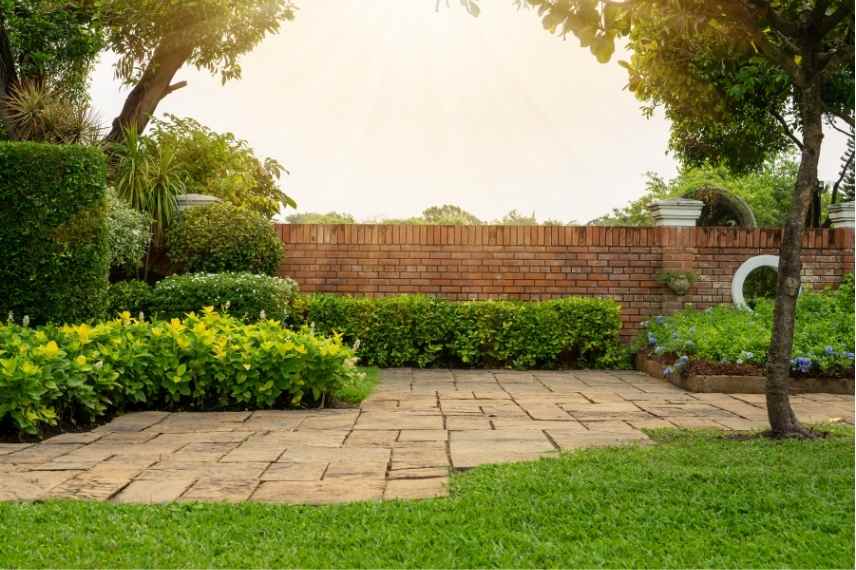 A terrace that extends and softens the square feel of the garden.
Getting along with a small kitchen garden
The square garden is ideally suited to separating the space from a vegetable garden, soft fruits or a mini orchard: by placing it in the background, delineated by a mid-sized flowering ornamental hedge, it again helps to break up the geometry and draw the eye toward another area to discover…
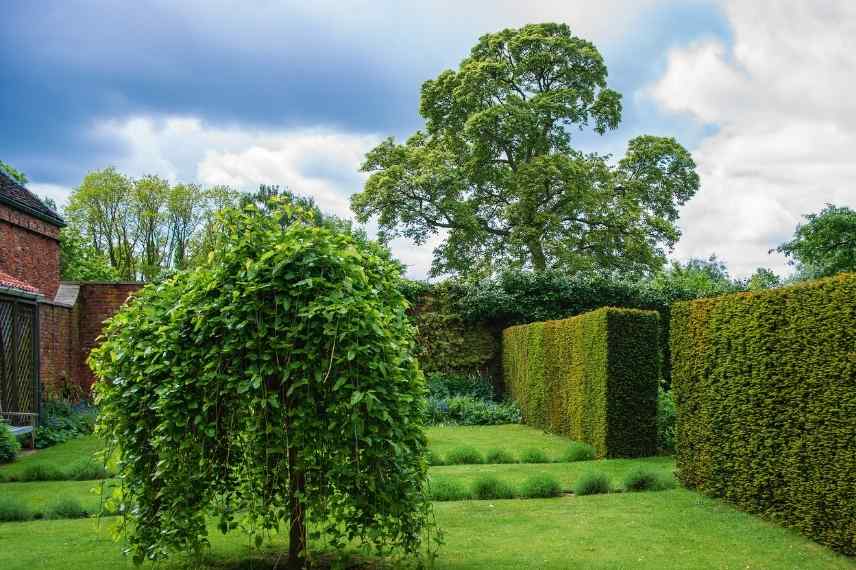
Cheating with a triangle or a few steps
Integrating a single triangular shape or a diagonal line in the square garden allows the volumes to be distributed differently, projecting an off-centre vanishing point, making the space appear larger. This also allows for wider planting strips than the narrow borders often seen in the square garden. This is especially interesting in a contemporary garden. Two small steps leading to an elevated area are also a handy trick to break up the garden’s overly square feel.
Pushing back the garden’s limits
Directing the eye elsewhere helps push the garden’s boundaries, and this is particularly useful in a square garden where one might immediately see the whole space. You can cheat with successive divisions (a small gate or wrought-iron gate, an evergreen hedge), or use the boundaries by vegetating the verticals (walls, low walls, fences) to blur the ends or the edge of the garden.
Also read: Creating a secret garden, Wrought iron in the garden: ideas and inspiration.
- Subscribe!
- Contents
Comments