





























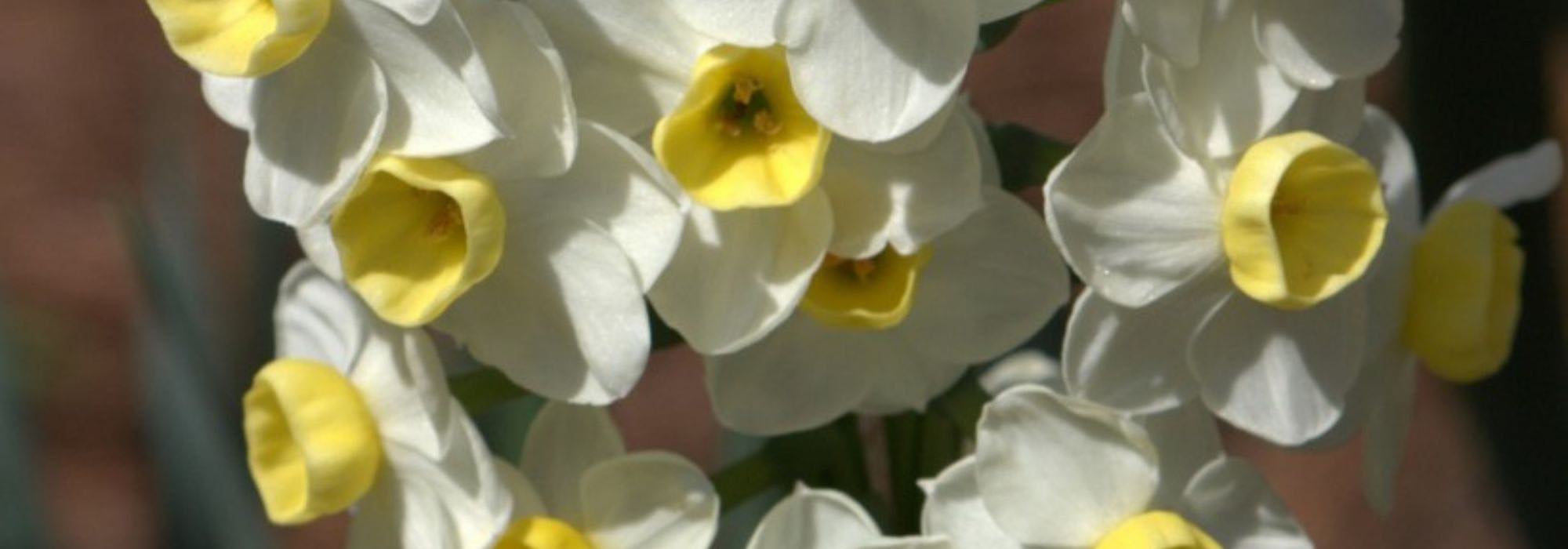
The best daffodils to naturalise in the garden
Our selection of daffodils that reproduce easily
Contents
Daffodils or narcissi are among the very easy-going bulbous plants. Unfussy and robust, they faithfully return each year and sometimes have the added advantage of multiplying by themselves. Botanical species indeed produce seeds, but daffodils can also reproduce effectively through the production of bulblets. These small bulbs form new plants capable of flowering in 1 to 2 years.
This allows for relatively quick acquisition of new daffodils, which will naturally multiply. Over time, you will enjoy at least two or three times more plants than you initially planted!
Depending on their flowering period, we have selected the best daffodils for you that will easily reproduce.

Early flowering daffodils
The flowering period of daffodils extends from late winter to late spring. The earliest varieties show the tips of their petals as early as February.
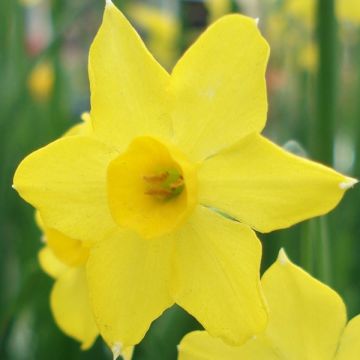
Narcissus bulbocodium ‘Golden Bells’
‘Golden Bells’ is a true little sun that heralds the return of fine weather between February and March, depending on the region. Each bulb of this variety produces around ten stems, at the top of which gather up to 5 flowers. ‘Golden Bells’ is a floriferous daffodil that rewards us with very bright golden-yellow flowers. They are funnel-shaped, measuring between 4 to 5 cm, and are delicately scented.
This daffodil is part of the small varieties or “mini daffodils”. Measuring 15 cm in height and 10 cm in spread, it will fit in anywhere: in borders, planted in groups to brighten up a lawn, in containers, or in rockeries.
It is a low-maintenance plant that naturalises easily.
Narcissus cyclamineus ‘Jet Fire’
‘Jet Fire’ does not go unnoticed with its beautiful colourful flowering, which will add a touch of pep everywhere. This is a single daffodil producing magnificent bicoloured flowers: the petals are bright yellow, highlighted by a corona of orange-reddish centre. Each stem reveals 2 to 3 small trumpet-shaped flowers, lightly scented. Flowering occurs as early as February or March and lasts for several weeks.
This dwarf variety reaches only 25 cm in height, allowing it to be grown both in pots and in the garden, for example, in borders or in a small rockery.
Expect 3 to 4 years for this variety to multiply on its own in the garden, gradually providing you with more and more new daffodil bulbs over time.
Narcissus tazetta ‘Erlicheer’
‘Erlicheer’ is a daffodil with a very sophisticated appearance. It is perfect for making bouquets, but will also, of course, look wonderful in the garden.
This variety of double daffodil is particularly multiflorous: in March, it produces up to 8 flowers per stem, forming real little pom-poms. In terms of colour, it boasts a very refined ivory white, highlighted by a pale yellow centre.
To further complement its list of qualities, note that it is a highly fragrant variety, exuding a sweet and suave fragrance, enchanting or heady depending on personal taste!
This old variety, which deserves to be rediscovered, has even received an ‘Award of Garden Merit’ from the Royal Horticultural Society in England.
Originating from the Mediterranean region, this daffodil tolerates both dry soils and wetter meadows, as long as the soil is well-drained (does not retain excess water).
Reaching up to 40 cm in height and 20 cm in spread, it will adapt to cultivation in pots as well as in open ground. Plant your daffodil bulbs near areas of passage to fully enjoy their fragrant flowering.
Narcissus cyclamineus ‘Tête-à-Tête’
This botanical daffodil is very common among florists. It is yet another mini daffodil, which does not exceed 25 cm in height. In February-March, it reveals 2 to 3 flowers per stem, in an adorable lemon yellow. The flowers consist of reflexed outer petals, like those of cyclamens, and a small undulating trumpet crown at the centre. They are subtly scented.
‘Tête-à-Tête’ is one of those easy-to-cultivate daffodils that establish themselves in the garden over time by multiplying spontaneously.
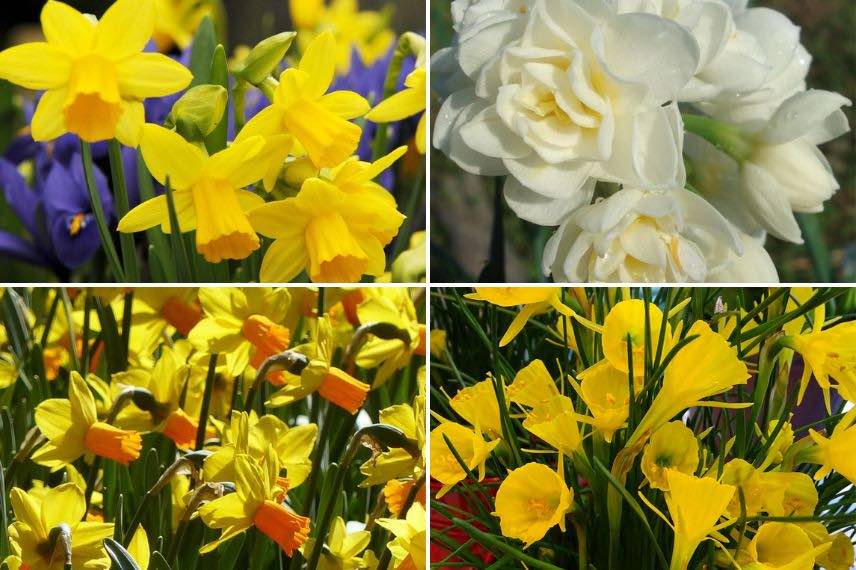
Clockwise: Narcissus ‘Tête-à-Tête’, Narcissus tazetta ‘Erlicheer’, Narcissus bulbocodium ‘Golden Bells’, Narcissus ‘Jet Fire’
Mid-season flowering daffodils
These daffodils bloom in early spring, between March and April.
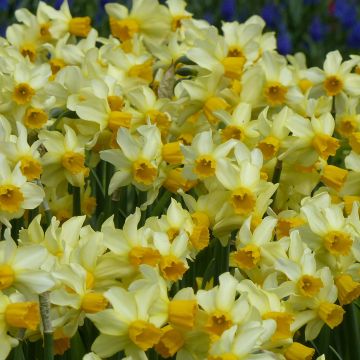
The tazetta daffodil ‘Avalanche’
To say the least, the daffodil ‘Avalanche’ is generous with its flowers: in early spring, each stem produces 10 to 20 bright flowers, grouped in clusters. Each flower consists of a corolla of white petals surrounding a light yellow cup-shaped coronule. The flowers also reveal a musky fragrance, which further enhances their natural charm. This flowering lasts between 3 weeks and 1 month.
This daffodil will reach a height of 50 to 70 cm. It will easily beautify rockeries or thrive in borders alongside other bulbous plants.
‘Avalanche’ is an old and vigorous variety, which has the advantage of tolerating heat and drought well. It will settle in the garden without difficulty, returning each year in greater numbers.
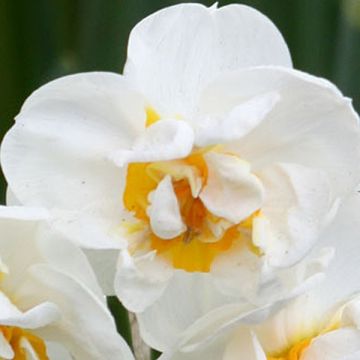
The odorus daffodil ‘Campernelle’
‘Campernelle’ is an old variety that has many advantages. In March, this daffodil reveals adorable double flowers with a slightly tousled appearance. The outer petals are rather elongated, while the trumpet-shaped centre appears more crumpled. Their bright yellow sunny colour and powerful fragrance cheerfully announce the arrival of spring. They last for over a month.
Considered a semi-dwarf variety, this daffodil measures about 35 cm in height.
Give it a sunny spot, in even calcareous and dry soil, as long as it is well-drained. It will acclimatise easily and multiply spontaneously over time.
The pseudonarcissus daffodil ‘Obvallari’
Certainly one of the most popular species: the daffodil ‘Obvallari’, better known as the wood jonquil. This botanical daffodil reveals pretty bright yellow trumpet-shaped flowers in April. Each stem produces a single flower with a wide corolla of petals surrounded by a flared centre, measuring 5 to 6 cm.
Note that its green foliage offers lovely bluish reflections, which pair beautifully with the colour of the flowers.
This variety will naturalise easily in cool soils (that do not dry out), in full sun or partial shade. It is ideal for light woodland, for example, to dress the base of deciduous trees.
The (x) jonquilla daffodil ‘Martinette’
We particularly love ‘Martinette’ for the stunning vibrant colour of its flowers. In early spring, this daffodil reveals indeed bicoloured flowers, with yellow petals surrounding a small central crown of bright orange. They rise in groups of 4 or 5 atop sturdy stems about 40 cm tall. Their warm colours certainly poetically announce the return of fine days. Another advantage: this variety is among the most fragrant.
This daffodil will tolerate even dry soils in summer and heat. It grows very well in the Midi, the west, or in Provence and will naturalise effortlessly in the garden.
Enjoy its fragrance in a flowering pot, near pathways, or in beautiful bouquets for the home.
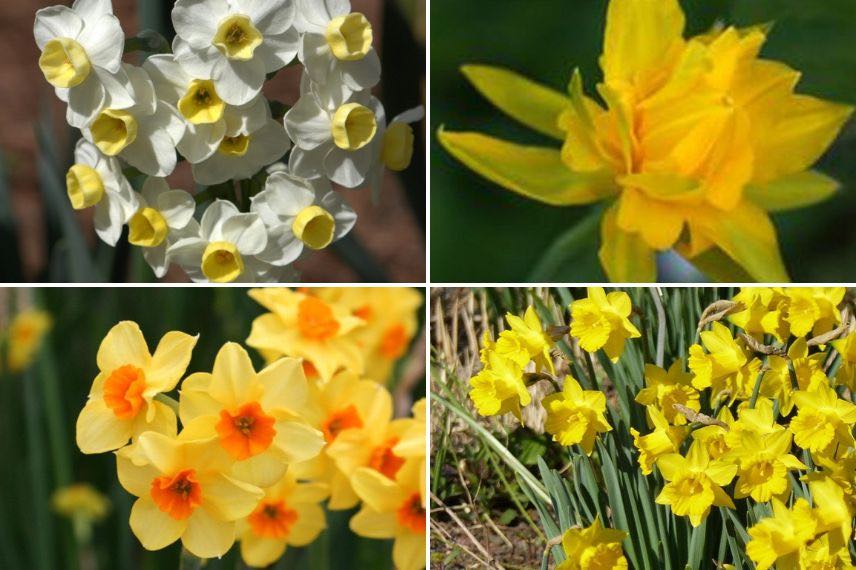
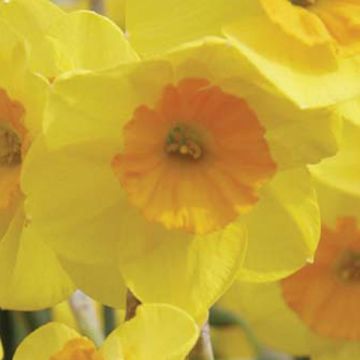
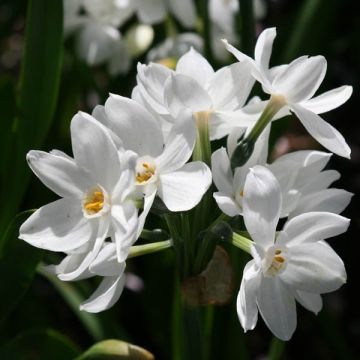
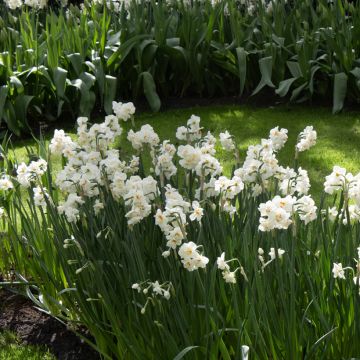
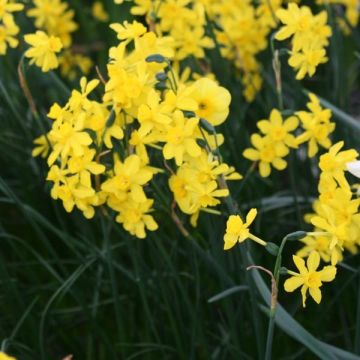
Narcissus tazetta ‘Avalanche’, Narcissus odorus ‘Campernelle’, Narcissus pseudonarcissus ‘Obvallaris’, Narcissus jonquilla ‘Martinette’
Discover other Narcissi - Daffodils
View all →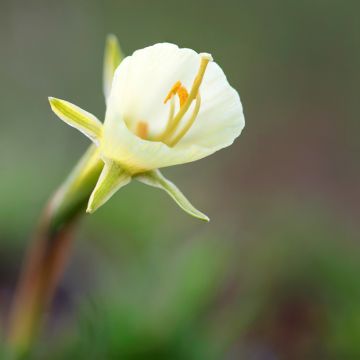
Available in 1 sizes
Available in 1 sizes
Available in 1 sizes
Available in 1 sizes
Available in 1 sizes
Available in 1 sizes
Available in 1 sizes
Available in 1 sizes
Available in 1 sizes
Available in 1 sizes
Late flowering daffodils
The latest narcissi reveal themselves at the end of spring, between late April and May.
The Narcissus poeticus ‘Actaea’
This poet’s narcissus originates from wild varieties growing in the Pyrenees and the Alps. It is among the most fragrant varieties, exuding powerful floral notes.
To top it off, its flowers are of great delicacy: the petals, a pristine white, open to a well-undulated crown of soft yellow-green, accented by a very graphic red edge. They appear between April and May, depending on the climate.
Its silhouette reaches about forty centimetres in height. This narcissus will tolerate all soils, even heavy ones, remaining fresh to moist. It will thus thrive near a small pond. It is also an excellent flower for bouquets.
‘Actaea’ requires no special maintenance to bloom again each year and multiply.
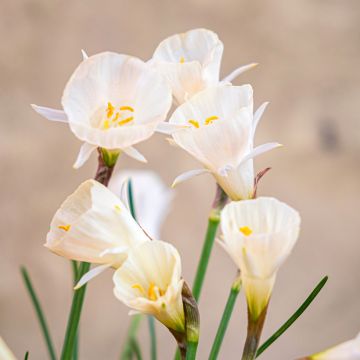
The narcissus triandrus ‘Thalia’
‘Thalia’ is a narcissus of great refinement, simple yet generous. Between April and May, it rewards us with small star-shaped flowers of pure white, delicately nodding towards the ground. They have the emblematic shape of the narcissus: an outer corolla of petals surrounding a undulated cup-shaped heart. These flowers are grouped in pairs or threes at the top of stems reaching about 35 cm in height. The flowering is also slightly fragrant.
Easy to grow, this old variety proves robust and trouble-free. It is endemic to Finistère, where it finds the growing conditions that allow it to thrive. Simply provide it with well-drained soil, in full sun or partial shade, for this narcissus to naturalise and multiply spontaneously year after year.
Use it in masses (at least 10 to 20 bulbs) to elegantly dress a well-kept lawn, in a bed with other spring-flowering plants, or in rockeries.
The narcissus ’New Baby’
This late variety differs slightly in its colouring: its bicoloured flowers are adorned with petals that are white beautifully striped with yellow, surrounding a bright yellow cup-shaped heart.
Generous and sunny, it is easy to cultivate even in heavy soils and will multiply spontaneously just as easily.
As its name suggests, ‘New Baby’ is a dwarf variety, not exceeding 25 cm in height with a spread of 10 cm. This narcissus is therefore one of the ideal candidates for pot, container, or window box cultivation. Consider it to simply brighten up small gardens, terraces, or balconies at the end of spring.
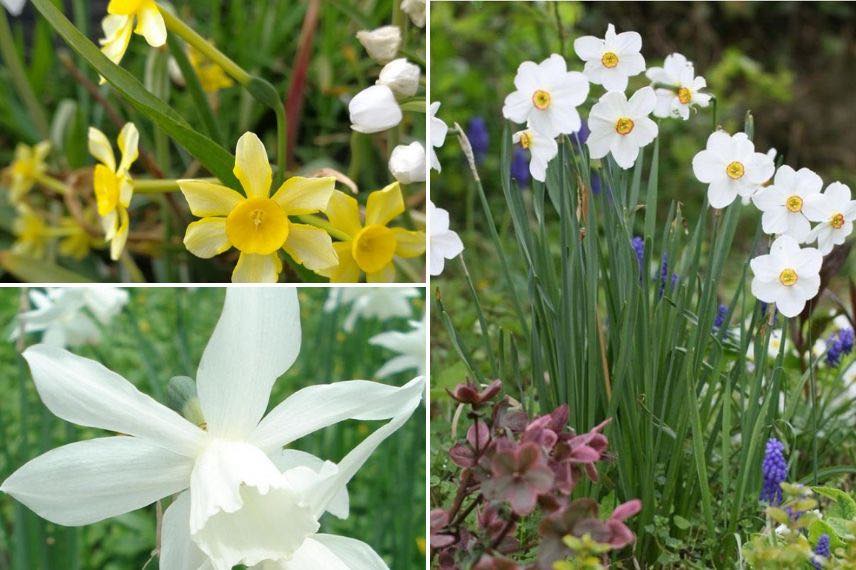
Narcissus ‘New Baby’, Narcissus poeticus ‘Actaea’, Narcissus triandus ‘Thalia’
- Subscribe!
- Contents
Comments