






























Diseases and parasitic pests of wallflowers
Identification, prevention and treatment with natural solutions
Contents
The wallflower is a relatively trouble-free plant that many of us grow in the garden, against stone walls or in pots.
It is sometimes the target of insect pests or diseases that spoil its flowering or damage its foliage. As a member of the Brassicaceae family, it does indeed inherit some well-known parasitic pests from that family.
Let’s review the few troubles this pretty perennial may face and how to combat certain unwanted insects or fungi indésirables.

Wallflowers, so beautiful in spring or summer, can sometimes experience a few parasitic problems…

Wallflower pests
Flea beetles
It’s the most common pest of wallflowers and its number-one enemy. The cabbage flea beetle, or crucifer flea beetle, is indeed a familiar visitor to this plant family (Brassicaceae). Flea beetles resemble small beetles and are black in colour. They primarily attack the seedlings of Matthiola and annual wallflowers.
- Description : Cabbage flea beetle is a small beetle that feeds on the leaves of cruciferous plants.
- Symptoms : leaves suddenly become speckled with tiny holes. This is particularly visible on young seedlings.
- Treatment : use pyrethrum-based products to combat the infestation. Some manures are also effective, such as lavender manure, onion-skin decoction, elder-leaf manure and horsetail manure.
→ Also read How to use pyrethrum in the garden and How to combat flea beetles?
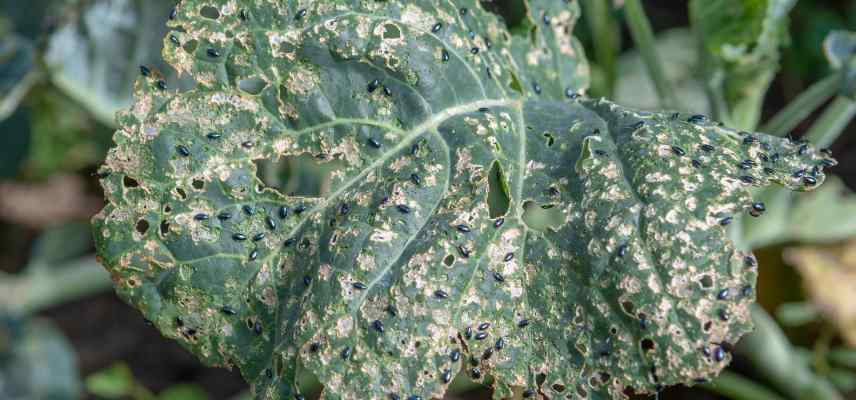
Flea beetles on a cabbage leaf
Aphids
They can also completely invade young wallflower shoots.
- Description : Aphids are small sap-sucking insects that weaken plant growth. They can be green, black or brown, measuring about 1–3 mm long. They are commonly found on terminal shoots and young leaves.
- Symptoms : presence of colonies of small green or black insects on the terminal shoots.
- Treatment : in case of infestation, treat by applying a solution of black soap to eliminate aphids or spray the plants with a tansy decoction or tansy tea, a fern manure or a rhubarb leaf infusion.
Caterpillars
On established plants, caterpillars can cause heavy damage. They will defoliate wallflowers that are still young, their leaves, but also their flowers.
- Description : Caterpillars are the larvae of certain butterflies, often green or brown, measuring 1–4 cm long. They can cause significant damage by eating the leaves of wallflowers.
- Symptoms : leaves are partially or wholly eaten. Small caterpillars may be seen on the plants.
- Treatment (mechanical) : Mechanical control: remove caterpillars one by one from the plants. Pick them off with gloves or use a biological insecticidal product such as Bacillus thuringiensis (Bt).
Gastropods
Snails and other slugs also sometimes attack the young, tender wallflower plants.
- Description : Slugs and snails feed on the leaves and young shoots of wallflowers, especially in damp conditions.
- Symptoms : leaves chewed or eaten, slime trails on the plants.
- Treatment : to stop them reaching the plant, install physical barriers: scatter a little ash (unfortunately ineffective after the next rain), diatomaceous earth or lava granules, or coarse RCW around the plants, or crushed eggshells around the plants to form a barrier. You can also use a slug killer in Ferramol granules. Finally, optionally, beer traps (though controversial, often attracting more slugs from around). Water in the morning, not in the evening.
Wallflower diseases
Cruciferous Root Gall
- Description : Cruciferous root gall is caused by a protozoan, a micro-organism that infects plant roots. This protozoan enters the roots and causes the formation of nodosities or swellings, thereby disrupting the plant’s uptake of water and nutrients.
- Symptoms : the plants wilt during the day, show nodosities on the roots and eventually wither.
- Treatment : uproot and destroy infected plants, and avoid replanting crucifers in the same spot the following year. Enrich soil with well-rotted compost or manure to improve soil structure and drainage, and strengthen plant resilience.
Rust
It can occur in damp springs, where it develops on the leaves, staining them brown—rust colour—hence its name.
- Description : white rust is a fungal (cryptogamic) disease that produces spores that are white or orange in colour.
- Symptoms : white or orange pustules on the undersides of the leaves. The leaves dry up gradually.
- Treatment : limit watering, remove affected parts and spray a nettle manure, a horsetail manure or tansy. Use Bordeaux mixture as a preventive.
Late blight
Late blight is best observed in summer: this fungal disease, caused by Phytophthora infestans, appears with hot days and high humidity. It produces yellow to brownish spots and a white down on the undersides of the leaves. The leaves become stunted and eventually drop.
- Description : late blight is a fungal disease that develops in moist conditions, causing yellow to pale-brown spots on the leaves and a white down on the undersides of the leaves. It can slow growth and lead to plant decline if unfavourable conditions persist.
- Symptoms : pale green spots on the leaves, turning greyish on the underside. Affected wallflowers become stunted and weaken considerably if nothing is done, causing their foliage to drop.
- Treatment : spray a horsetail decoction to strengthen the plant. Always ensure the soil is well-drained to avoid residual moisture. A comfrey manure is also recommended as a preventive to help plants boost their natural defences and thus better combat late blight.
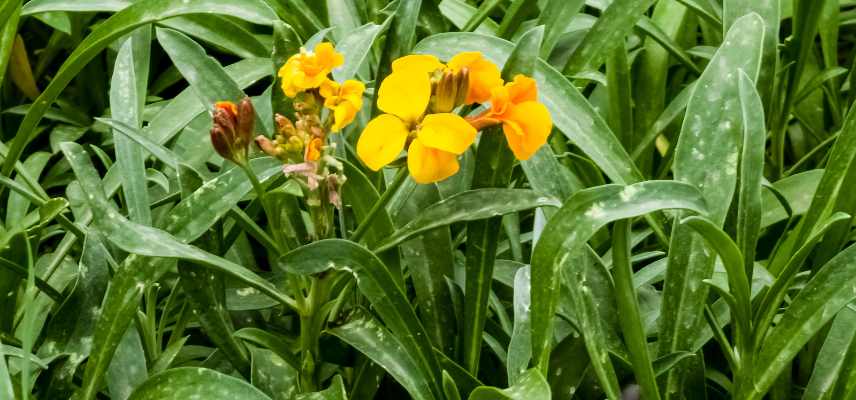
Grey mould (Botrytis)
Grey mould is caused by a fungus, Botrytis cinerea, which proliferates in damp conditions. It is recognised by browning and desiccation of the affected stems. They gradually become covered with a greyish mould.
- Description : the disease manifests as a greyish fuzz on the leaves, stems and flowers, leading to their decomposition. It proliferates in damp conditions and can quickly affect the whole plant if not controlled.
- Symptoms : rot of the leaves, stems and flowers, with a white to grey mould.
- Treatment : Avoid watering the foliage and treat preventively with a garlic decoction.
Lace Powder (Powdery mildew)
Powdery mildew develops mainly in warm, dry conditions. It is a fungal disease that affects photosynthesis and slows growth of the plants.
- Description : a characteristic white, powdery coating appears on the entire plant.
- Symptoms : white, powdery coating on the leaves and stems. The wallflower gradually becomes deformed, then dries out.
- Treatment : spray a horsetail decoction or nettle manure every fortnight. As a preventive, limit watering to a minimum and avoid wetting the foliage.
- Subscribe!
- Contents
Comments