





























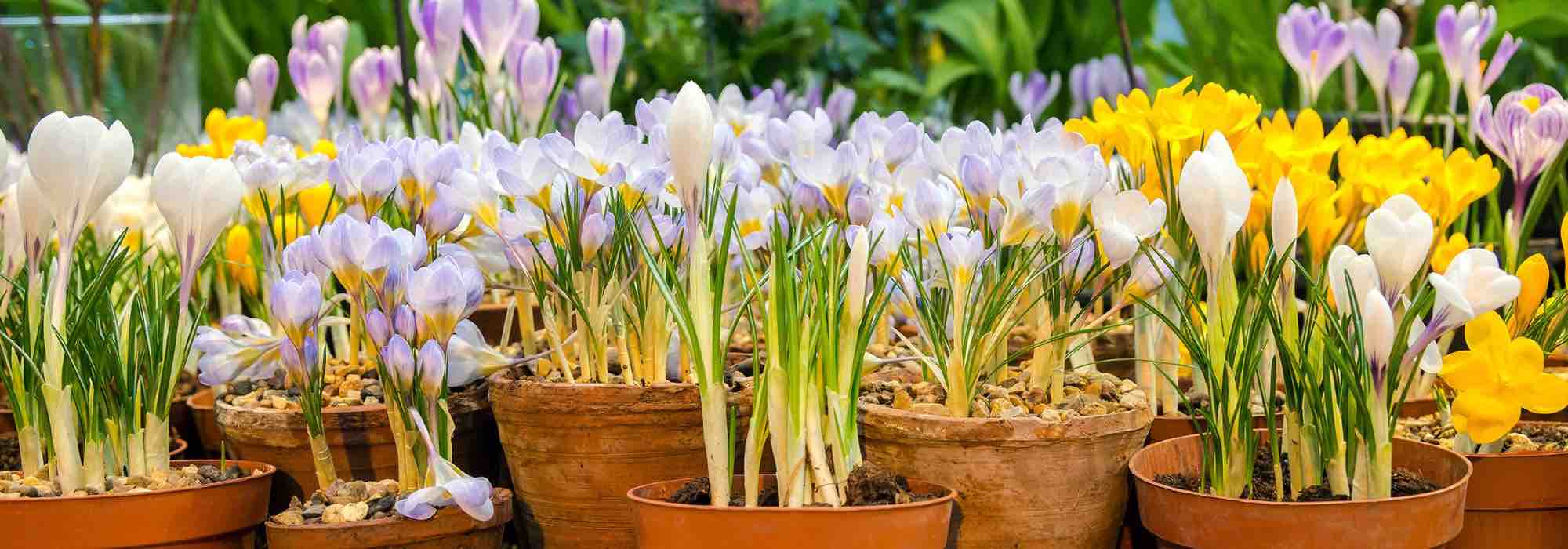
Growing Crocus in pots
To enjoy their colours as early as winter or spring
Contents
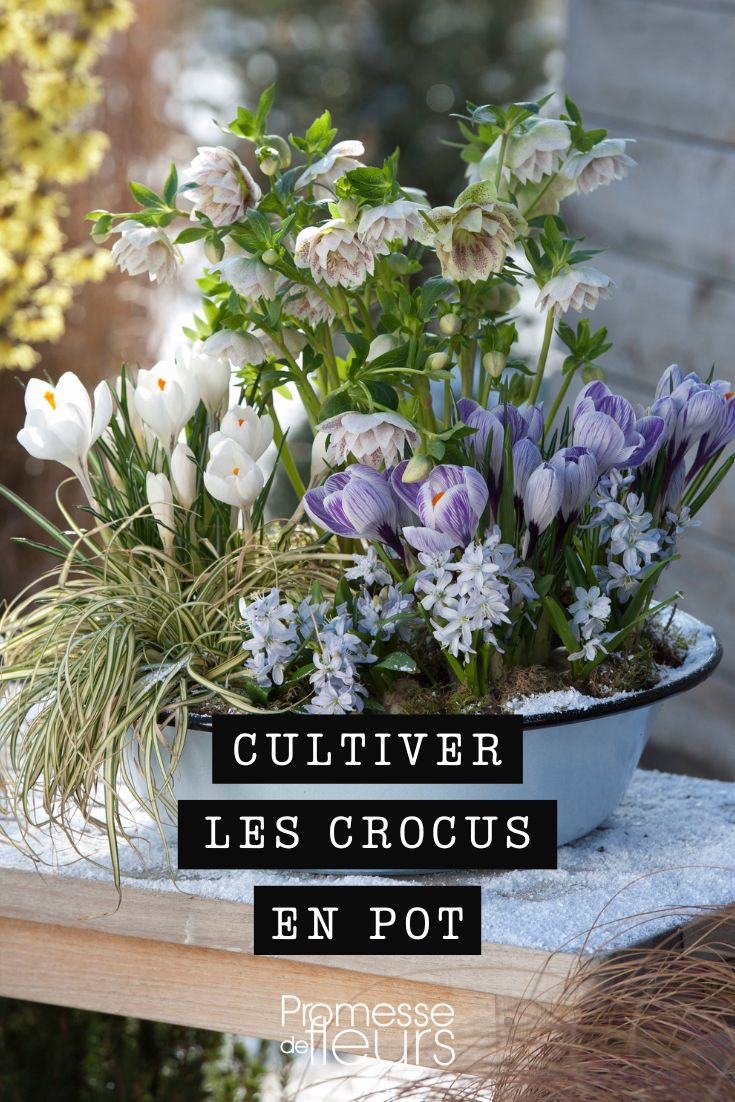
Flowering very early, from spring or late winter, crocuses are perennial plants with bulbs that colour the lawns and the pots, announcing the arrival of warmer days. They are distinguished by their fine foliage and their flowers open in a flared cup like those of colchicums, with which they are easily confused. The flowers form a corolla of six petals, which can be yellow, white or purple, with orange-yellow stamens in the centre. They bloom, for the most part, between February — sometimes even January — and April, some species flowering in autumn. Easy to grow and hardy, they need sun and well-drained soil and require little maintenance. Discover our tips for growing crocuses in pots.

Which crocus varieties to grow in a pot?
Crocuses measure between 8 and 15 cm in height and can practically all be grown in pots.
There are two main categories of crocuses flowering in spring: the botanical crocuses (Crocus chrysanthus) with small flowers, opening as early as January or February, and the large-flowered Dutch hybrids derived from Crocus x vernus, which flower later in spring.
Some crocuses are scented, such as Crocus chrysanthus.
Crocuses are grown in sun in well-drained soil, but some, like Crocus tommasinianus, tolerate being planted in shade.
Among the reliable varieties you can plant in pots, discover:
- Crocus chrysanthus ‘Miss Vain’
Standing 12 cm tall, it bears pure white flowers, slightly tinged with blue and scented. It flowers early, from February to March. It thrives in sun and is hardy down to −23 °C. - Crocus Mammouth ‘Flower Record’
Measuring 10 cm, this crocus produces large 8 cm flowers, purplish-violet in colour, with a somewhat truncated appearance, a white throat highlighted by orange stamens. Hardy down to −23 °C, it can also be planted in sun. - Crocus tommasinianus
Delicate with its star-shaped lavender-coloured flowers that appear from February, this crocus will establish itself equally well in sun or shade. Standing 12 cm tall, it is one of the earliest and easiest to grow. Hardy down to −23 °C. - Crocus vernus ‘Vanguard’
This crocus offers 6 cm flowers in soft, novel shades, the inside of the petals being bluish-mauve and the reverse being greyed, even silvery. It flowers in March and April and measures 10 cm in height. Hardy down to −23 °C, it is planted in sun. - Crocus chrysanthus ‘Cream Beauty’
This crocus offers 3 cm flowers, creamy-beige warmed with yellow, with a purple-marginate centre and orange stamens. It opens in February and March. Standing 10 cm tall, it is hardy down to −23 °C and thrives in sun. - Crocus Mammouth ‘Grand Jaune’ (‘Golden Yellow’)
This crocus displays large golden-yellow flowers that brighten up pots in February and March. Standing 15 cm tall, it is planted in sun and withstands temperatures down to −23 °C.
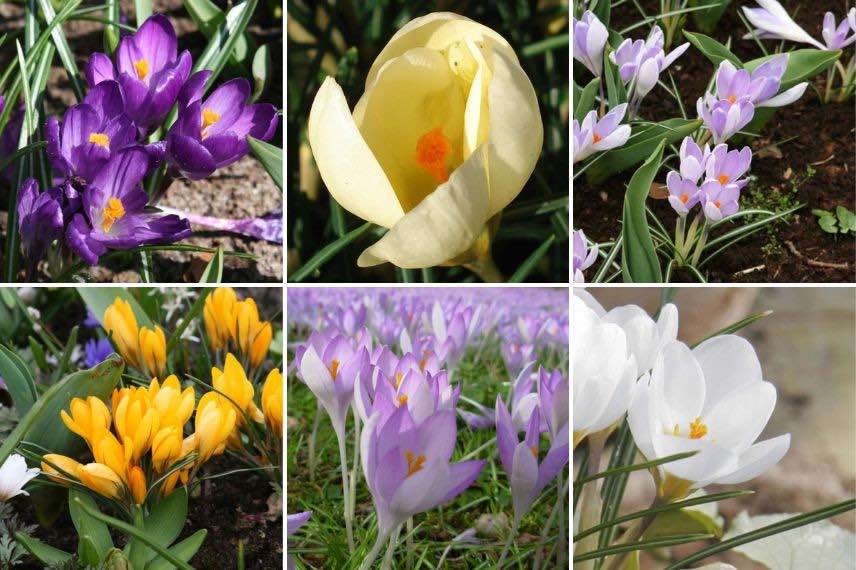
Clockwise: Crocus ‘Mammouth Flower Record’, Crocus chrysanthus ‘Cream Beauty’, Crocus ‘Vanguard’, Crocus chrysanthus ‘Miss Vain’, Crocus tommasinianus, Crocus ‘Mammouth Grand Jaune’
Read also
Crocus: how to plant them?When and where to plant a crocus in a pot?
- Spring-flowering crocuses are best planted in September and October, which allows them to become well established and to perform at their best at the next flowering.
- Crocuses do best in full sun, except Crocus tommasinianus, which can also be planted in shade.
How to grow a crocus in a pot?
Which type of pot?
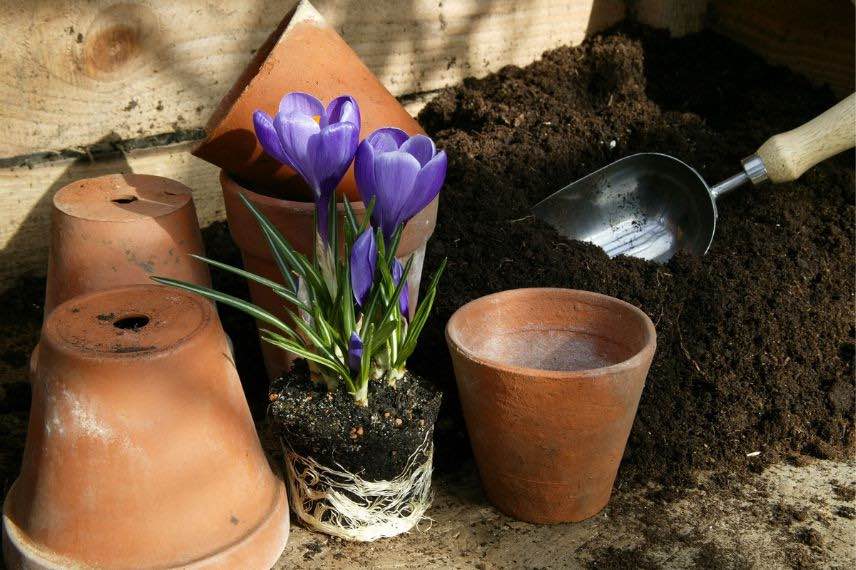
Crocuses can be planted in any type of pot, but only terracotta pots provide excellent aeration for the bulbs.
Which substrate?
- Crocuses need a light, well-draining substrate.
- They do not like an overly wet substrate, which can cause the bulbs to rot.
Planting
- Use a wide, shallow pot or planter, with drainage holes in the bottom
- Place at the bottom of the pot a layer of gravel or clay pebbles to ensure good drainage.
- Add potting compost mixed with a little sand
- Place the bulbs the right way up with the pointed end facing upwards, between 5 and 10 cm deep.
- You can plant them fairly close together to create a nice massed effect, about 5 cm apart.
- Cover with the remaining substrate and firm down lightly to remove any air pockets.
- There is no need to water.
- It is also possible to force the bulbs at planting time to bring forward the flowering period. To do this, place the pots in a dark, cool place (around 10 °C), such as a cellar or garage. Water them regularly. After two months, shoots of 5 to 10 cm should appear. This is the time to expose them to light and to room temperature, in your home, for example near a window, so you can see them flower as early as winter
Care
Crocuses are easy to grow and require little maintenance.
Watering
- Water moderately. Crocuses need little watering, as they dislike damp conditions.
- Do not water them when they enter dormancy, after flowering.
Pruning
- Remove faded flowers.
- Remove the leaves when they are completely yellow or dry, so the bulb can build up its reserves for the next year.
Dividing the corms
- The bulbs of crocuses are called corms and multiply over the seasons. Corms are the storage organs of crocuses.
- Divide the corms every 4 to 5 years to create space in the pot and to replant others elsewhere.
- Carry out this operation in May by gently lifting the corms and separating the bulblets, which you will replant elsewhere.
Diseases
- Crocuses are vigorous and resistant to disease.
- They can sometimes be eaten by rodents, such as squirrels, voles or mice. In this case, protect them with wire mesh.
To learn more about growing crocuses, consult our complete guide to planting and caring for crocuses, as well as our full range of crocuses.
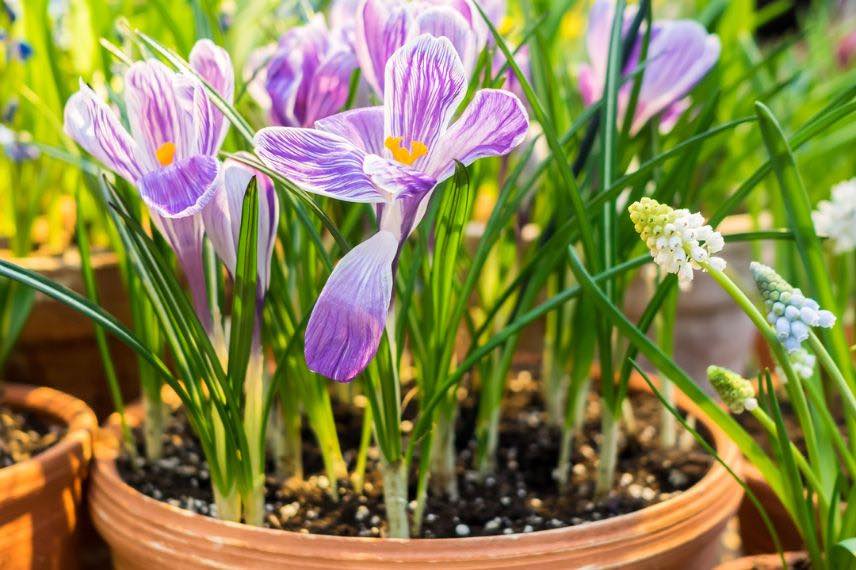
When the pot is full, it is time to divide crocuses
- Subscribe!
- Contents
Comments