





























Top 5 butterfly bushes with yellow and orange flowers
Varieties of butterfly trees in warm colours
Contents
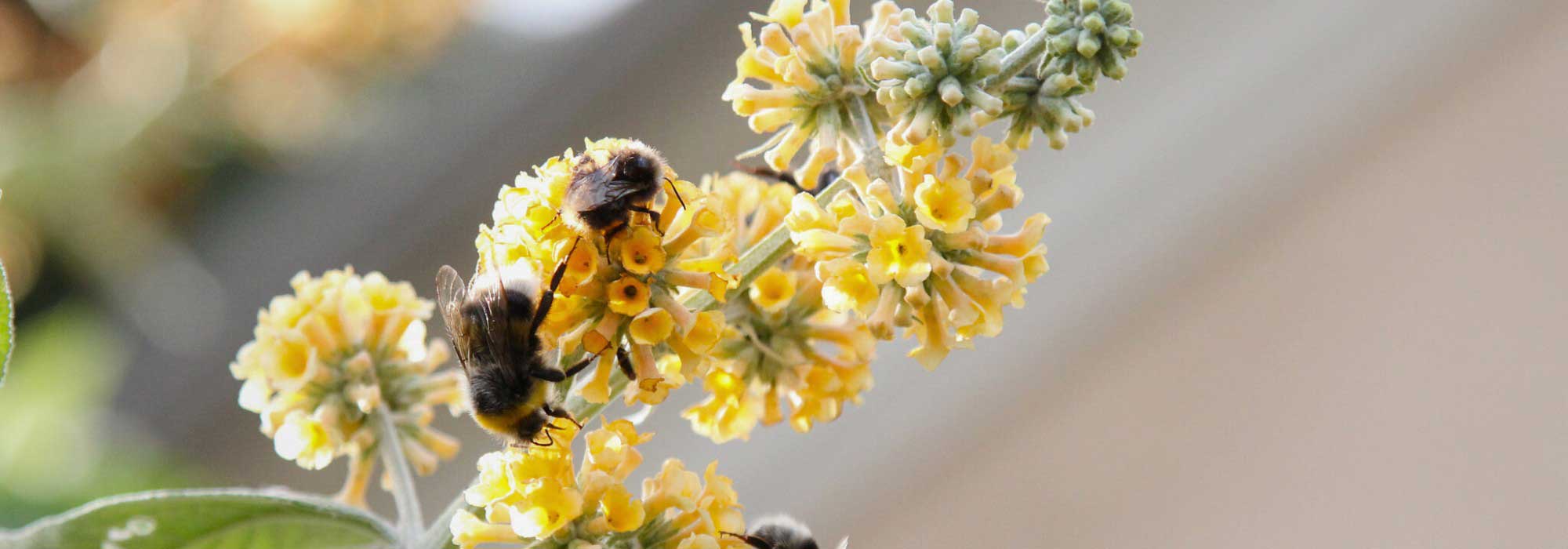
Butterfly bushes are appreciated for their long, generous, fragrant flowering that irresistibly attracts nectar-seeking insects. All summer, and sometimes in spring or winter, their panicles of fragrant flowers unfold in colours ranging from white to mauve, through pink and indigo blue. Among the many varieties, some Buddlejas come in warm yellows and oranges, brightening the garden or terrace with their radiant touch. Like most Buddlejas, they are easy-to-grow shrubs that thrive in sun in any well-drained soil. They can be used as a specimen, in a border, in a hedge, or even in pots for the smaller varieties. Discover five original butterfly-bush varieties with orange- or yellow-coloured flowers that differ from the classic Buddleja davidii!

Buddleia weyeriana 'Sungold'
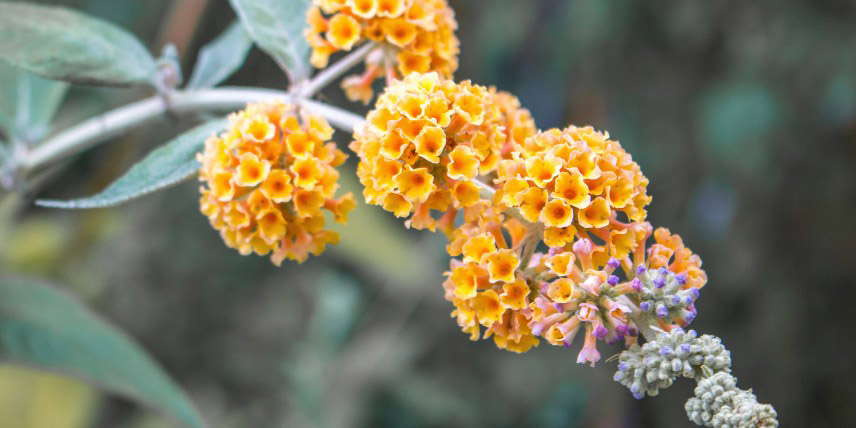
The Buddleja x weyeriana ‘Sungold’ is a form quite particular arising from a hybridization between Chinese Buddleja davidii and the Buddleja globosa (or globose). The characteristic of Buddleja weyeriana is to bear inflorescences half-spherical and half-panicle. It flowers from July, often until October, and astonishes with the unusual shape of its flower spikes, about 10 to 15 cm long. This cultivar is distinguished by its panicles formed of small globose, dense and compact flowers, in an especially intense yellow-orange. They exude a delicate honey scent, attracting many butterflies and other pollinating insects. Its habit is elegant and trailing, with flexible and arching branches. It quickly forms a light and bright shrub of 3 metres across, clad in a glaucous and deciduous foliage that provides a handsome backdrop to this sun-loving flowering. This shrub is moderately hardy (to about -10°C) and prefers light, well-drained soil and will thrive in a free-standing hedge or at the back of a border in gardens with winters not too severe. You can also keep it in a pot to brighten a terrace, for example. Regular pruning is recommended to maintain a harmonious habit and promote flowering.
Pair it with beautiful sun-loving perennials in complementary colours such as Delphiniums Pacific ‘Black Knight’, a Buddleja davidii ‘Empire Blue’ with vivid blue spikes or with evening primroses (oenothera) flowering in a vibrant yellow for a colourful harmony.
Read also
Extraordinary Butterfly bushesBuddleia globosa
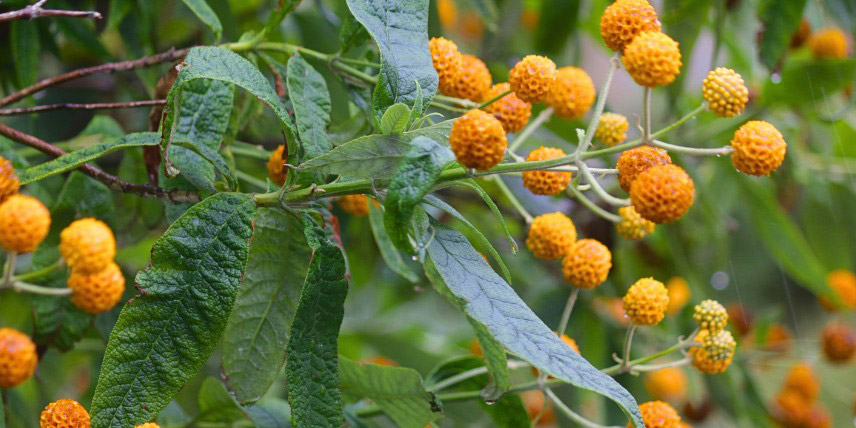
Originating from South America, the Buddleja globosa is a true botanical marvel with dazzling spherical inflorescences. It stands out for its perfectly spherical, bright flower heads, reminiscent of lantana blooms. These compact clusters of flowers in a yellow-orange hue, about 3 cm in diameter, are arranged in airy panicles, appearing from May to July, irresistibly attracting butterflies. The intensity of their colour contrasts with the dark green foliage. This foliage persists through mild winters. This shrub, with a bushy yet upright silhouette, reaches a mature height of 4 to 5 metres, with a spread nearly as wide. Hardy to -12°C, it is ideal in a border or free-standing hedge, paired with other Buddlejas, such as the Buddleja alternifolia.
The Buddleia 'Orange Sceptre'
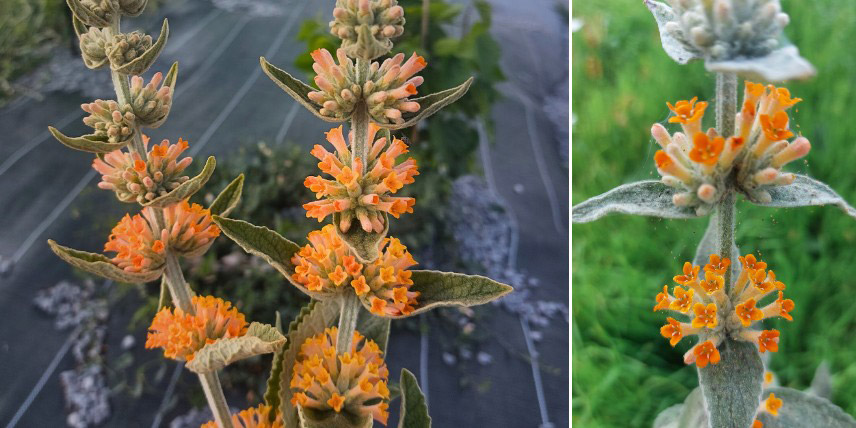
Yet another Buddleja revealing flowering spikes unique in their kind! The Buddleja ‘Orange Sceptre’ stands out from other varieties thanks to its unusually distinctive flowering. It shows a striking arrangement of the flowers. The inflorescences of this shrub are whorled, i.e., arranged in a circle around the stem and set off by two small villous leaves. These small clusters of flowers extend for about 30 cm along the shoots. They open to a pale orange colour, uncommon among Buddlejas. Several ‘tiers’ of flowers follow one another from July to frost, attracting foraging insects that come to feed on their delicate nectar. This Buddleja forms a compact shrub, well suited to small gardens and even to container cultivation, not exceeding 2.40 m in height and 1.20–1.40 m in width. It bears opposite, downy and greyish leaves, deciduous or semi-evergreen depending on the climate.
Hardy to around -10°C, it will thrive in regions with a climate that isn’t too severe. It will add a touch of the exotic to a border with Eucalyptus ‘Baby Blue’ for a contrasting and exotic pairing.
Read also
7 evergreen butterfly bushesThe Buddleia glomerata 'Silver Service'
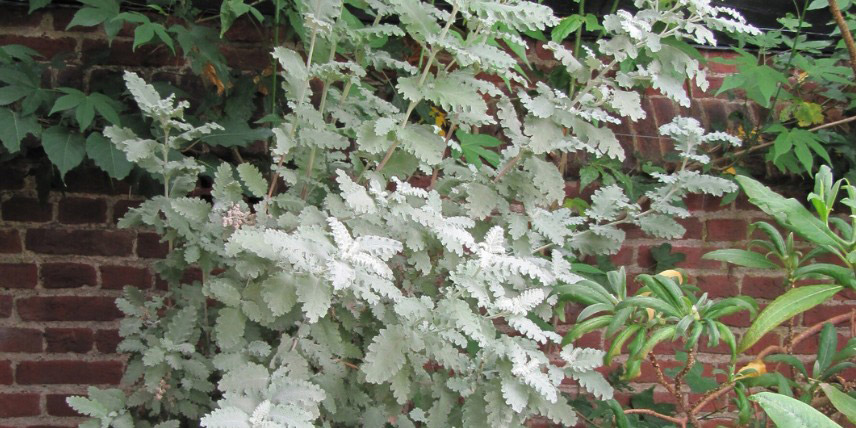
This butterfly bush packs a host of features! Here is a Buddleja cultivar grown mainly for its remarkable foliage. The Buddleja glomerata ‘Silver Service’ is a descendant of a South African evergreen buddleia. Native to semi-arid regions, its foliage is entirely covered with a silvery-white down that gives it a velvety texture and a bright appearance, even in intense sun. This adaptation enables the plant to reflect light, reducing water loss through transpiration—an essential trait for surviving extreme droughts. Its silvery leaves, with a bluish tinge, persist through winter as they age. Their leaves are crimped and slightly lobed, reminiscent of yarrow or oak leaves. The underside of the leaves is covered with fine white hairs, giving a soft texture to the touch. The small melliferous yellow flowers, appearing from June to July, have a velvety appearance reminiscent of mimosa. Each tubular flower, about 1 cm long, exudes a delicate fragrance that attracts pollinators, notably butterflies. Light, yet grouped into dense panicles, they create a striking contrast with the silvery foliage.
This evergreen bush typically reaches a height of 1.5 to 2 metres with a similar width, offering a bushy, dense habit, ideal for a border or a large rock garden. This cultivar is frost-tender and only hardy to -8°C in the ground: outside our mild and sunny regions, spared from heavy frosts, it should be grown in a pot to shelter from the cold in winter. It is a very drought-tolerant variety, ideal for Mediterranean gardens or xerophyte borders. Surround it with companions adapted to arid conditions such as lavenders or Perovskia, for example.
Buddleja macrostachya
Another rarity in the world of butterfly bushes!
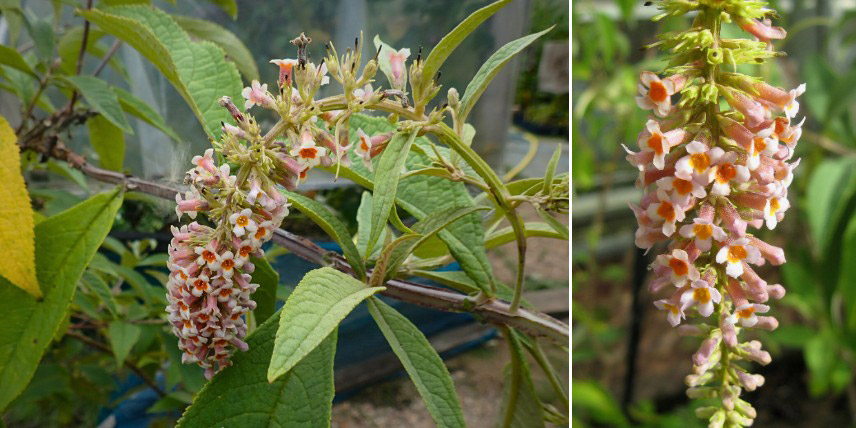
The Buddleja macrostachya is a very ornamental species thanks to its slightly pendulous habit, its very graceful panicles, and its leaves more slender than those of other Buddlejas. At maturity, the shrub stands about 3 m high with a comparable spread. The flowering of Buddleja macrostachya is spectacular. The flowers, grouped into long pendulous panicles, can reach up to 30 cm in length. They are bi-coloured, pale yellow, highlighted by an orange throat. This mix of hues yields a subtle apricot-toned effect. Each tubular flower has four petals, and the stamens protrude slightly from the corolla, adding a delicate texture to the inflorescence as a whole. The flowering is abundant and continues from late spring to summer, sometimes until frost. Very fragrant and melliferous, it attracts a wide range of pollinators, particularly butterflies. This Buddleja also bears long pointed leaves, which can reach up to 25 cm in length. They are dark green on the upper surface and lighter underneath, with a light down.
Like other butterfly bushes, it requires full sun and a soil that is moist to dry, but well-drained. A little frost-tender (-8°C), as with most Buddlejas in this colour selection, it is best grown in a pot in less clement areas and overwintered to protect it from frost. Pair it with the superb flowering of the Achillea millefolium ‘Terracotta’: its warm tones will echo those of our buddleja, and together contribute to the ceaseless ballet of butterflies!
- Subscribe!
- Contents

Comments