





























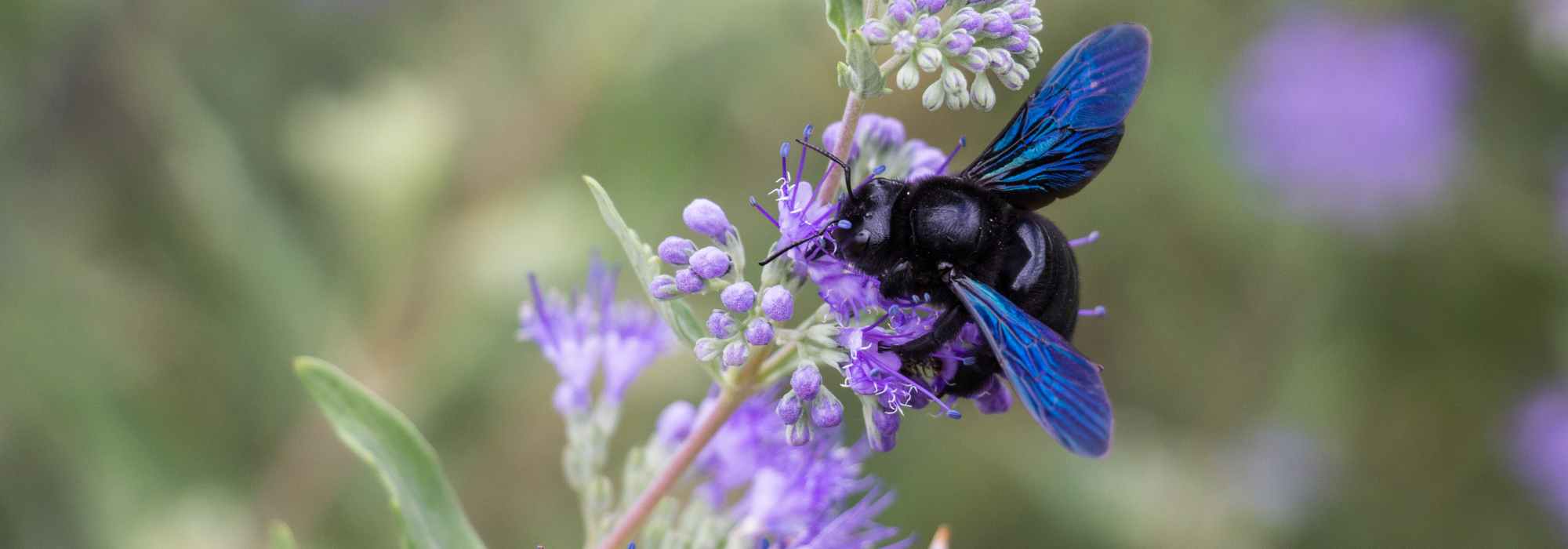
Violet carpenter bee: a gardener's valuable ally
Discover this little-known pollinator
Contents
The violet carpenter bee, or Xylocopa violacea, is among the most intriguing and beneficial pollinators in our gardens and natural ecosystems. Recognisable by its imposing size and its violet metallic sheen in the light, this carpenter bee plays a crucial ecological role. Indeed, a fact little known, but the violet carpenter bee plays an indispensable role in preserving biodiversity and the health of ecosystems. As pollinators, they ensure the reproduction of many plant species, essential for maintaining natural habitats and food production. The genetic diversity of plants, further strengthened by cross-pollination carried out by these bees, is a pillar of ecological resilience, enabling ecosystems to better resist changes and disruptions. Moreover, their nesting activity in dead wood also contributes to the decomposition of wood, a vital ecological process that recycles nutrients and supports a multitude of other life forms.
So let’s quickly discover this friendly and imposing black, buzzing insect!

How can you positively identify Xylocopa violacea?
The violet carpenter bee (Xylocopa violaceae) is one of the largest bee species found in Europe, with an impressive size reaching up to 3 cm in length. Its robust silhouette is immediately recognisable: a bulky body, mainly black, adorned with a faint violet iridescence on the wings, hence its name. This metallic hue is particularly visible in direct sunlight.
Males and females can be differentiated by a few details: females possess denser hair on the thorax and are generally larger than the males. Moreover, the males’ antennae are curved, whereas the females’ are straight.
The violet carpenter bee can be confused with other bee species or insects, but several features help to distinguish it:
- Size and shape: Its large size and robust body distinguish it from honey bees and many other species of wild bees.
- Colour: The violet iridescence of its wings is unique and provides a key visual cue for identification. Most other bees and pollinating insects do not display this feature.
- Behaviour: The violet carpenter bee is solitary. It does not live in colonies like honey bees. Its nesting method, which involves drilling into wood, is also a good clue for recognising it.
- Flight sound: Its hum is deeper and lower than that of other bees (you could swear you’re hearing an old twin-engined aircraft…), which can aid in identifying it by ear even before you spot it.
Oli’s note: the genus Xylocopa, better known as carpenter bees or wood-borers, comprises a variety of species notable for their imposing size and singular ability to bore into wood to establish their nest. These solitary bees, widespread across many regions of the world, are characterised by their robust bodies, often black or with metallic reflections, and by their powerful and sonorous flight. Despite their intimidating appearance, carpenter bees play a crucial ecological role as efficient pollinators for many plant species. Their nesting behaviour, which involves reusing and reshaping dead wood or hollow stems, also makes them important players in natural habitat management. By encouraging carpenter bees in gardens and green spaces, biodiversity is promoted.
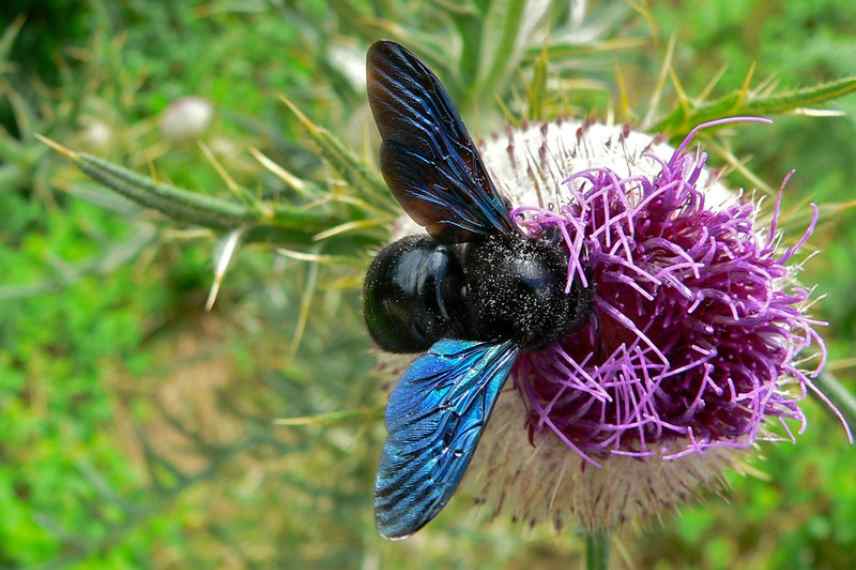
Xylocopa violacea (© Bernard Dupont)
Habitat and life cycle
The violet carpenter bee is widely distributed across Europe, Western Asia and North Africa. This species prefers temperate to warm climates, where conditions are favourable to an abundance of flowers. It is found in gardens, meadows, hedgerows and near forests, especially where dead wood or untreated wooden structures offer opportunities for nesting. Sunny regions with diverse and rich vegetation attract these bees in particular, which require suitable areas for nest-building to reproduce.
Detailed life cycle
The life cycle of the violet carpenter bee begins with the egg-laying in galleries drilled into wood. The female carefully selects a nest site, often in dead wood or in large enough plant stems, where she can work away from predators.
- 1. Egg-laying: After mating in spring, the female prepares each cell of the nest by placing an egg, together with a supply of pollen and nectar. This mixture serves as food for the larvae upon hatching.
- 2. Larval development: The eggs hatch into larvae, which feed on the stored provisions until they reach their maximum size. This larval stage may last several weeks, or even months, depending on climatic conditions and the availability of food.
- 3. Pupation: Once the larval growth is complete, the larva transforms into a pupa. This transitional stage is crucial: the pupa gradually metamorphoses into the adult bee.
- 4. Emergence of adults: The young carpenter bees emerge from the nest in spring (sometimes even at the end of winter) or in early summer, ready to feed, to pollinate and to continue the life cycle.
The violet carpenter bee nest
- Nest location: Violet carpenter bees favour establishing their nests in dead wood or untreated wooden structures, such as tree stumps or exposed beams.
- Nest appearance: Violet carpenter bee nests are characterised by circular holes about 8 to 10 mm in diameter, clearly cut into the wood. These entrances lead to galleries where the bees lay their eggs. By contrast, pest infestations, such as termites or house longhorn beetles, show more extensive wood decay and irregularly sized holes.
- Impact on the wood: Although violet carpenter bees drill into wood for nesting, they generally do not cause significant structural damage, unlike wood-boring pests, which can considerably weaken the structure of the infested timber.
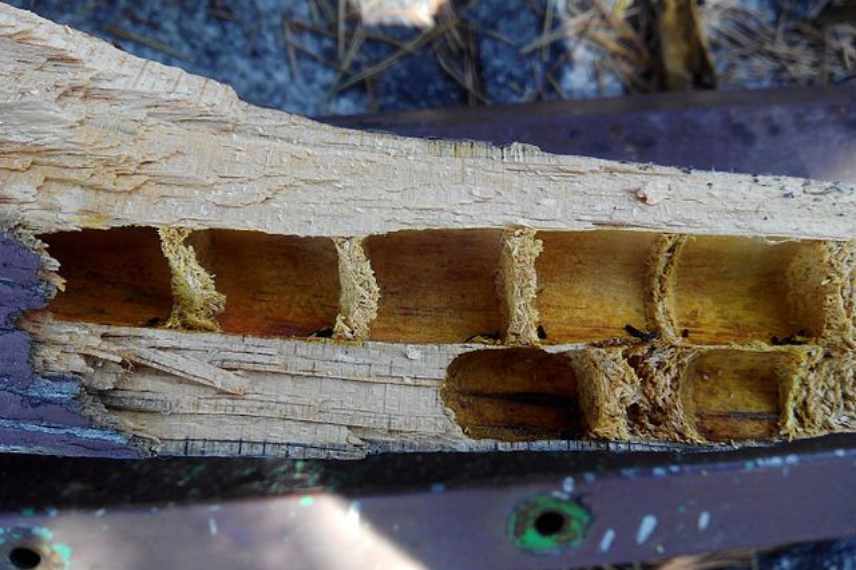
Nids de xylocopes accueillant les larves (© Wikimedia Commons- Wikiguadia)
The violet carpenter bee’s favourite plants
The violet carpenter bees have a marked preference for flowers rich in nectar, particularly those that offer easy access to this precious resource, such as the legume family (Fabaceae) or the mint family (Lamiaceae). Among their favourite plants, the following include:
- Wildflowers, such as lupins, lavenders and centaureas, which attract violet carpenter bees with their vibrant colours and abundant nectar, but also the Lathyrus latifolius, the common viper’s-bugloss, purple clover or the spotted lamium.
- Flowering shrubs, such as lilacs, Colutea, or Wisteria, provide not only food but also potential nesting sites.
- The flowers of fruit trees, such as cherry trees, apple trees and plum trees, are visited by violet carpenter bees, greatly contributing to pollination.
- Very early spring blooms, especially willows, are crucial for the first carpenter bees emerging at this time.
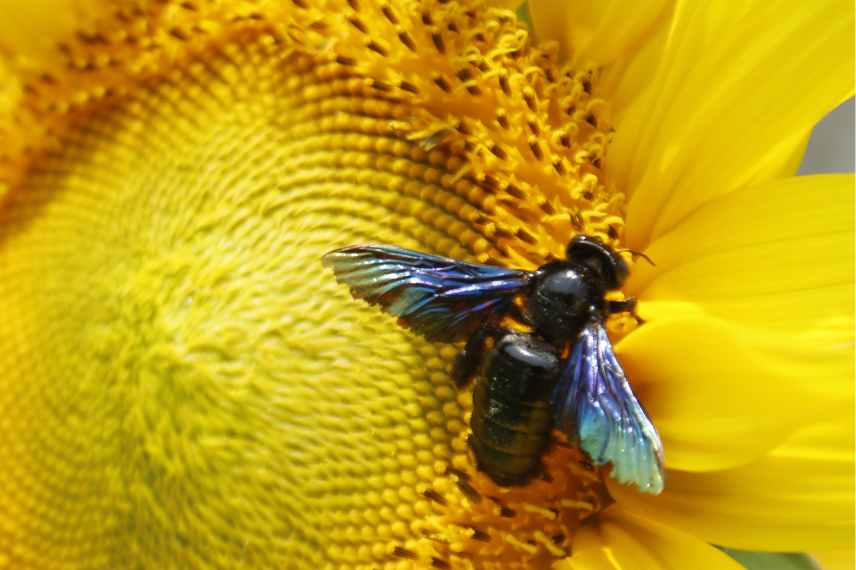
The large landing platform and the sunflower’s colour also attract violet carpenter bees
Ecological roles of carpenter bees
The violet carpenter bees are effective pollinators, and their activity significantly contributes to plant reproduction. By visiting flowers to feed on nectar and collect pollen, these bees enable pollen transfer from one flower to another, thus facilitating fertilisation and the production of fruits and seeds. The role of the violet carpenter bees in pollination directly supports the genetic diversity of plants and their ability to adapt to changing environments. Moreover, many plant species depend specifically on pollinating insects for their reproduction.
The interaction of the violet carpenter bee with plants is not limited to pollination. By choosing certain plant species to feed on and others to nest in, these bees influence the composition and structure of natural habitats and gardens. Their preference for digging nests in dead wood or hollow stems also contributes to the decomposition of wood, a key ecological process that recycles nutrients and promotes soil health.
Finally, violet carpenter bees also interact with other insect species, notably by sharing food resources and habitats. These interactions can be competitive or symbiotic, but they all play a role in ecological balance. Moreover, by serving as prey for certain predators, the violet carpenter bees contribute to the food chain and to the biodiversity of ecosystems.
In summary, the violet carpenter bee can be considered a useful garden and crop insect, especially for fruit crops.
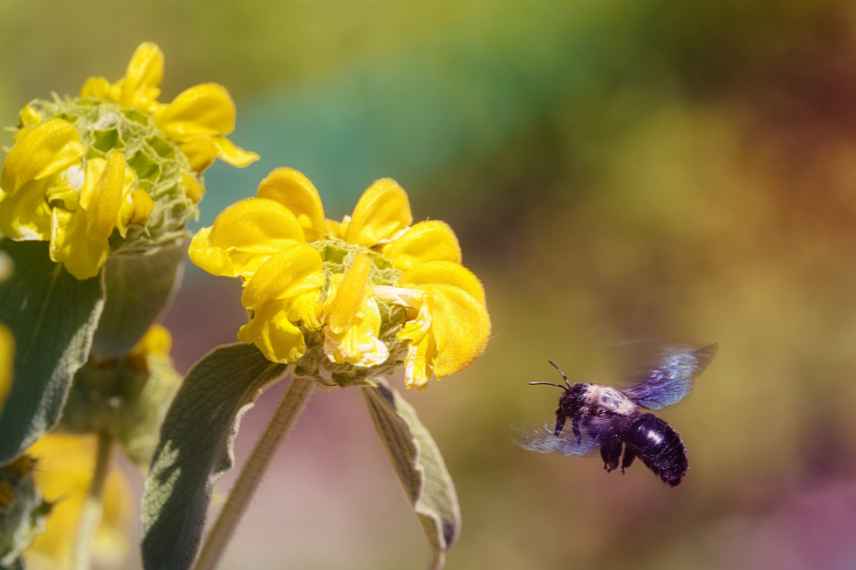
The violet carpenter bee, an insect playing a major role in the biodiversity of gardens and spaces
Read also
Flowers that attract beesHow to attract violet carpenter bees to your garden?
The choice of plants is fundamental to attracting violet carpenter bees, which are particularly drawn to flowers rich in nectar and pollen. Prioritise the following:
- Blue- or purple-flowering plants: The violet carpenter bee is particularly attracted to these colours. Plants such as lavender, cornflower, or Common sage provide an abundant food source.
- Flowering shrubs and fruit trees: species such as lilac, wisteria, cherry trees, apple trees, and plum trees provide not only nectar but also spaces conducive to nesting or roosting.
- Native plants: favouring local species contributes to the overall health of your garden and ensures a food source suited to the needs of native carpenter bees in your region. Discover native species and their cultivars (nativars) within our online nursery.
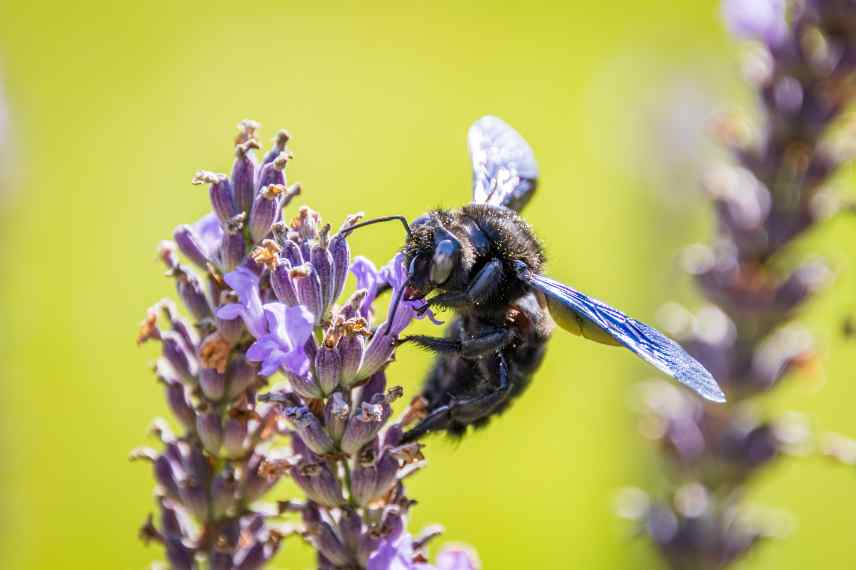
A violet carpenter bee on a lavender spike
Nesting-friendly arrangements
Violet carpenter bees prefer to dig their nests in dead wood or hollow stems. To encourage them to settle in your garden:
- Preserve areas with dead wood: if possible, leave stumps or dead branches in your garden. They will serve not only as nesting sites but also as refuges for other species.
- Install insect hotels: although violet carpenter bees are capable of digging their own nest, providing insect hotels with blocks of wood drilled with holes of different diameters can make their task easier and encourage them to stay in your garden.
- Use hollow stems or bamboo: place these materials in bundles or in structures that can keep them upright, creating ideal nesting spaces.
→ All you need to know to build an insect hotel on your land
Are Xylocopes dangerous to humans and pets?
No! Although the violet carpenter bee is imposing in size and with its loud buzz (“boo, the big beast!”), it is actually fairly docile and poses no danger to humans. Females have a sting, but they sting only if they are handled aggressively or feel threatened. Stings are rare and, unless there is a specific allergy, less painful than those of other bees.
In any case, carpenter bees play a crucial role in our ecosystems as pollinators. Rather than fear these carpenter bees, it is beneficial to promote their presence in our gardens to support biodiversity.
Is the Xylocope or carpenter bee endangered?
To date, the violet carpenter bee is not listed as an endangered species on the IUCN Red List (International Union for Conservation of Nature). However, that does not mean it is safe from threats. Habitat destruction, pesticidal use and land-use change are all factors that can reduce violet carpenter bee populations by limiting their food sources and nesting sites.
In some regions, climate warming may have prolonged flowering seasons or made habitats previously too cold for the violet carpenter bee available. These changes could favour an expansion of the species’ range and an increase in its population in these areas. But conversely, climate change can also make some habitats currently occupied by the violet carpenter bee unsuitable, either by higher temperatures beyond their tolerance threshold, or by changes in precipitation, making habitats too dry or too wet for their nesting. Moreover, climate changes can disrupt the synchronisation between plant flowering periods and the activity of violet carpenter bees, thereby affecting their ability to feed and reproduce. In short, the topic is complex!
- Subscribe!
- Contents
Comments