


Walnut tree: how to choose the right variety?
Our tips for making the right choice with our buying guide
Contents
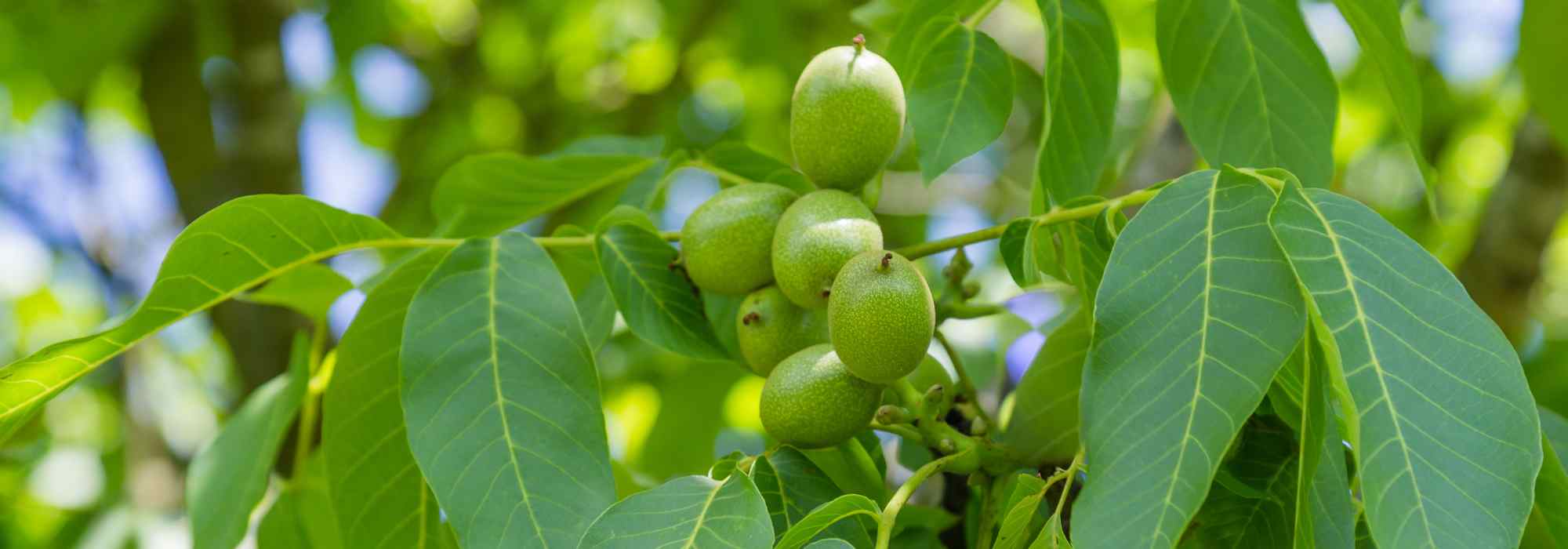
The walnut tree is a fruit tree cultivated for its shell fruits: walnuts. In France, this terroir-rich fruit is grown mainly in Dauphiné and in the Périgord. There are two protected designations of origin: the famous Grenoble walnuts and those from the Périgord. Most walnut varieties originate from Juglans regia or the common walnut. They mainly differ in the size and flavour of the walnuts, the onset of fruiting, the harvest period, the yield and the tree’s habit. Vigorous and hardy (−25°C), although susceptible to spring frosts, the walnut thrives in a sunny, not-too-windy site, in deep, well-drained soil. With this buying guide, follow all our advice to choose a walnut tree according to your criteria and expectations!

Depending on walnut size
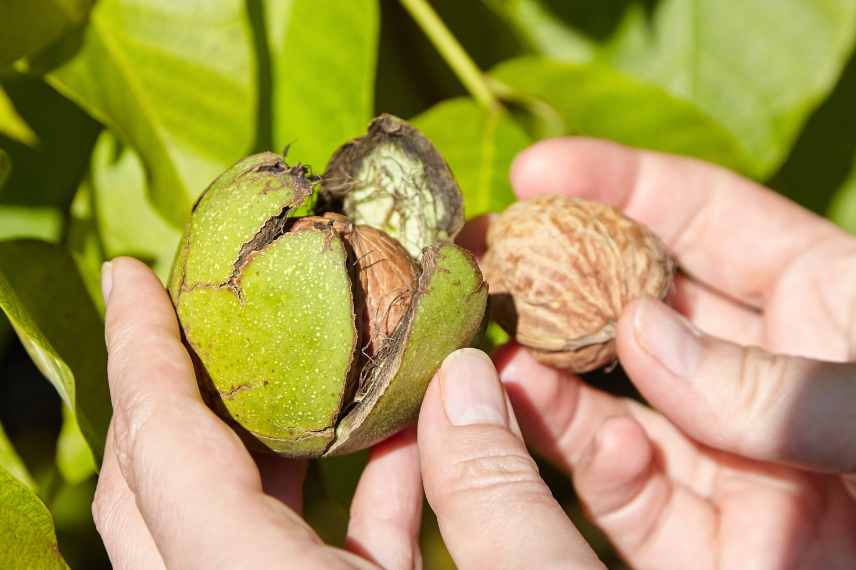
Walnut size can form part of your selection criteria, as it varies considerably from one variety to another.
- The Juglans regia ‘Parisienne’ is a large-calibre walnut variety, exceeding 32 mm, which makes it interesting for both fresh and dried walnuts.
- The Juglans regia ‘Mayette’ is an old walnut variety that produces large, almost round walnuts measuring 3–4 cm long and 3 cm in diameter.
- The Juglans regia ‘Purpurea’ is a not widely grown cultivar that yields very small walnuts 2 cm in diameter with a hard shell, as good dried as fresh.
- The Juglans regia is the type species that yields well-sized, ovate walnuts with a soft shell.
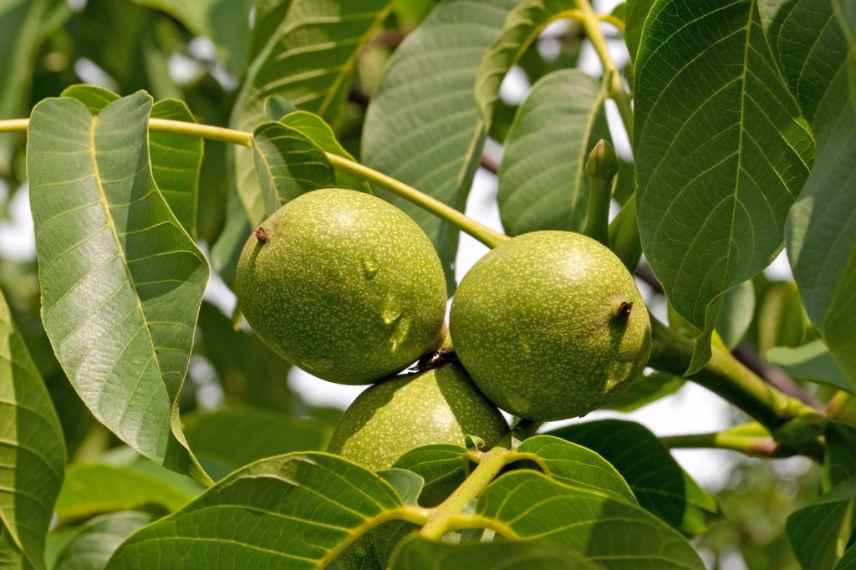
Juglans regia ‘Mayette’
Based on the flavour of the walnuts and the quality of the tree rings
The different varieties of walnuts resemble one another, although there are subtle differences related to the texture of their kernels, as well as to their flavour.
- The Juglans regia ‘Corne’, or ‘Corne du Périgord’ yields blond kernels, very tasty, but difficult to extract, with a fine texture, a sweet and sugary flavour, with subtly fragrant aromas.
- The Juglans regia ‘Purpurea’ yields kernels of excellent flavour with a fine, sweet and delicious texture.
- The Juglans regia ‘Franquette’ offers large kernels with a delicate, mild and not very sweet aroma, delicious both fresh and dried. Its nuts are among the Grenoble walnuts AOP varieties.
- The Juglans regia ‘Parisienne’ yields tasty nuts that split easily, to be enjoyed dried or fresh.
- The Juglans regia ‘Esterhazy II‘, produces kernels with a thin skin, with a fine texture and a sweet flavour, with hazelnut aromas.
- The Juglans regia ‘Mayette’ delights us with kernels, pale blond, tasty and easy to extract, with a fine, sweet and delicious texture.
- The Juglans regia ‘Fernor’ yields elongated nuts containing very pale blond kernels of excellent flavour. Their flavour is mild and slightly sweet.
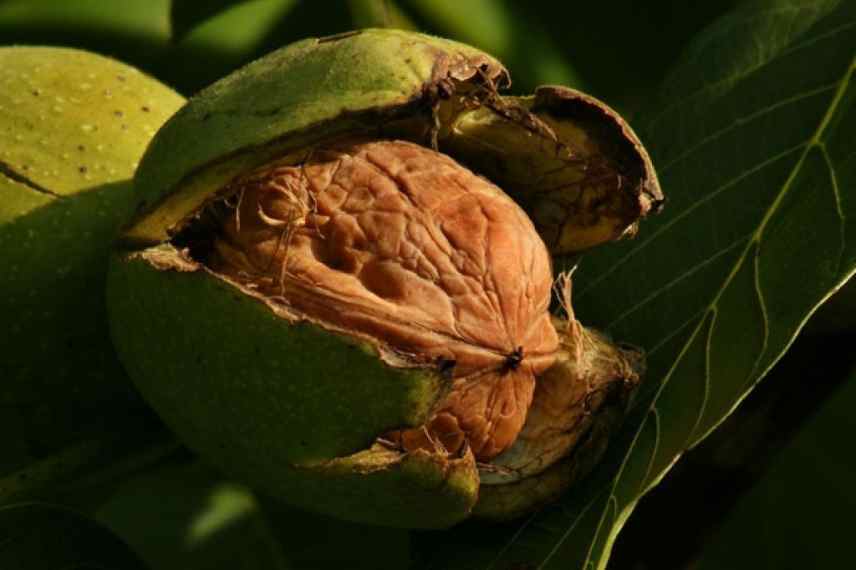 Juglans regia ‘Franquette’
Depending on fruit set
The walnut tree requires a long establishment before it starts to produce walnuts, between 15 and 25 years, around fifteen years on average for most varieties before your first harvest. By contrast, production can continue up to around 70 years old. There are, however, varieties with quicker fruiting that bear walnuts only 4 to 5 years after planting! Among the varieties that fruit quickly:
- The Juglans regia ‘Fernor’ produces fairly quickly, around six to seven years for its first harvest.
- The Juglans regia ‘Franquette’ begins to bear walnuts from around its fifth year.
- The Juglans regia ‘Weinsberg 1’ is a walnut with very rapid fruiting between 3 and 5 years.
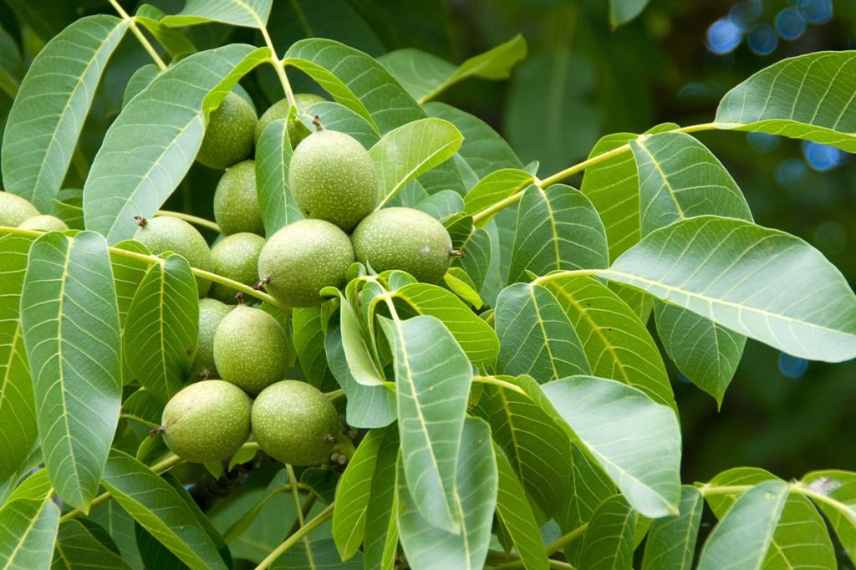
Juglans regia ‘Weinsberg 1’
Read also
Harvest and store walnutsBased on its yield
Walnut yield may also vary between species. Typically, good walnut trees yield between 30 and 160 kg of walnuts per year, however, as this fruit tree is prone to alternate bearing, production can be irregular in some years. Some varieties are self-fertile; they can be grown on their own, but yield will be much better with other walnut trees nearby. Pollination will be optimised if a pollinator variety is planted nearby(‘Ronde de Montignac’, ‘Meylannaise’, ‘Fernette’…), which involves choosing another walnut tree with a matching flowering period and compatible pollen. Among high-yielding varieties, you can choose:
- The walnut Corne du Périgord walnut is certainly the highest-yielding.
- The Juglans regia ‘Esterhazy II’ is a walnut with high yield, and with abundant and regular fruiting.
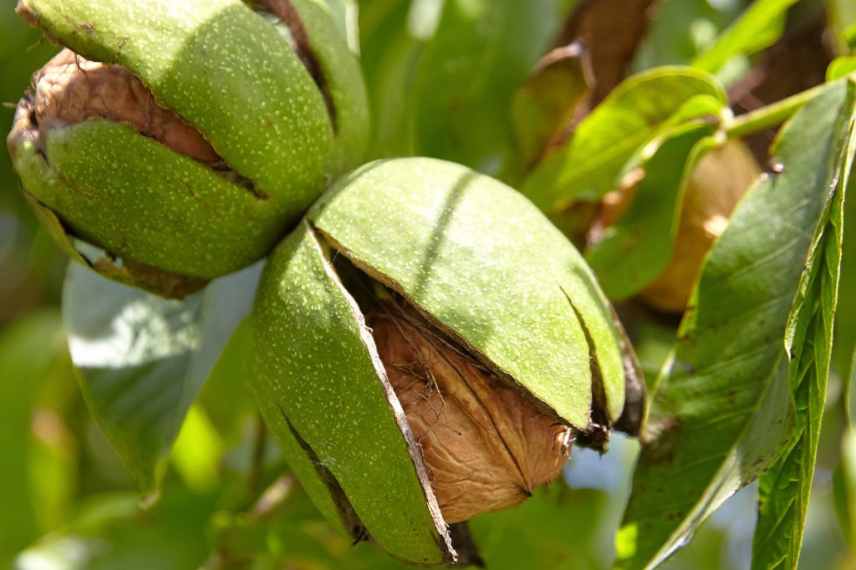
Juglans regia ‘Corne du Périgord’
Depending on the harvest period
After summer, the hull bursts, releasing the walnut and causing it to fall to the ground. The walnut harvest varies from year to year, region to region and variety to variety, over a relatively short period, from mid-September to the end of October, or even into November. It ripens earlier or later depending on the varieties.
The walnut harvest from the varieties ‘Fernor’,‘Franquette’, ‘Mayette’, ‘Parisienne’ is late and takes place around mid-October. The Juglans regia ‘Weinsberg 1’ yields its walnuts a little earlier, from mid-September.
According to its heigh
Walnut trees are vigorous, large trees that can reach 10 to 20 metres in height, with a spread of 9 to 18 metres at maturity. Allow sufficient space for the tree to develop as it matures, and choose a variety suited to the size of your garden. They grow to around 10 metres in height in 20 years. Very long‑lived, they can live for more than 200 years. Some varieties stand out for their more modest dimensions, well suited to small gardens. Among them:
- The Juglans regia ‘Purpurea’, a variety with purple foliage that will not exceed 4 to 5 metres in height, for about 3 metres in diameter at maturity.
- The Juglans regia ‘Corne’, has a medium size, 6 to 8 metres in height, and 5 to 7 metres in diameter.
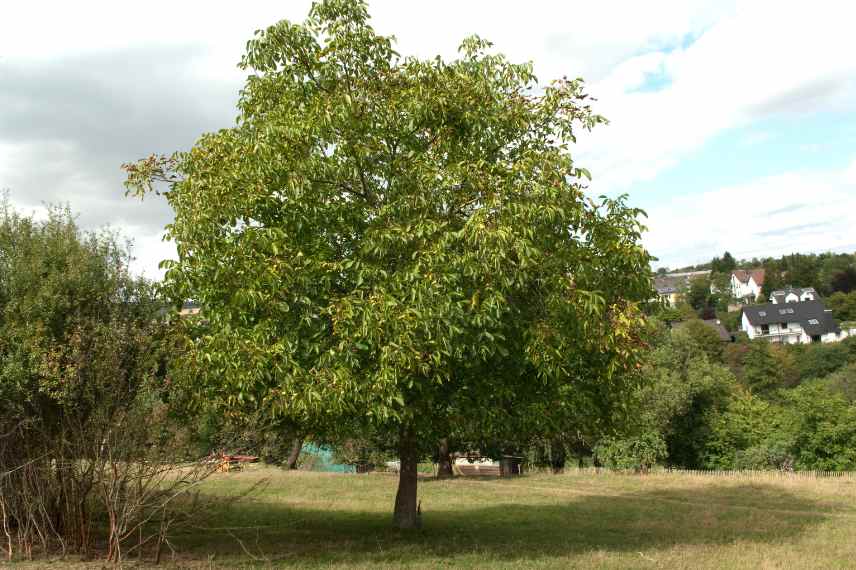
The walnut, a stately tree (here the representative species, Juglans regia)
Depending on its flowering
Despite its excellent hardiness (-25°C), the walnut fears spring frosts that risk damaging its flowering and its young shoots, thereby limiting its fruiting. In the regions north of the Loire, there are varieties with a later flowering that escape spring frosts.
- The Juglans regia ‘Corne’ flowers from late April to mid-May, which generally keeps it safe from frosts.
- The Juglans regia ‘Fernor’ is another walnut variety notable for its relatively late flowering, in May, which protects it from spring frosts.
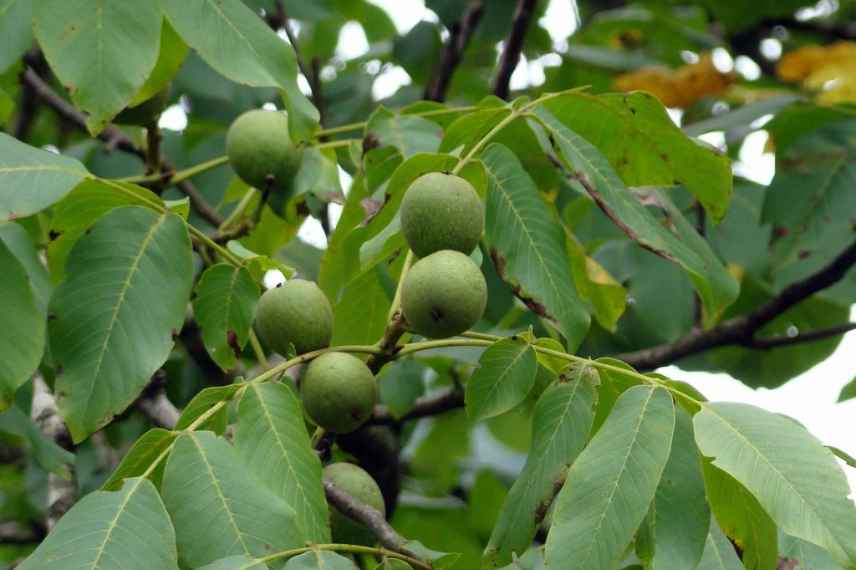
Juglans regia ‘Fernor’
- Subscribe!
- Contents

Comments