





























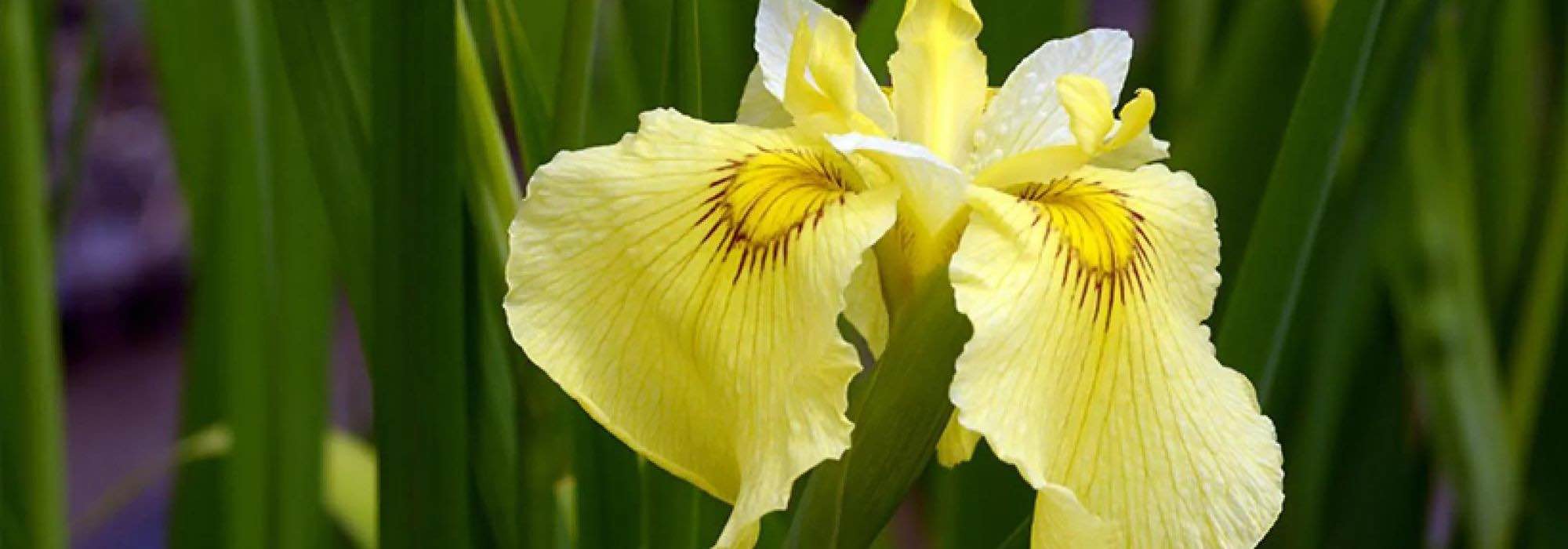
Top 5 yellow-flowered water irises
Joyful and elegant flowers
Contents
Yellow-flowered water irises are semi-aquatic perennial plants that thrive in damp areas and along pond banks. These irises are characterised by their vibrant flowers that stand out against dense green foliage in a water garden. Adapted to a range of climates and soil conditions, these hardy irises require little maintenance once established and can be planted in full sun or partial shade. Discover five yellow-flowered water irises to help you choose the variety best suited to your environment.

Marsh iris - Iris pseudacorus
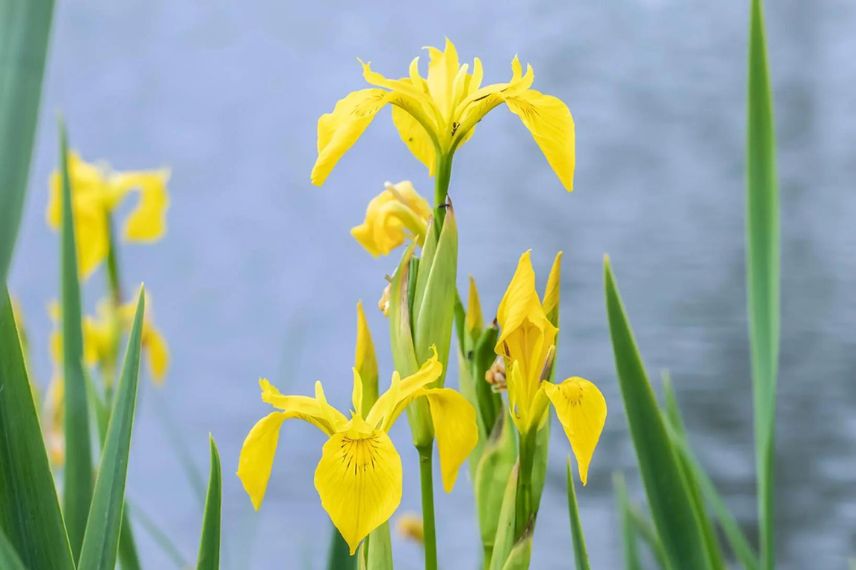
Iris pseudacorus, commonly known as marsh iris, is an iconic species of wetlands, where it naturally thrives in ditches and along the banks of standing water. With its spectacular flowering in vibrant golden hues, this iris captures the eye in spring under the sun’s rays, rising to up to a metre in height, and sometimes more.
This semi-aquatic rhizomatous perennial has green, glabrous, slender and narrow leaves that persist year-round, ending in a point. The flowers, in vibrant golden-yellow, are arranged in clusters of two or three at the tops of flowering stems, mainly from April to early July. This iris is found in many parts of Europe and up to the borders of Asia, as well as around the Mediterranean basin where it blends into natural landscapes.
Perfectly suited to gardens with a water feature, Iris pseudacorus is not only an aesthetic choice with its bright, decorative flowers, but also an ecological ally thanks to its ability to stabilise banks and its contribution to the phyto-purification of aquatic environments.
Its robustness and great adaptability make it ideal for a range of settings, from full sun to partial shade. It is often paired with plants such as reeds or cattails for a natural, wild effect. This plant thrives along the edge of a pond, permanently submerged or only for part of the year.
Marsh iris - Iris pseudacorus var. bastardii
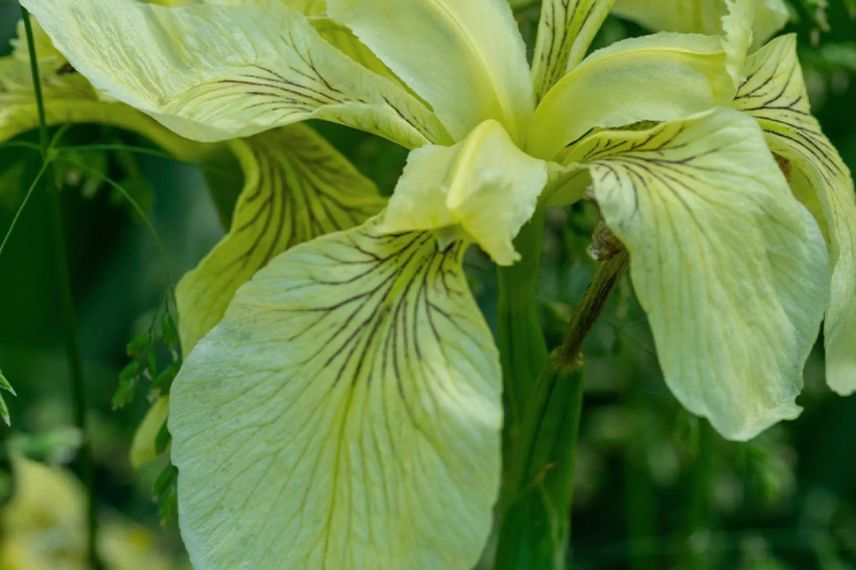
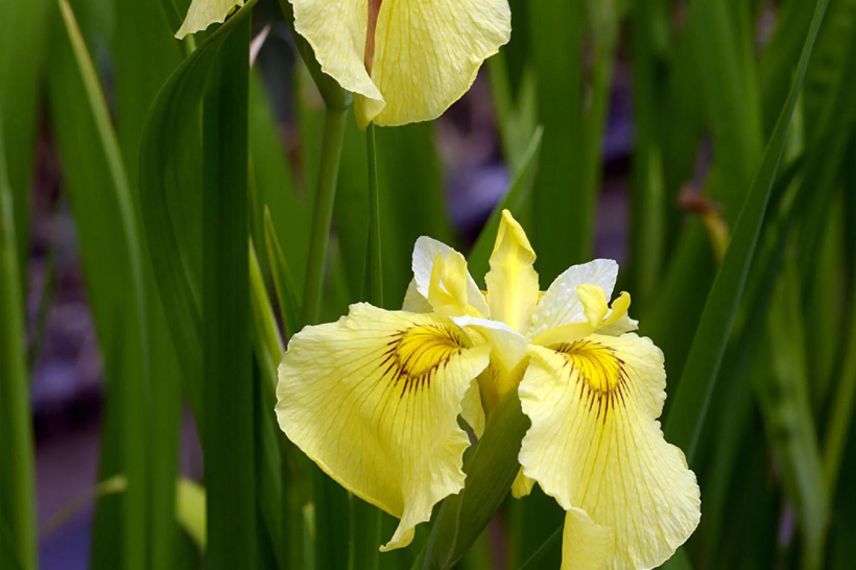
Iris pseudacorus var bastardii is a form of marsh iris distinguished by its pale-yellow flowering, which is less showy than the type species. This variety bears butter-yellow flowers delicately veined with brown at the centre, with romantic softness. Adapted to moist habitats, it thrives along the water’s edge where it can be partially submerged or planted at a pond border, exposed to sun or to partial shade.
This hardy iris belongs to the Iridaceae family and is widespread across Europe and to Asia’s doorstep, including Mediterranean regions. It develops green, smooth and pointed leaves, evergreen in winter, and reaches a height of 80 cm, up to 1.2 m. Flowering from June to August, it has no limit to spreading and pairs well with plants such as Hostas and Astilbes for structured displays.
Marsh iris - Iris pseudacorus 'Plena'
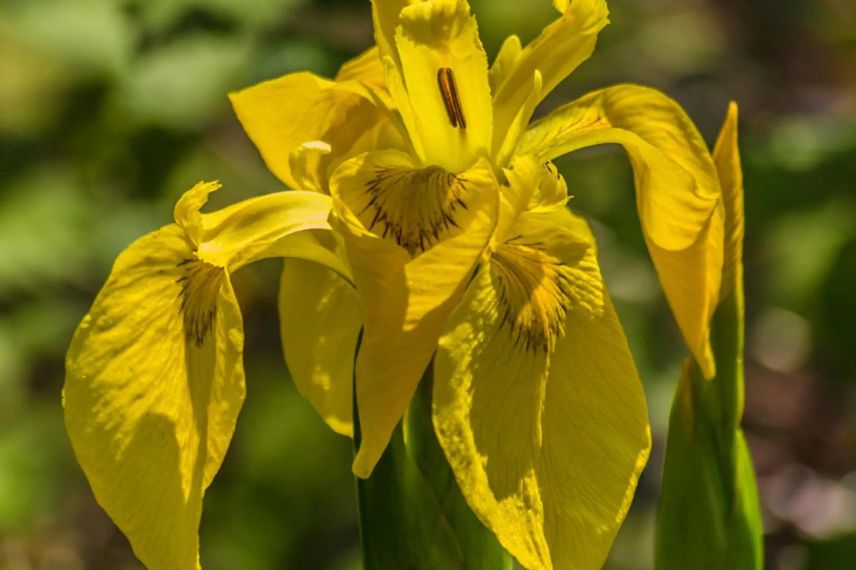
The Iris pseudacorus ‘Plena’ is characterised by its unique double flower, appearing to enclose a second flower within the first. This feature gives it a distinctive beauty with a golden-yellow colour, bringing brightness and elegance to any aquatic garden. Ideally grown along a pond edge, this iris appreciates sunny or partially shaded exposures with the base slightly submerged.
The green, smooth and slender leaves of the Iris pseudacorus ‘Plena’ persist through winter and withstand harsh conditions. It reaches a height of 60 to 80 cm and can spread up to 1 m. This plant brightens the banks with clumps of two to three vibrant flowers that appear between June and August.
In addition to its aesthetic qualities, the Iris pseudacorus ‘Plena’ has the same ecological characteristics as the type species. It blends harmoniously with Aruncus and Ligularias to diversify the layout of your garden’s wet zones.
Read also
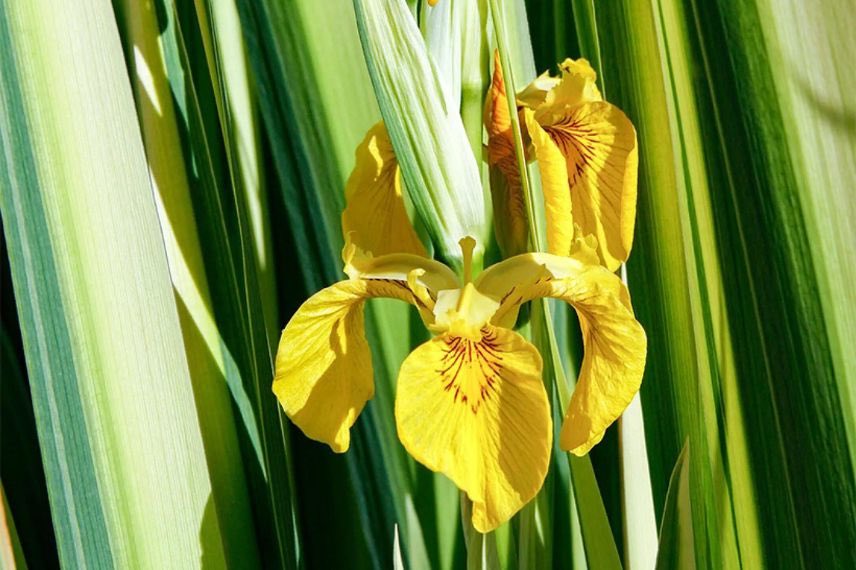
How to plant and care for water irises?Marsh iris - Iris pseudacorus ‘Variegata’
Latest Marsh Iris variety in this selection, the Iris pseudacorus ‘Variegata’ stands out for its unique variegated foliage with cream-white stripes, bringing exceptional brightness to the banks of water features. This particular cultivar provides a striking visual contrast in summer, when its bright golden-yellow flowers, marked by a brown-maculated throat, emerge, arranged in threes at the top of sturdy stems. This cultivar has been recognised by the Royal Horticultural Society with an Award of Garden Merit.
This plant reaches a height of up to one metre, with evergreen, slender, narrow leaves that retain their decorative appeal year-round. The presence of broad white stripes on the dark green foliage not only catches the light but also draws attention.
Suitable for bank edges or damp ditches, this iris thrives in exposures from full sun to partial shade. It is often used in combination with other water-loving plants such as Marsh poplar or Caltha palustris. Its good hardiness and ability to adapt to various aquatic environments make it ideal for ecological gardens aiming to stabilise soils and enhance wetlands.
In addition to its ornamental role, Iris pseudacorus ‘Variegata’ is also recognised for its ecological contribution in stabilising banks and improving water quality. It also provides essential habitat for local wildlife, thereby enhancing biodiversity of aquatic gardens.
Japanese iris - Iris 'Aichi-no-Kagayaki'
The first successful hybrid between Iris ensata and Iris pseudacorus, the Iris ‘Aichi-no-Kagayaki’ is called Iris x pseudata. Its large yellow flowers are absent from the usual cultivars of Japanese irises. It offers a pale yellow flowering, arising from upright, slender, light-green foliage. The flowers, characterised by rounded petals that are slightly undulated and droop gently, present an appearance that is both elegant and delicate.
With a height of up to 90 cm, this iris forms dense tufts of long leaves. It is suitable for both aquatic conditions and traditional damp gardens.
In terms of planting, this iris can be submerged to a maximum depth of 20 cm. Despite its vigour, it is important to note that the Iris ensata Aichi-no-Kagayaki is sterile, which means it will not spread in waterways unlike the Iris pseudacorus, thereby ensuring ecological control while enhancing the space.
Its pale green foliage, combined with its bright flowers that attract pollinators, makes it a valuable addition to any garden, especially when mixed with Anemone rivularis,Darmera peltata or lysimachias.
- Subscribe!
- Contents
Comments