





























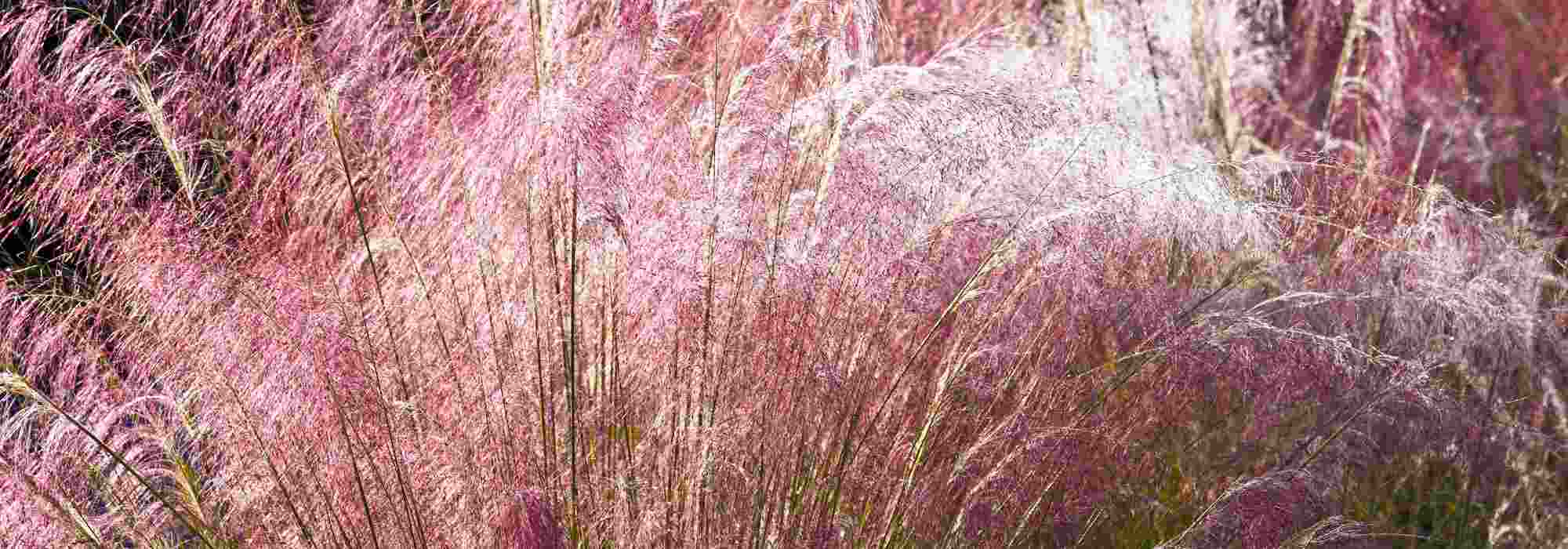
Which grasses grow in calcareous soil?
Complete guide to choosing grasses for your garden
Contents
With their wild, carefree look, grasses are unrivalled for enlivening the garden through the seasons. Boasting a wide range of ornamental species, grasses offer a broad palette of sizes and leaf colours that range from green to blue-green to golden. All feature discreet flowers, grouped in spikes or plumes, with reproductive organs enclosed by an envelope and lacking petals. Easy to plant and maintain, the graphic, airy foliage of grasses makes an impact in borders, edging and rock gardens… in all soil types, including calcareous soils. Discover the best varieties of grasses that thrive in calcareous soil and all our tips for successful cultivation.

Characteristics of calcareous soil
Having calcareous soil may, at first glance, somewhat unsettle an amateur gardener. However, beyond the drawbacks inherent to this type of soil, calcareous soil can perfectly accommodate a wide variety of plants, among which grasses.
With a pH above 7, calcareous soil is a stony and rocky, even chalky, soil that dries out very quickly in summer. These are soils that can be recognisable by their very light, almost whitish colour. Calcareous soil is, moreover, very well-drained and well-aerated; it does not retain water. This characteristic is an advantage, in the sense that the soil is well suited to plants that fear standing moisture or that are frost-tender. By contrast, although calcareous soil drains well, nutrients leach away just as water does. Calcareous soil is therefore fairly poor in minerals. They will therefore need watering and enrichment with organic matter fairly regularly.
By contrast, calcareous soil warms up more quickly than other types of soil.
The most beautiful grasses suited to calcareous soil
Some grasses can thrive on calcareous soil that is fairly dry and poor, yet well-drained. And with a wide range of species and varieties available, it is relatively easy to make an informed choice and to vary colours, shapes and heights.
Stipa
Stipa are ideal grasses for calcareous soils in that they tolerate harsh, dry, stony and poor conditions, provided they are well-drained. However, Stipa particularly dislikes stagnant moisture, especially in winter. A calcareous soil is therefore a perfect site for the various Stipa species. It will also require a fairly sunny position.
Stipa also have the capacity to withstand salt spray, winds, heat and drought, and temperatures down to -15 to -20 °C. In other words, they are ideal candidates for calcareous soil.
It is possible to plant several Stipa species:
- Stipa tenuifolia: this grass adapts to the most challenging conditions without batting an eyelid. It forms a small tuft with very fine, fountain-like foliage and long, soft spike inflorescences.
- Stipa gigantea: this Stipa species is remarkable for its tall habit and golden inflorescences in winter.
- Stipa barbata: a very pretty species with very fine foliage and inflorescences in the form of brush-like silver-white spikes.
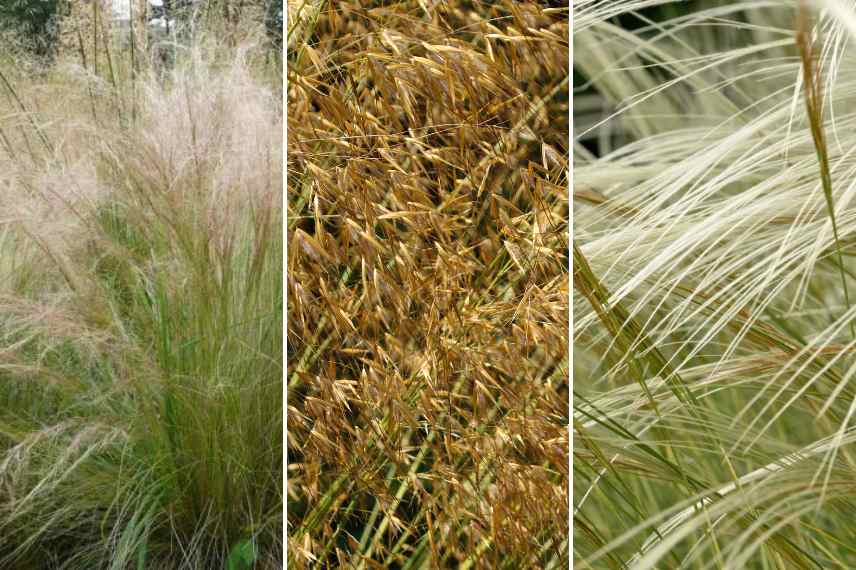
Three Stipa species suited to calcareous soil
Pennisetum
Pennisetum are also grasses that prefer light, dry and well-drained soils. They are also resistant to salt spray and marine winds. They are not at all troubled by calcareous soils. As there are nearly 80 different species, you have plenty of choice. Three species stand out:
-
- Pennisetum alopecuroides: This is the most common species of Pennisetum, hardy to -20 to -25 °C, of medium height. It is notable for its bottle-brush-like panicles in late summer.
- Pennisetum incomptum: ideal on a slope, this grass presents a very wild look, but can be somewhat invasive.
- Pennisetum macrourum: moderately hardy (down to -10 °C), this grass is very drought-tolerant.
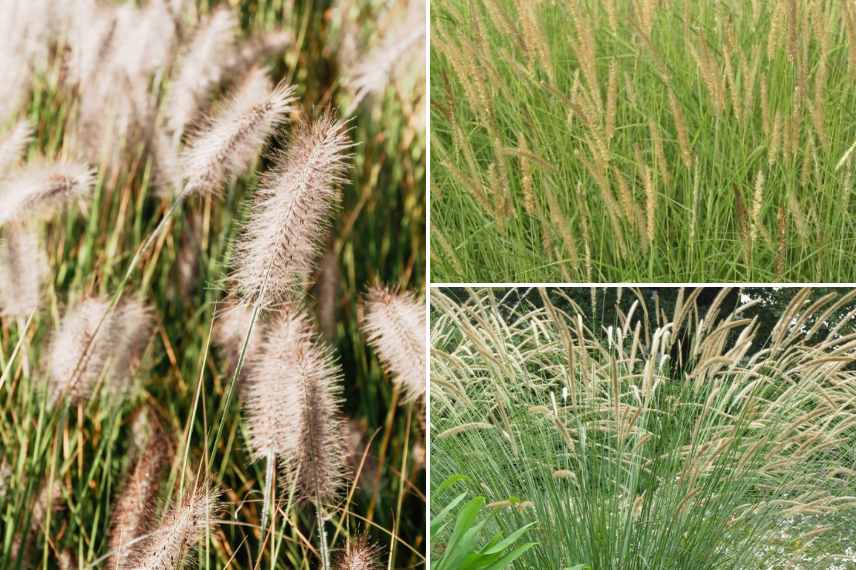
Three Pennisetum for calcareous soils
Fescues
Fescues are classic grasses for dry soil par excellence, which is why they thrive in calcareous, stony and rocky soils of rockeries and slopes. And among the best suited, one can cite Festuca glauca or blue fescue, with foliage that is really dense and fine, showing different shades of blue depending on the variety. The foliage of the variety ‘Golden Toupee’ becomes straw-yellow in winter.
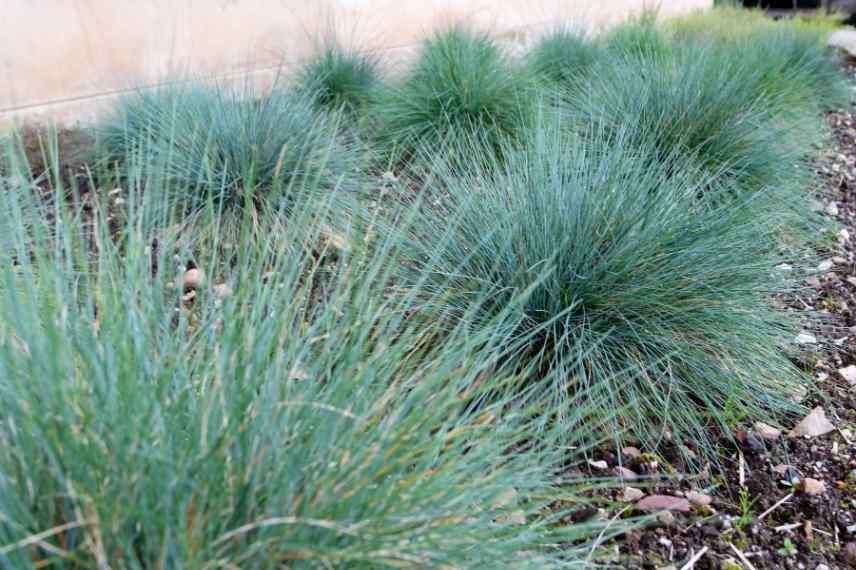
Blue fescue thrives in calcareous soils
As for Garnier’s fescue (Festuca gautieri), it forms a neat, dense cushion of emerald green that makes an excellent ground cover in poor soil.
Other less common grasses
- Schizachyrium, or broom grasses, are characterised by a very dense tuft of fine, upright foliage that shifts from green to blue-tinged, to display magnificent autumn colours. This grass prefers dry, poor soils and full sun. A rich, heavy soil can be fatal to it.
- Eragrostis, or love grasses, are notable for a very airy, often coloured flowering that lasts throughout summer and autumn. They thrive in calcareous, neutral or even acidic soils.
- The Arrhenatherum bulbosum ‘Variegatum’ or bulbous oatgrass stands out for its blue-green foliage edged with white.
- Briza, or love grasses, are charming grasses, notable for their graceful flowering in heart-shaped spikelets that move with the slightest breeze.
- Sporolobus, or pearl grasses, are grasses perfectly suited to very calcareous, rocky and saline soils. These grasses are highly ornamental with their extremely fine foliage
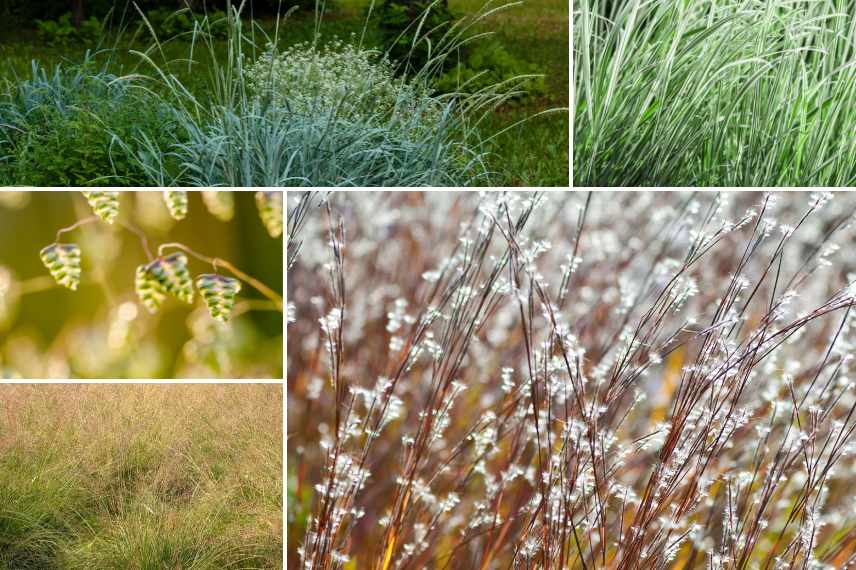
- Leymus arenarius, or blue wheat, is very attractive with its blue-silver foliage and ears similar to wheat.
- Helictotrichon sempervirens, or evergreen oat grass: a grass with metallic blue evergreen foliage that dislikes heavy, damp soils.
- Sesleria can adapt to slightly calcareous soil. They form small tufts with narrow, persistent foliage and slender plume-like inflorescences.
How to plant and grow these grasses?
Grasses are generally easy to plant and maintain. They are undemanding and require little upkeep, but look attractive all year round.
Planting
To plant grasses in chalky soil, whether in a border, a rock garden, or a planting bed, you should:
- Moisten the rootball in a bucket of water
- Dig a hole twice as large as the rootball
- Remove stones
- Add some compost to the bottom of the hole
- Mix a little compost with the excavated soil to enrich the soil, improve its structure and aid water retention
- Place your grass in the hole, the collar at soil level
- Backfill the hole with the excavated soil
- Water thoroughly and mulch with a mulch made from fallen leaves, RCW and wood chips…
Care
In the weeks following planting, regular watering is necessary to help the grasses establish themselves. Thereafter, rainfall will be sufficient.
Care essentially involves pruning the foliage, either in late winter or at the very start of spring. Evergreen grasses should be brushed from the top down to remove dead or damaged leaves. As for deciduous grasses, they should be cut back in late winter with a sharp pruning shear or a sharp pair of shears. Indeed, these clumps of dry foliage are often very beautiful in winter when covered with frost. In addition, they provide refuge for many small insects and can offer some seeds for birds.
When the clump no longer forms shoots, it will be time to divide your grasses. This clump division is usually carried out in February–March.
How to combine grasses in calcareous soil?
In calcareous soil, ornamental grasses can form the backdrop of a border or a rock garden. They will certainly be paired with calcicolous plants that thrive in calcareous soils. Thus, the lavender, the yarrow, the spurges, the pinks (Dianthus) (Dianthus), the centaureas, the acanthuses, the shrubby sages, the Santolina… are perennials that thrive in calcareous soils. With their colourful flowering and vertical habit, they make good companions for grasses. For autumn flowering, also consider asters that tolerate calcareous soils.
Roses also form a winning pairing with grasses. But in calcareous soil you must choose a rose grafted onto Rosa canina, which is fairly lime-tolerant. Without this precaution, your rose will soon suffer from chlorosis.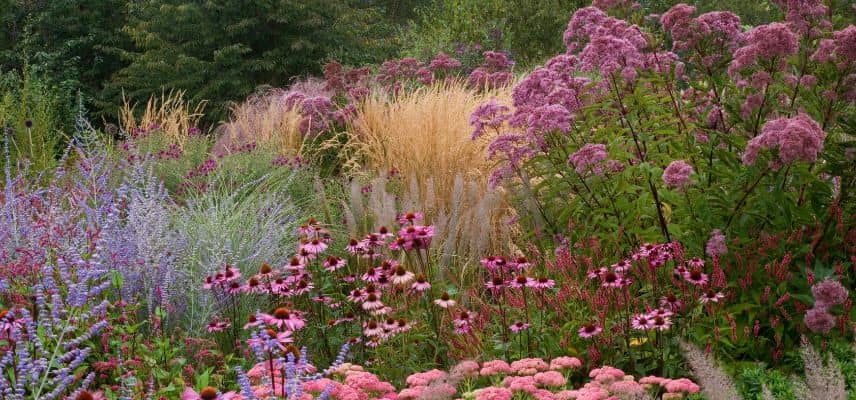
With their handsome size, ornamental grasses can also mingle with a few shrubs such as Buddleja (butterfly bush), Lavatera or Perovskia, which tolerate calcareous soils. Or Ceanothus or Mexican orange blossom if your soil is not overly calcareous.
Finally, remember to pair bulbs with grasses to provide colour year-round. Generally, most bulbs tolerate all soil types, provided they are well-drained. You can therefore plant Anemones, Muscari (grape hyacinths), ornamental Alliums, Scilla (squill), Crocus… for spring flowering, Ornithogalum (star of Bethlehem) or garden irises for summer flowering.
- Subscribe!
- Contents
Comments