


What to plant at the base of climbing plants in pots?
Our guide to choosing companion plants for your climbing balcony or terrace plants
Contents
When you observe a pot in which a climbing plant thrives, you are easily tempted to add another plant to fill the pot, as often the climbing plant does not fill the base and only a trunk or stems exist at this level. It’s a good idea, provided you meet certain essential criteria to ensure this pairing grows in the best possible way. At that moment, a gardener can be unsure about which choice to make.
In this article we outline the rules to follow for adding a plant at the base of a climbing plant in a pot or tub, as well as tips for selecting plants for this purpose.

Why mulch around the base of climbing plants?
A climbing plant in a pot grows upwards from the pot, either on a support system or by itself. Some climbing plants have a dense, lush foliage at the base, but most have a bare base, with the starting point of stems or a trunk.
It is then worthwhile to plant another plant at the base for several reasons:
- Improve aesthetics: take the opportunity to form a pleasing pairing and not leave the base bare.
- Avoid drying out the substrate: it’s always better not to leave substrate exposed to air, uncovered. It dries out more quickly. In this case, two options: plant a groundcover or mulch the base of the plant.
- Optimise space: if you have a small balcony or terrace, planting several plants in the same pot helps maximise the space available for plants, taking advantage of different foliage, colours and potential flowering.
However, you must observe several conditions to pair plants favourably in the same container. Discover our tips!
Which climbing plants should you grow in pots?
First, note that growing a climber in a pot makes it more dependent on care than if it is planted in the ground. Most climbers are vigorous: for a pot to provide the conditions they need for growth, it generally requires regular watering and fertiliser applications to support their flowering. Which climbing plants are ideal for pot growing?
In full sun
- Passionflowers : They are grown in a well-drained, light substrate and have fairly low water requirements.
- annuals : Ipomoeas, Sweet peas, Nasturtiums, Thunbergia, are good choices for their vigour and floribundity, even though they last only one season. They are often easy to sow directly in place, for a modest price.
- Bougainvillea : relatively undemanding, they do, however, have higher watering needs in pots.
- climbing roses : they add a romantic touch to pot spaces. They favour a substrate rich in organic matter, well drained. Regular watering is essential, avoiding waterlogging. For pot planting, choose varieties with compact growth.
- Bougainvillea : This climber is famous for its coloured bracts and heat tolerance. Bougainvillea needs regular watering, especially during hot seasons.
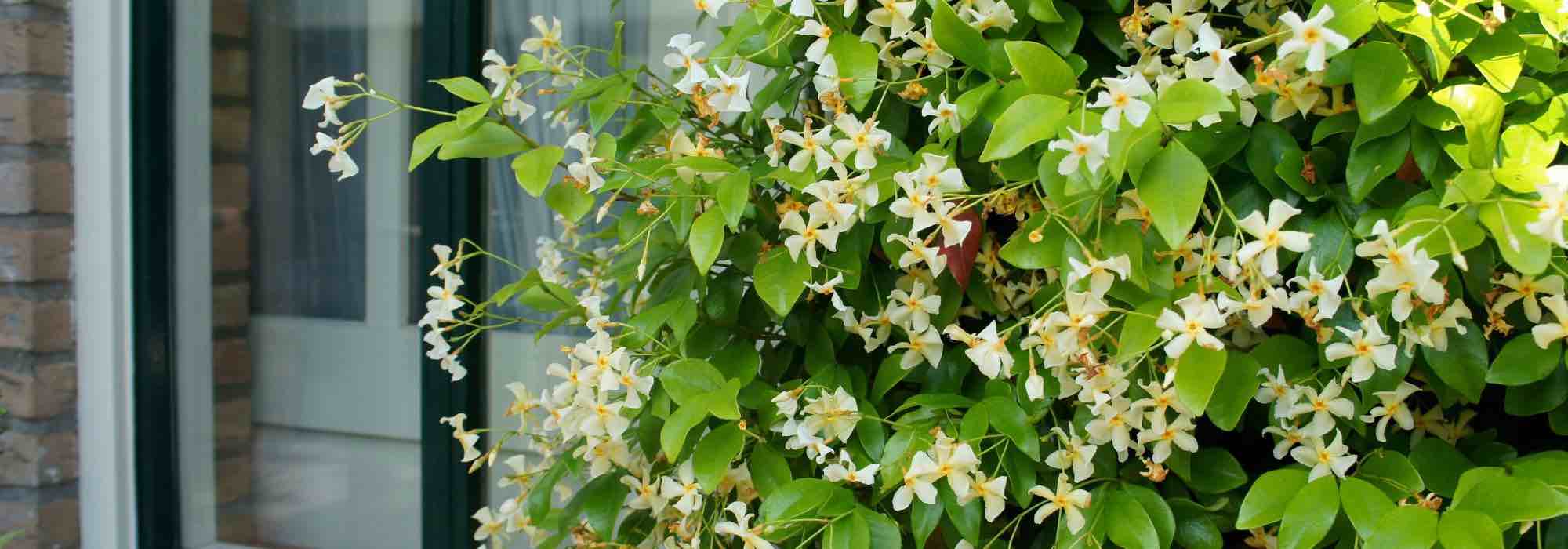
- Solanum : Also known as Jasmine nightshade, this climber produces white star-shaped flowers. It is not very hardy (to around -5°C): a pot planting allows overwintering if needed.
- Wisterias : Wisterias are very vigorous; choose the most compact varieties, reaching a maximum height of 4–5 m. Not fussy about soil, they enjoy a sunny position, sheltered from cold winds.
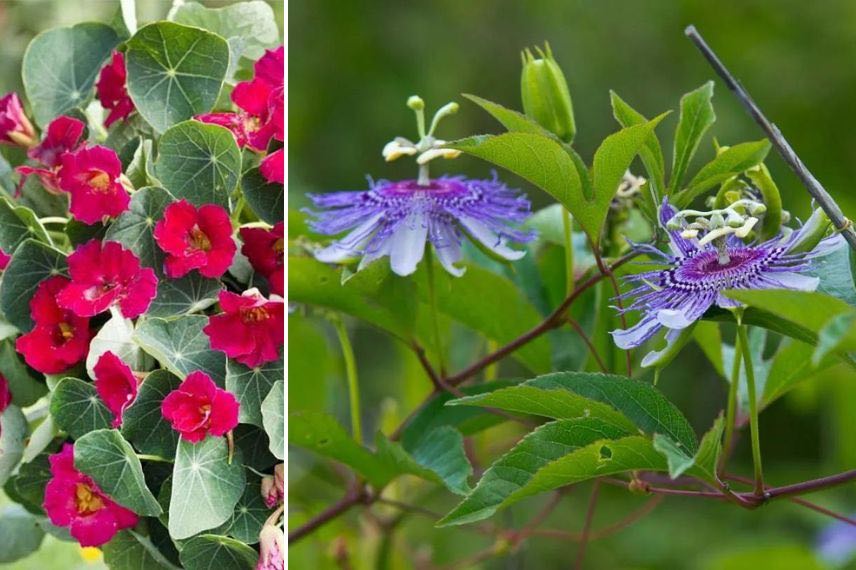
A dwarf nasturtium, ‘Baby Rose’, and a passionflower enjoy full sun
In partial shade or sun that isn’t scorching
- Clematis for pots : these are the small-growing types. These climbing plants are prized for their beautiful flowers in a variety of colours and for their diversity. They prefer a sunny or partly shaded position and a well-drained substrate. Clematis have medium water requirements. They like having their feet in shade and their head in the sun. It is therefore ideal to add a groundcover to achieve this.
- Honeysuckles : These are fragrant climbers with attractive flowers. They thrive in sun or partial shade and require fertile, well-drained soil. These plants need regular watering, especially during dry periods.
- Star jasmines or Trachelospermum : A highly scented jasmine. It prefers sunny or lightly shaded spots and well-drained soil. Moderate watering is sufficient for this plant.
- Akebia : It provides attractive foliage and a pretty bloom. Akebia needs rich, well-drained substrate that stays cool, even moist. It appreciates a semi-shaded position, for example east-facing, though it is tolerant of its exposure.
In shaded areas
- Ivy : it tolerates all exposures, though it is not wise to plant it in scorching sun, as it prefers cool conditions.
→ Read Marion’s article to discover more climbing plants to grow in pots on a north-facing balcony.
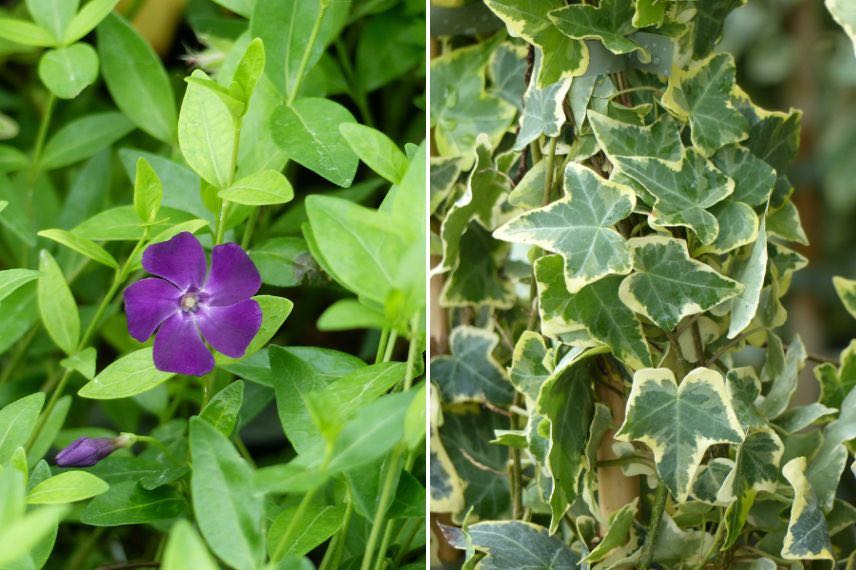
The purple-flowered periwinkle, Vinca minor ‘Atropurpurea’, and variegated ivy ‘Goldchild’, two vigorous plants for partial shade or shade
Considerations when selecting companion plants
The first rule for decorating a pot with a climbing plant by pairing it with another plant is to consider the cultivation conditions of the two plants and to choose plants with similar needs. But there are also other criteria to consider to ensure the success of a plant combination in a pot.
They are listed below, in order of importance:
The plants’ needs
- Exposure: Ensure that the plants chosen for the base of the pot have light needs similar to those of the climbing plant.
- Climate conditions: Beyond sun or shade, also check other aspects: should your plant be sheltered from wind, can it withstand sea spray, is it frost-tender?
- Substrate and nutrients: Most plants prefer a well-drained substrate. However, some plants do not like an overly rich substrate, take care not to plant a groundcover in poor soil with a flowering climbing plant that has high fertiliser needs.
- Water: Some plants require more water than others. It is crucial to select plants with compatible water needs to avoid over-watering or underwatering.
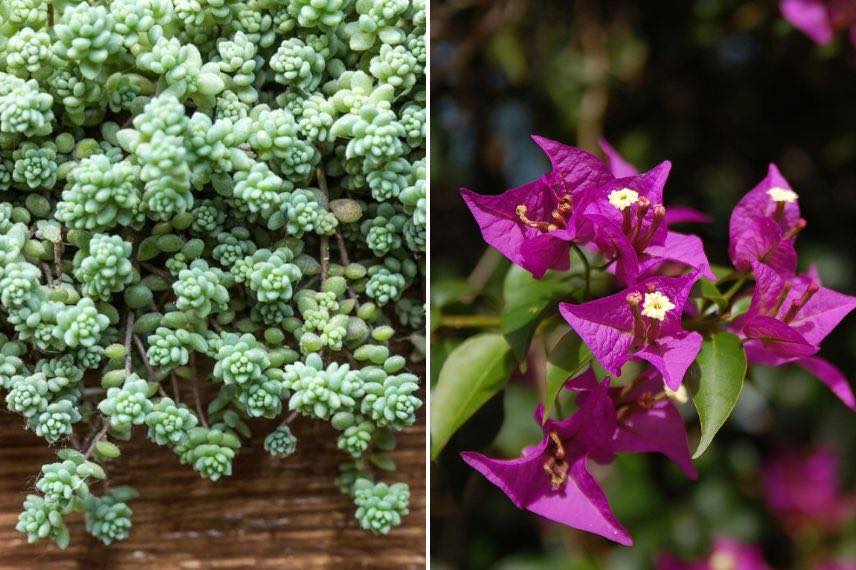
Sedum dasyphyllum and Bougainvillea are both sun-loving plants that thrive in well-drained soil
Pruning and space, root system
- Ensure that the chosen plants do not compete with the climbing plant for space, especially if the pot is small.
- Low-growing plants are generally preferable to avoid shading or hindering the climbing plant’s growth.
- Avoid plants with invasive roots, as they could hinder the growth of the climbing plant. Avoid for example so-called suckering or running plants.
Aesthetics and flowering period, foliage persistence
- Take into account the colour, shape and texture of the plants. Select plants that visually complement the climbing plant to create a harmonious overall effect.
- Do not overlook the aesthetic qualities of the foliage, often overlooked. But if you choose a flowering plant, ask yourself whether you want its flowering to coincide with the climber’s flowering or to be offset for a longer flowering period.
- Also check whether the chosen plants have evergreen foliage in winter or not. Do not choose only evergreen-leaved plants, you would miss out on many interesting species.
Beneficial interactions
- Some plants can have beneficial properties for others. For example, plants that repel certain pests or attract beneficial insects can be an excellent choice.
Resistance to diseases and pests
- To prevent the spread of diseases or pests from one plant to another, choose resistant plants or, above all, plants that do not attract the same pests or develop the same fungal diseases:
Maintenance
- Consider the level of maintenance required for all selected plants. If you prefer to spend as little time as possible, avoid plants that require regular pruning or other specific care.
A change of scenery!
- If you plan to rotate plants seasonally, choose plants that can be easily replaced without disturbing the climbing plant.
What to plant at the base of climbers?
Here are the types of plants to consider for planting at the base of climbers:
-
Groundcover perennials:
They are naturally suited to cover the surface of the pot, without hindering the climber. Choose relatively undemanding ones for well-drained soil.
- For full sun, think of low-growing sedums, delospermas, armeria, Aster alpinus, Erigeron karvinskianus, to hardy geraniums of type Geranium cinereum, sanguineum, renardii, and low-growing yarrow such as Achillea tomentosa or crithmifolia.
- In semi-shade, consider Alchemilla, Brunnera, Bergenia, Epimedium, hardy geraniums, Heuchera, to name a few.
-
Grasses :
The short ornamental grasses make a very interesting choice (Stipa, Carex, Festuca, Ophiopogon).
-
Bulbs :
Spring-flowering, summer-flowering or autumn-flowering, they are additional decorative elements, ideally planted as a low groundcover. They are chosen for their flowering. Most prefer well-drained potting medium, sun and partial shade. Just avoid the more demanding ones.
-
Annuals :
Low-growing, flowering annuals are also options to consider, before being replaced by other plants for the next season. Examples include French marigolds, Bacopa, Bidens, Lobelia, Californian poppy seeds…
Some example pairings
- A low nasturtium, ‘Baby Rose’, which does not exceed 30 cm in height, as groundcover for a full-sun climber such as Bougainvillea. Or a taller nasturtium, which we let cascade rather than climb. If your climber is aphid-prone, there is a good chance they will feast on the nasturtium, which they love.
- The periwinkle at the base of ivy. A robust plant to match the periwinkle at the base of ivy, and vice versa. Both enjoy partial shade and a moist soil.
- A Delosperma or a Sedum dasyphyllum at the base of sun-loving climbers such as Bougainvillea, under similar cultivation conditions. The grey foliage of Sedum pairs well with the fuchsia flowering Bougainvillea.
- In partial shade, for its small round foliage, a Muehlenbeckia complexa that we let cascade, at the base of the Akebia’s delicate foliage.
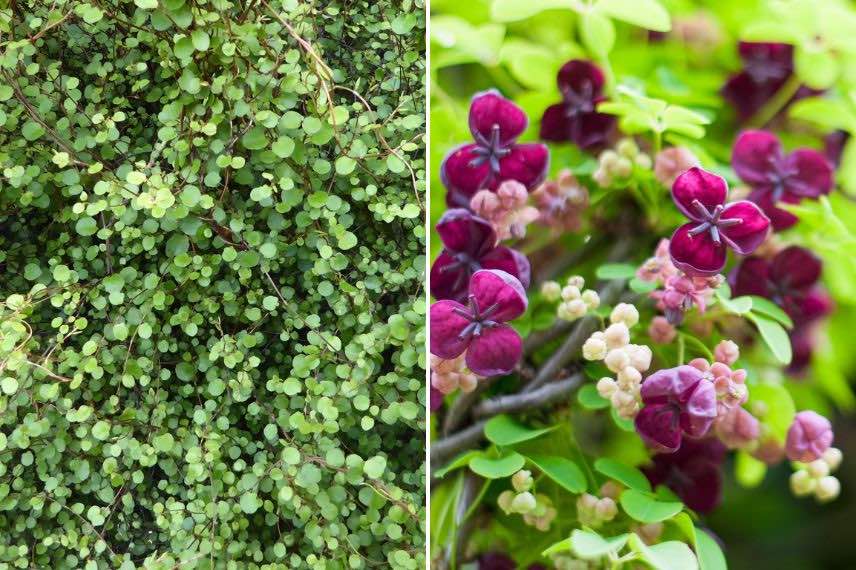
The compact foliage of Muehlenbeckia complexa and the pretty Akebia both enjoy freshness and an east-facing position
How to plant?
Here are planting tips:
- Ideal time to plant: Spring is generally the best time to plant new low-growing potted plants, when temperatures are mild and plant growth is active.
- Pot preparation: make sure the pot or container is large enough to accommodate climbing plants and their companions. Add a drainage layer at the bottom to prevent waterlogging. If you are only adding the groundcover, remove the top few centimetres of potting mix and dig a hole without damaging the climbing plant’s roots.
- Planting: place the climbing plants in the centre of the pot and the other companion plants around them. Fill with a mix suitable for your plants.
- Watering: follow the specific water requirements of each plant and ensure water does not stagnate in the pot.
- Subscribe!
- Contents
Comments