





























Which shrubs to plant along a wall or low wall?
Our tips and selection for easily greening a wall without damaging it
Contents
Greening a garden wall or low wall with shrubs has several advantages. The first benefit is aesthetic: concrete, brick, or block walls are not always very attractive and can be difficult to integrate into the landscape. Growing plants can make them warmer and more natural.
The presence of bushes along a wall also acts as a thermal insulator. Plants reduce heat projection in summer, providing shade and ambient cooling through the evapotranspiration of their foliage. Additionally, they can offer a barrier against cold and humidity in winter. For these bushes, the presence of a wall serves as protection, allowing them to be less exposed to wind or heavy rain.
Finally, planting bushes will help promote biodiversity by providing shelter, and sometimes even cover, for local wildlife.
So, to easily dress up a party wall, retaining wall, or fence, a gable wall, or the facade of a house without damaging them, follow our tips.

The various factors to consider before greening your wall
The aim is to dress a wall, a gable end of a house, or a façade without causing damage. To achieve this, several elements need to be considered in advance.
The nature of the wall
If it is a private wall, you will have more freedom than with a party wall or a communal wall. If the wall does not belong to you, it will be necessary to consult the owner in advance of the planting project to obtain a written agreement if possible.
Also ensure the stability and solidity of the wall and its foundations before embarking on planting shrubs nearby.
Finally, take into account the elements that are associated with or installed on the wall, so that the future plants do not damage them: gutters, TV antennas, etc.
The choice of plants
The first criterion to consider is the growing conditions. This includes the type of soil (heavy, poor, chalky…), the climate (frequency and intensity of frosts, humidity, drought…), but also the exposure of your wall (sunny, shaded…). Be sure to observe the cast shadow, which can impact the available light for your plants. If your wall has an overhanging roof, also consider the reduced access to rainwater when choosing your shrubs.
Opt for robust plants that are known to be less sensitive to pests and diseases. Growing in a restricted area can indeed favour these issues, and maintenance will be more challenging near a wall.
We recommend selecting several shrubs from different families or species, to avoid creating a monochrome wall that gives the impression of a green concrete. If you want a flowering wall for extended periods, choose shrubs with staggered flowering to enjoy them for as long as possible. For year-round coverage and to avoid having to collect autumn leaves, opt for evergreen foliage. Deciduous foliage can, however, be particularly decorative: it’s up to you to choose according to your goals and preferences!
Consider the dimensions at maturity of the chosen shrubs (size and spread). Planting at the foot of a wall implies a more limited space, whether in spread or depth. A small stone wall may only accommodate low shrubs or even young plants. Conversely, a façade can be enhanced with larger specimens. Also think about calculating the necessary planting distances for the proper growth of each shrub, based on their spread at maturity.
Avoid shrubs with overly vigorous and running root systems, which can damage the foundations of the wall or low wall and ultimately cause it to shift or even fall. The presence of ducts must also be taken into account. Forget about invasive sumac, running bamboos, sea buckthorn that suckers a lot (especially in sandy soil), and fig trees with their sprawling root systems. Also avoid shrubs whose stumps take up a lot of space over time, like spireas, which also produce numerous suckers.
Read also
What to plant at the foot of a wall?Our selection of bushes for sunny walls and low walls
Walls that receive sunlight for long hours during the day are generally south or south-west facing. They store a lot of heat and redistribute it at the end of the day. The chosen bushes should not be too thirsty, or you risk having to water them too frequently. They should therefore be quite tolerant of drought and heat.
Mediterranean shrubs, for example, will be good candidates, but other plants will also thrive under these growing conditions.
Choose from:
- the Helichrysum;
- the lavender;
- the cistus;
- the Perovskia;
- the oleander;
- the cordyline;
- the Yucca;
- the gorse;
- the broom;
- the rosemary;
- the sage;
- the strawberry tree;
- etc.
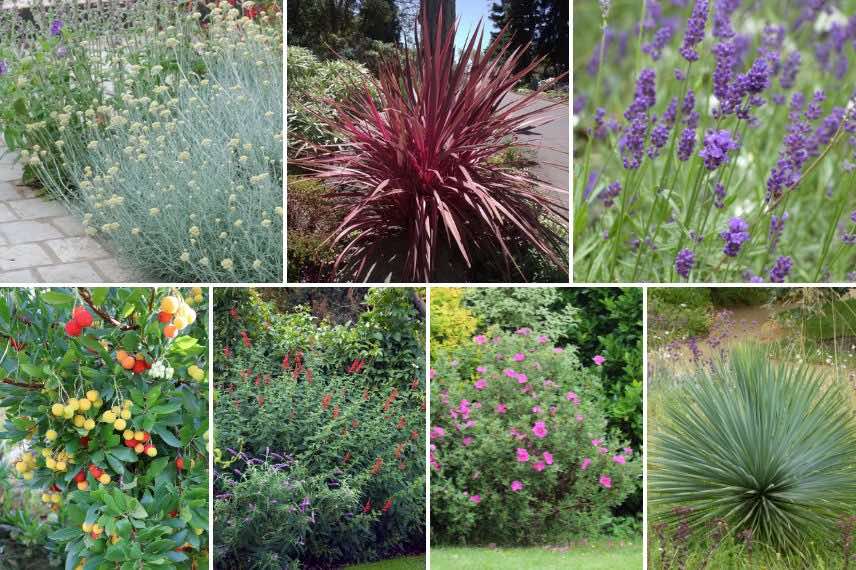
Clockwise: Helichrysum, Cordyline, Lavender, Yucca, Cistus, Sage, Strawberry tree
Our selection of bushes for semi-shaded walls and low walls
These are the walls located to the east or west, which benefit from partial sunlight. The sun’s rays reach them either only in the morning or only in the late afternoon. The wind can be stronger on the west side and colder on the east side, sometimes leading to rapid thawing that can be damaging to the bushes. However, the semi-shaded exposure is among the most accommodating for most bushes.
Consider opting for:
- the Japanese quince;
- the viburnum;
- the rhododendron;
- the mock orange;
- the ADR roses;
- the Mexican orange blossom;
- the Pittosporum;
- the Physocarpus;
- the heather;
- the small magnolias;
- the weigela;
- the Hibiscus syriacus;
- the boxwood;
- etc.
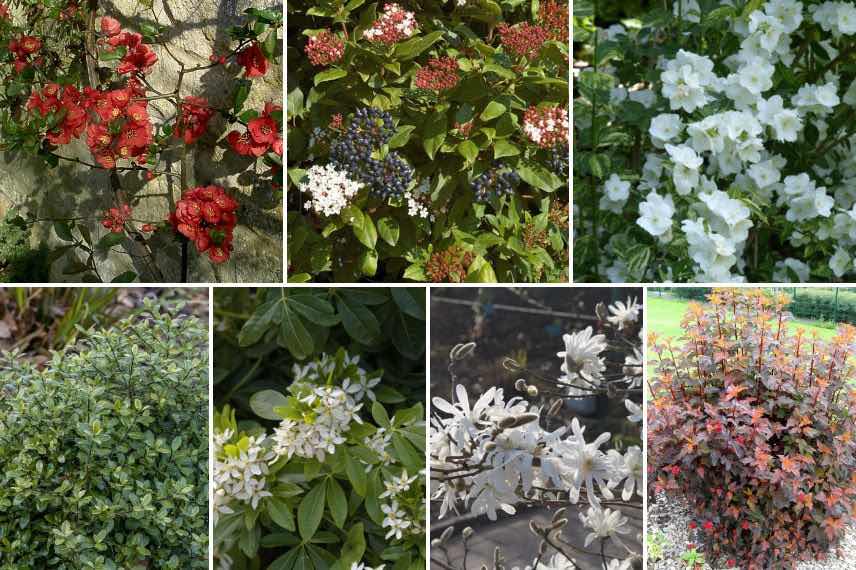
Japanese quince, Viburnum tinus, Mock orange, Physocarpus, Magnolia stellata, Choisya, Pittosporum
Our selection of shrubs for shaded walls and low walls
In a north or north-east exposure, plants receive very little sunlight. The location is rather dark and damp. It is also colder, and late frosts can affect spring-flowering shrubs.
The chosen plants must therefore tolerate these specific conditions. Those native to woodlands will be ideal, as will certain heather soil shrubs. Flowering may be less spectacular and colourful. However, to bring light into this area, you can also play with decorative foliage.
For example, consider cultivating:
- shade-loving hydrangeas;
- Magellan fuchsia;
- Japanese azalea (‘Amoena’, ‘Blue Danube’, ‘Eucharis’…);
- certain camellias (‘High Fragrance’, ‘Spring Festival’, ‘Kerguelen’…);
- Mahonia;
- Canadian dogwood;
- cherry laurel and laurustinus;
- Virginia Itea;
- Japanese andromeda (‘Little Heath’, ‘Carnaval’, ‘Pink Passion’…);
- Sarcococca;
- Japanese maple;
- Enkianthus;
- bushy honeysuckle (Lonicera nitida ‘Ernest Wilson’, ‘Hohenheimer Findling’);
- Aucuba;
- etc.
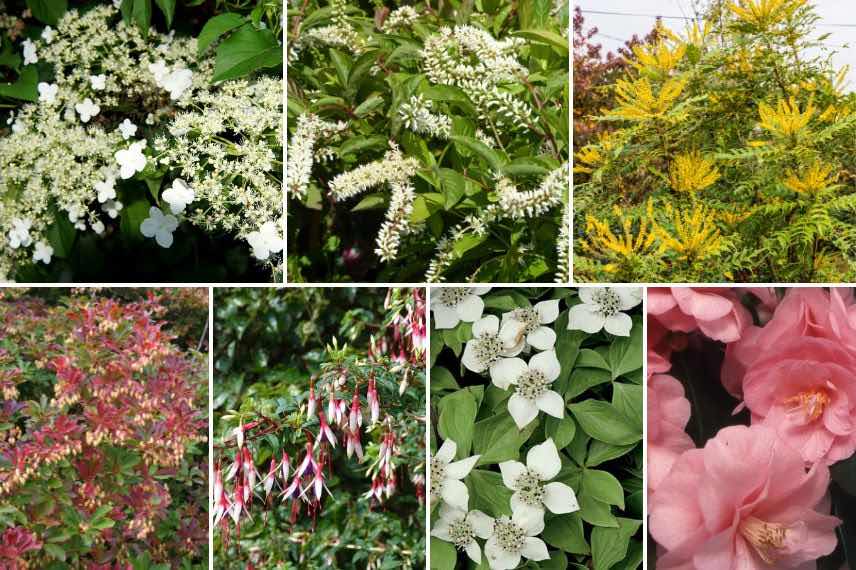
Hydrangea petiolaris, Itea virginica, Mahonia japonica, Camellia ‘Spring Festival’, Cornus canadensis, Fuchsia magellanica, Enkianthus campanulatus
The choice of packaging for shrubs
For your shrubs, you will have the choice between different packaging options, each with its advantages and disadvantages.
- Shrubs in pots. They are very accessible, easy to find in stores or online, and offer a great diversity. The downside is that you will need to be patient before they reach a suitable size.
- Shrubs with bare roots. They are cheaper to purchase than container-grown shrubs, generally ensure good establishment, and are more environmentally friendly. On the downside, they are only available for a limited period (approximately from October to February) and are not available for all species. They also require an additional step of coating the roots before planting.
- Shrubs in clumps are more expensive, but ensure very good establishment and ease of planting. However, they are becoming increasingly difficult to find.
- Shrubs in pots or containers are available for purchase all year round and offer a wide variety of choices. However, they are more expensive, and the plants may be subject to root-related bun problems.
To learn more, feel free to consult our article: Trees and bushes: bare roots, clumped or potted?
Planting and maintaining shrubs grown at the foot of a wall or low wall
Planting Period and Stages
Ideally, plant your shrubsagainst a wall or low wall in spring or autumn. Avoid periods of frost or heatwaves.
If it is a boundary wall, you must adhere to certain planting distances. Shrubs under 2 metres should be planted more than 50 cm from the boundary. For larger bushes, allow a distance of over 2 metres, even 3 metres from the boundary. To learn more, read our article: Planting Trees and Bushes: What Does the Law Say?
In any case, we advise against planting shrubs too close to your wall or low wall. This is to avoid damaging the foundations and to allow for good air circulation between the plants. Therefore, allow at least 50 cm of clearance.
The soil at the foot of a wall is often of poorer quality than the soil in the garden. It is less forgiving, less fertile, and sometimes stony. Before planting, we recommend adding organic amendments to enrich it. To do this, incorporate well-decomposed potting soil, compost, or manure, and ground horn… Then, install a mulch to protect the soil.
The different stages of planting.
- Prepare the soil. Using a spade or shovel, loosen the soil. Remove any stones, break up clumps, and weed the area.
- Dig your planting holes, approximately 2 times the volume of the root ball. For the planting distances between each shrub, consider their spread at maturity.
- Place the root balls in the centre of the holes and cover with garden soil or potting mix.
- Firm the soil around the root ball.
- Water generously.
- Install an organic mulch (or a mineral mulch for plants that prefer dry conditions).
If you wish to limit watering management, consider installing ollas at the time of planting. To learn more: Ollas or Oyas: An Efficient and Economical Watering System.
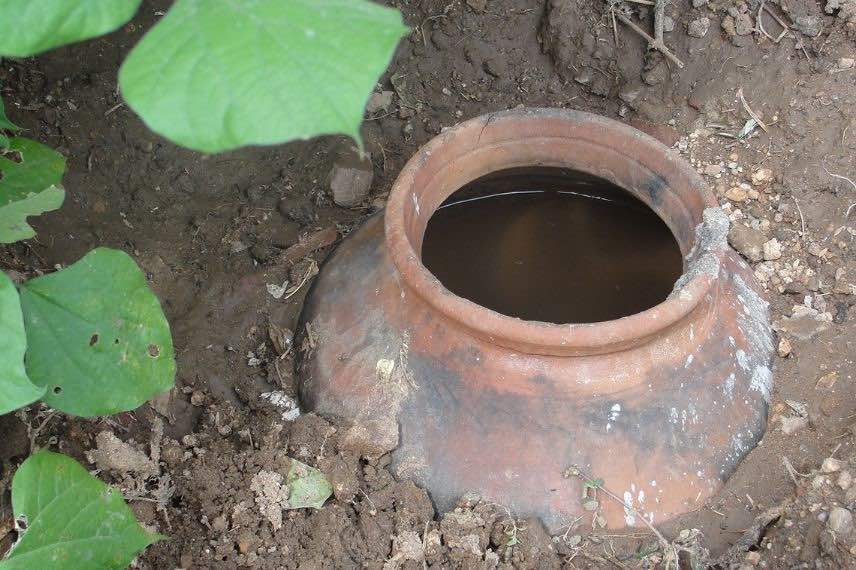
An Olla or Oya installed at the foot of the plants for water management
Maintenance
Once your shrubs are planted along the wall or low wall, some maintenance actions will be necessary.
- For the first two years, water frequently, even for shrubs known to be drought-resistant. Plants need time to establish and develop a root system that allows them to draw water from deeper sources.
- In the first months after planting, regularly weed the area to limit competition from adventive plants (“weeds”).
- In the years following planting, remove any suckers or spontaneous seedlings produced by the shrubs.
- Annually, you can carry out maintenance pruning to maintain harmonious shapes.
- Regularly observe your shrubs es to act quickly in case of symptoms of diseases or pests.
- Subscribe!
- Contents

Comments