





























What are the best grasses for wet soils?
Our tips for riverbanks and ponds
Contents
Grasses are increasingly captivating to gardeners, particularly in contemporary and dry gardens, but there are also varieties that thrive in water, perfect for aquatic gardens. Their natural appearance and low maintenance make them ideal plants for enhancing the banks of ponds, damp areas or even submerged parts. Discover the benefits of these grasses, the best varieties suited to aquatic gardens, as well as practical tips for integrating them into your green space.

Benefits of grasses in aquatic gardens
A natural and vibrant aesthetic
Ornamental grasses bring movement to any aquatic garden, thanks to their linear and flexible leaves that ripple in the wind, evoking a peaceful and soothing ambience. Planted along the edge of a pond or water feature, they soften the contours of a basin, adding volume and height.
Moreover, their varied hues, from deep green to golden yellow, with shades of blue or purple depending on the variety, offer a rich palette that changes with the seasons. Some varieties, such as the Deschampsia cespitosa ‘Tardiflora’, even boast plume-like inflorescences at the end of summer, adding yet another poetic note.
An ecological and sustainable solution
Beyond their aesthetic appeal, grasses also play an important ecological role. Thanks to their dense root system, they stabilise soils and prevent bank erosion. This is particularly useful in areas where soils are regularly exposed to water and wind.
These plants are also a refuge for biodiversity : their clumps provide shelter for small animals and insects, while their seeds feed birds in winter.
Minimal maintenance for maximum impact
Grasses suited to wetlands are valued for their robustness and adaptability. They generally tolerate varied climates, and require little maintenance. Unlike other aquatic plants, they do not require intensive fertilisation, nor frequent pruning. A simple annual prune at the end of winter is usually sufficient to stimulate new growth, but one can also allow the old foliage to decompose (outside the pond, of course).
Best grasses for aquatic gardens
Grasses suited to banks
Golden Sedge (Carex elata ‘Aurea’)
With its yellow-gold leaves edged in pale green, this grass brightens the edges of ponds. It prefers waterlogged soils and can even tolerate marshy areas. Compact in size (50–70 cm tall), it is ideal for structuring borders or providing a touch of light.
Blue Moor Grass (Molinia caerulea ‘Edith Dudszus’)
This Molinia variety forms dense tufts with upright foliage, blue-green in summer, turning straw-coloured in autumn and persisting through winter. It bears brown inflorescences, swaying with the wind, rising to about 1 m tall, giving graceful verticality. Perfect for damp banks, it also suits naturalistic gardens, in both dry and damp soils.
Diffuse rush is an iconic plant of wetlands. Its upright, cylindrical stems, arranged in a fan, create a graphic effect that structures banks. Very hardy, it grows easily in soils that remain waterlogged and damp.
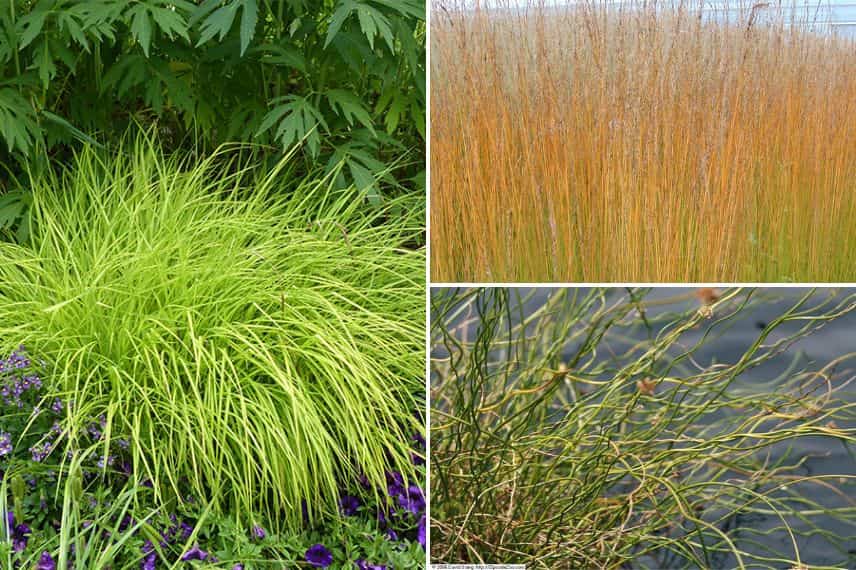
Golden Sedge (Carex elata ‘Aurea’), Blue Moor Grass (Molinia caerulea ‘Edith Dudszus’) and Diffuse Rush (Juncus effusus)
Grasses for submerged or semi-aquatic zones
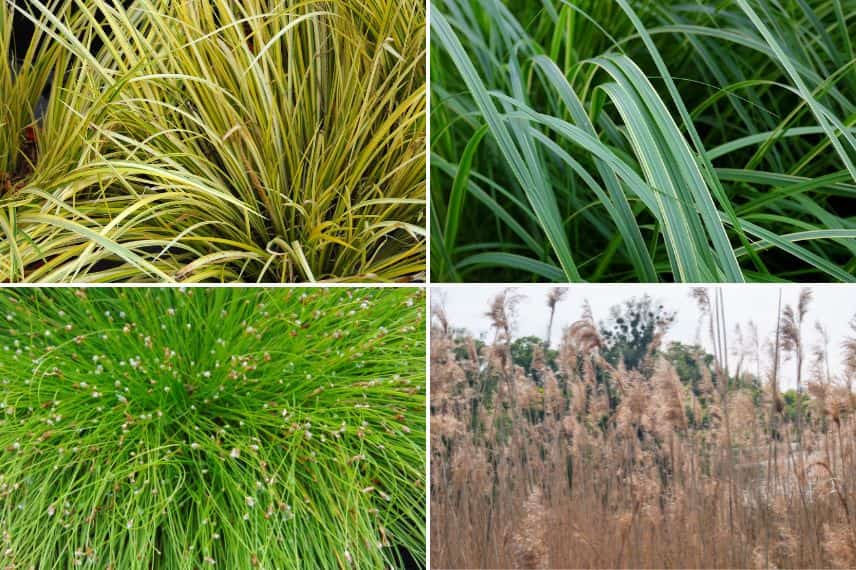
The variegated Japanese sweet flag (Acorus gramineus ‘Ogon’)
This small grass is a jewel for wetlands, submerged to 10–15 cm of water. With its dense, fine foliage, variegated cream-yellow and chartreuse green, it brightens the banks. This semi-evergreen foliage remains partly visible even in winter.
Fibre-optic Grass (Scirpus cernuus)
Ideal for small ponds or mini-ponds, this ornamental bulrush produces slender, curved stems topped with small flowers, resembling tiny pompoms. It grows well in partial immersion, at a depth of 5–10 cm of water, which highlights its delicate habit while promoting its growth.
Spartina pectinata ‘Aureomarginata’ (variegated)
This hardy grass, with green foliage striped with yellow, is ideal for wetlands or flooded areas. It grows up to 1.5 m tall and is perfect for creating a dramatic backdrop in a water garden. It tolerates immersion of 10–15 cm, allowing it to thrive in areas where water is continuously present, even in saline water. It also tolerates temporary drought.
The common reed (Phragmites australis)
The common reed is a robust aquatic grass, capable of thriving in submerged zones up to 50 cm deep. With its tall stems often exceeding 2 metres and its plume-like inflorescences, it offers a majestic presence. Note that its rhizomes are running.
→ Find more ideas for grasses for wetlands on our site: grasses for wet soils, and in our article: “7 ornamental grasses to plant by the water’s edge.”
Practical tips for incorporating ornamental grasses into a water garden.
How to choose the right plant for the right place?
To position your grasses correctly, consider the following:
- Water depth and moisture: For pond areas where water reaches 10 to 50 cm in depth, choose grasses suited to that depth, such as Phragmites australis or Glyceria aquatica. If soil is continually moist but not submerged, varieties such as Carex elata ‘Aurea’ or Molinia caerulea ‘Edith Dudszus’ will thrive perfectly. Areas farther from the pond, where the soil is slightly moist but well-drained, can accommodate other grasses tolerant of moisture without excess, such as Miscanthus sinensis ‘Gracillimus’ or Panicum virgatum ‘Rehbraun’.
- Exposure: Not all grasses enjoy the same exposure. Varieties such as Spartina pectinata thrive in full sun, while species such as Acorus gramineus ‘Ogon’ tolerate partial shade better.
- Size and space: Consider the space available and the size the plant will reach at maturity. For example, favour compact grasses such as Scirpus cernuus for small ponds, and imposing species such as Phragmites australis to structure large spaces.
- Behaviour and maintenance: Some grasses, such as Spartina pectinata, can become invasive if not controlled. To prevent this, use rhizome barriers or plant them in submersible pots.
When to plant?
Aquatic grasses are ideally planted in spring or autumn, when soil is moist and temperatures are moderate. This allows them to establish well before periods of climatic stress (summer heat or winter frosts). For submerged areas, wait until water is at a stable temperature and not too cold to avoid root shocks.
Care tips
- Annual pruning: At the end of winter, cut back dry or damaged growth to encourage new growth. Decorative flower heads may be left in place until the end of the winter season for their aesthetic appeal.
- Division of clumps: Every 3 to 5 years, divide grasses to prevent them from becoming invasive and if they start taking up a lot of space. This also helps maintain vigour.
- Watering: Grasses planted in a wet area do not need additional watering, but those planted in well-drained soil near a pond will appreciate watering during dry spells.
- Subscribe!
- Contents
Comments