






























Which lawn grasses should be sown on dry soil?
Our tips for selecting the most drought-tolerant lawns
Contents
Naturally, when you have a lawn in your garden, you dream that it stays green all year round, vigorous and healthy. However, that same lawn is often confronted with unwelcome trampling, and especially with scorching heat, even drought and a lack of water. Especially if you live in a region with a dry climate. Hence, two options present themselves: either you resign yourself and accept your lawn turning yellow in summer, or you adopt a lawn suited to dry soils. There are, in fact, alternatives to traditional lawns that are more drought-resistant.
Discover all our explanations and advice to choose the lawn best suited to hot climates and soils that dry out easily in summer.

Everything you need to know about the different types of lawns
Until recently, drought was confined to the southern regions of the country. But with climate change, France has experienced, over the past twenty years, recurring episodes of heatwaves and drought that are no longer limited to southern areas. It is now a given: we will need to change the way we garden to adapt to climate change that is already underway. And the lawn is no exception.
Among the vegetated spaces most affected by these droughts, the lawn is one of them.
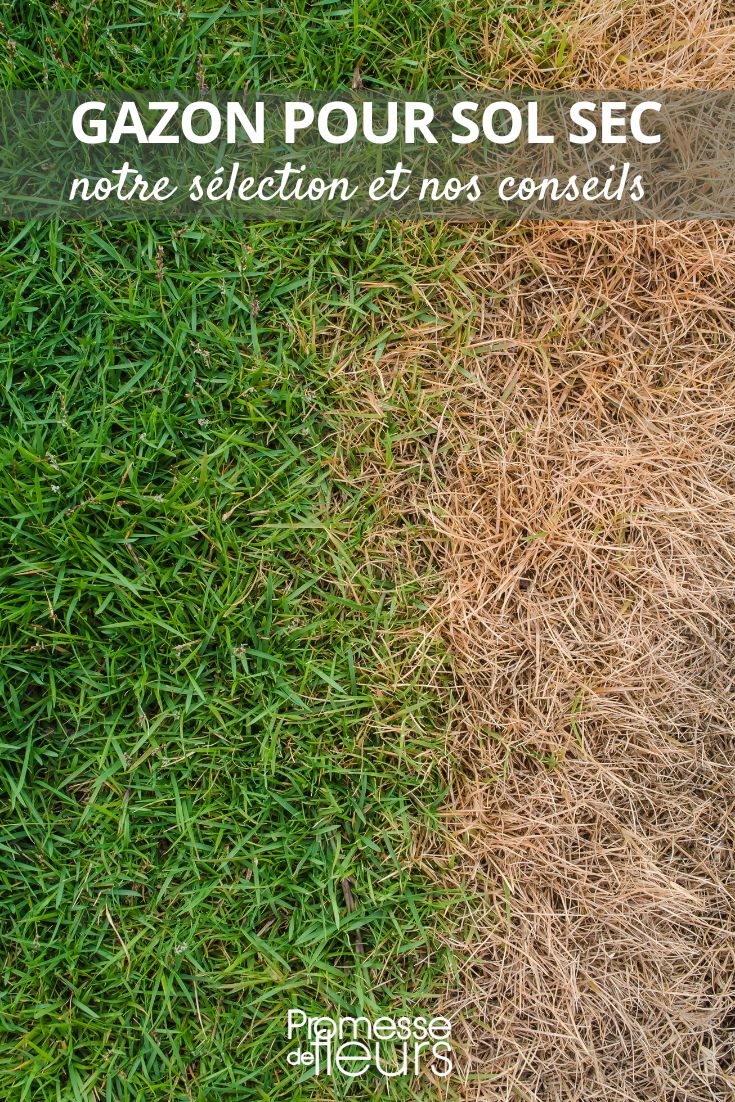
With the lack of rainfall or irrigation, the lawn browns, then inevitably yellows. It takes on a dry, straw-coloured appearance. That’s quite normal! Indeed, during periods of high heat and without irrigation, a lawn enters dormancy. This means that the grass blades stop growing for a period of a few weeks. Until the next rainfall!
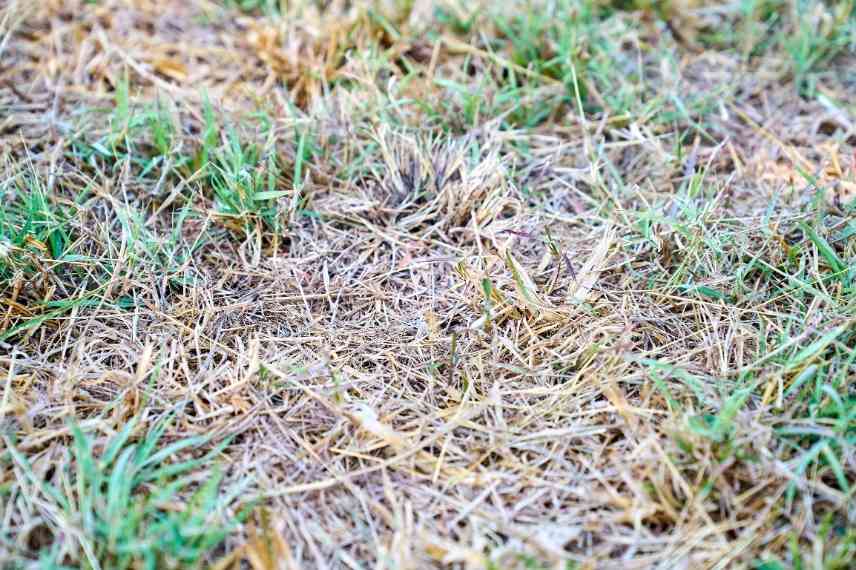
In summer, during drought episodes, the lawn goes dormant and yellows.
<Evidently, some lawns prove more resilient in dry conditions. It all depends on the seeds that make it up. Thus, an English lawn will be considerably less resistant than a sport and play turf. Indeed, the English lawn contains seeds of English ryegrass, but also red and sheep fescues, and Timothy grass. Whereas the sport and play turf is composed of ryegrass, but primarily rhizomatous tall fescue, particularly resistant to drought, to trampling and to uprooting, while being hardy. This grass thus has a very deep root network that allows it to withstand drought and high heat with minimal damage. Likewise, it has the ability to re-green after summer dormancy.
That is why, in dry sites, it is preferable to select seed mixtures with a high percentage of tall fescue.
Read also
Burnt lawn: what to do?Traditional lawns adapted to dry soils
In dry conditions, it is therefore advisable to opt for a drought-tolerant lawn, which stays green despite heat spikes. Even though it is natural for a lawn to dry out and yellow under extreme weather conditions. Thus, among the range of lawns we offer, two stand out for their suitability for dry soils. Simply because they are predominantly composed of tall fescue:
- The dry-ground lawn: this seed mix yields a water-saving lawn that is highly drought- and heat-tolerant, staying green longer in summer. This lawn is composed of 80% tall fescue and 20% English ryegrass. These grasses meet aesthetic requirements while proving robust. As soon as the first late-summer rains arrive, the lawn regains its density and its green colour, because ryegrass, but especially tall fescue, self-repairs naturally.
- The South and seaside smart lawn is also suitable for dry ground. This seed mix, to be sown in all soil types, heavy or light, acidic or alkaline, helps to establish a dense turf even in summer. Indeed, it consists of 60% tall fescue, 10% ryegrass, 10% red fescue, 10% meadow grass, and 10% Cynodon dactylon, a herbaceous grass which we will come back to. By comparison, the Continental Smart Lawn does not contain tall fescue.
Smart Meadow and Seaside Grass Seed
The smart lawn adapted to the dry climate of the South and the coast- Hauteur à maturité 20 cm
The alternatives, highly drought-tolerant
Today, for turfing surfaces on dry soil, there are some very appealing alternatives thanks to their heightened drought resistance. These grasses, often of tropical or subtropical origin, offer many advantages in terms of robustness to trampling and high heat. In summer, they stay noticeably greener than traditional lawns:
The Cynodon dactylon lawn, an improved couch grass
The lawn in Cynodon dactylon, also known as “tropical lawn”, “Bermuda grass” or “couch grass” allows you to create a lawn dedicated to leisure in hot and dry climates. It is a perennial herbaceous plant in the Poaceae family, native to the African savanna, with extensively running rhizomes and bright green foliage. Thanks to its highly developed root system, a single plant can cover up to 1 m²! This is why it can be invasive, especially as it also self-seeds. Nevertheless, it is ideal for establishing a durable lawn, resistant to heat and drought in dry soil. The only thing that Cynodon dactylon dislikes is constantly damp soils.
Maintenance is minimal. In the first year, to aid establishment, watering is obligatory, once a week. In subsequent years, it manages on its own. One mowing per month is sufficient. Fertiliser applications are unnecessary.
Hardy to -15°C, this grass yellows in winter, during its dormancy. But greening up is effective from April.
Kikuyu, a subtropical grass
Kikuyu (Pennisetum clandestinum) is a grass native to the African savannas. That said, it is suited to regions with mild winters. Indeed, its hardiness is limited to -5°C. This Poaceae grass, however, shows great resistance to heat and drought thanks to its enormous, deep stolons. Slow-growing, this grass takes time to establish, but it offers a dense and thick lawn, sometimes perhaps a little coarse. Without maintenance, but with water, the blades can reach over 30 cm in height. In dry periods, kikuyu slows its growth. Like Cynodon dactylon, kikuyu yellows in winter during its vegetative rest.
Kikuyu requires minimal maintenance. Indeed, it does not tolerate close mowing. That is why it is only mown on rare occasions, at a high cutting height.
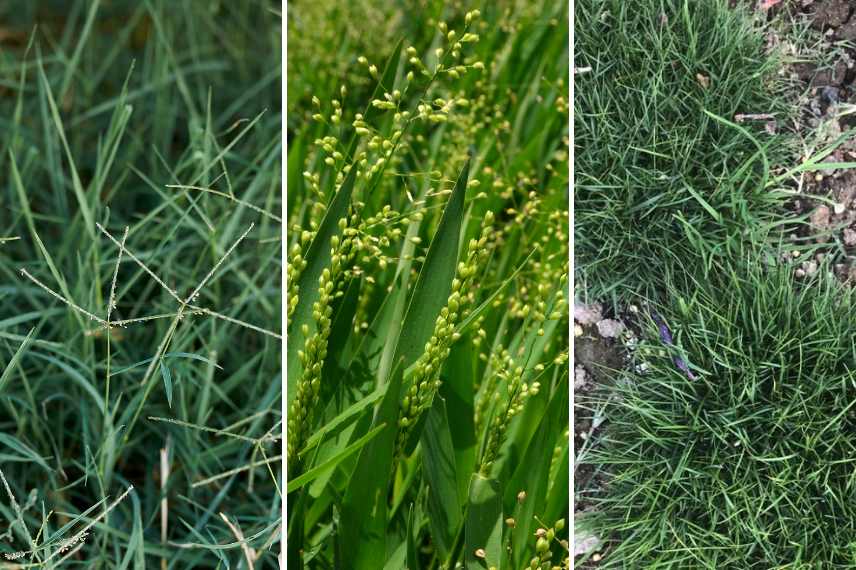
From left to right, Cynodon dactylon, kikuyu and Mascarenes lawn
Zoysia tenuifolia, ideal in dry climates
Often called Mascarenes lawn, Zoyzia tenuifolia is a drought-tolerant grass, thus perfectly suited to dry soils, while being resistant to intensive trampling. With running rhizomes, this Poaceae grass spreads to about 50 cm across and reaches a height of 10–12 cm. That is to say, it hardly needs mowing. One to two per year are enough. Very ornamental, this grass forms small tufts with foliage that is truly fine and a vivid green.
A little slow to establish due to its slow growth, Mascarenes lawn is frost-tender down to -10 to -12°C if the soil is well-drained.
- Subscribe!
- Contents
Comments