


Wisteria: the most fragrant
Fill your garden with a delightful fragrance in spring
Contents
Wisteria offers a divine flowering in pendulous clusters during spring, very graceful indeed. Always fragrant regardless of the species and cultivars, these flowers do not, however, develop the same intensity and aromatic trail. The two most well-known species of wisteria are the Chinese wisteria, Wisteria sinensis, and the Japanese wisteria, Wisteria floribunda, although there are others that are also interesting. These two iconic species can always be distinguished as follows: the flowering before leafing of the Chinese wisteria, whose stems twist around their support in a counter-clockwise direction, and the flowering once leafing is established of the Japanese wisteria, whose stems spontaneously twist in the opposite direction. Another difference that sets them apart is: the flowering of the Chinese wisteria is more fragrant than that of the Japanese wisteria. The former fills the space with a prominent scent, while the latter is a bit more subtle. Among other species and hybrids of wisteria, some have a well-defined fragrance. Discover in this article a few varieties with remarkable scents.

Wisteria sinensis 'Alba'
The Wisteria sinensis ‘Alba’ is a vigorous Chinese Wisteria with white flowers, whose pendulous flower clusters can reach 60 cm in length. This results in an intense floral fragrance, with a prominent honeyed trail for this remarkably fragrant variety. This exuberant liana reaches 9 m at ripeness and blooms in spring, in April-May, before or at the same time as its young bronze-coloured leaves appear, which then take on a light green hue. Repeat flowering, it often blooms again during the summer, albeit more sporadically. Its long clusters of white flowers are very lightly maculate with pale yellow on the lip of each papilionaceous flower. It is distinguished from the botanical species by the size of its inflorescences, which are larger, and their white colour. However, its belonging to this species is clearly recognised by the way it spontaneously twists counterclockwise around supports. The growth of new shoots of this vigorous variety is very rapid, reaching several metres in a single season in fresh soil.
Quintessentially romantic, this white-flowered variety also enchants with its powerful fragrance in spring, and one can imagine sitting beneath the multiple nectariferous and melliferous clusters.
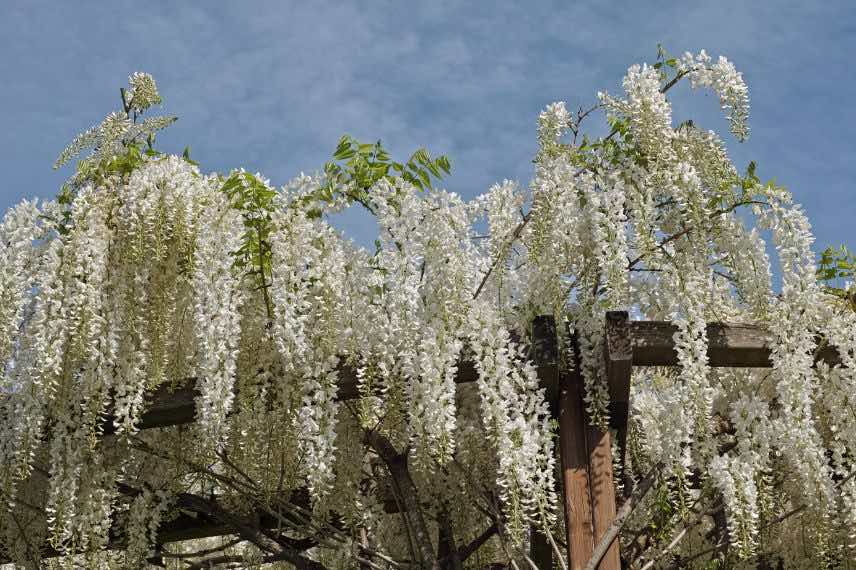
Wisteria sinensis ‘Alba’
Read also
Wisteria: how to plant, prune and care?Wisteria 'Grande Diva® Maria'
The Wisteria ‘Grande Diva® Maria’ is a hybrid wisteria of the botanical species Wisteria brachybotrys, formerly known as Wisteria venusta. ‘Maria’ is the most fragrant selection of the Diva® series. Its flower clusters, measuring 15 to 20 cm long, are pastel in colour, featuring a duo of white and pale mauve blue, lightly touched with soft yellow, appearing in May-June alongside the young bronze foliage. They exude a sweet, vanilla-like fragrance. With a modest stature and vigour, this wisteria reaches between 3 m and 10 m in length depending on whether it is grown in a pot or in the ground, and how it is pruned.
Wisterias from the Diva series produce flowers from the first years of cultivation. They bloom abundantly, harmoniously, and homogeneously across their entire height without damaging their support. Their stems twist in a clockwise direction. They are created in France and hybridised, among others, from a Japanese species known as silky or graceful wisteria. Easier to train on supports that do not need to be as strong as those for Wisteria sinensis or floribunda, they adorn modest-sized gardens or can even be grown in pots.
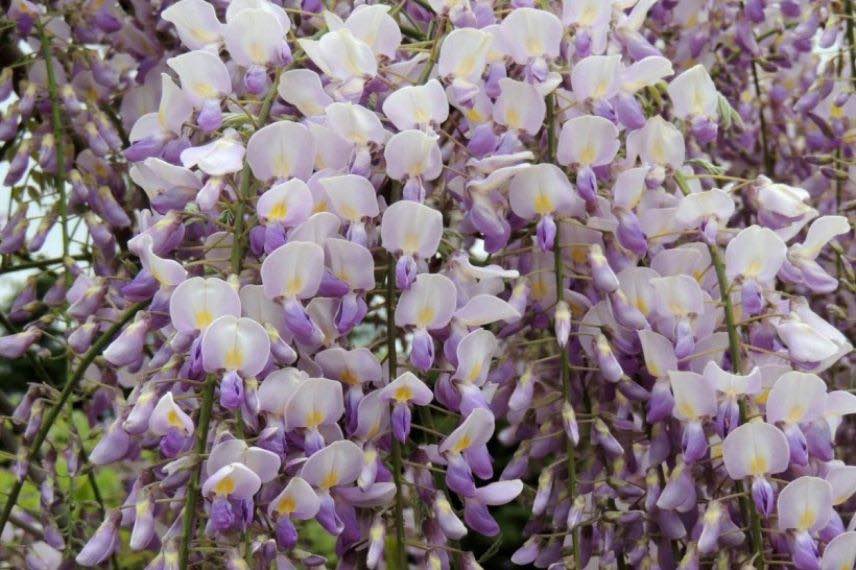
Wisteria ‘Grande Diva Maria’
Discover other Fragrant climbers
View all →
Available in 1 sizes
Available in 1 sizes
Available in 1 sizes

Available in 1 sizes
Available in 1 sizes
Available in 1 sizes

Available in 1 sizes

Available in 1 sizes
Available in 1 sizes
Available in 1 sizes
Wisteria 'Yokohama Fuji'
Another Wisteria from Wisteria brachybotrys or Wisteria venusta, the Wisteria ‘Yokohama Fuji’, is highly floriferous, displaying rather short clusters that are divinely fragrant, revealing hints of jasmine and neroli, notes of broom, caramel, and honeysuckle, as well as touches of camphor and clove! Its dark flowers, in shades of purple, violet, and mauve, bloom in May-June, coinciding with the emergence of the young bronze foliage. This foliage, which turns green in the meantime, changes to dark yellow in autumn and remains attached to the stems for a long time before falling.
Suitable for modest-sized gardens, this wisteria easily adapts to being trained as a bush and also makes lovely bonsai specimens. When left free, it reaches a height of 6 to 7 m, but only 4 m when grown in a pot or regularly pruned.
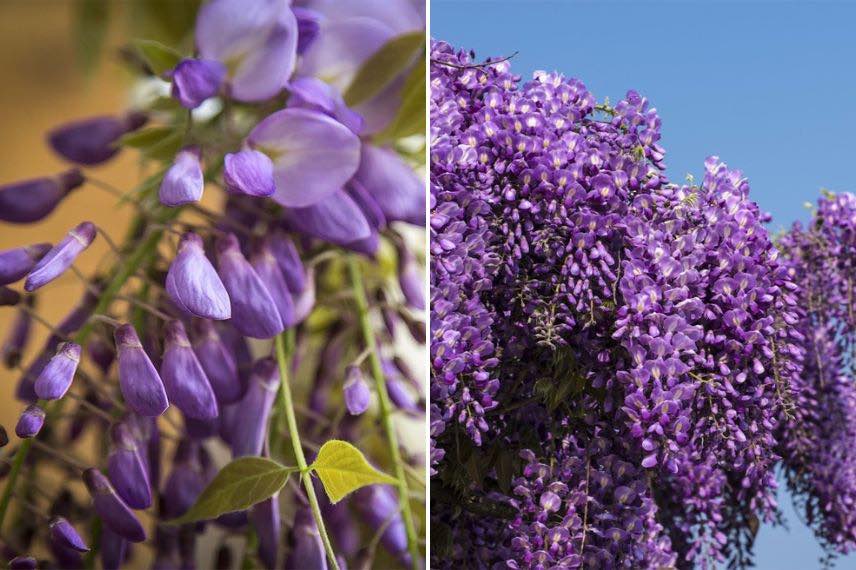
Wisteria ‘Yokohama Fuji’
Read also
Choosing your wisteria: buyer's guideWisteria sinensis 'Caroline'
Chinese Wisteria Wisteria sinensis ‘Caroline’ is an early and highly floriferous variety. Its clusters of flowers are densely packed, with a cooler, more bluish hue than the mauve of the typical species. They appear on nearly naked shoots, opening from the base to the tip of the cluster, and just precede the emergence of the young bronze leaves. Its early flowering is accompanied by a lovely, fragrant scent that envelops the air in a sweet and suave trail.
This wisteria, while large-growing, is somewhat modest, reaching 7 m in length when the typical species exceeds 10 m. Its mauve-blue flower clusters, very abundant, are 20 to 25 cm long and bloom slightly again during the summer, in July-August. Its young bronze foliage appears at the end of flowering, later turning a light green. This ornamental foliage, divided into rounded leaflets, is light and gives the plant an elegant, airy silhouette.
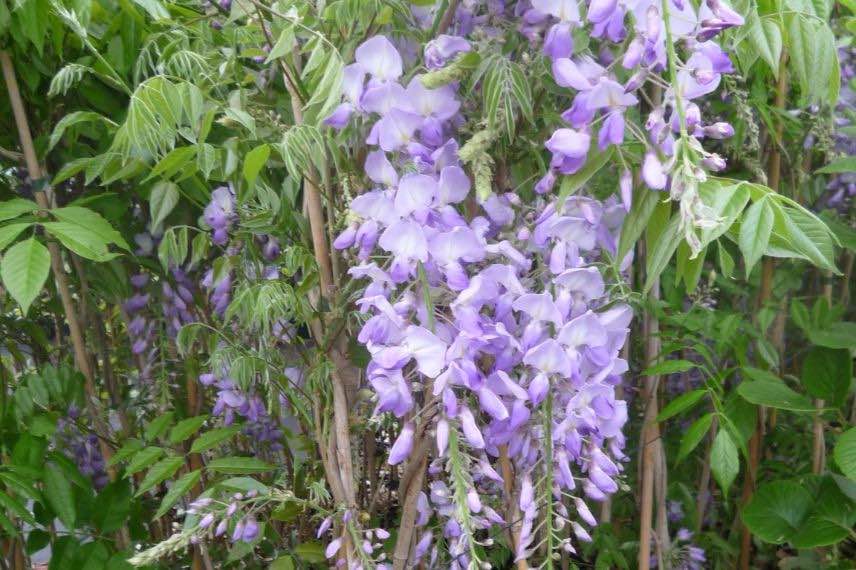
Wisteria sinensis ‘Caroline’
Wisteria macrostachya (or frutescens) 'Clara Mack'
Little known, the Kentucky Wisteria offers moderate growth, reaching heights of 5 to 6 m at maturity, and a more modest flowering compared to Asian species. It originates from the species Wisteria frutescens or American Wisteria, and the subspecies Wisteria macrostachya, which can be found in wet forests and along waterways in a more restricted geographical area, ranging from southern Missouri and Illinois to eastern Kentucky. The Wisteria macrostachya (or frutescens) ‘Clara Mack’ is a beautiful form with densely packed flowers, pure white in colour, exuding a very pleasant sweet fragrance reminiscent of grapes and honey. Its very dense clusters, measuring 20 to 30 cm long, can hold up to 50 flowers, amplifying the fragrance.
This wisteria is particularly interesting in regions with long, cold winters. As it forms its flower buds on the wood of the year, it proves to be particularly resilient in these conditions. Its first flowering occurs in June, among darker and shinier foliage than that of Asian wisterias, before returning in a more anecdotal manner during the summer. Like most American wisterias, this species flowers from a young age. It is not demanding regarding soil, as long as it is deep and cool below, and it tolerates intermittently waterlogged soils. Once established, it withstands summer drought quite well. However, it should be avoided in overly calcareous soil.
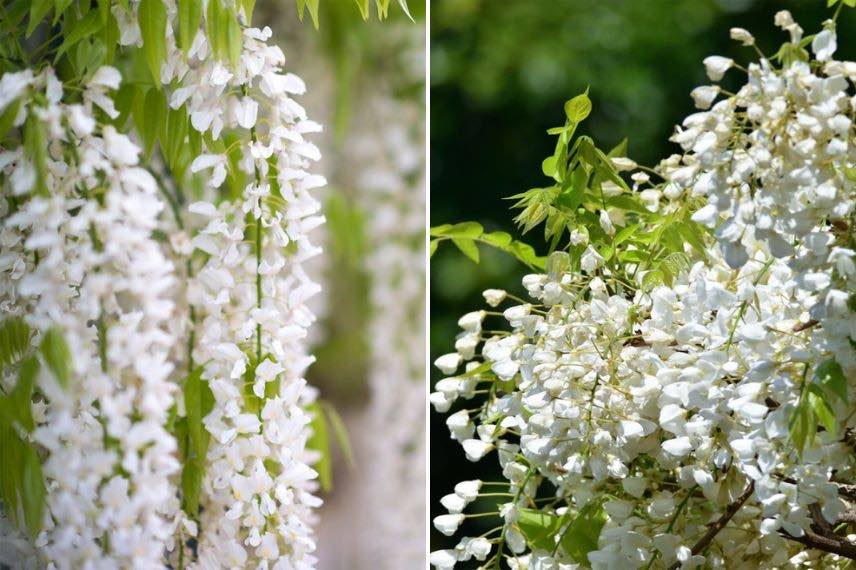
Wisteria macrostachya (or frutescens) ‘Clara Mack’
- Subscribe!
- Contents
Comments