





























At the end of each year, it's an opportunity to reflect on the favourite plants of the editorial team, those that have marked our gardens, terraces, and interiors with their beauty, originality, or ease of cultivation. Behind each favourite, there is a gardener's story, a meeting with a plant that has found its place and transformed a patch of greenery into a true source of inspiration.
In this article, the editorial team shares its top plant picks for 2025, from characterful trees and shrubs to floriferous perennials, not forgetting the graphic houseplants and lesser-known species that deserve to be recognised. This selection is guided by a passion for gardening, a desire to share useful tips, and to help you find the plant that will make your heart race.
Ingrid: the Cercis canadensis 'Ruby Falls'
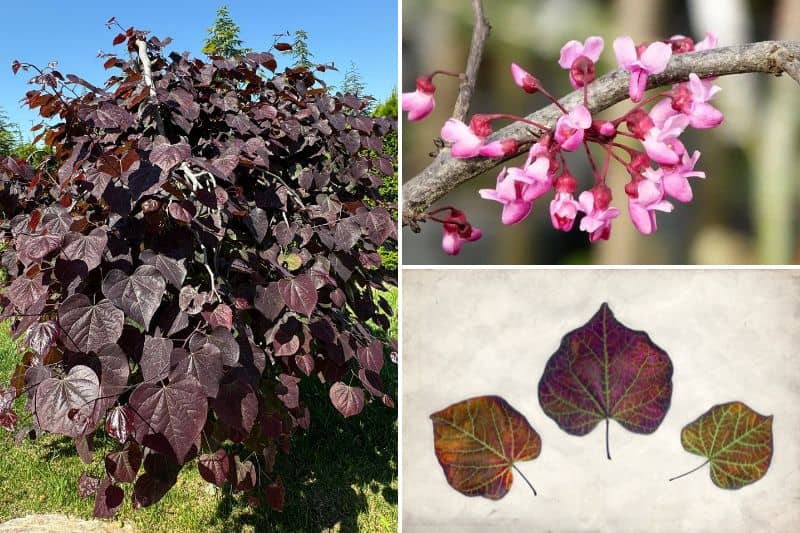
This year, my choice is the Cercis canadensis 'Ruby Falls', a dwarf weeping redbud that offers a poetic presence in my bordering terrace bed. Planted in partial shade, it boasts heart-shaped leaves of a deep purple mixed with green, which seem to cascade along its drooping branches. In spring, its violet-pink flowers emerge on the still bare wood, bringing unexpected colour before the young red leaves unfurl. In autumn, this foliage takes on bronze and copper hues before falling.
I particularly love the contrast of its purple foliage with that of the surrounding plants, especially the bright green and violet-blue flowers of a nearby Hardy geranium 'Rozanne'. Alongside them, my Greater celandine, more spontaneous, naturally brightens the base of the shrub with its light green foliage. A little further away, a Acer palmatum ‘Bloodgood’, with its reddish-brown foliage, echoes the Ruby Falls. This chromatic continuity, from the purple of the Cercis to the darker hue of the maple, gives a gentle coherence to the bed and creates a visual depth where the light catches differently depending on the seasons.
This little Canadian redbud easily finds its place in a garden, thanks to its weeping habit and compact size. Its good hardiness makes it simple to cultivate, as long as the soil retains some moisture in summer. At my place, it quickly integrated into the bed, bringing softness to this part of the garden without ever overshadowing the neighbouring perennials.
Virginie: the Begonia 'Rex Escargot'
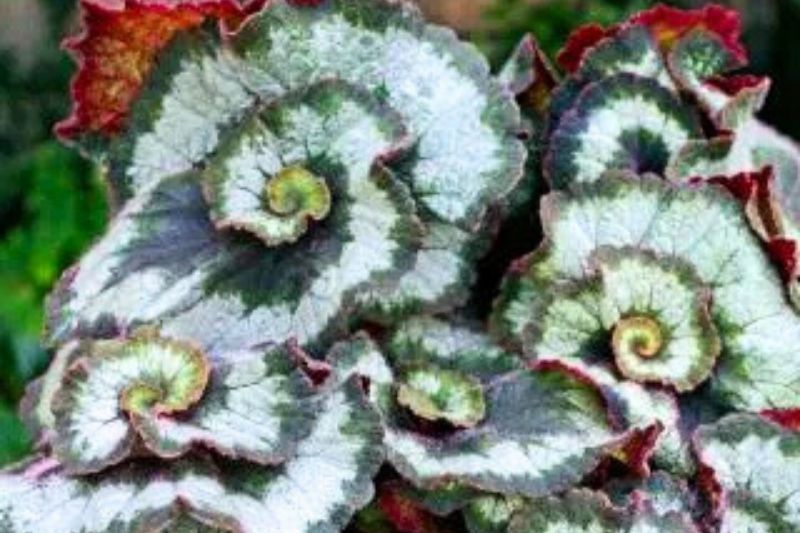
My heart undoubtedly leans towards the Begonia 'Rex Escargot'. What makes it truly special? This variety lives up to its name: each leaf spirals and seems to form a small snail shell, hypnotic and wildly graphic. We love its artistic touch with its unique colour contrasts: a blend of greens, silver, and chocolate.
With its velvety foliage, spiralled patterns, and unprecedented colours, it marks the strong return of indoor begonias, which are increasingly appealing due to their original aesthetics and diverse foliage. Long relegated to grandmothers' balconies or forgotten greenhouses, begonias now rank among the top 5 most sought-after plants for our interiors. Right in line with the major trend of decorative begonias, this variety stands out as a vintage icon brought back to life. Easy to cultivate (as long as you respect its preference for ambient humidity and filtered light), it adapts perfectly to all our interiors.
Olivier: the Hyssopus officinalis
"You, who are very sentimental, will surely appreciate this plant!" And bam! I was handed, without further ado, a clump of earth, from which only a few meagre green shoots emerged. Of course, I knew a bit about hyssop, as I have been passionate about medicinal plants since my studies. Moreover, it held a prominent place in medieval herb gardens. However, in my heavy soil, I remained… sceptical about its future. So, I decided to try it in a large container alongside my other Mediterranean plants, botanical cousins: thyme, sage, rosemary, and lavender.
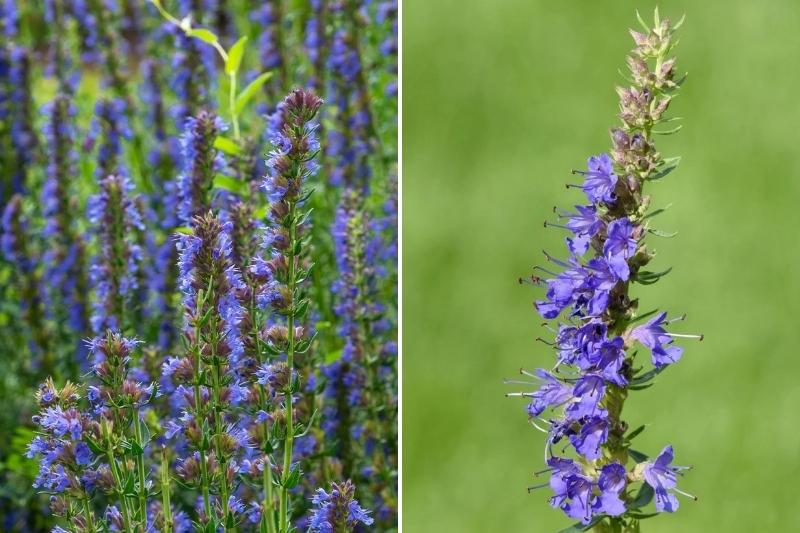
Hyssopus officinalis is a dwarf undershrub (you can use that as a somewhat original insult), ideal for very sunny spots and dry or calcareous soils. And, in just one season, mine has thrived. I particularly love its flowers, a lovely violet-blue, which bloom from July to September and are highly appreciated by pollinating insects, including butterflies. Known as "sacred herb" by the ancient Greeks, this aromatic plant can reach up to 50 cm in height and has very fragrant leaves. It is cultivated for its medicinal properties (infusion for bronchial issues and digestion) and to flavour various dishes such as salads and soups. In short, if you have a spot left in your herb garden: give hyssop a try!
Sophie: the Westringia fruticosa
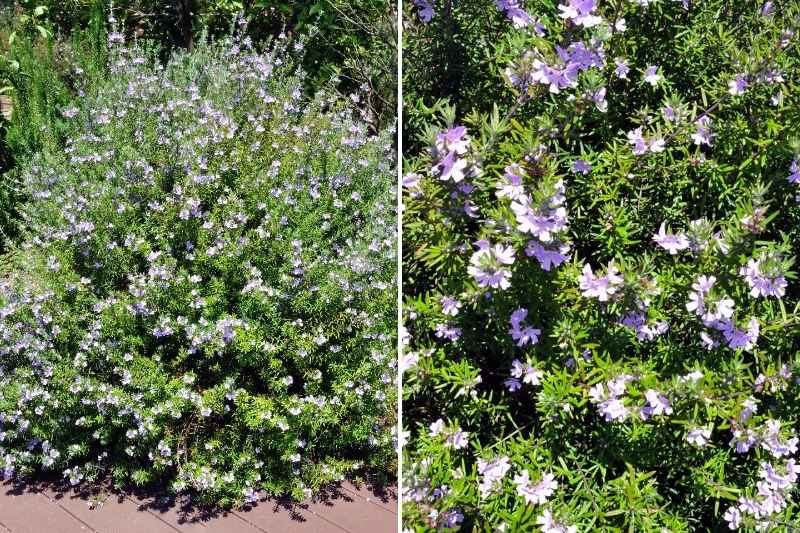
I have chosen the Westringia fruticosa, also known as Australian rosemary, as my plant pick for 2025, because it embodies the perfect companion plant, one that simplifies gardening! With its slight resemblance to rosemary, it has that familiar and sunny charm that immediately sets the tone. In my southern garden, amidst gauras, agapanthus, Leucophyllums, and lavender, it has settled in as if it has always belonged there. Its evergreen and silvery foliage captures the light, its naturally well-defined silhouette adds elegance, and its impressive resistance to heat, wind, and drought makes it a reliable choice, as I know it can thrive without any care. It tempers the exuberance of the blooms, highlights the volumes, and its light and delicate flowering brings just the right amount of freshness. What I love is its easy-going nature and its clean and bright appearance all year round.
With its 1 to 1.5 m in height and the same in spread, the Westringia fruticosa easily finds its place in the garden. Its delicate flowering extends from spring to autumn, returning in waves. It withstands light frosts down to -5 °C without flinching, sometimes even more in well-drained soil, making it perfectly suited for southern gardens, sheltered areas, and coastal climates. To thrive sustainably, it primarily requires a well-drained soil, preferably light, poor, and stony, where water never stagnates, an essential condition to preserve its longevity and natural vigour.
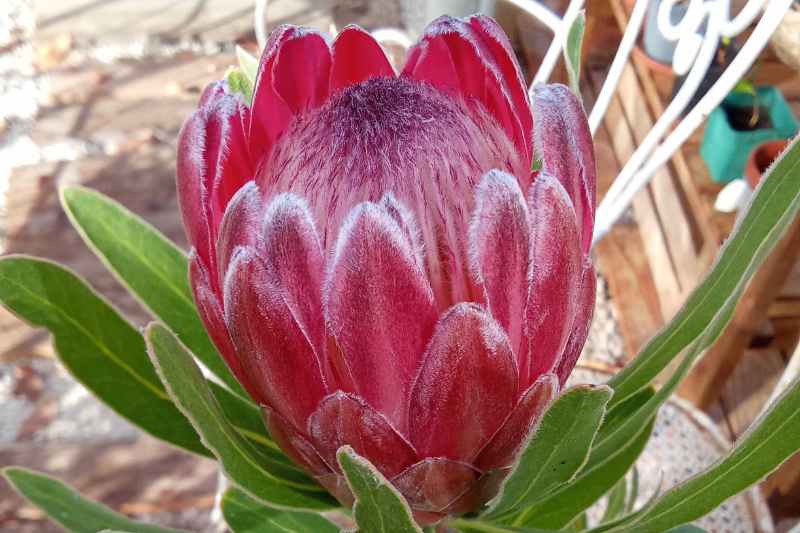
Gwenaëlle: the Protea 'Pink Ice'
Every year, when we choose our plant of the year to share with you, I always hesitate, as several plants in my garden could claim a spot on this podium. This year, there’s no hesitation… Drumroll… It’s my Protea 'Pink Ice', brought back from Madeira in 2022, that wins all the votes! The tiny plant I bought at the flower market in Funchal and lovingly planted has seen it all, and it’s the only one of the three plants to have survived. Growing it in a greenhouse and repotting it as it grew, it suffered, two years ago, from my carelessness as a gardener when, in the middle of summer, I forgot to ventilate the greenhouse. As a result, one of the two main branches completely cooked, throwing it somewhat off balance. But, with care, it continued to grow, forming new branches to my great satisfaction. What a surprise it was in September to see three buds appear, slowly but surely transforming into those sublime pink inflorescences I had been patiently waiting for in early November.
Proteas, native to South Africa, are considered delicate plants due to their very low hardiness. Of course, I protect it in winter, wrapping it up and watching it like a hawk. I also only water it with room temperature rainwater and have provided it with an acidic and light substrate. I’m not sure I’ll plant it in the garden for a few more years, in which case I’ll need to find it a particularly sheltered spot. The arrival of these large fluffy flowers is such a spectacle that I recommend it to all gardeners who love exotic plants, as this plant literally transports me elsewhere!
Pascale: the Sedum ‘Thunderhead’
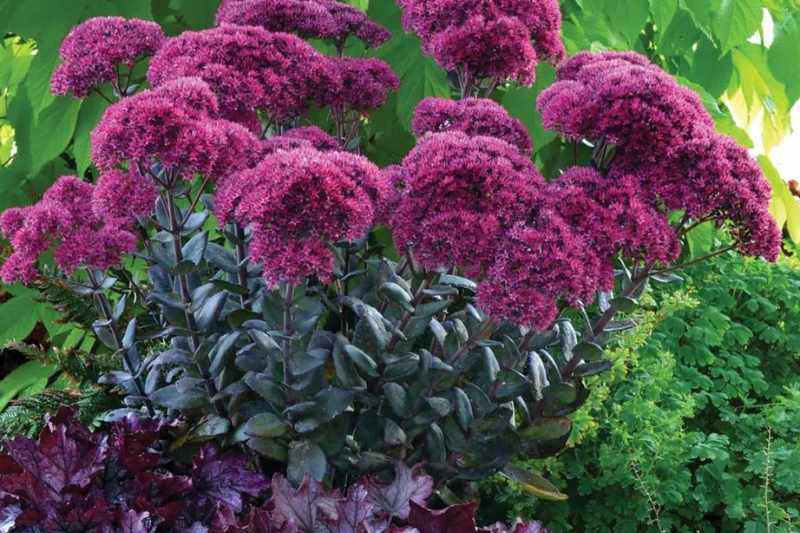
I admit, I was long among the detractors of sedums. Perhaps because these plants always seemed a bit dull and unremarkable in the beds. And then, what’s the point of growing these succulent plants at home, in a region where drought was hardly an issue? Climate change has decided otherwise, and the heatwave has taken its toll on other plants I cherished… Not to mention the numerous cultivars of stonecrop that offer new cultivation perspectives.
The Sedum ‘Thunderhead’ is one of the pleasant surprises. This variety has literally swept away my prejudices about sedums, thanks to its presence and vigour. From spring, its robust dark stems stand proudly, bearing very fleshy bluish-green foliage. But it’s at the end of summer that the magic happens: the dense and enormous flower heads bloom in a deep purplish-red, lasting until early winter. As these flowers, perched on purple stems, are highly melliferous and nectariferous, they attract swarms of pollinators.
And in winter, this sedum continues to put on a show with its dry inflorescences. I’ve even taken a few to enhance a bouquet of dried flowers and herbs. And already, the next spring shoots are emerging from the ground.
Paired with my beloved heucheras, this stonecrop has found its place in my semi-shaded bed. But elsewhere, it could bask in the sun all summer long.
Elisabeth: the Monstera deliciosa, 25 years of cohabitation with my "philo"
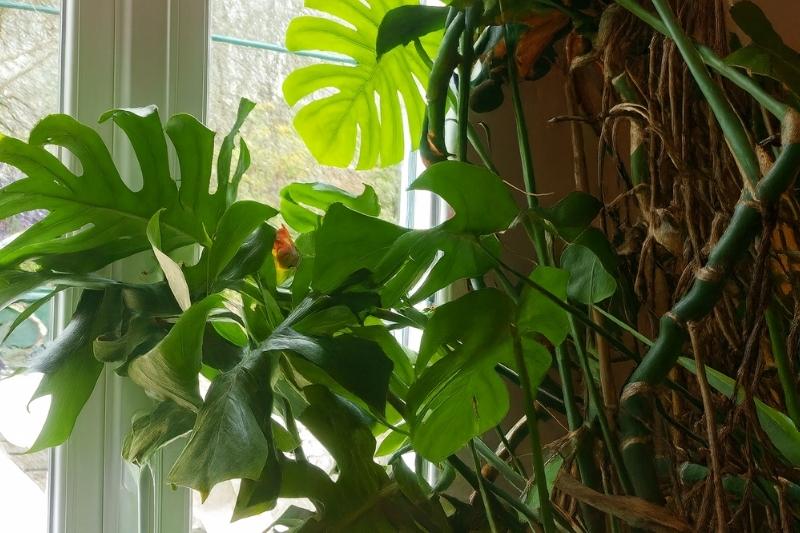
Some stories last, enduring through moves, neglect, and trends. The one I’m about to tell is that of my Monstera deliciosa, my big "philo". It’s 25 years old, and it’s a green giant, a delicious monster clinging to the wall of my living room like a reminder of beautiful holidays in Spain.
Embracing its kitsch nature, it’s a bit of a grandmother’s plant, a symbol of the 70s, the spirit of bygone interiors. One might find this Monstera outdated, with its veranda plant look and postcard charm. Yet, it’s precisely this slightly old-fashioned air that makes it endearing. It signifies comfort and nostalgia.
If this houseplant had a CV, the first line would read: "Survival Expert". I forget to water it for three weeks? No problem, it will halt its growth, and that’s that. A bit of drastic pruning in anticipation of a move? It will sulk, but it will recover. It’s the ideal green plant for busy (or lazy) people; I don’t judge, I’ve lived through both.
Despite its 25 springs, "philo" has never deigned to flower. Because yes, this plant is capable of flowering! And even fruiting! Apparently, its fruits are deliciously edible. It might be lacking some geranium fertiliser, or perhaps it sulks because my living room isn’t humid enough, or too warm. Unless it’s just being a diva. It’s a whimsical creature: its leaves, sometimes smooth, sometimes holey like Swiss cheese, tell the story of its moods. Its support, doubled with bamboo and securely fastened to the wall with a battalion of strings, has become an original element of my décor. Over time, the inhabitants of the house hardly notice it anymore. Visitors, however, never miss the opportunity to comment: “But it’s huge!” or “How old is this monster?” And I confess its age with barely concealed pride.
Why do I love it (and why you might adopt it too)? First, because it endures. Even cats can’t really kill it — at least not mine, despite its efforts and persistence. Secondly, because it’s terribly photogenic: its large, cut leaves and vines bring a little bit of South American jungle into the home. And it’s a true conversation starter. “Do you think it will flower one day?” “How do we give it a more classic shape?”… With it, we learn patience; I still hope it will flower.
My Monstera deliciosa is not “just a plant”. It’s a life companion, a silent witness to my troubles, joys, successes, and also my losses. It’s a rock, a stubborn presence you can count on. And that’s precisely why I love it.
Aurélien: the Winecup or Callirhoe involucrata
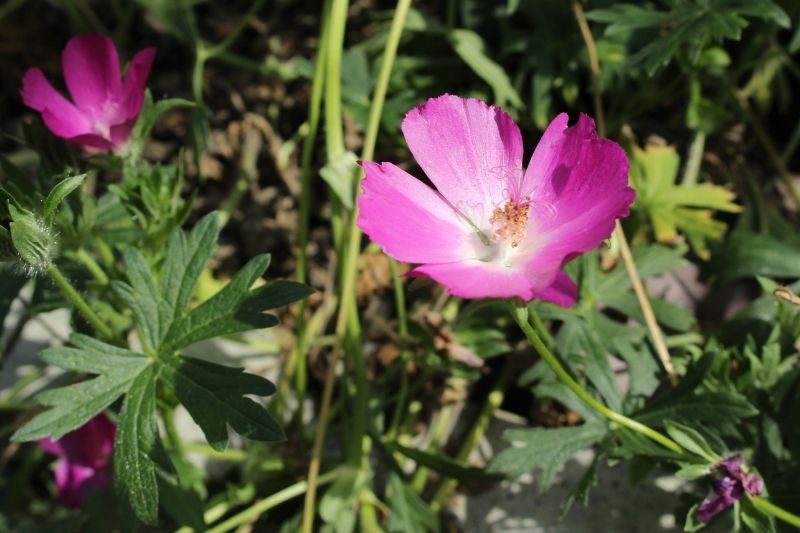
If you appreciate mallows, lavateras, and other Anisodontea, then you’ll surely fall for their perennial and ground-cover cousin, the winecup (Callirhoe involucrata)!
Far less common in gardens, this Mexican species produces fine creeping stems with deeply lobed leaves, which weave between neighbouring plants without bothering them in the least. It reaches about 60 cm in diameter and 20-30 cm in height. The plant can easily be forgotten until large corollas of saturated fuchsia pink appear throughout the summer. Despite their ultra-vibrant hue, they blend effortlessly, in joyful whimsy, with blues, purples, or grey foliage: shrubby sages, immortelles, and perennial verbenas, or even yuccas will make excellent companions to create a Mediterranean atmosphere or a garden that requires no watering.
Frugal, floriferous, and quite resistant to drought once established, the winecup has many qualities and will thrive in any well-drained soil, preferably calcareous. North of the Loire, a spot in a rock garden or a sloped bed facing south will make it happy, possibly with the addition of some coarse sand or gravel to improve water drainage. In good conditions, it can be expected to withstand, despite its Central American origins, temperatures down to about -12/-15°C. A lovely addition to your borders that you won’t see everywhere!

Comments