





























Peony or Paeonia continues to enchant us with its large flowers in various shapes and colours. This is what makes it so charming!
Its generous flowering in spring is accompanied by great ease of cultivation, excellent hardiness, and good resistance to diseases... not to mention that some varieties are delightfully fragrant. It is a beauty with a captivating charm that, although it does not bloom for long, returns faithfully for many years.
HERBACEOUS PEONIES, SHRUB PEONIES, AND HYBRIDS
- The herbaceous peonies (Paeonia lactiflora) are the most well-known. I particularly love them for their longevity and easy-going nature. A staple of traditional gardens, they thrive in both old and contemporary gardens. Personally, I prefer them simple or semi-double, or even with an anemone heart if I fancy a touch of whimsy. They blend quite well into the decor of my naturalistic garden. Well, I admit, I also have some doubles. In fact, one of them comes from my great-grandmother's garden, passed down from mother to daughter, from gardener to gardener. Suffice it to say, I cherish it!
- The shrub or tree peonies (Paeonia suffruticosa) form majestic bushes with large flowers adorned with a lovely bouquet of golden stamens. They grow very slowly, but what a spectacle after a few years! I started planting them five years ago. First, a Paeonia delavayi var. lutea from a seedling, a gift from a friend, which I patiently waited for three years. I particularly admire its young copper-tinted foliage in spring, finely cut, and its pure yellow flowers. Another shrub peony joined the garden last year, namely Paeonia suffruticosa 'Charming Garden', but this one has yet to bloom. I shall be patient!
- Finally, the Itoh hybrids are the result of cross-breeding between a herbaceous and a shrub peony. They are characterised by exceptional robustness and traits from both parent types. The flowering period is extended, the beauty of the foliage lasts all season, and the colour palette is varied. I haven't planted any yet, but it won't be long.
A MULTITUDE OF SHAPES AND COLOURS
Peony flowers can be classified into several categories, knowing that the boundary between them is not always clear. Moreover, the shape and colour of the flowers can vary from year to year depending on climatic conditions and soil quality.
That said, we distinguish between singles (P. 'Flame'), Japanese (P. 'Neon'), anemones (P. 'Gay Paree'), crowns (P. 'Félix Crousse'), globular (P. 'Karl Rosenfield'), semi-doubles (P. 'Golden Treasure' and 'Lilac'), and doubles (P. 'Coral Sunset' and 'Sarah Bernardt').
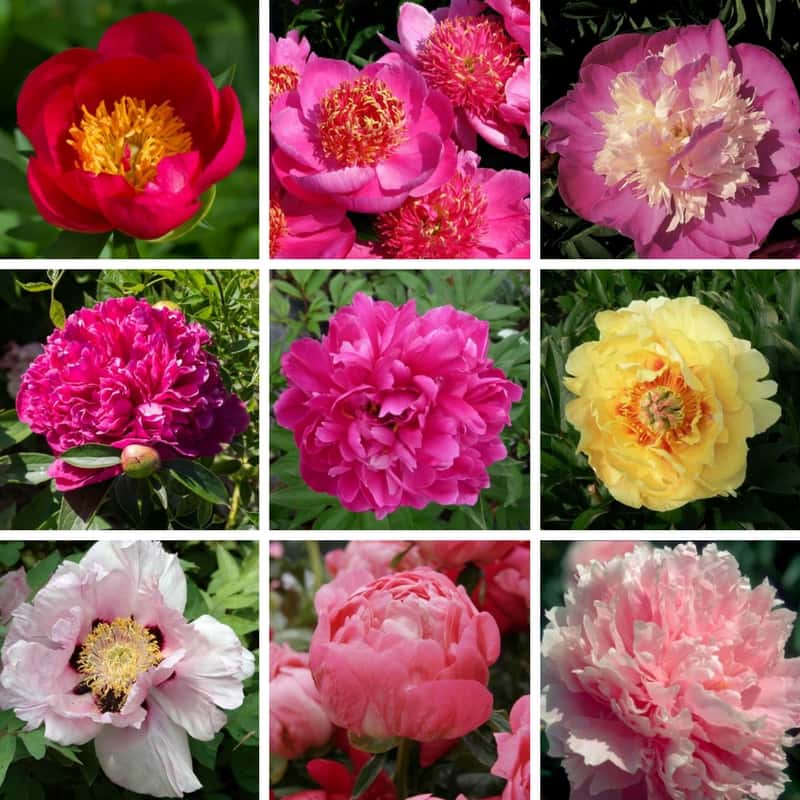
From left to right and top to bottom: Paeonia ‘Flame’ - Paeonia lactiflora ‘Neon’ - Paeonia ‘Gay Paree’ - Paeonia lactiflora ‘Felix Crousse’ - Paeonia lactiflora ‘Karl Rosenfield’ - Paeonia itoh ‘Garden Treasure’ - Paeonia ‘Lilac’ - Paeonia ‘Coral Sunset’ - Paeonia ‘Sarah Bernardt’
FRAGRANT FLOWERS
Peonies are renowned for their fragrance. They are famous in perfumery for their scents reminiscent of rose or lily of the valley. However, not all of them are fragrant! Generally, double-flowered peonies are more aromatic than single-flowered ones, but there are many exceptions. Among the varieties with the most remarkable fragrance are: ‘Myrtle Gentry’, ‘Alice Crousse’, ‘White Cap’, ‘Duchesse de Nemours’, and ‘Alice Harding’.
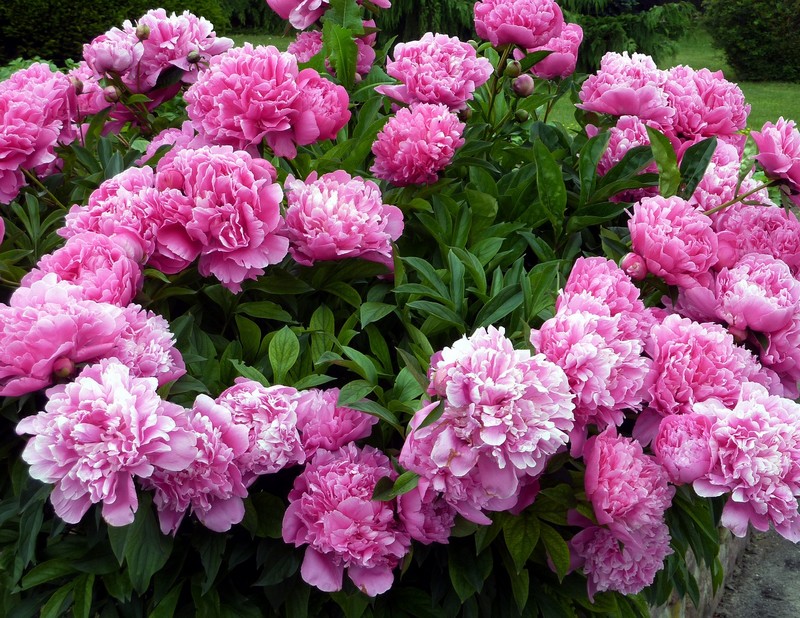
By the way, my ancestor's peony smells divine! When I sense rain approaching, I pick a bouquet to enjoy the flowers and their fragrance in the house.
WHERE DO PEONIES THRIVE?
The hardiness of peonies is no myth! They are not afraid of the cold and, with a few exceptions, they grow wild at altitudes where frosts are common. At worst, a few branches may suffer, but they will regrow beautifully the following spring. However, late frosts can impact flowering. I experienced this issue this spring, with frosts in May while the buds of my Paeonia delavayi var. lutea were already well-formed. Sheltered near a wall, most of its buds turned black, and a few survivors produced somewhat deformed flowers. In the rest of the garden, the herbaceous peonies simply did not bloom.
Choosing the right location is key to successful planting. Peonies thrive in the sun, otherwise, flowering may suffer. However, the ideal exposure varies depending on your geographical location. In Mediterranean regions, it is better to avoid full sun in the early afternoon. An east or southeast exposure is preferable. Similarly, in areas where late frosts are common (like mine in the Ardennes), prefer a west exposure to prevent the first rays of morning sun from causing too rapid a thaw, which can affect the quality of flowering. Elsewhere, full sun exposure is recommended. Note that a minimum of half a day of sun is necessary for good flowering.
Remember that peonies dislike waterlogged soils, so it is important to plant them in well-drained soil. In my clay soil, I have added plenty of humus (homemade compost, horse manure... an 8-year-old vintage from my farmer neighbours), as well as wood chips over the years to improve the soil. You can also add gravel or pumice at the bottom of the planting hole. These are greedy plants that do not appreciate competition. Mix good quality compost or well-decomposed manure into the planting soil. Be careful not to bury them too deeply: 2 to 3 cm of soil should cover the buds, no more! Finally, they do not like being moved, so choose the location of your new acquisition carefully; otherwise, it may sulk for 2 or 3 years before blooming again.
After that, maintenance consists of removing dead wood and dry or damaged parts when the buds start to swell in late winter for the shrub types, and simply cleaning the dry parts in March for the herbaceous types. A piece of cake!
TIPS FOR GOOD FLOWERING
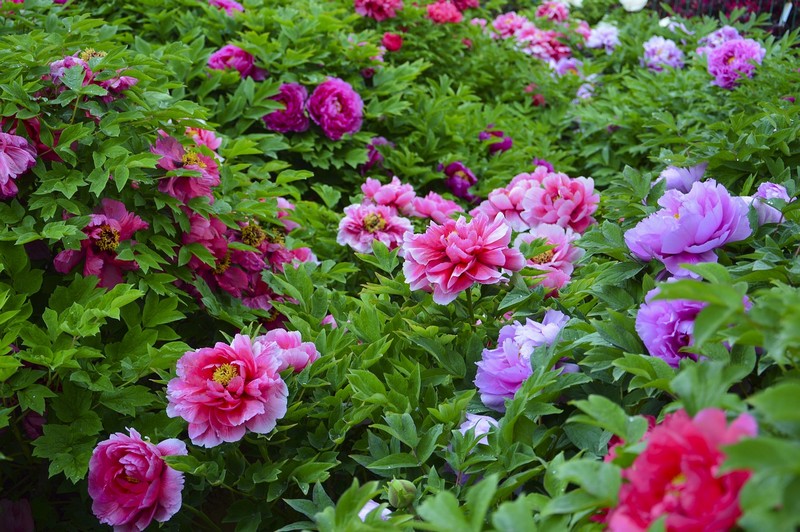
The first flowering of herbaceous peonies can occur between the first and third year after planting. This depends on the size of the plant. If it has one root and one eye, it will easily take three years to bloom. However, if it has four to five roots with three or four well-swollen eyes, there is a good chance it will bloom in the first spring if planted under good conditions.
The same goes for shrub peonies, but the probability of flowering is slightly lower in the first two years.
An application of humus is necessary every autumn. I spread a good amount of well-decomposed manure all around the plant. Then I bury it in the following spring during weeding. Peonies appreciate a potash boost that encourages flowering. However, be aware that nitrogen should be limited as it weakens the foliage and promotes the development of botrytis. Choose a fertiliser accordingly, or do as I do, a bit of wood ash each spring, and you're good to go!
Some peonies with fragile stems and particularly heavy flowers need support. This comes in the form of a metal circle with stakes to drive into the ground. Once the foliage develops, the device is completely hidden. It's simple and effective!
SUCCESSFUL PAIRINGS
Peonies lend themselves well to planting in borders or mixed beds. I find them wonderful with smaller flowers that highlight them, such as Cirsium rivulare ‘Atropurpureum’ or hardy geraniums, but also with irises, lupins, Centaurea montana, poppies, roses, alchemilla, delphiniums, alliums, and anthemis for an English garden, romantically appealing, or even with colourful foliage, particularly the purple of Sambucus nigra ‘Black Beauty’ or ‘Black Lace’.
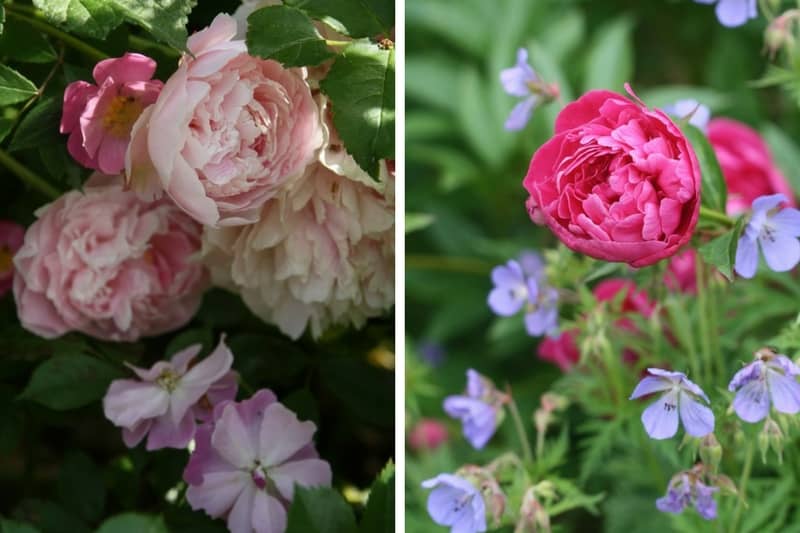
Paeonia lactiflora 'Sarah Bernardt' with the rose 'Lavender Dream' - Paeonia lactiflora from my ancestor with the Geranium pratense 'Mrs Kendall Clark'[/caption>
In my garden, the peonies ‘Bowl of Beauty’, ‘Springfield’, and ‘Do Tell’ are always very much admired by my visitors. They are surrounded by a variety of hardy geraniums, creating a very natural tableau.
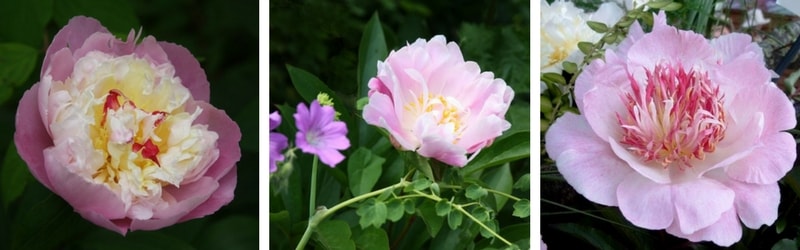 From left to right: Paeonia lactiflora 'Bowl of Beauty' - Paeonia lactiflora 'Springfield' - Paeonia lactiflora 'Do Tell'
And you, tell me, what are your favourite peonies?

Comments