





























Uncontrolled frenzy around the tulip, tulipomania is considered the first speculative bubble in history. This enthusiasm for a small, familiar bulb, now affordable for everyone, seems unimaginable! Yet, before becoming the most popular flower in its category, the tulip indeed travelled and became a coveted item exchanged for a fortune.
So why this tulip crisis? What legacy have tulips left us? Let’s travel back a few centuries to trace the tulip and its incredible journey in Europe…
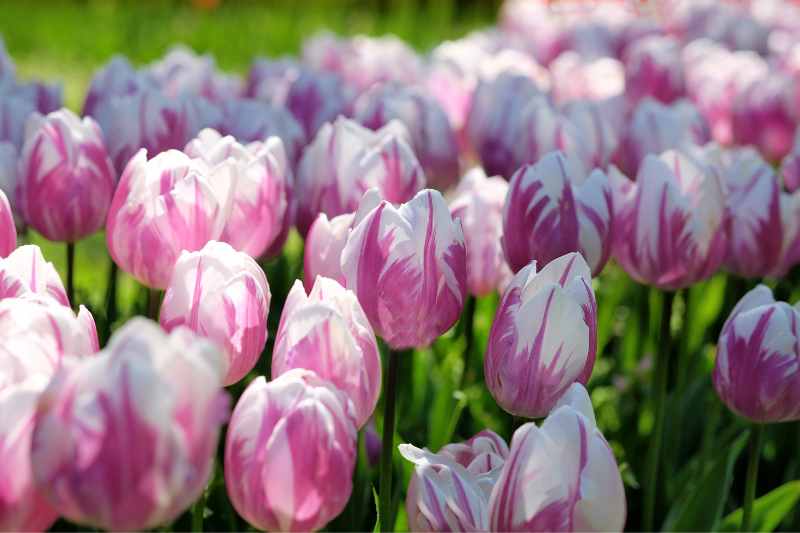
What is tulipomania?
Much has been said and written about tulipomania, that moment in European history when tulips were sold for exorbitant prices on the market. A troubled period, a fascinating and worrying phenomenon… It all unfolds in the 17th century, during the Dutch Golden Age, which radiates across the world, the seas, and trade.
Introduced around 1560 in the United Provinces (now the Netherlands), tulips first sparked the interest of botanists, and soon that of the general public. They garnered admiration in the Netherlands, but also in France, where they were planted in the gardens of the Louvre, with Louis XIII making them a symbol of luxury, and Louis XIV adopting this flower as the official flower of the court…
It was Charles de l’Ecluse (Carolus Clusius), a botanist and professor at the University of Leiden, who began planting the bulb in the sandy soils of the university garden in 1594, thus reproducing the tulip.
Horticulture was already developing in the province of Holland, where around fifty varieties were known by 1580. But by 1630, everything accelerated: over 100 different species of tulips arrived in less than a century.
The tulip became synonymous with success, an outward sign of wealth, and the powerful elite of the country understood this well. One must have them in their garden. Flemish bourgeois, nobles, and tavern owners began cultivating tulips, with some even abandoning their flourishing businesses and shops…
It became so coveted that sales now took place on a secondary market. The tulip became an object of speculation. A financial system was even established around what were called effect notes: from 1635 onwards, this mechanism allowed bulbs to be sold year-round, even while still in the ground, whereas previously tulips were sold in spring when one could assess the flower's conformity. A simple paper was signed, a sort of tulip share, where the merchandise was no longer visible... This sparked unparalleled enthusiasm, exchanging titles multiple times a day to drive prices up.
Tulips were exchanged for astronomical prices, or for land, livestock, silver cups, tons of grain, and other absurdities. It was said that the price of a beautiful bourgeois house on the Dutch canals could buy a single tulip or that it cost ten to twenty times the annual salary of a skilled artisan to procure the precious bulb at the height of the crisis. Even in France, tulipomania raged, as in Lille, where a tulip bulb became the currency of exchange for a brewery, which would bear the name of the tulip brewery. Between 1633 and 1637, tulips were the subject of frenzied trading, with gardens even being raided to unearth the precious bulb. The 'Viceroy' tulips streaked with lilac, and ‘Semper Augustus’, rare with marbled white petals (actually afflicted by a virus, difficult to reproduce), reached records, equivalent to 110,000 euros for a single bulb today. The bursting of the first speculative bubble in history was not far off…
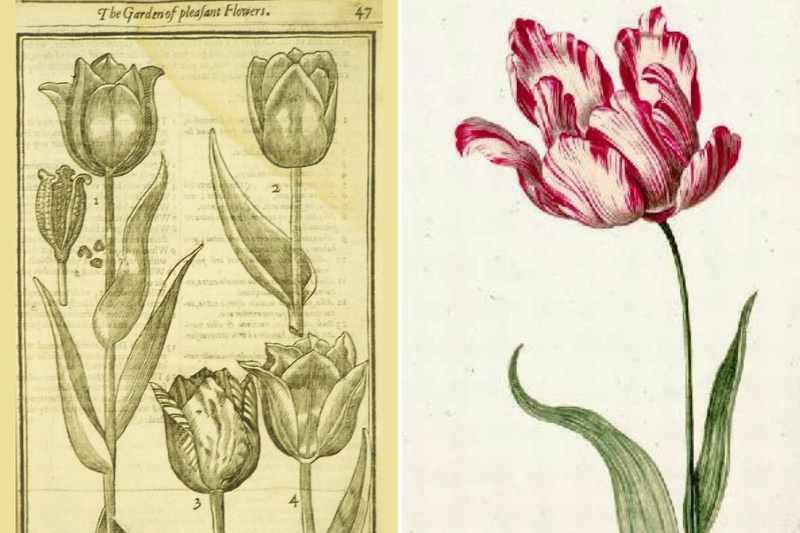
In February 1637, after two years of uncontrolled growth, tulips suddenly found no buyers in Haarlem, and sold poorly, even causing a discount… unprecedented! The government had to intervene to regulate sales. Prices collapsed, word of mouth did the rest, leading to a dizzying drop in market prices.
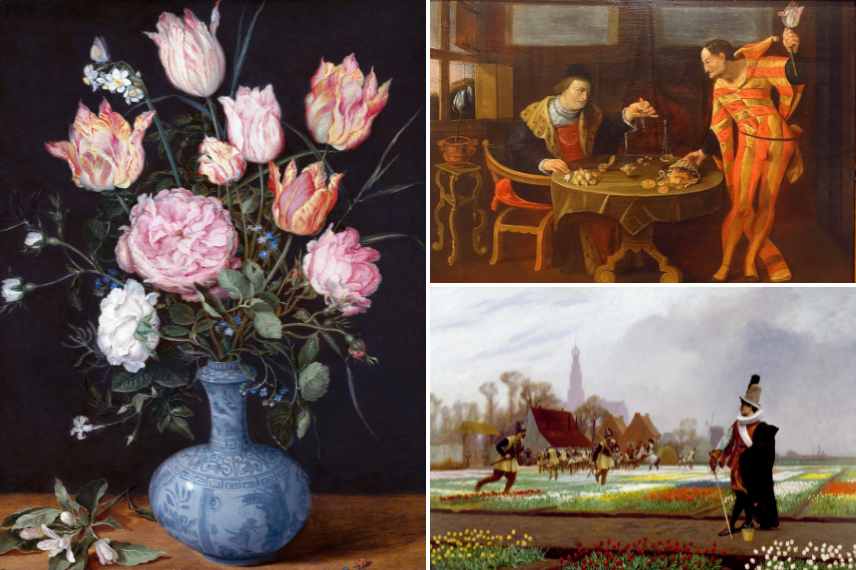
All those who had bet on the tulip found themselves ruined overnight, while large fortunes, empires built around the tulip, had emerged a few years earlier. The enthusiasm for tulips fell almost overnight. However, the real impact on the economy of the United Provinces was not as severe as that, as the merchants involved remained a restricted elite of the country. In contrast, a moral crisis emerged, denouncing, often in the arts, the indecent profits of a part of society, as seen in Jan Brueghel the Younger's painting satirising the tulip in 1640, where he caricatures speculators as monkeys. Later, other painters would also take up this subject, such as Jean-Léon Gérôme and The Duel at the Tulip (1882), followed by various authors. This was also followed by a number of works on tulip cultivation, including the famous Treatise on Tulips in 1765.
The fascination for tulips continued to be felt until the 19th century, with the famous novel The Black Tulip by Alexandre Dumas (father) which takes us back to the previous 17th century in Holland, where the main character dreams of creating a black tulip to win a fabulous reward.
Turkey: the other land of tulips
But let’s go back even further in time to find the origins of this small bulb… and the first fans of tulips!
Tulips actually come from the East, where they grew wild in the steppes of Central Asia, between Iran, the Caspian Sea, and as far as Afghanistan. These are botanical species of very small size, in warm colours, from yellow to red. They were known and cultivated as early as the 11th century in these regions. They gradually made their way to Anatolia, first through caravans returning from the Silk Road. Then Suleiman the Magnificent conquered some of these regions in the mid-16th century, and nomadic tribes brought back these beautiful flowers in large numbers, landing in Constantinople, now Istanbul. The tulip then became the flower of the sultans.
During the reign of Suleiman the Magnificent, the tulip was everywhere: in the sumptuous gardens of the Ottoman palaces, but also on the ceremonial caftans of the sultans, fabrics, and on the Iznik ceramics, this city that would make ceramic art shine throughout the country. Tulips were a recurring motif, along with the carnation, in the ceramics of the Topkapi Palace, as well as in mosques where floral representation was common. Tulips also adorned the sultan's turbans: Suleiman was known to stick one in his. Fashion did the rest… It was indeed the Turks who first became enamoured with this small, colourful bulb! In Ottoman art, the tulip symbolised the divine.
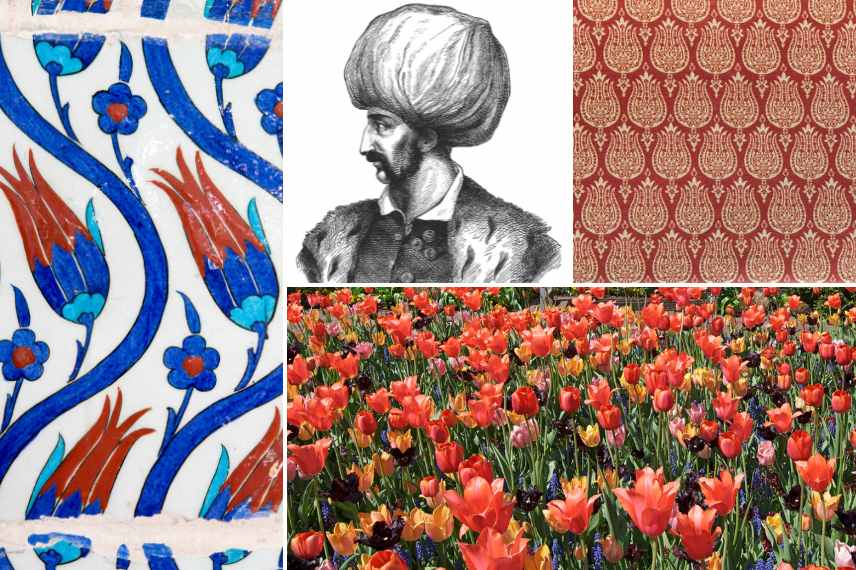
The word tulip comes from the Persian word, tülbend, which became türban in Turkish: originally a traditional turban of the Turks, they had taken to adorning their headgear when the tulip was introduced to the country. By confusion, the name tulipan was soon attributed to the flower. The Latin name tulipa became widespread in Europe from 1593. However, in Turkey, the flower still retains its original name of lale.
It is reported that in 1554, Suleiman the Magnificent offered some bulbs to a Flemish diplomat, the ambassador of Austria in Constantinople, Ogier Ghislain de Busbecq. He is credited with introducing the tulip to Europe, as he met Charles de l'Ecluse in Vienna a few years later, to whom he handed over some bulbs. Clusius would soon leave to work in Leiden, in the Netherlands, and successfully attempt to multiply tulips there... The rest is tulipomania and its excesses...
In Istanbul, since 2005, every April, the Tulip Festival takes place, a vibrant spectacle, a true open-air exhibition, celebrating the arrival of spring by honouring the tulip in many parks across the city. This is the direct legacy of the tulip festival that took place during the time of the sultans, up to Ahmed III, in the early 18th century, the peak of tulipomania in Turkey, more commonly known by historians as the "Tulip Era".
Tulips today around the world
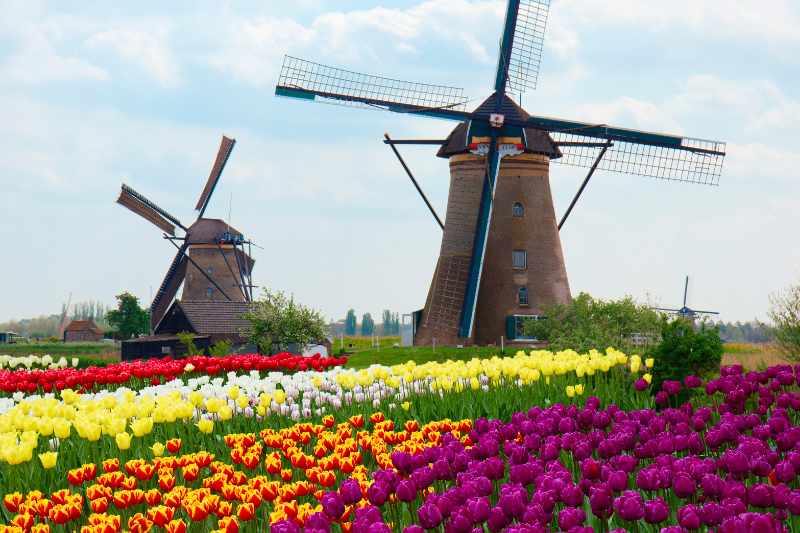
Since tulipomania… not much has changed in tulip production, as today, they are still primarily produced in the Netherlands, which is the world's leading producer. The tulip has become the emblematic flower of the country. Holland even has a world-renowned showcase at Keukenhof, where millions of tourists flock each year to admire the mass-planted flowerbeds. Over twenty thousand hectares are dedicated to bulb flowers in Holland, half of which is solely for tulips, still in the same region of Lisse, the cradle of production in the Netherlands, between Leiden and Haarlem.
Today, there are over 150 different varieties of tulips, and thousands of hybrids. Some producers continue to uphold a French tradition by producing and developing bulb plants, including tulips, particularly in Anjou where the sandy and loamy soil along the Loire is conducive to their cultivation, or in the Landes region.
At Promesse de fleurs, one in three spring bulbs sold is a tulip... There is no doubt that this wonderful little bulb - now affordable - has a bright future ahead!
Further reading
- Everything you need to know about the history of the tulip, with a reference book: The Tulip by Anna Pavord, (2001). Ed. Actes Sud;
- Read or reread The Black Tulip by Alexandre Dumas, a classic;
- Browse online at the BNF, the book by Charles Malo, History of Tulips (1821);
- Explore The ABC of Tulips, by Yves-Marie Allain and Catherine Garnier. 1996. Ed. Flammarion;
- Visit the Keukenhof park near Amsterdam where 7 million bulbs are planted each year, and explore the Amsterdam Tulip Museum.
- Bulbs 2026: 7 spring novelties to plant now!

Comments